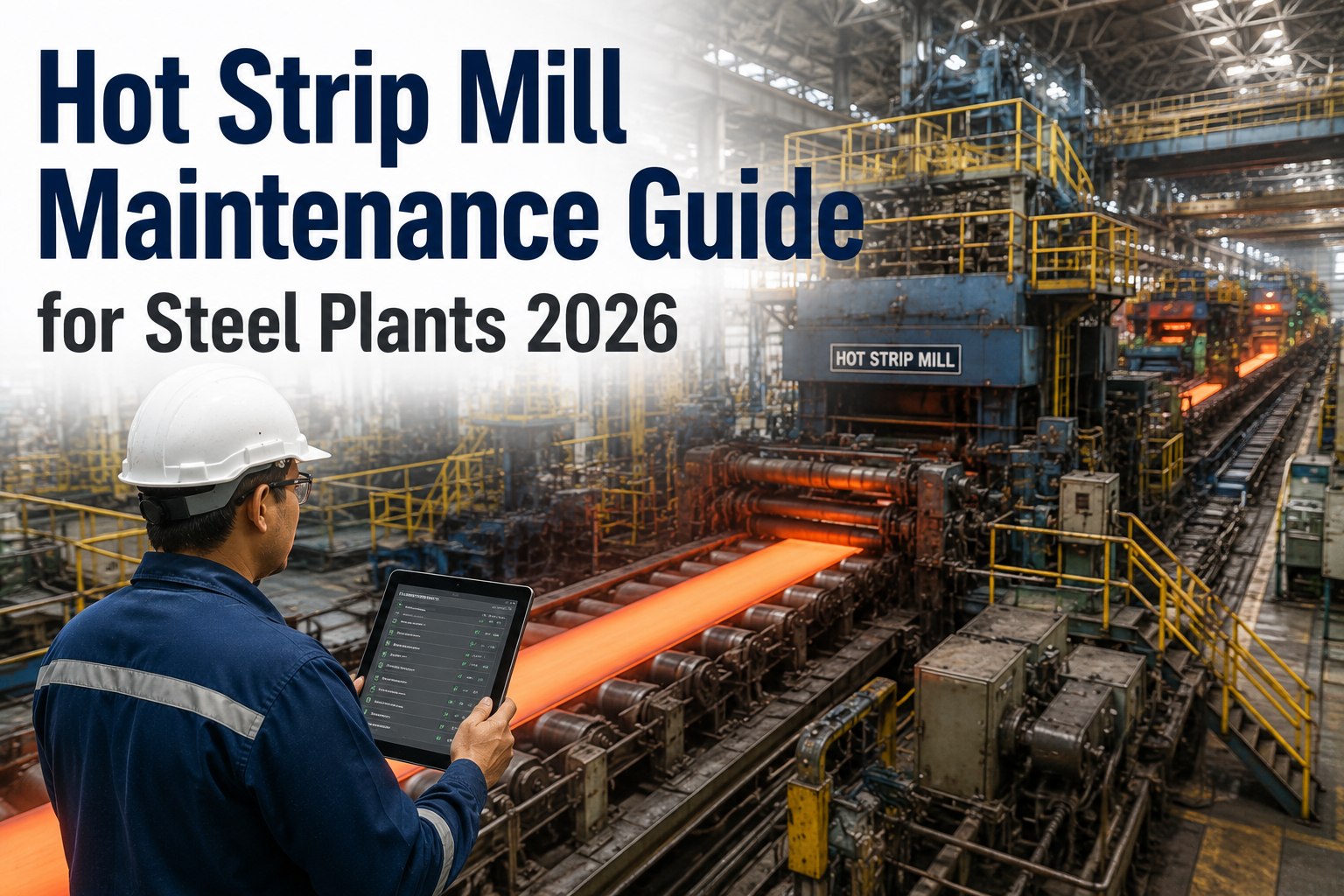
Hot strip mill availability is the single most leveraged variable on a steel plant's rolling floor — every unplanned hour of downtime on a 5-stand finishing train typically wipes 800–1,200 tonnes of prime coil output, and the margin erosion compounds downstream when downstream pickling, cold-rolling and galvanizing lines run starved. A 2025 benchmark across 18 integrated mills showed that facilities operating above 88% finishing-train availability captured 2.3× the contribution margin per rolling-hour of peers stuck below 80%. The maintenance discipline that separates those two cohorts is not exotic — it is roll management, bearing PM, AGC hydraulics, mill-stand drives and coiler upkeep, all wired into a CMMS that closes the work-order loop. This guide distills the 2026 playbook plant reliability teams use to push finishing-train availability past 90% — and you can put it to work today with a Start Free Trial on Oxmaint.
Can your finishing train hold 90% availability through the next campaign?
Every percentage point of finishing-train availability lost translates to roughly 1,100 tonnes of deferred coil output per month on a mid-cap mill — and the gap is almost always traceable to five maintenance domains: rolls, bearings, AGC hydraulics, drive trains, and coilers.
Five maintenance domains that decide HSM availability
A 2025 cross-plant study of 18 hot strip mills found that 84% of unplanned finishing-train stoppages traced back to just five asset groups. Each domain below carries its own failure signature, inspection cadence, and payback window.
Work Roll Management
Work rolls consume 28–34% of HSM maintenance spend. Grinding schedules of 3,500–5,000 tonnes per campaign, paired with camber and surface-finish tracking, push roll life 18% longer and cut spalling rejects.
Rolling-Mill Bearings
Bearings cause 19% of unplanned stand stoppages. Oil-mist lubrication health, vibration trending at 4–6 kHz, and ultrasonic monitoring extend bearing MTBF from 9 to 14 months on F1–F3 stands.
AGC Hydraulics
AGC servo-valve drift above 3% degrades strip gauge by ±25 µm. Fluid cleanliness at ISO 4406 ≤16/14/11, filter ∆P trending, and accumulator precharge checks keep gauge deviation inside ±8 µm.
Mill Stand Drives
Spindle couplings and gearboxes account for 14% of drive-train failures. Thermography quarterly, oil analysis every 500 hours, and torque-shaft alignment within 0.05 mm reduce overload trips.
Coiler & Pinch Roll
Mandrel bearing failures and wrapper-roll wear drive 22% of coiler delays. Mandrel expansion-stroke trending, wrapper hydraulic pressure mapping, and pinch-roll gap audits recover 6–9 hours/week.
Roughing Scale Breaker
Descaling header pressure 180–220 bar, nozzle wear inspection per 10K tonnes, and spray-pattern audits prevent scale-rolled-in defects that cost 0.6% prime yield on exposed-grade coil.
Tiered HSM preventive maintenance checklist
Tiered PM cadence is the backbone of ISO 55000-aligned asset management. The checklist below mirrors the schedule deployed by mills sustaining above 88% finishing-train availability — split into daily operator rounds, weekly reliability inspections, and monthly engineering audits.
- Walk F1–F7 stands; log oil leaks, coolant flow, vibration noise
- Inspect AGC accumulator precharge (±5% nominal)
- Verify coiler mandrel expansion stroke within ±0.3 mm
- Check descaling header pressure stable at 190–210 bar
- Confirm crop-shear blade gap and edge condition
- Review previous-shift work orders closed in CMMS
- Vibration route on all stand bearings (4–6 kHz band)
- AGC servo-valve step-response test; flag drift >3%
- Roll-force transducer calibration check on F2, F4, F6
- Mandrel bearing grease analysis and temperature trend
- Wrapper-roll hydraulic pressure mapping at coiler entry
- Oil sample — viscosity, water, particle count (ISO 4406)
- Thermography sweep on drive motors, gearboxes, spindle couplings
- Spindle coupling alignment verification within 0.05 mm
- Work-roll surface audit; plan grinding at 4,000 t threshold
- Descaling nozzle orifice wear and spray-pattern inspection
- OEE review: availability × performance × quality by stand
- CMMS backlog burn-down review with maintenance superintendent
From downtime hours to recovered margin
Reliability investments live or die on whether the numbers hold. The formula block below shows the standard HSM availability calculation, followed by a worked example for a 2.5M t/yr mill running 78% availability today against a 90% target.
Reactive vs. planned vs. predictive maintenance on the rolling floor
Most HSM plants sit somewhere on the reactive-to-predictive spectrum. The table below benchmarks the three strategies against availability, cost per tonne, and the CMMS tooling required to sustain each — drawn from a 14-plant benchmark.
| Dimension | Reactive (Run-to-Fail) | Planned (Time-Based PM) | Predictive (CBM + CMMS) |
|---|---|---|---|
| Typical availability | 68–76% | 80–86% | 89–93% |
| Maint. cost / tonne | $11.50–14.20 | $7.80–9.40 | $5.20–6.80 |
| Unplanned downtime / yr | 1,300–1,800 h | 700–950 h | 350–520 h |
| Work-roll life | 3,000–3,500 t/campaign | 4,000–4,500 t | 5,000–5,800 t |
| Bearing MTBF | 6–8 months | 9–11 months | 13–16 months |
| CMMS capability | Basic work-order log | PM scheduler + asset register | Condition data + analytics + mobile |
| Payback window | — | 8–14 months | 5–9 months |
A 90-day path from reactive chaos to controlled availability
Reliability transformations on hot strip mills rarely need a greenfield rebuild — they need a disciplined 90-day rollout that sequences asset criticality, PM templates, condition monitoring, and CMMS-driven work-order closure. The month-by-month timeline below is the sequence used by a 1.8M t/yr Midwest mill that lifted finishing-train availability from 79% to 88% in one quarter.
Asset criticality ranking + failure-mode mapping
Rank all 180+ finishing-train assets by criticality (ABC). Map top-20 failure modes per asset group. Baseline OEE, MTBF, and unplanned-downtime hours per stand in the CMMS. Output: asset register cleansed, criticality matrix approved by the plant manager.
Tiered PM templates loaded + route optimization
Load daily, weekly, and monthly PM templates into the CMMS for all five core domains. Build vibration and oil-sampling routes. Train operators on mobile round execution. Target: 95% PM compliance by week 8, backlog reduced 40%.
CBM thresholds live + work-order auto-generation
Wire vibration, temperature, and fluid-cleanliness thresholds to auto-generate corrective work orders. Hold daily 15-minute reliability huddles reviewing CMMS exception dashboards. By day 90: unplanned downtime down 38%, availability at 88%.
What mills say after wiring PM into a CMMS
Two short field notes from HSM reliability leaders who moved from spreadsheet-driven PM to a CMMS-orchestrated routine.
"We lifted finishing-train availability from 81% to 89% in five months. The biggest lever was catching F3 bearing degradation three weeks before failure — CMMS auto-triggered the work order, we changed it on a planned window, and lost zero tonnes."
"Coiler delays dropped from 11 hours/week to under 4 once we put mandrel stroke trending and wrapper-pressure mapping on a daily route inside the CMMS. Operators actually use it because the mobile rounds take 22 minutes, not 45."
Stop losing 1,100 tonnes a month to unplanned stand stoppages
Deploy the full HSM maintenance playbook — roll PM, bearing CBM, AGC hydraulics, drive-train thermography, and coiler upkeep — inside a CMMS built for steel-plant reliability teams.
HSM maintenance — the five questions plant managers ask most
How often should work rolls be changed on a hot strip mill finishing train?
Most mills change work rolls every 3,500–5,000 tonnes per campaign, depending on product mix and grade hardness. Mills rolling high-strength steels trend toward the lower end. The key is tracking surface-finish degradation and camber in the CMMS so changes are planned, not reactive — planned changes cost 60% less downtime than forced ones.
What vibration thresholds trigger a bearing work order on F1–F3 stands?
ISO 10816 velocity thresholds between 7.1 and 11.2 mm/s RMS in the 4–6 kHz band warrant a corrective work order within 72 hours. Below 4.5 mm/s is healthy. The real signal is trend deviation — a 25% rise over two weeks is a stronger failure predictor than any single absolute reading, which is why a CMMS with trending matters. You can set this up quickly with a Start Free Trial.
What fluid cleanliness level should AGC hydraulics maintain?
Target ISO 4406 cleanliness code 16/14/11 or better for AGC servo-valve circuits. Each ISO code above target roughly doubles servo-valve wear and can push gauge deviation from ±8 µm to ±25 µm. Weekly fluid sampling, filter ∆P trending, and automatic work-order generation on threshold breach are standard practice at top-quartile mills.
How does a CMMS pay back on a hot strip mill?
A properly deployed CMMS typically returns payback in 5–9 months. The largest contributors are reduced unplanned downtime (worth $8K–15K per hour on a mid-cap mill), extended roll and bearing life (18–25% gains), and lower maintenance cost per tonne (often falling from $9 to $6). Most plants see the first measurable availability lift within 60–90 days of go-live.
What is the single highest-ROI PM task on a hot strip mill?
Weekly vibration trending on finishing-stand bearings. It costs roughly 3 technician-hours per week and routinely catches bearing degradation 2–4 weeks before failure, converting a 6-hour unplanned stand stop into a 2-hour planned change. On a 2.5M t/yr mill that single task has recovered over $1.2M/yr for several plants we benchmarked. To see the route template, Book a Demo with our team.
Build your 90-day HSM availability plan inside Oxmaint today
Roll PM templates, bearing CBM thresholds, AGC hydraulic checks, drive-train thermography routes, and coiler upkeep — all wired into one steel-plant CMMS with mobile rounds and auto-generated work orders.
Free 14-day trial · No credit card
.png)