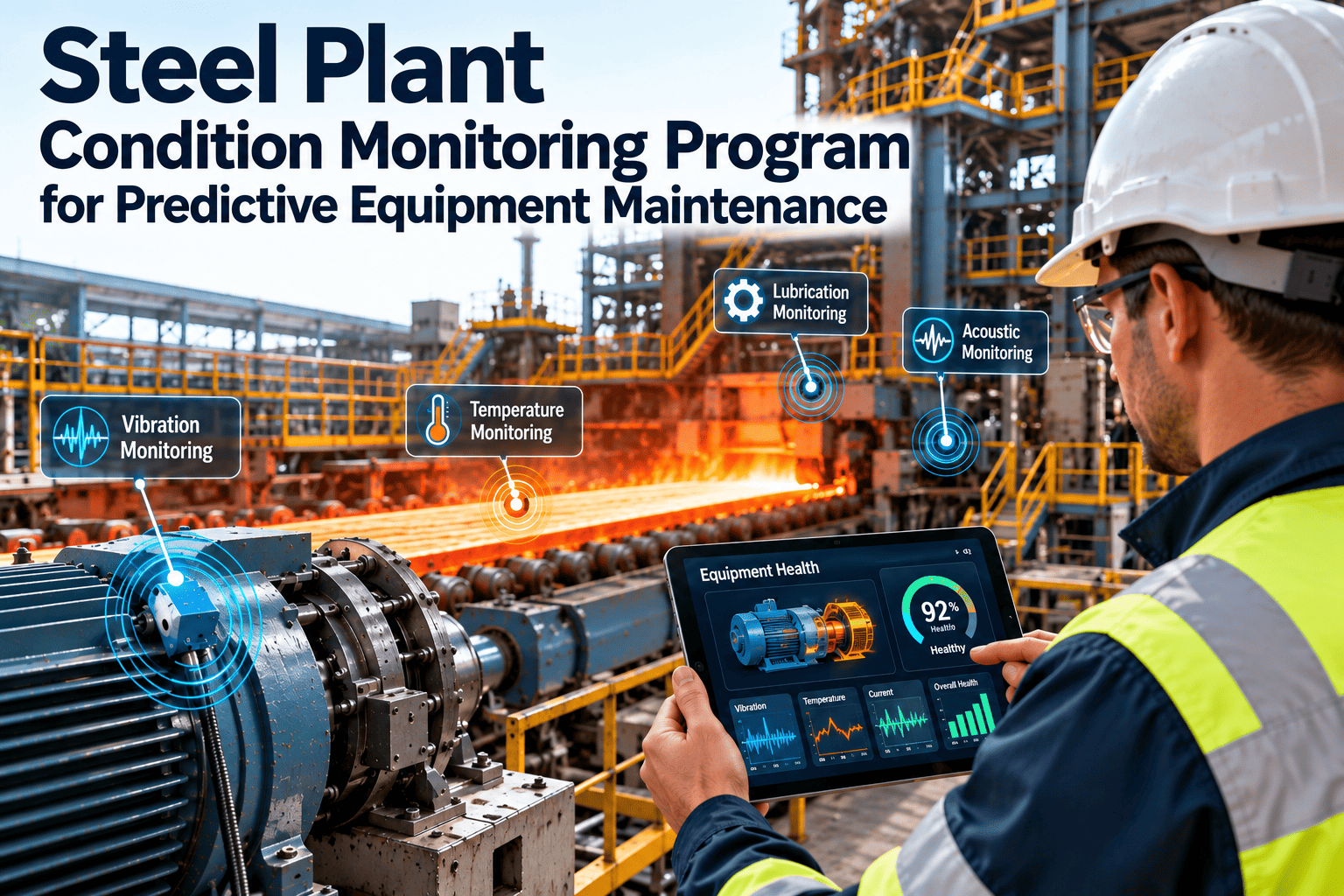
Time-based maintenance schedules replace parts that still have 40% of their useful life remaining — or miss failures that develop faster than the fixed interval predicts. Condition-based maintenance (CBM) in steel plants closes this gap by triggering maintenance actions from actual equipment health data — vibration signatures, thermal profiles, oil analysis results, and ultrasonic readings — rather than from a calendar. Plants that implement CBM across critical assets report 28–41% reductions in unplanned downtime and 15–22% reductions in total maintenance cost within 18 months of structured deployment.
Maintenance Strategy · Predictive Maintenance AI
Condition-Based Maintenance in Steel Plants
Vibration · Thermal · Oil Analysis · Ultrasonic — CMMS-Triggered Work Orders from Real Equipment Health Data
Time-Based
Replace at fixed interval
40% of life wasted on average
Failures still occur between cycles
No data on actual condition
Cost: High & unpredictable
Condition-Based
Intervene when data says act
Full asset life utilised
Failures predicted before occurrence
Continuous health score per asset
Cost: 15–22% lower overall
The 4 CBM Monitoring Techniques for Steel Plant Assets
01
Vibration Analysis
Rolling mill drives · Ladle cranes · Pump sets · Fans
Continuous or periodic vibration spectrum analysis detects bearing defect frequencies (BPFO, BPFI, BSF), unbalance, misalignment, and looseness. Trending RMS velocity and acceleration values identifies degradation trajectories weeks before failure. ISO 10816 alarm thresholds are configured per machine class — what constitutes a warning on a 250kW pump differs from a 4MW finishing mill drive.
7–21 daysadvance warning
ISO 10816alarm standard
02
Thermal Inspection
Electrical panels · Refractory · Transformer banks · Couplings
Infrared thermography identifies hot spots in electrical connections, transformer windings, and refractory linings before they become failures or safety incidents. Blast furnace shell scanning with fixed thermal cameras detects refractory wear-through 4–8 weeks before breakthrough risk. A 15°C rise above baseline in an electrical panel connection predicts imminent arc fault — intervention cost is £200, failure cost is £40,000+.
4–8 weeksrefractory warning
15°C deltaelectrical alarm threshold
03
Oil and Fluid Analysis
Gearboxes · Hydraulic systems · Transformer oil · Compressors
Spectrometric oil analysis detects wear metal concentrations (iron, copper, lead, chromium) that identify which component inside a gearbox is degrading before any vibration signal appears. Particle count trending reveals hydraulic system contamination before valve and cylinder failures. Rolling mill gearbox oil sampling every 500 operating hours provides a 6–12 week early warning on gear tooth pitting and bearing cage wear.
6–12 weeksgearbox warning
Every 500 hrsrecommended sample interval
04
Ultrasonic Monitoring
Slow-speed bearings · Steam traps · Pressure vessels · Valves
Airborne and structure-borne ultrasound detects defects in slow-speed bearings (below 100 RPM) that vibration analysis misses — ladle crane wheels, coke pusher bearings, and converter tilting drives are classic steel plant examples. Steam trap surveys using ultrasound identify failed-open traps that waste steam and failed-closed traps that cause water hammer — a single steam survey typically finds 15–30% of traps in a steel plant failing.
Below 100 RPMwhere vibration fails
15–30%steam trap failure rate
CBM Alerts That Don't Create Work Orders Are Noise. OxMaint Closes the Loop Automatically.
Every condition monitoring alert above threshold generates a prioritised, assigned OxMaint work order — no alert gets acknowledged and forgotten, no data stays siloed in a monitoring dashboard.
CBM Implementation Roadmap — Steel Plant Phased Approach
Phase 1
Foundation — 0 to 3 Months
Asset criticality ranking — identify top 20 assets by production impact
Baseline vibration routes established and first readings taken
OxMaint work order templates configured for CBM finding types
Oil sampling programme started on all critical gearboxes
Thermal camera routes defined and baseline images captured
Phase 2
Expansion — 3 to 9 Months
Alarm thresholds set from baseline trending data per asset class
Continuous online sensors deployed on 5–8 highest-criticality assets
First CBM-triggered work orders generated and tracked through OxMaint
CBM findings linked to asset history — confirmation or refinement of alarms
Rolling mill and caster coverage extended to additional stand/segment
Phase 3
Optimisation — 9 to 18 Months
PM intervals adjusted for CBM-covered assets — reduce over-maintenance
PMP and MTBF KPIs tracked to quantify CBM programme ROI
ML anomaly detection layer added on top of sensor data in OxMaint
Full plant coverage achieved for top 50 assets by criticality ranking
Annual review: confirmed saves, false positive rate, programme cost vs avoidance
CBM Performance Benchmarks — Steel Plant Asset Classes
| Asset Class | CBM Technique | Monitoring Frequency | Avg. Warning Lead Time | MTBF Improvement |
|---|---|---|---|---|
| Rolling Mill Drive | Vibration + oil analysis | Continuous + monthly | 14–21 days | +38% |
| Blast Furnace Shell | Thermal imaging | Weekly scan | 30–60 days | Campaign extension +12% |
| Ladle Crane | Ultrasonic + vibration | Monthly | 5–14 days | +29% |
| Caster Gearboxes | Oil analysis + vibration | Every 500 hrs + continuous | 21–45 days | +44% |
| EAF Transformer | Thermal + oil DGA | Quarterly + annual | 30–90 days | +51% |
| Hydraulic Power Units | Oil particle count | Monthly | 4–8 weeks | +33% |
"
The steel plants that struggle with CBM are not struggling because condition monitoring technology does not work — it does. They struggle because the monitoring programme and the maintenance execution system are disconnected. You have a reliability engineer reading vibration reports in one system, a maintenance planner scheduling in another, and a stores team managing parts in a third. When the vibration alarm fires, four people need to coordinate before a work order even exists. In OxMaint, the alarm fires and the work order is already there — assigned, parts flagged, history visible. That integration is what converts a monitoring investment into actual downtime reduction. Without it, you are spending money on data that never becomes action.
Alejandro Vega Ruiz, Ing. (Mechanical), Certified Maintenance and Reliability Professional (CMRP)
Reliability Manager — Celsa Group (Barcelona) · 22 Years Steel Plant Maintenance · Specialist in CBM programme design, vibration analysis, CMMS integration, and maintenance strategy transformation for electric arc furnace and rolling mill operations
Frequently Asked Questions
Where should a steel plant start with CBM if budget is limited?
Start with a vibration route programme on your top 10 assets by production criticality — typically the main rolling mill drives, caster drives, and ladle crane. Portable vibration data collectors require no infrastructure investment and can establish baselines within 60 days. Pair this with an oil sampling programme on all critical gearboxes. Both programmes feed findings directly into OxMaint as condition-triggered work orders from day one. The combined investment is typically recovered within the first avoided failure event, which in steel usually occurs within 6–9 months of establishing baselines. Start your free trial to see how CBM findings map to OxMaint work orders.
How does OxMaint handle condition monitoring alerts from multiple sensor systems?
OxMaint integrates with vibration monitoring systems, thermal imaging platforms, and oil analysis laboratory portals via API, normalising alerts from all sources into a single prioritised work order queue. Each incoming alert is matched to the correct asset in the OxMaint asset register, classified by severity level, and converted into a work order with the original sensor data attached as evidence. Maintenance managers see one unified queue — not three separate monitoring dashboards — with CBM work orders appearing alongside PM schedules and reactive work orders in a single prioritised view. Book a demo to see multi-sensor CBM integration in OxMaint.
How do we set alarm thresholds that avoid too many false positives?
Alarm thresholds should be set from baseline data collected over a minimum 60–90 day period per asset, not from generic industry tables. OxMaint stores measurement history per asset and automatically suggests threshold values based on observed operating band plus a configurable standard deviation multiplier. As the programme matures and confirmed failure events are logged, thresholds self-refine. Most programmes see false positive rates fall from 25–35% in months 1–3 to below 8% by month 12 as baselines mature. A high initial false positive rate is normal and expected — the system learns your plant's specific operating signatures. Explore OxMaint's CBM alarm configuration in your free trial.
Can CBM replace time-based PM schedules, or should both run in parallel?
CBM replaces the monitoring function of time-based PMs — the inspection and measurement tasks that assess whether maintenance action is needed. It does not replace lubrication tasks, consumable replacements with fixed life limits (refractory, wear plates), or mandatory regulatory inspections with legal intervals. In OxMaint, assets transition to a hybrid schedule where condition-monitored components move to CBM work order triggers while fixed-life tasks remain on PM schedules. This hybrid approach typically reduces total PM task volume by 25–35% in the first 18 months while simultaneously improving reliability — the combination of fewer but better-timed interventions. Book a demo to see how OxMaint manages hybrid CBM and PM schedules.
OxMaint · Predictive Maintenance AI
Condition Data Without Work Orders Is Just a Dashboard. OxMaint Turns Every Alert into Action.
Vibration alarms, thermal findings, oil analysis results — every CBM signal flows into OxMaint as a prioritised, assigned, tracked work order. No alert acknowledged and forgotten. No finding lost between systems.