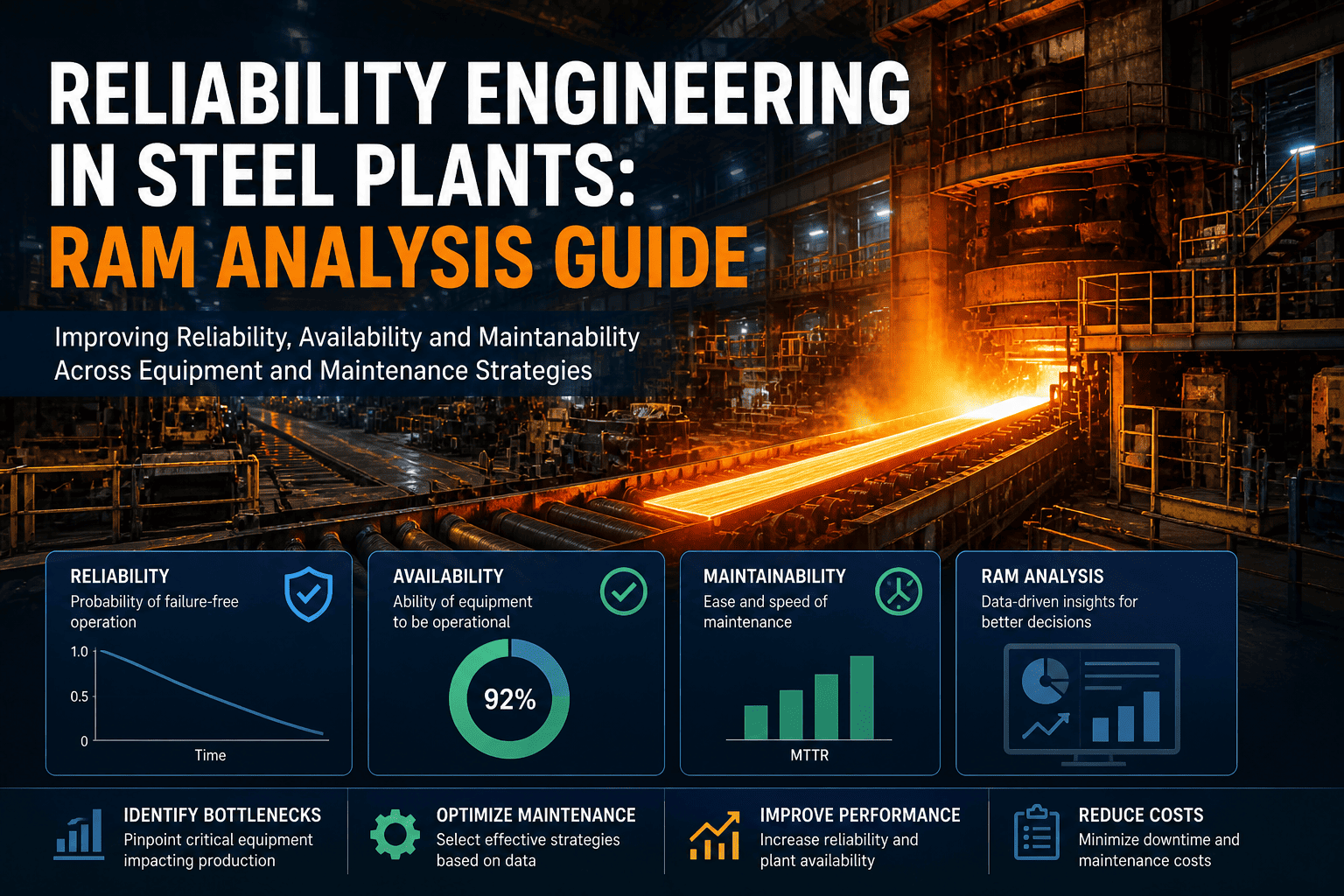
Steel plants lose an average of $500,000 per hour of unplanned blast furnace downtime. Yet most reliability engineers are still pulling MTBF data from spreadsheets, running RAM models in disconnected tools, and presenting findings that plant managers can't act on before the next failure hits. This guide applies structured RAM analysis — Reliability, Availability, and Maintainability — to the specific equipment, failure modes, and bottleneck constraints found in integrated steel plants. Start tracking RAM metrics automatically in Oxmaint or book a walkthrough with our steel plant reliability team.
What RAM Actually Means in Steel
The Three Pillars — and Why Steel Plants Struggle with All of Them
R
Reliability
How long does a piece of equipment run before it fails? Measured as MTBF. In steel, blast furnace cooling pumps should hit 8,000–15,000 hrs. Many plants are running at half that due to untracked degradation.
A
Availability
What percentage of scheduled time is the asset actually operable? Formula: MTBF ÷ (MTBF + MTTR). A hot strip mill at 92% availability leaves 700+ hours of production gap per year.
M
Maintainability
How quickly can failures be repaired? Measured as MTTR. Steel plants with poor spare parts management typically see 40–60% of MTTR consumed as wait time — not repair time.
Bottleneck Mapping
Critical Equipment RAM Benchmarks Across Steel Process Areas
RAM analysis in a steel plant must begin at the bottleneck — the single asset whose failure shuts down the entire value chain. In integrated steel, that's almost always the blast furnace or the continuous casting machine. Use this benchmark table to compare your current MTBF performance against industry targets.
| Equipment |
Process Area |
Target MTBF |
Target MTTR |
Availability Target |
RAM Priority |
| BF Cooling Pumps |
Blast Furnace |
8,000–15,000 hrs |
< 2 hrs |
99.5%+ |
Critical |
| Hot Blast Stove Valves |
Blast Furnace |
12,000–20,000 hrs |
4–6 hrs |
99%+ |
Critical |
| Continuous Caster Mold |
Steelmaking |
500–800 heats |
< 4 hrs |
97%+ |
Critical |
| Roughing Stand Gearbox |
Hot Strip Mill |
6,000–10,000 hrs |
8–24 hrs |
96%+ |
High |
| EAF Electrode Arms |
Electric Arc Furnace |
2,000–4,000 hrs |
2–4 hrs |
95%+ |
High |
| Gas Cleaning ESP |
Environmental |
6,000–10,000 hrs |
6–12 hrs |
94%+ |
Medium |
| Charging Bell/Hopper |
Blast Furnace |
4,000–8,000 hrs |
8–16 hrs |
95%+ |
High |
RAM Modeling Steps
How to Run RAM Analysis in a Steel Plant: 5-Step Framework
01
Define the System Boundary and Process Flow
Map each major production unit — iron making, steelmaking, casting, rolling — as nodes in a reliability block diagram. Identify series vs. parallel configurations. A blast furnace has no parallel; a continuous caster with two strands offers partial redundancy. Boundary clarity prevents scope creep in the analysis.
02
Collect Failure History and Repair Records
Pull the last 24 months of work order data per asset. You need failure timestamps, repair durations, technician hours, and parts consumed. Plants with CMMS-tracked corrective work orders can generate MTBF and MTTR automatically. Plants without clean data must start with a manual failure log exercise — typically 4–6 weeks of retrospective data capture.
03
Run Criticality Classification (ABC / Pareto)
Not all 3,000 assets in a steel plant need equal RAM attention. Apply the criticality matrix: production impact × safety consequence × repair cost. Typically, 15–20% of assets drive 80% of downtime cost — these are your RAM focus assets. Assign Class A (blast furnace, casting line), Class B (secondary utilities), Class C (non-production support).
04
Model Availability with MTBF / MTTR Data
Use the formula: Availability = MTBF ÷ (MTBF + MTTR). For each Class A asset, calculate current availability and compare against the benchmark table above. A blast furnace cooling pump running at MTBF 4,000 hrs / MTTR 3 hrs achieves 99.9% availability — but if MTBF has declined 40% quarter-over-quarter, that number is about to change fast.
05
Identify Improvement Levers and Set Targets
RAM analysis produces two types of outputs: reliability improvements (better PM, CBM triggers, design changes) and maintainability improvements (spare parts pre-staging, faster LOTO, better procedures). Set 12-month MTBF targets per asset class and track them monthly. Steel plants with mature MTBF/MTTR programs achieve 15–20% higher equipment availability than plants without structured tracking.
Connect RAM Data to Live Work Orders
Oxmaint automatically calculates MTBF and MTTR from your corrective work order history — no spreadsheets. Flag assets with declining reliability trends and generate PM recommendations from real failure patterns.
Common RAM Failures in Steel
4 Mistakes Steel Plants Make in RAM Analysis
1
Using Plant-Level MTBF for Engineering Decisions
Plant-level MTBF is a financial reporting metric. It can mask a blast furnace cooling system whose MTBF declined 40% while improvements elsewhere offset the aggregate. Always make decisions at the individual equipment level — flag any asset whose MTBF drops more than 20% quarter-over-quarter.
2
Including Planned PM Downtime in MTBF Calculations
MTBF counts only unplanned failures and the operating hours between them. Including scheduled PM downtime understates true asset reliability by 20–50% and inflates urgency for assets that are actually well-maintained. Your CMMS work order types must separate corrective from preventive events automatically.
3
Measuring MTTR as a Single Number
Total MTTR is the sum of six segments: failure detection, notification, technician response, diagnosis, parts/logistics wait, active repair, and return-to-service testing. Most steel plants discover 40–60% of MTTR is wait time — not wrench time. You cannot improve what you cannot segment.
4
Treating RAM Analysis as a One-Time Study
RAM is not a project — it is a continuous improvement cycle. A RAM model built on 2022 failure data is already obsolete if your rolling mill underwent a major rebuild in 2024. Tie your RAM model to live CMMS data so targets update as asset condition changes. Static studies become comfort documents, not decision tools.
Expert Review
What Reliability Engineers Say About Steel Plant RAM Programs
"The single biggest RAM failure I see in steel plants is using aggregate fleet availability as the primary reliability KPI. It gives leadership a comfortable number while a blast furnace cooling system degrades quietly below the surface. Equipment-level MTBF trending is the only early warning that matters."
Senior Reliability Engineer
Integrated Steel Plant, South Asia — 12 years RAM program leadership
"We reduced corrective maintenance interventions by 91.7% after applying RCM to Class A criticality equipment on our blast furnace. The key was that we used real failure data from the CMMS — not generic failure rate databases. Real data produces real results."
Maintenance Manager
Steel Mill, Southeast Asia — post-RCM implementation review, 2022
Frequently Asked Questions
RAM Analysis in Steel Plants — Common Questions
Turn Your Work Order History into a RAM Model
Oxmaint's Analytics & Reporting module calculates MTBF, MTTR, and availability trends per asset automatically — giving reliability engineers a live RAM dashboard without manual data extraction. Built for steel plants, heavy industry, and complex multi-equipment facilities.