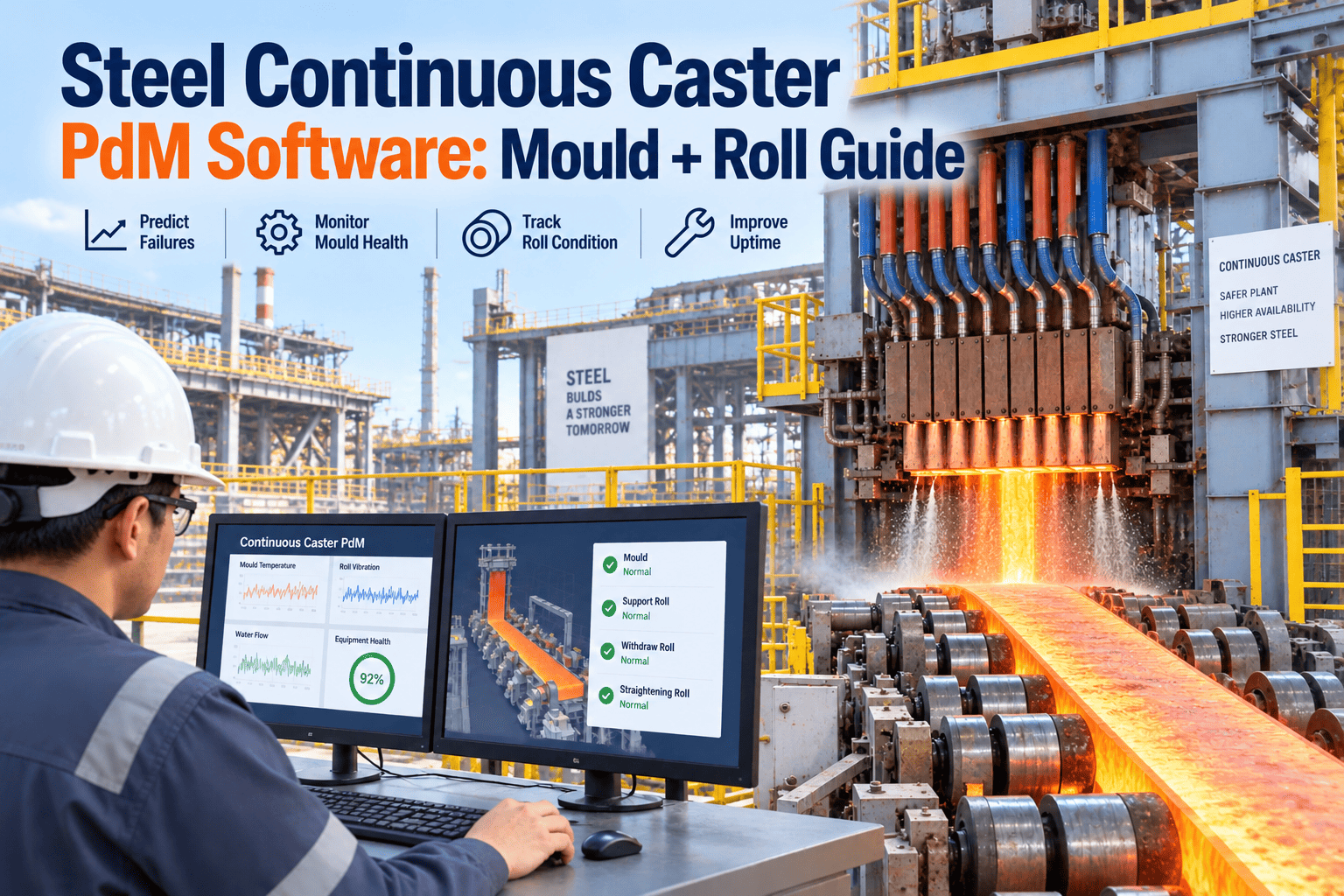
Steel Continuous Caster PdM Software: Mould + Roll Guide

By Corin Hale on September 4, 2026

steel-continuous-caster-pdm-software-mould-roll-guide

A continuous caster rarely fails without warning. Long before a breakout drops molten steel into the containment pit, the machine has already been telling on itself — a mould thermocouple drifting a few degrees per heat, a segment roll bearing running warmer than its neighbours, a tundish car wheel bearing groaning under load it was never rated for. Most plants still catch these signals only after the strand has jammed or the shell has already thinned past recovery. Steel continuous caster PdM software turns that same sensor drift into a scheduled work order days or weeks ahead of time, and you can start tracking your caster fleet free with Oxmaint before your next sequence begins.

Caster Reliability, By The Numbers
Why Reliability Teams Are Moving From Calendar PMs To PdM
$200K+
Cost Per Breakout
Average cost of a single continuous caster breakout — lost steel, refractory damage, mould repair, and four to twelve hours of unplanned downtime.
80%+
Precursors Detected
Share of breakouts that leave a measurable fingerprint in thermocouple, oscillator, or segment vibration data hours before the event.
21 Days
Earliest Warning Logged
Longest lead time recorded when caster PdM caught a degrading segment roll bearing before it escalated into a multi-million dollar failure.
What Continuous Caster PdM Actually Watches

A single caster strand carries thousands of live data points across four zones that decide whether a heat casts clean or ends in a containment pit clean-up. Each zone has its own failure signature, and grouping them correctly is what separates a real PdM programme from a dashboard nobody trusts.

Mould Zone
Mould Oscillator & Thermocouple Trend
Mould copper plate taper narrows with every heat, and oscillator stroke or frequency drift changes the friction signature between shell and copper. Tracking thermocouple arrays alongside oscillator vibration flags sticker risk and taper deviation before a thin shell reaches the mould exit.
Segment Zone
Segment Roll Displacement & Bearing Temperature
Roll gap deviation as small as half a millimetre can produce surface cracks, and a seized segment roll bearing can destroy a costly roll in a single sequence. Position transducers and bearing housing temperature together give the earliest reliable read on segment health.
Tundish Zone
Tundish Car Wheel Bearings & Refractory Life
The tundish car carries the full weight of molten steel on rail-mounted wheel bearings that see thermal cycling and heavy eccentric loads every cycle. Load, alignment, and refractory heat-count tracking prevent car seizure and unplanned nozzle change delays.
Cooling Zone
Secondary Cooling Flow & Nozzle Integrity
Nozzle blockage or flow imbalance in the secondary cooling headers produces uneven solidification and internal cracking. Per-zone flow tracking against a metallurgical baseline catches drift long before a defect shows up in the hot mill.
Every one of these failure modes leaves a trail in your sensor data. Oxmaint turns that trail into scheduled work orders instead of surprise breakouts — for the mould, the segments, the tundish car, and the cooling headers, all on one caster CMMS.
Calendar PMs vs. Partial Monitoring vs. Full Caster PdM

Not every "predictive" caster programme is actually predictive. Here is how the three approaches steel plants typically run compare on detection method, lead time, and breakout exposure.

Maintenance Approach Detection Method Typical Lead Time Breakout Risk Best Fit
Calendar-Based Overhaul Fixed inspection interval, no live sensor input None — reactive by design High Legacy casters with no sensor budget
Vibration-Only Monitoring Segment bearing vibration alone 2 to 4 weeks, bearings only Medium Plants with partial instrumentation
Oxmaint Integrated Caster PdM Mould thermocouples, oscillator, segment position and temperature, tundish car load Hours to weeks depending on failure mode Low Multi-strand casters feeding downstream mills
Manual Shift-Log Inspection Operator observation and paper checklists Seconds before a visible strand deviation Very High Single-strand billet casters, low budget
Four Failure Modes Oxmaint Tracks On Every Strand
01
Mould Oscillator Stroke And Frequency Drift
A rising friction signature calculated from oscillation force feedback can precede a sticker breakout by thirty to ninety minutes — short, but enough time to slow the withdrawal speed or hold the ladle. Oxmaint ingests oscillator force and stroke data continuously and compares it against a per-grade baseline so the alert fires at the first deviation, not after the strand has already thinned.
02
Segment Roll Gap And Bearing Vibration
Segment rolls carry well over a hundred tonnes of ferrostatic weight while bathed in spray water, and a single seized bearing can scratch every slab passing through it for hours before anyone notices. Oxmaint tracks roll gap against the caster map and flags bearing vibration once it crosses the trained threshold, typically giving two to four weeks of runway to plan a replacement instead of reacting to a jam.
03
Tundish Car Wheel Bearing And Refractory Heat Count
Tundish car wheel bearings absorb the full moving weight of a filled tundish on every reserve-to-casting transfer, and a seized wheel bearing can strand a tundish mid-cycle at the worst possible moment. Oxmaint logs car travel cycles, bearing temperature, and refractory heat counts side by side so the reliability team can retire a bearing or reline a tundish on a planned break instead of an emergency stop.
04
Secondary Cooling Flow Per Zone
A blocked nozzle zone creates a localised hot streak that generates transverse surface cracks — a defect that is usually only caught during downstream inspection, long after the strand has been rolled. Oxmaint compares per-zone flow rate against the metallurgical cooling model and schedules nozzle cleaning before the deviation shows up as a quality claim.
What Changes When You Move From Reactive To Predictive
Reactive Caster Maintenance
Segment bearings pulled on a fixed calendar regardless of running condition
Near-miss breakouts caught only by an operator noticing a smell or a visual strand deviation
Tundish car wheel bearings replaced only after they seize mid-cycle
Mould taper problems discovered during post-campaign teardown, after the damage is done
Spare parts ordered after a failure, adding days to every unplanned repair
Predictive Caster PdM With Oxmaint
Bearings and rolls replaced when trend data says they need it, not on a fixed date
Automated alerts fire on thermocouple, oscillator, and vibration deviation, hours to weeks ahead
Tundish car load and bearing temperature tracked continuously between cycles
Per-sequence mould taper measurement flags drift long before it reaches critical threshold
Spare parts auto-requested when alert patterns predict a four to eight week replacement window
A segment roll bearing on a four-strand slab caster degraded for twenty-one days with zero visible shop-floor signs before it was caught by continuous monitoring. That single catch avoided an estimated four point two million dollars in lost production, refractory damage, and emergency repair.
One Caught Failure, Broken Down

These figures come from a real four-strand slab caster reliability programme where a degrading segment roll bearing was caught weeks before it would have taken down a strand feeding a hot strip mill.

$4.2M
Total Cost Avoided
21 Days
Early Warning Lead Time
96 Hrs
Alert To Planned Repair
0 Hrs
Unplanned Downtime Incurred
Your 4-Step Path To Caster PdM
1
Instrument The Four Zones
Connect mould thermocouples, oscillator force feedback, segment position transducers, bearing temperature sensors, and tundish car load cells into Oxmaint as a single unified data pipeline.
2
Train Baselines Per Grade
Run sixty to ninety days of baseline casting data per steel grade so alert thresholds reflect real operating variation instead of a generic factory setting.
3
Route Alerts Without Stopping The Cast
Critical alerts during an active sequence route straight to the on-call reliability engineer, while non-urgent condition alerts schedule automatically into the next planned casting gap.
4
Pre-Position Spares Automatically
When alert patterns indicate a component replacement within four to eight weeks, Oxmaint checks inventory and raises a purchase request before the repair becomes urgent.
We used to find out about a segment bearing problem when the strand jammed, not before. Running mould, segment, and tundish car data through one caster CMMS gave us weeks of warning instead of minutes. That gap is the difference between a planned roll change and a shutdown that idles our hot strip mill.
Reliability Manager, Integrated Slab Caster Plant
Frequently Asked Questions
What is steel continuous caster PdM software?
It is a CMMS-connected monitoring discipline that trends mould thermocouple, oscillator, segment roll, and tundish car data against a baseline so reliability teams get an alert at the first deviation. Try Oxmaint free to see it running on your own caster data.
How early can a segment roll bearing failure be detected?
High-frequency vibration on segment rolls typically correlates with bearing degradation two to four weeks before failure, giving enough lead time for a planned replacement instead of an emergency strand stop.
Why track tundish car wheel bearings separately from segment rolls?
The tundish car carries the full moving weight of molten steel through repeated thermal cycling, and a seized wheel bearing strands the tundish mid-transfer. It fails differently from a segment roll and needs its own load and temperature baseline.
Can caster PdM prevent a breakout entirely?
Over eighty percent of breakouts leave a measurable precursor in thermocouple or vibration data, so most are preventable with the right alert thresholds, though no monitoring system removes every risk on a live casting sequence.
How do I get started on my own caster?
Most plants start by connecting existing mould and segment sensors into a single dashboard. Book a demo and Oxmaint's team will map your current instrumentation to a rollout plan.
Stop Finding Out About Caster Failures From The Shop Floor
Oxmaint connects your mould, segment, tundish car, and cooling zone data into one caster CMMS, so your reliability team gets weeks of warning instead of minutes. Track every bearing, every heat, every alert in one place.

Share This Story, Choose Your Platform!