On a continuous caster, hydraulics do the work nobody notices until it stops. They oscillate the mould, clamp the segments, set the roll gap, lift the tundish and swing the ladle turret over the casting floor. When pressure drifts, a seal starts to weep or a servo valve begins to stick, the first symptom is often a surface defect, a bulging strand or a breakout alarm rather than an obvious puddle of fluid. This continuous caster hydraulic maintenance checklist gives maintenance and reliability teams a shift-to-shutdown routine for pumps, accumulators, valves, cylinders, hoses, filters and fluid condition, and shows how to record every reading in Oxmaint steel plant maintenance software so abnormal trends surface before they become downtime.
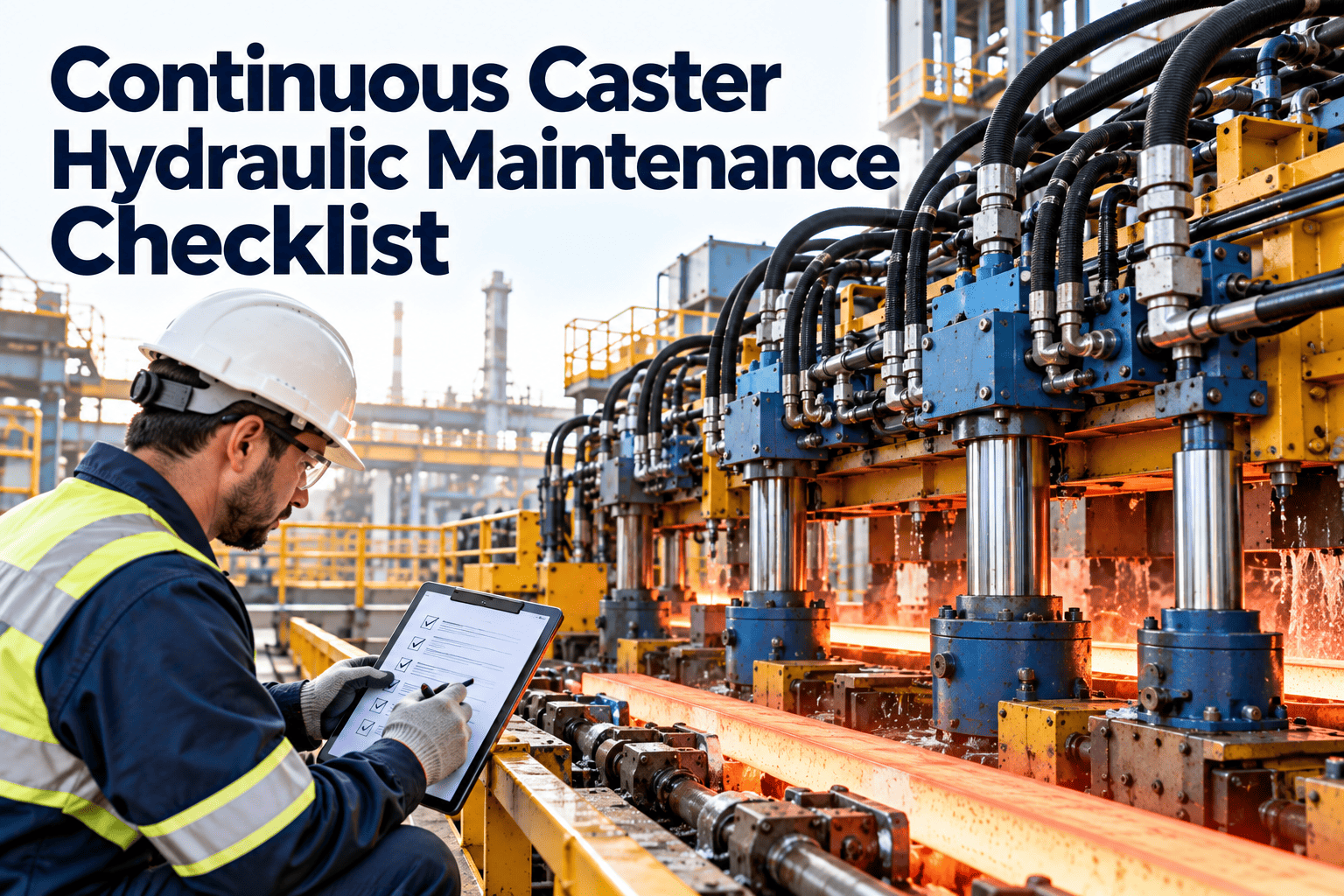
Continuous Caster Hydraulic Maintenance Checklist
Keep oscillation, segment clamping and strand guidance hydraulics stable with interval-based checks for pressure, leaks, seals, pumps, cylinders, filters and fluid health, backed by digital records your team can trend, audit and act on.
Where Hydraulics Work Along the Caster Strand
A caster is not one hydraulic system but several, each with a different duty, cleanliness demand and failure consequence. Mapping them from the ladle to the torch cutter makes it clear why one generic "check hydraulics" task is not enough.
- Ladle turret Lift cylinders and, on many turret designs, accumulator-backed emergency rotation that must work during a power loss. If degraded: a ladle that cannot be swung clear in an emergency, or uneven lift that loads the arms.
- Tundish car Lift and centring cylinders that position the tundish and submerged entry nozzle over the mould. If degraded: nozzle misalignment, asymmetric flow in the mould and uneven shell growth.
- Slide gate and stopper actuation Actuators that control steel flow from ladle and tundish, often in the hottest, dirtiest zone of the platform. If degraded: sluggish flow control, mould level fluctuation and a higher risk of slag entrainment.
- Mould oscillation Servo-controlled hydraulic oscillators that set stroke, frequency and waveform, including non-sinusoidal profiles. If degraded: waveform distortion, poor mould flux infiltration, deeper oscillation marks and sticker breakout risk.
- Strand segments Clamping and roll gap cylinders with position feedback, including dynamic soft reduction on modern slab casters. If degraded: roll gap drift, bulging, internal cracks and centreline segregation.
- Withdrawal and straightener Pinch roll pressure cylinders and dummy bar handling that control strand speed and straightening. If degraded: strand slip, speed variation and loss of dummy bar control at start-up.
- Torch cutting machine Clamps and carriage motion that grip the strand and travel with it during the cut. If degraded: off-length cuts, damaged clamps and run-out table disruption.
Root Causes of Caster Hydraulic Problems
Most caster hydraulic failures trace back to a small group of causes. Inspection points in the checklist below are chosen to catch each of them early.
Particle contamination
- Scale, mould powder and dust entering through breathers and worn rod seals
- Wear debris from pumps and cylinders circulating when filters are in bypass
- Dirty top-ups from open containers or unfiltered transfer pumps
Heat and radiant load
- Hoses and cylinders close to the strand ageing faster than their rating suggests
- Fluid temperature above supplier limits accelerating oxidation or degradation
- Fouled or scaled coolers reducing heat rejection over months
Water and steam
- Spray chamber steam and cooling water leaks reaching reservoirs and actuators
- Water-glycol fluids drifting from specified water content through evaporation
- Hydrolysis of ester-based fluids when water ingress goes unchecked
Mechanical stress
- High-cycle oscillation loading on cylinder seals, bearings and mounting bolts
- Vibration loosening fittings and chafing unsupported hose runs
- Side loading on cylinders from worn guides or misaligned segments
Procedure gaps
- Readings taken but not recorded, so no baseline exists to compare against
- Accumulator precharge checks skipped because they need isolation
- Repairs closed without a pressure or function test being logged
The Checklist, Organised by Interval
Each item names the subsystem, the check and what an acceptable result looks like. Numeric limits must come from your OEM manuals, circuit drawings and fluid supplier data; the checklist tells you what to measure and record.
Every shift
Operator or shift maintenance- Power unitRecord main system pressure at the power unit gauge or HMI and compare against the set value and the last shift's reading.Pass: stable at set value, no fluctuation beyond normal ripple.
- ReservoirCheck reservoir level and fluid temperature; note any unexplained level drop, which usually means an external leak somewhere on the strand.Pass: level in normal band, temperature within fluid supplier limits.
- FiltersCheck differential pressure indicators on pressure and return filters, including clogging alarms on the HMI.Pass: no indicator tripped, no bypass condition.
- Mould oscillationReview oscillation stroke, frequency and servo position error on the level 1 or level 2 screen for the current casting speed.Pass: actual follows setpoint, no alarms, error within normal band.
- WalkdownWalk the accessible power unit, platform and segment areas looking for fresh leaks, wet hoses, fluid mist or unusual pump noise.Pass: no new leaks; any finding raised as a defect with a photo.
Daily
Hydraulic technician- PumpsListen for cavitation or aeration and check pump inlet conditions; on piston pumps with case drain flow meters, record case drain flow.Pass: smooth running, case drain flow at baseline.
- CoolingCheck cooler inlet and outlet temperatures on both the fluid and water side to confirm heat is being rejected.Pass: temperature difference consistent with previous readings.
- Tundish and turretObserve lift and positioning movements for smooth travel, correct speed and no drift when held.Pass: no hesitation, jerking or creep under load.
- SegmentsCompare actual roll gap positions against setpoints for each segment and flag any cylinder showing repeated correction or drift.Pass: all segments within tolerance with no persistent deviation.
- Leak logUpdate the leak register: open leaks, estimated severity and top-up volume added in the last 24 hours.Pass: top-up volume stable or falling.
Weekly
Hydraulic technician or reliability engineer- HosesInspect hose assemblies near the strand for abrasion, heat hardening, cracking, blistered covers, kinks and damaged heat-protection sleeves.Pass: no cover damage or reinforcement exposed; replace if in doubt.
- CylindersInspect accessible cylinder rods for scoring, pitting or scale build-up and check rod seals and wipers for leakage.Pass: dry or lightly filmed rods, no scoring.
- Fittings and mountsCheck fittings, flanges, clamps and cylinder mounting bolts in high-vibration areas such as oscillator frames.Pass: tight, supported, no weeping at connections.
- BreathersCheck reservoir breathers and desiccant indicators, and confirm fill points are capped.Pass: desiccant not saturated, caps in place.
- OscillationTrend oscillation servo error and cylinder pressure over the week to spot slow degradation that single-shift readings miss.Pass: no rising trend in error or pressure demand.
- Slide gateInspect slide gate and stopper actuator hoses and quick couplings for heat and spatter damage between sequences.Pass: couplings seal fully, no burnt covers.
Monthly
Reliability engineer or lubrication specialist- Fluid sampleTake a representative sample from a live sampling point and test particle count, water content, viscosity and the fluid-specific tests described below.Pass: results within targets set for each circuit.
- AccumulatorsWith the fluid side isolated and fully discharged, check nitrogen precharge against the design value on the tag or circuit drawing.Pass: precharge at design value; recharge with nitrogen only.
- Relief valvesVerify relief and pressure-reducing valve settings where the procedure allows a safe test, and record as-found and as-left values.Pass: settings match the circuit drawing.
- PumpsReview pump case drain flow, outlet pressure and motor current trends to estimate internal wear.Pass: no sustained upward trend in case drain flow.
- FiltersReview filter element change history; frequent changes on one circuit point to an ingress source that needs investigation.Pass: element life consistent with previous months.
Planned shutdown
Maintenance planner and hydraulic crew- SegmentsDuring segment exchange, inspect or overhaul segment cylinders, test position transducers and pressure-test on the maintenance stand.Pass: no internal leakage on hold test, transducers calibrated.
- OscillatorInspect oscillator cylinders, servo valves, feedback sensors and guiding elements; send servo valves for bench testing per OEM interval.Pass: test report on file, no excessive play in guides.
- HosesReplace hose assemblies that have reached the plant's replacement age or showed damage during weekly checks.Pass: replacement dates recorded against each hose tag.
- ReservoirInspect reservoir internals for sludge, water and corrosion; clean if required and flush with offline filtration afterwards.Pass: clean tank, cleanliness restored before restart.
- CoolersClean or descale heat exchangers and check for internal leaks between water and fluid circuits.Pass: no cross-contamination, heat rejection restored.
- RecommissioningAfter any opened circuit, bleed air, verify pressures, run function tests and confirm cleanliness before handing back to operations.Pass: signed function test and cleanliness result logged.
Turn This Checklist Into Scheduled, Trackable Work
Load every interval into Oxmaint as preventive maintenance tasks, capture pressures and readings on mobile at the machine, and raise a work order the moment a result falls outside its limit.
Fluid Condition: What to Test and Why
Caster hydraulics often run fire-resistant fluids because of the molten steel nearby. Each fluid family degrades differently, so the tests you trend should match the fluid in each circuit.
| Test | Mineral oil (HM/HV) | Water-glycol (HFC) | Synthetic ester (HFDU) |
|---|---|---|---|
| Particle count | Trend against ISO 4406 target | Trend against ISO 4406 target | Trend against ISO 4406 target |
| Water content | Keep as low as practical; free water is a warning | Keep within supplier's specified range; low water raises viscosity and fire risk | Critical, because water drives hydrolysis |
| Viscosity | Compare with new-fluid value | Moves with water content; correct water first | Compare with new-fluid value |
| Chemistry | Acid number and oxidation | Reserve alkalinity or pH | Acid number to track hydrolysis |
| Temperature | Within supplier limits | Lower maximum than mineral oil; check supplier data | Within supplier limits |
Abnormal Trend Matrix: Normal, Watch or Act
Single readings rarely tell the story. The value comes from comparing each result with the commissioning baseline and the last several readings.
From Abnormal Reading to Verified Repair
Hydraulic systems store energy in accumulators, raised loads and trapped pressure. A defined workflow keeps repairs safe and makes sure the fix is proven before casting resumes.
KPIs for Caster Hydraulic Reliability
These measures show whether the checklist is being done and whether it is working. Set targets from your own baseline rather than borrowed benchmarks.
- Checklist compliance
- Completed hydraulic checks divided by scheduled checks, by interval and by crew.
- Hydraulic-related casting delays
- Caster delay minutes coded to hydraulic causes per month, split by subsystem.
- Fluid top-up volume
- Litres added per week per power unit; a direct proxy for external leakage.
- Cleanliness on target
- Fluid samples meeting their ISO 4406 target divided by total samples taken.
- Defect closure time
- Hours from a hydraulic defect being logged to its verified close-out.
- Repeat failures
- Components with the same failure mode repaired more than once within a set period.
Paper Rounds Versus a Digital Hydraulic Checklist
Paper or spreadsheet rounds
- Readings written on sheets that are rarely trended
- Leaks noticed but not always converted into work orders
- Accumulator and relief valve checks easy to skip without anyone noticing
- No link between a fluid sample result and the repair it triggered
- Root cause analysis after a breakout starts with searching for records
Digital checklist in a CMMS
- Numeric fields capture pressure, temperature and flow for trending
- Out-of-limit results can prompt a corrective work order
- Overdue checks are visible on dashboards before audits
- Photos, sample results and repairs sit in one asset history
- Investigations start from a timeline of every check and repair
How Oxmaint Supports Caster Hydraulic Maintenance
Oxmaint is a maintenance management platform, so its role is to organise, schedule and record the work. The table maps its capabilities to the caster tasks above.
Frequently Asked Questions
How often should continuous caster hydraulic systems be inspected?
Pressure, level, temperature and filter indicators are checked every shift, with deeper hose, cylinder, fluid and accumulator checks weekly and monthly. Final intervals should follow OEM guidance and your own failure history.
Why does mould oscillation hydraulic health matter for breakout prevention?
Oscillation controls how mould flux lubricates the shell. A degrading servo valve or cylinder can distort the stroke or waveform, which increases the risk of sticking and sticker breakouts.
What is the safest way to check accumulator precharge?
Isolate the accumulator, fully discharge the fluid side, then check the gas side with the correct charging kit and compare it to the design value. Use nitrogen only and follow your plant's lockout procedure.
Which fluid tests matter most for caster hydraulics?
Particle count, water content and viscosity for all fluids, plus reserve alkalinity for water-glycol and acid number for esters and mineral oils. You can log each result against the circuit in Oxmaint.
Can a CMMS help predict caster hydraulic failures?
A CMMS makes condition-based maintenance practical by storing readings as trends and triggering work when limits are crossed. Book a demo to see how readings and work orders connect in Oxmaint.
Keep Every Strand Casting With Stable Hydraulics
Schedule every hydraulic check, capture every reading and close every defect with proof. Set up your caster hydraulic checklist in Oxmaint and give your reliability team the trend data it needs.