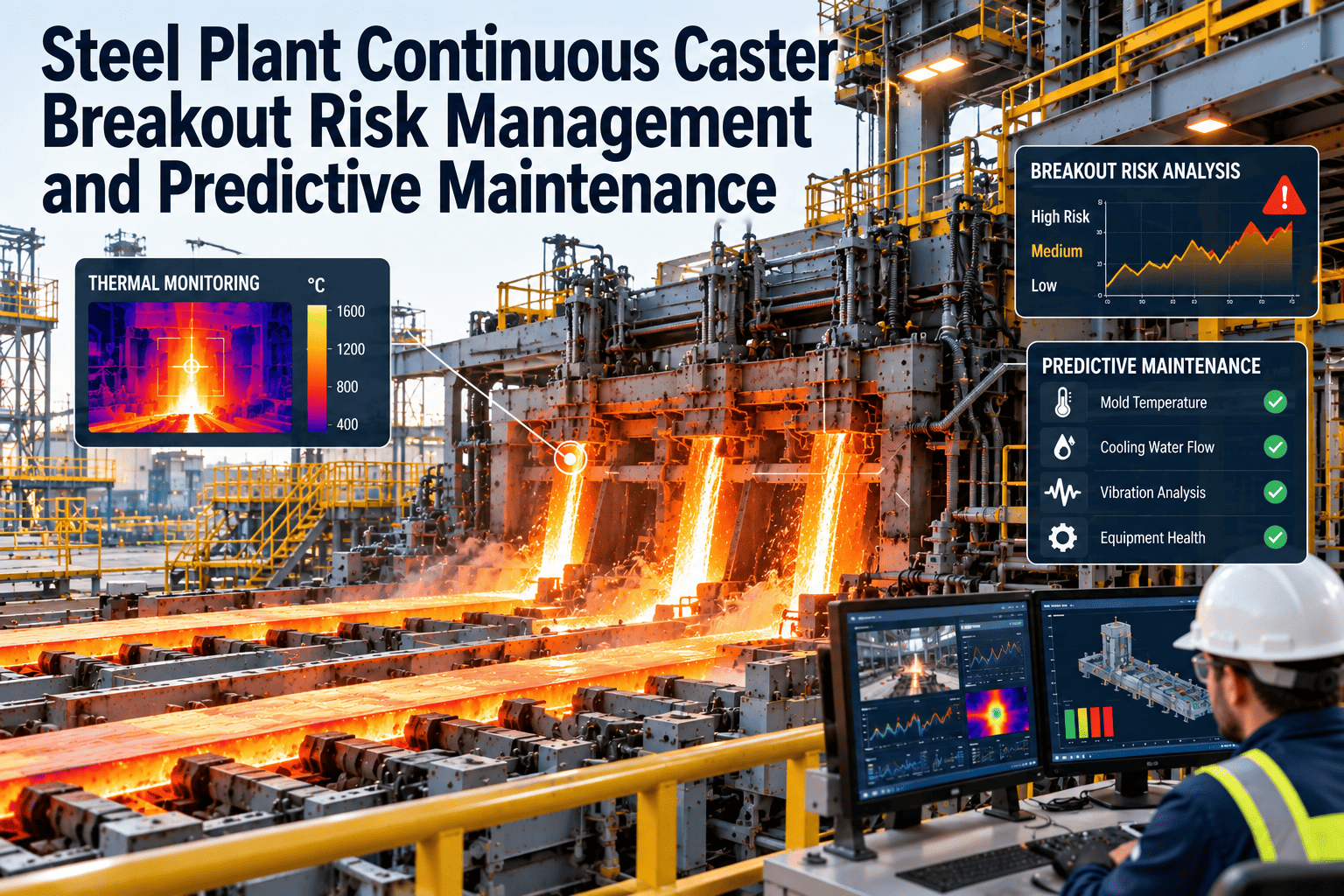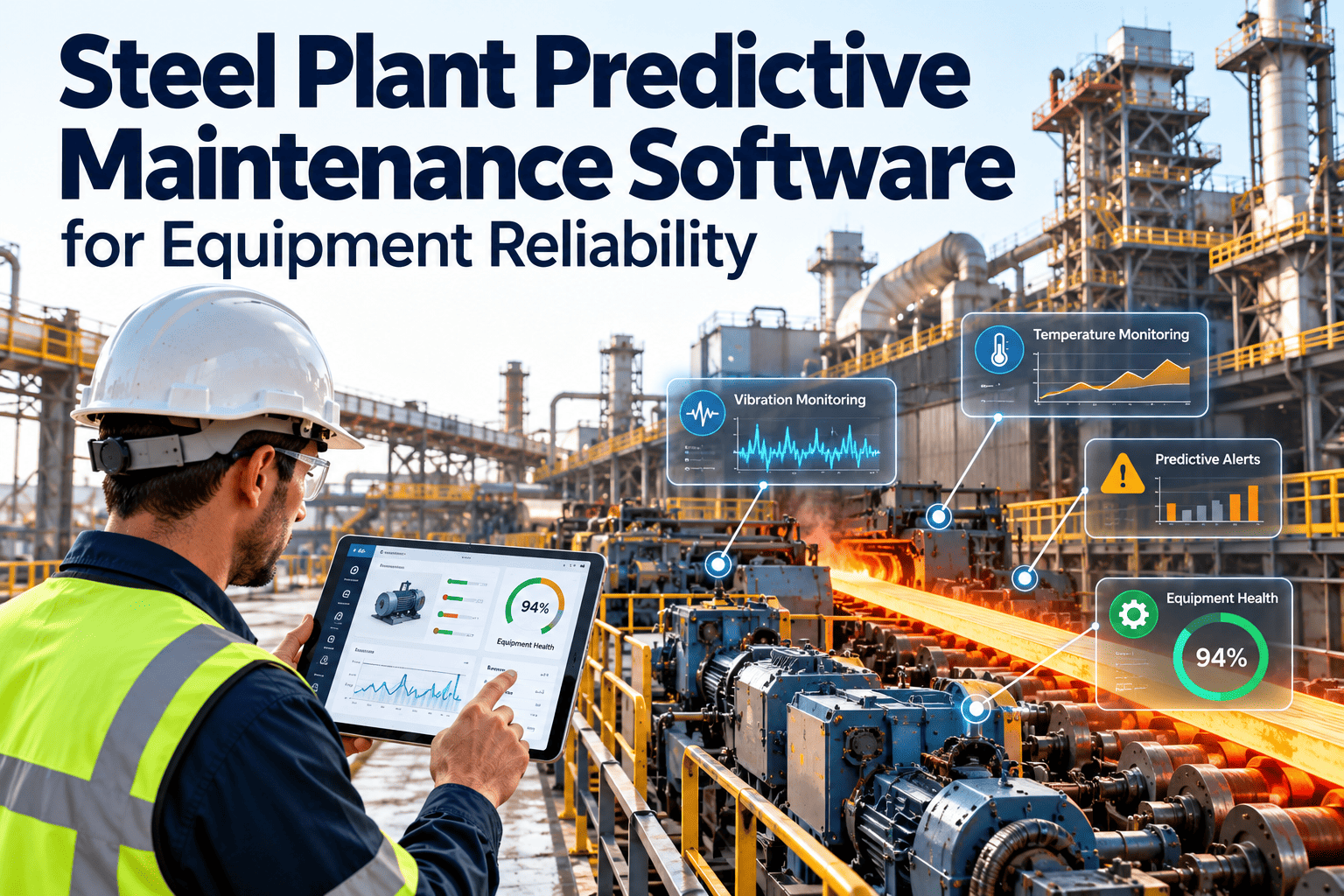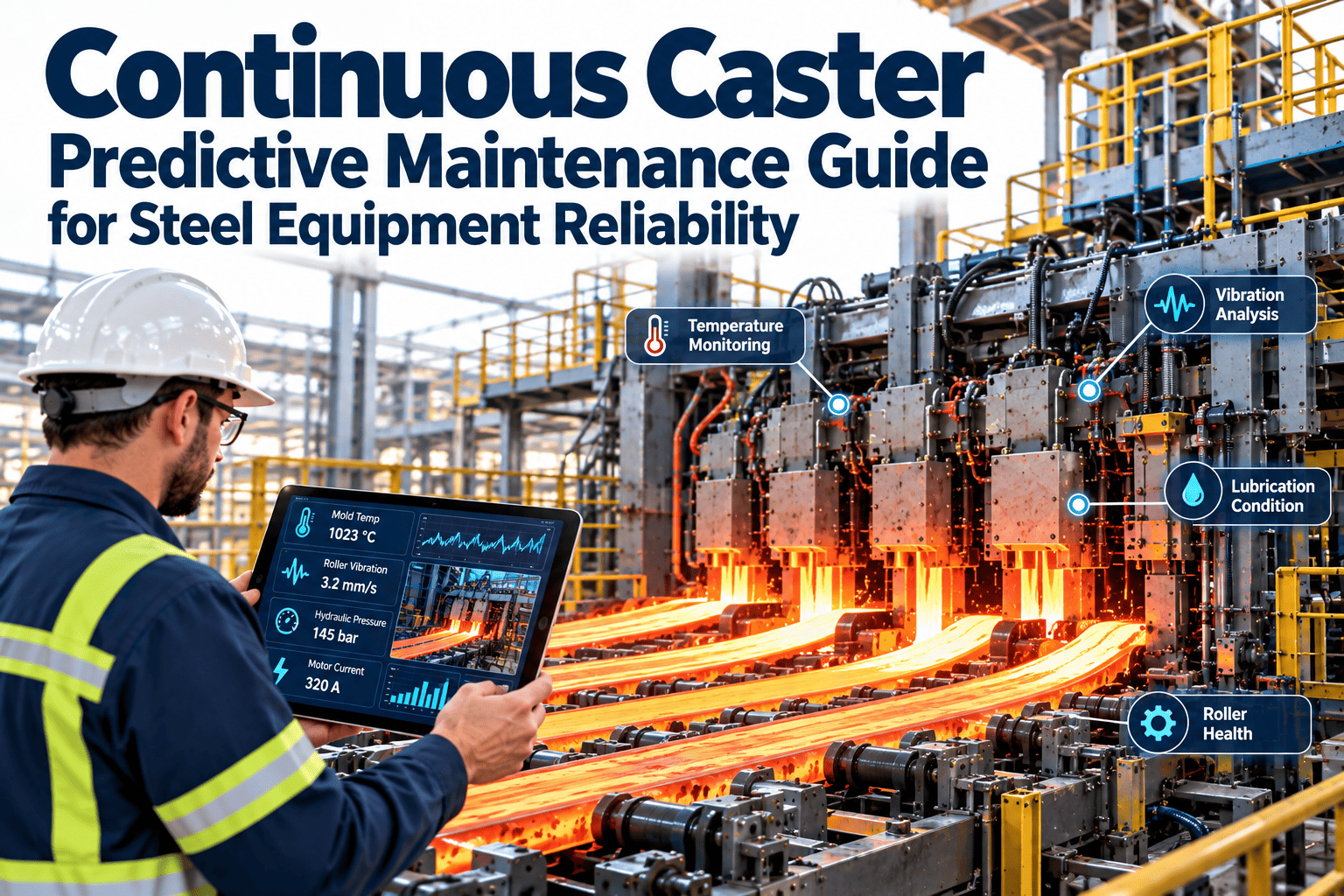
A continuous caster runs five interdependent systems at once — the copper mold, the segment rolls guiding the solidifying strand, the secondary cooling sprays, the oscillator drive, and the hydraulics that hold everything in position — and a failure in any one of them can escalate into a breakout within seconds. Most casters already generate the data needed to see that escalation coming: mold thermocouple arrays, segment position feedback, spray header pressure, oscillator vibration, and hydraulic pressure trends all carry early warning signatures well before a shell thins to the point of rupture. The gap in most plants is not the sensor data itself, it is the maintenance system that turns those signals into a work order before the strand hits the containment pit. This guide breaks caster predictive maintenance down system by system, with the specific triggers each one needs, and closes with how a CMMS such as OxMaint converts those triggers into scheduled interventions instead of emergency cleanups.
Continuous Caster Predictive Maintenance: Mold, Segment, Cooling, Oscillator, Hydraulics
Asset-specific triggers for every subsystem that can turn a small deviation into a breakout — built for reliability teams running slab, billet, and bloom casters.
What Predictive Maintenance Actually Watches on a Caster
Each caster subsystem degrades differently, and lumping them into one generic "caster maintenance" plan is why so many mills still find out about a problem only when the strand does. Treating the caster as one asset with one maintenance calendar also means a healthy mold can end up sharing a service window with a segment that is not due for inspection at all, wasting a shutdown on work that did not need to happen yet while genuinely urgent work waits for the next planned stop.
Breaking the caster down into its five subsystems, each with its own signal set and its own trigger logic, is what allows maintenance windows to be built around actual condition rather than a fixed rotation. A mold nearing its wear limit and a segment showing early bearing vibration do not necessarily reach their service point on the same day, and a program that tracks them separately can schedule each one at the moment it is actually needed instead of bundling everything into the next convenient outage.
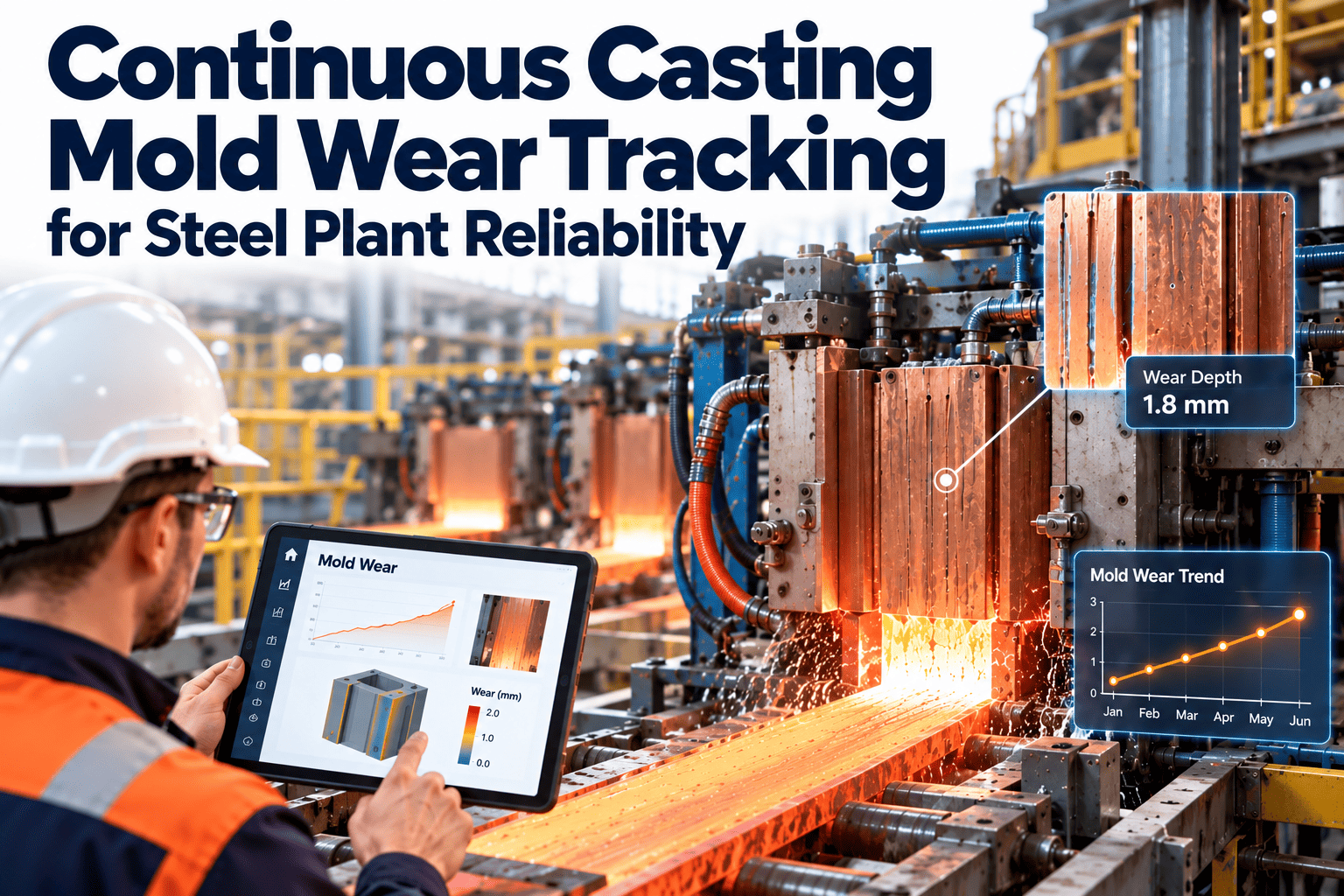
Copper plate wear, thermocouple drift, and localized heat flux anomalies are the earliest indicators of a sticker-type breakout. A mold with 100 or more embedded thermocouples produces a heat-flux map that should be trended per campaign, not just glanced at on a screen.
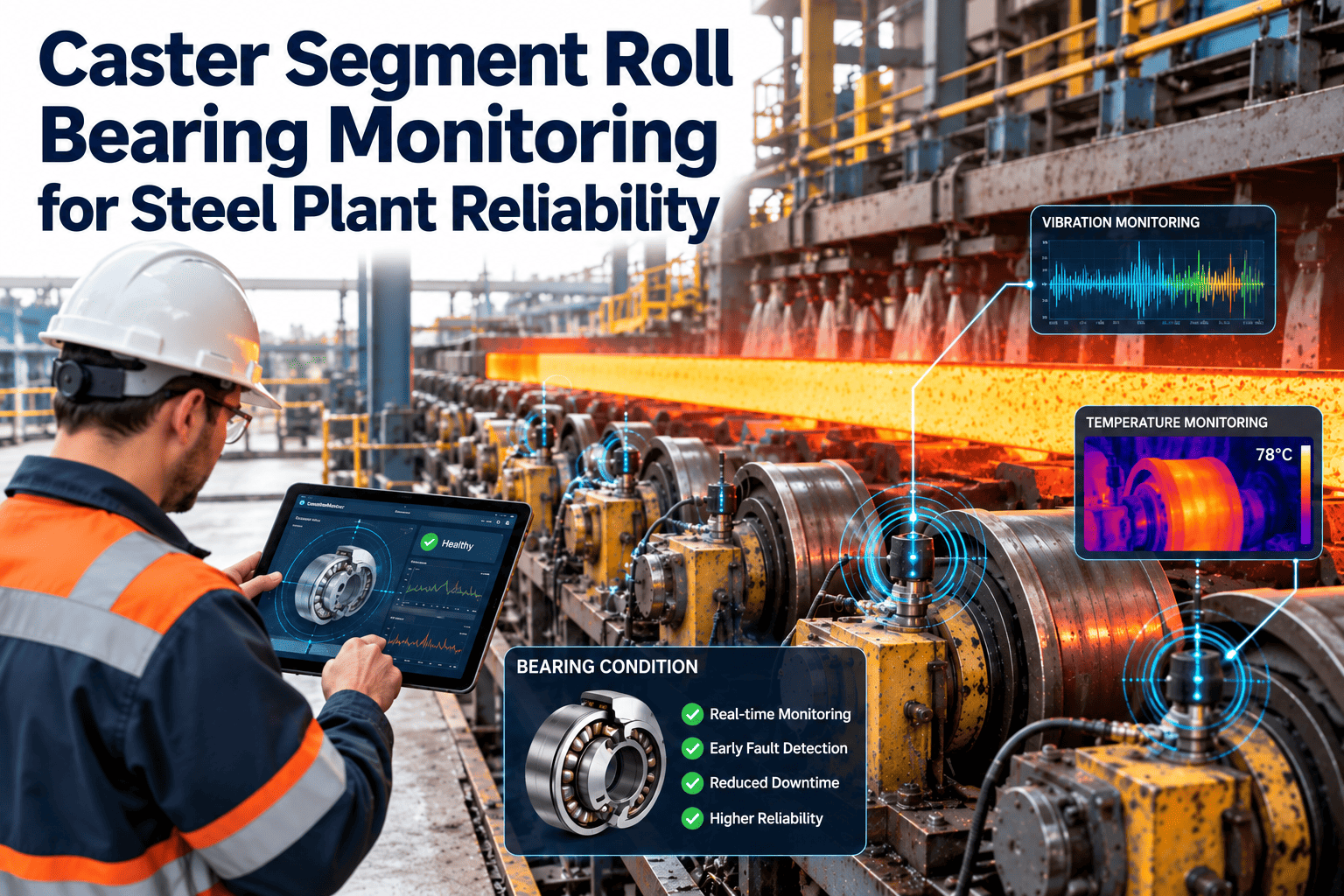
Roll bearing vibration and roll gap deviation reveal misalignment long before a locked roll drags on the strand shell. Torque imbalance between paired rolls in a segment is one of the clearest early flags of a bearing seizing up.
Spray nozzle flow rate and header pressure determine whether the shell solidifies evenly as it exits the mold. A clogged or misaligned nozzle creates a cold or hot spot that shows up in the same thermocouple data used to watch the mold.
Oscillation amplitude, frequency, and spring tension control how cleanly the shell releases from the mold wall each cycle. Drift here increases friction, which shows up as vibration signature changes at the drive bearing well before a mechanism failure.
Pressure trending and leak-rate monitoring on segment clamping and oscillation hydraulic circuits catch slow degradation in seals and valves before a sudden pressure loss lets a segment roll gap open under load.
The Signal, the Threshold, and the Work Order It Should Generate
| System | Monitored Signal | Predictive Trigger | Resulting Action |
|---|---|---|---|
| Mold | Thermocouple heat flux pattern | Localized deviation beyond baseline | Immediate cast-rate reduction review, mold inspection at next sequence end |
| Segment Rolls | Bearing vibration / roll torque | Vibration signature change or torque imbalance flag | Roll and bearing inspection scheduled at next segment change window |
| Secondary Cooling | Spray header pressure | Pressure anomaly outside nozzle spec | Nozzle flow verification work order, zone valve check |
| Oscillator | Amplitude / frequency, drive vibration | Deviation greater than roughly 5% from calibration | Oscillation recalibration, drive bearing inspection |
| Hydraulics | Circuit pressure trend, leak rate | Gradual pressure decline over successive heats | Seal and valve inspection before next scheduled shutdown |
Turn Sensor Deviations Into Work Orders — Not Post-Incident Reports
OxMaint ingests mold thermocouple, segment vibration, cooling pressure, and hydraulic trend data and converts a threshold breach directly into a scheduled inspection or corrective work order, tied to the exact segment, mold, or drive component involved.
Breakout Prevention Is Layered, Not a Single Alarm
Calendar-Based vs. Condition-Based Caster Maintenance
- Mold plates changed on a fixed schedule regardless of measured wear
- Oscillator calibration checked monthly, drift can persist between checks
- Nozzle flow verified on inspection rounds, clogging can go undetected between rounds
- Segment and bearing issues surface as unplanned stoppages
- Mold plates replaced against measured wear, extending usable campaign life
- Oscillator recalibrated the moment amplitude or frequency drifts beyond spec
- Nozzle flow deviations trigger inspection within the same shift
- Segment and bearing anomalies are scheduled into planned maintenance windows
A Practical Rollout Sequence
Most of the Data Already Exists — the Workflow Usually Doesn't
A modern continuous caster is not short on instrumentation. A single mold can carry more than a hundred embedded thermocouples, segment position feedback runs continuously to the process control system, and hydraulic circuits already have pressure transducers wired in for control purposes. The gap that stops most plants from running true predictive maintenance is not sensor coverage — it is that this data lives inside the process control historian, watched by process engineers for cast quality, while the maintenance team works from a completely separate CMMS with no automated link between the two.
Closing that gap does not require replacing either system. It requires a defined data path from the historian or PLC into the CMMS asset record for each mold, segment, and drive component, with threshold rules that convert a deviation into a work order rather than just an operator alarm on the pulpit screen. Once that path exists, the same thermocouple array that a process engineer already watches for surface quality becomes the same signal a reliability engineer uses to schedule the next mold inspection — one set of sensors, two teams working from consistent data instead of two separate pictures of the same caster.
Predictive Maintenance Only Works if Process and Maintenance Agree on Thresholds
A common failure mode in caster reliability programs is setting alert thresholds without input from the people who will act on them. A threshold set purely by a maintenance engineer, without checking against normal cast-to-cast variation that a caster operator already knows to expect, generates enough false alarms that the alerts get muted within a month. A threshold set purely by process engineering, without input on what a technician can realistically inspect within a single segment-change window, generates alerts that arrive with no time to act on them.
The plants that get the most out of caster predictive maintenance run the threshold-setting exercise jointly — process engineering supplies the normal operating range for each signal, maintenance supplies the realistic response window for each subsystem, and the two are reconciled into a single trigger table like the one above before it goes live. That joint table then becomes the reference both teams work from when a deviation fires, instead of a debate over whether the alert was even valid.
Auxiliary Equipment That Belongs in the Same Program
Once mold, segment, cooling, oscillator, and hydraulic monitoring are running reliably, the same predictive framework extends naturally to the equipment feeding and following the caster. Tundish preheat and nozzle condition, ladle turret bearing and rotation drive health, and torch cutting unit alignment all carry their own early-warning signals and all interact with the same cast sequence.
A tundish nozzle that is trending toward clogging affects flow control into the mold just as surely as a mold thermocouple anomaly does, and a ladle turret bearing degrading in the background can force an unplanned ladle change mid-sequence that disrupts cast rate as much as a segment roll failure would. Treating these as part of the same reliability program, inside the same CMMS, rather than as separate maintenance silos, is what turns caster predictive maintenance from a mold-and-segment project into a genuine end-to-end casting reliability program.
Frequently Asked Questions
Does caster predictive maintenance require new sensors?
Which subsystem should a plant start with?
How does OxMaint handle a false alarm?
Can this apply to billet and bloom casters, not just slab casters?
How long before a plant sees results?
How to Know the Predictive Program Is Actually Working
A predictive maintenance program on a caster needs its own scorecard, separate from general plant-wide reliability metrics, because the consequences of a missed signal on a caster are so much more severe than on most other equipment. Three measures matter most in the first year of a program.
The first is breakout frequency itself, tracked per campaign rather than per calendar month, since campaign length varies with mold and refractory life. A declining trend here is the ultimate outcome metric, but it can take months to show a clean signal simply because breakouts are, ideally, rare events even before a predictive program starts.
The second is the ratio of planned to unplanned segment and mold interventions. As the trigger thresholds mature, this ratio should shift steadily toward planned work — a mold changed at a scheduled sequence end because wear data indicated it was due, rather than pulled mid-campaign because a thermocouple anomaly forced an immediate stop.
The third, and the one most programs neglect, is false-positive rate on each trigger. A threshold that fires constantly without a corresponding real finding erodes trust in the whole system and eventually gets ignored by the floor crew, regardless of how sound the underlying logic is. Tracking and actively reducing false positives, quarter over quarter, is what keeps a predictive program credible long enough to prove its value on the metric that matters most — fewer unplanned strand events.
Every Caster Subsystem Sends a Warning Before It Fails
OxMaint connects mold, segment, cooling, oscillator, and hydraulic signals to a single reliability workflow — so the next deviation becomes a scheduled work order instead of an unplanned strand event.