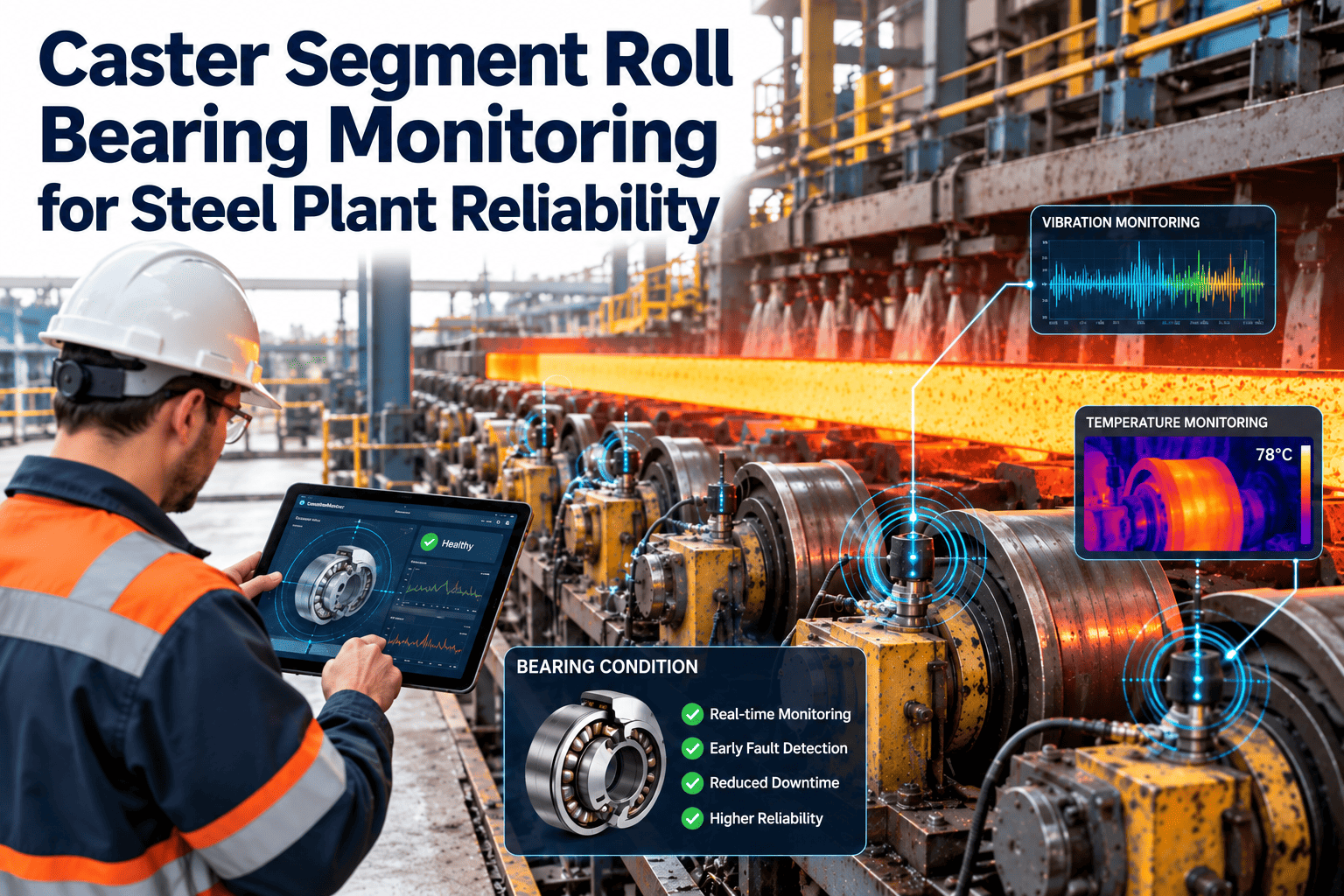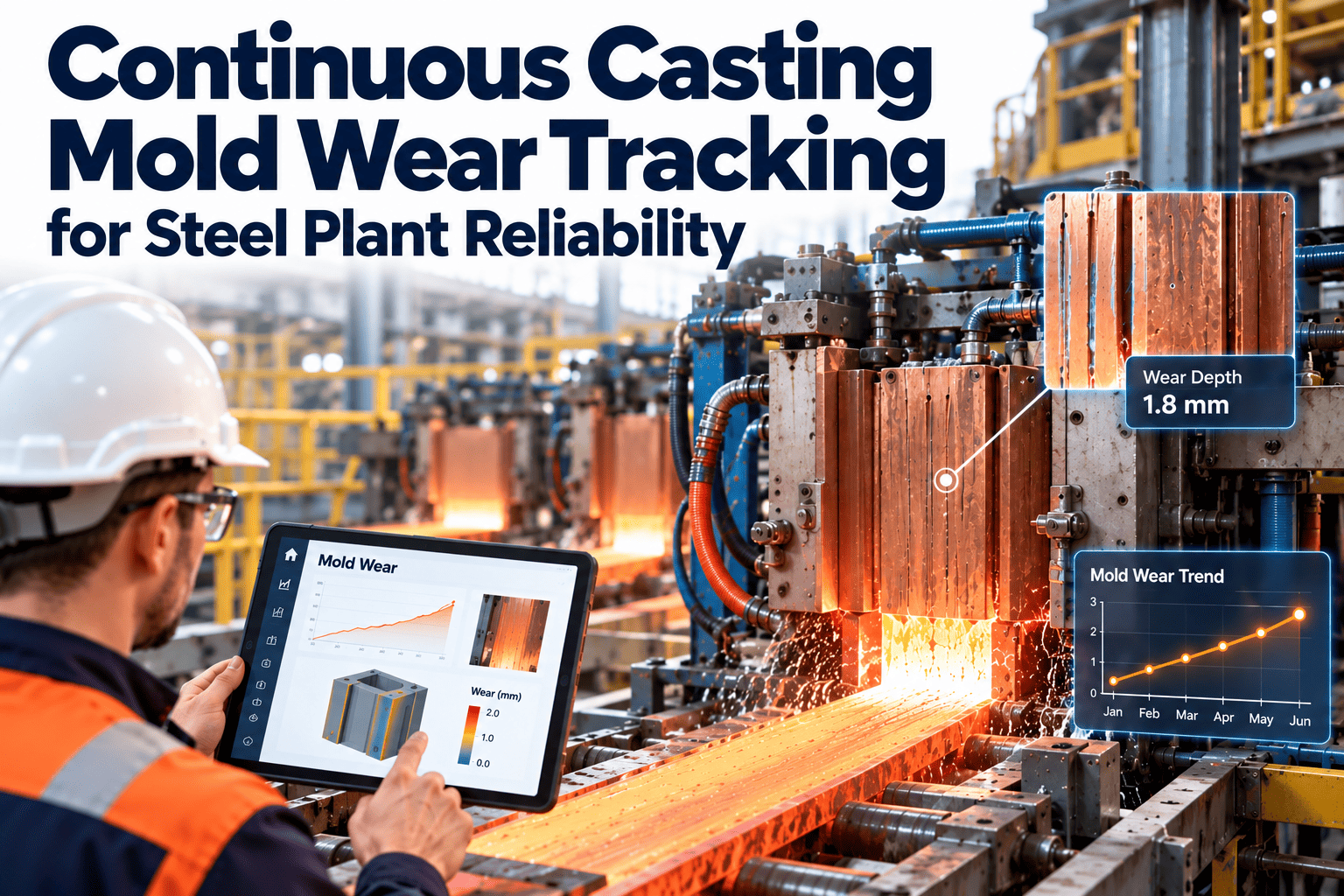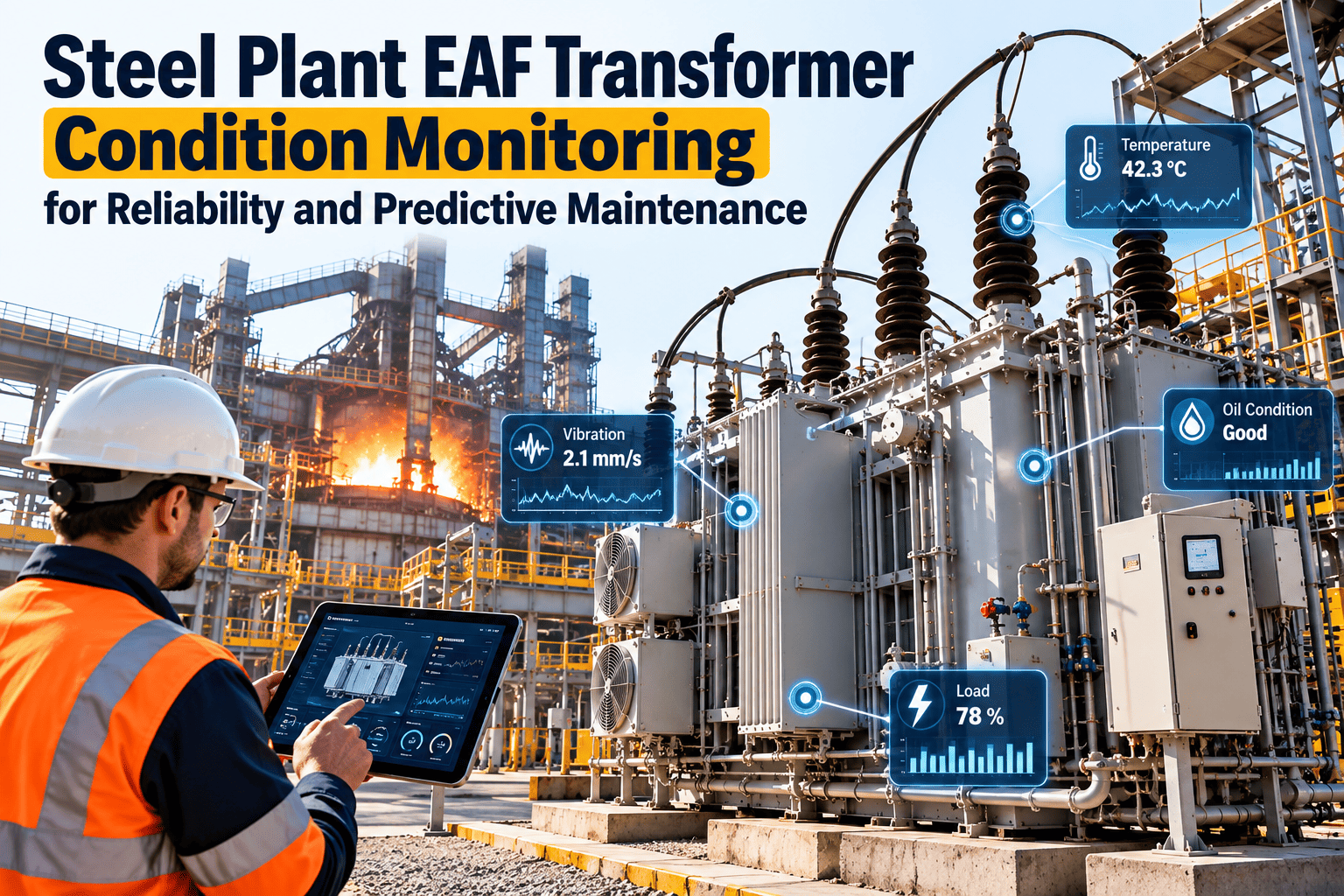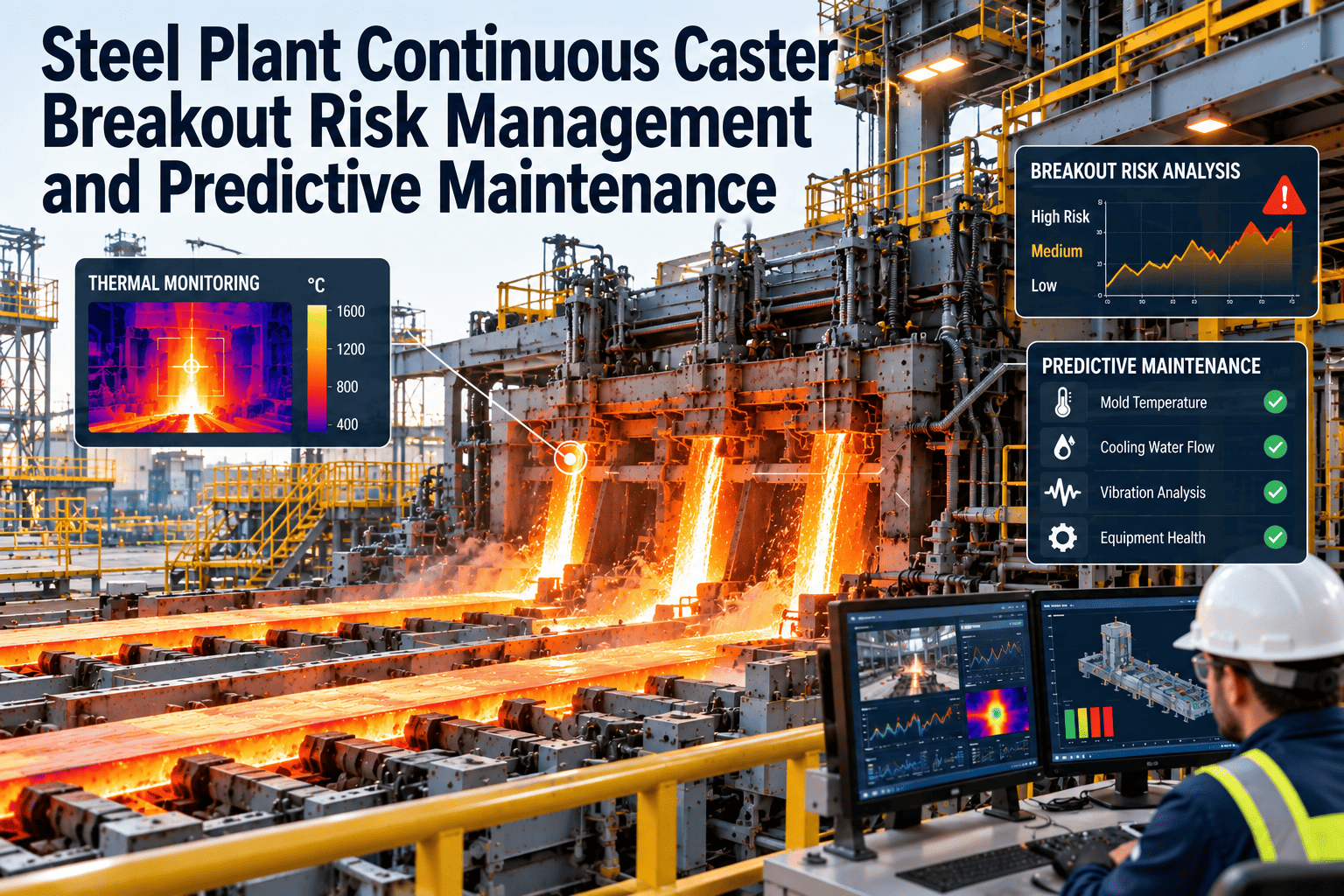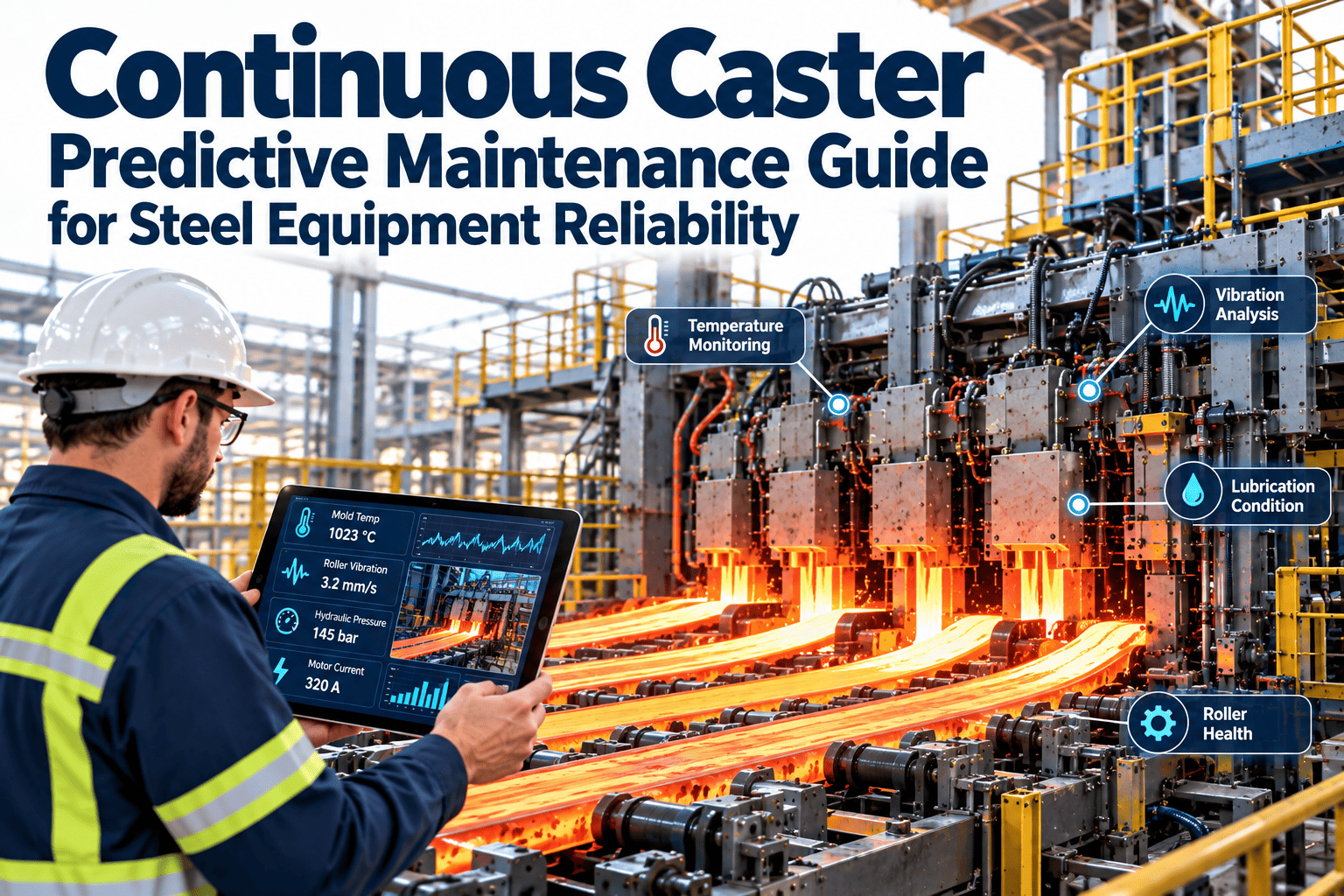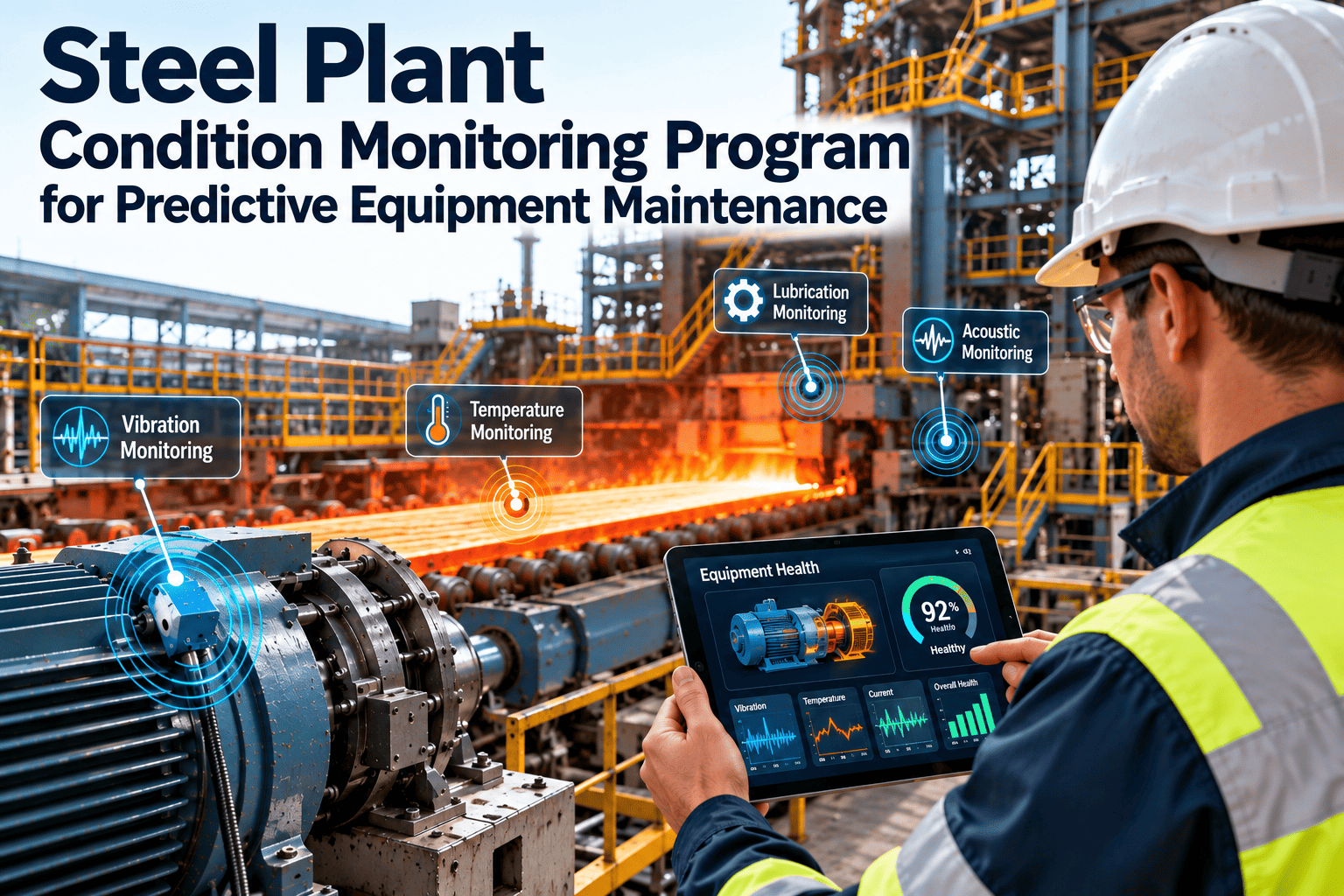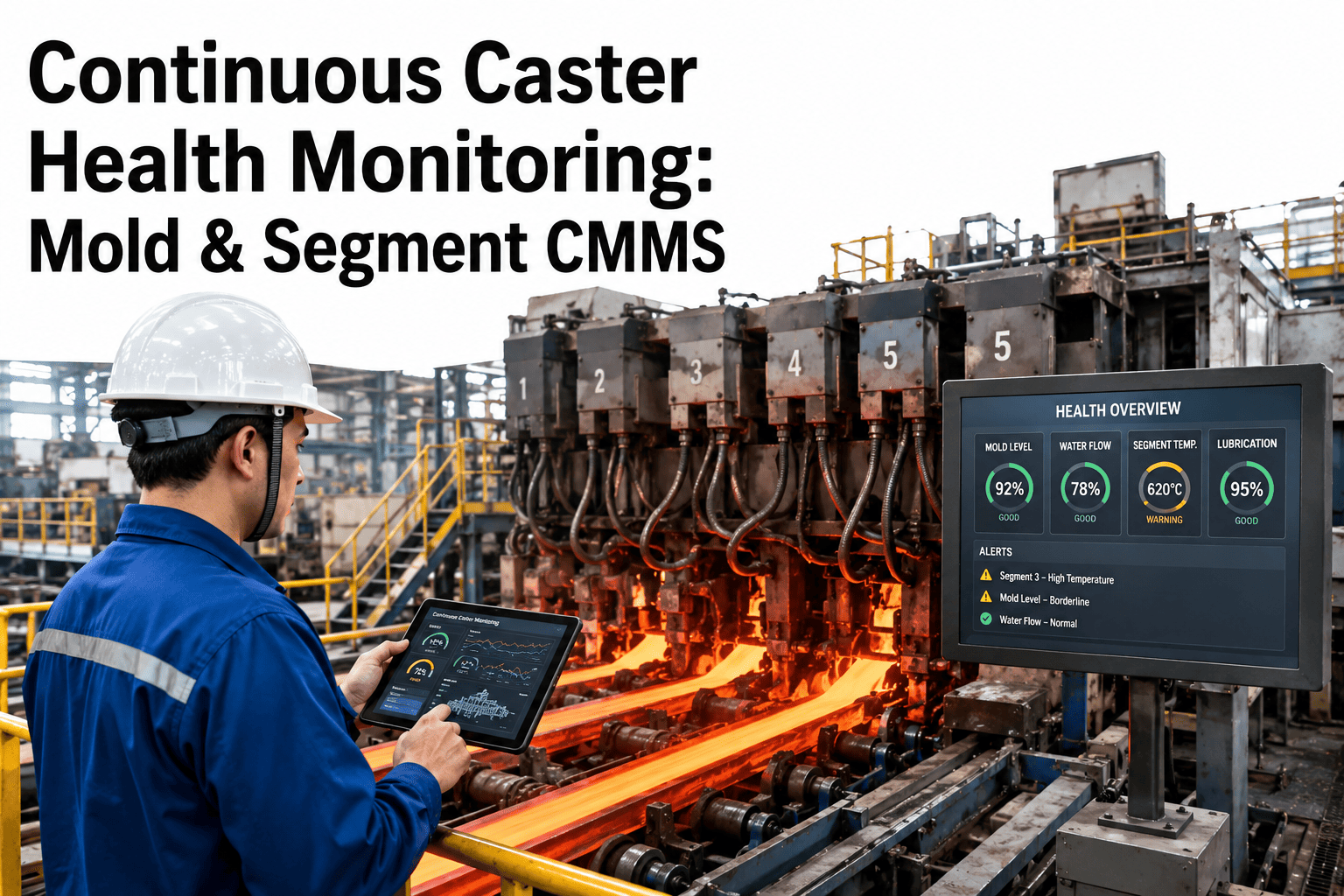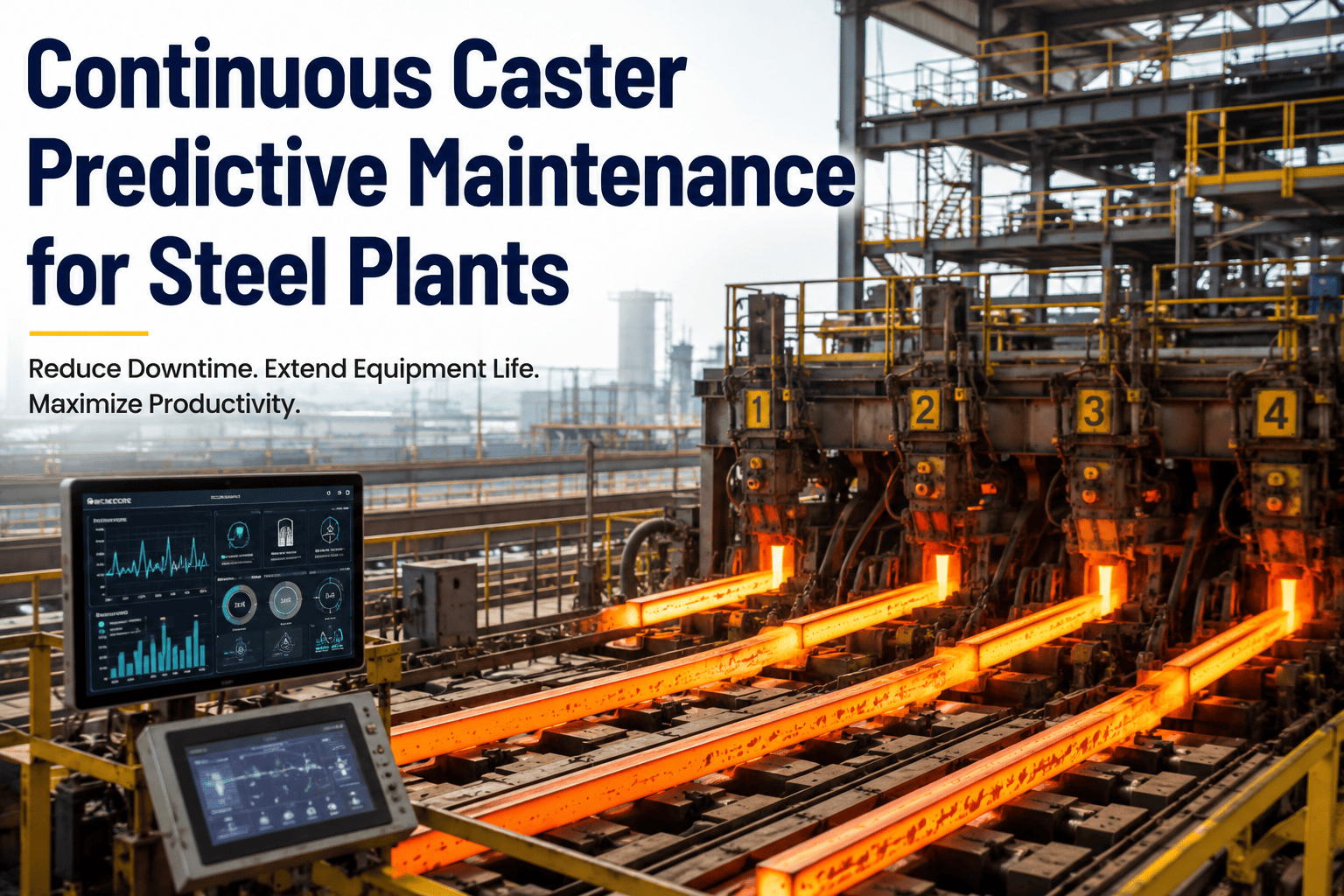
Continuous caster predictive maintenance is the difference between a stable cast sequence and a six-figure breakout event that halts steel production for hours. Most caster breakouts, cobbles, and segment failures give measurable early warning through mold thermocouple data, segment position feedback, and oscillator vibration trends — if your team has the CMMS infrastructure to catch those signals in time. This guide breaks down how modern steel plants use caster condition monitoring, mold oscillation maintenance, and segment roll tracking to predict failures before they escalate. Ready to replace reactive firefighting with data-driven reliability? Start Free Trial with OxMaint and digitize your caster maintenance program today.
Can your caster predict a breakout before the mold gives the first warning sign?
Over 80% of continuous caster breakouts leave detectable fingerprints in thermocouple data, oscillator vibration spectra, and segment position feedback hours before the event. OxMaint turns those signals into automated work orders — so your reliability team intervenes before steel hits the containment pit.
What continuous caster predictive maintenance actually monitors
A modern continuous caster runs thousands of sensors across the mold, segments, oscillator drive, and secondary cooling zone. Predictive maintenance for steel casters means trending those signals against baselines so reliability engineers get an alert at the first deviation — not after a breakout or segment roll failure.
Mold thermocouple trend monitoring
A breakout precursor often shows up as a localized thermocouple temperature spike — a "hot spot" — 2 to 20 minutes before shell rupture. OxMaint ingests mold thermocouple arrays, auto-trends each row and column, and triggers a priority work order when delta-T exceeds your configured threshold against the rolling baseline.
Mold oscillation vibration analysis
Oscillator stroke deviation, negative strip ratio drift, and bearing vibration harmonics signal mechanical wear in the oscillator drive before it affects strand surface quality. OxMaint logs oscillator vibration spectra on every cast and flags crest factor and RMS trend shifts for maintenance review.
Segment roll position & gap trending
Segment roll wear changes the strand gap by fractions of a millimeter per cast — until taper breaks and centerline segregation spikes. OxMaint tracks segment position feedback against per-strand tolerances, predicting when a segment cluster needs shimming or roll replacement before quality drift triggers a downgrade.
Secondary cooling nozzle inspection
A single plugged spray nozzle in the secondary cooling zone can shift the solidification endpoint by several meters and induce internal cracks. OxMaint schedules nozzle inspection and flow-test work orders per zone based on cast-length and water pressure trend deviations.
How much does a continuous caster breakout cost a steel plant?
A single breakout event on a slab caster typically costs between $150,000 and $500,000 when you factor in lost steel, mold tube replacement, refractory repair, sequence restart consumables, and 4–12 hours of lost production. A plant running three casters with two breakouts per caster per year is looking at $900K–$3M in avoidable annual losses — before you count segment roll failures and quality downgrades.
A three-caster steel plant averaging 2 breakouts per caster per year at $225K per event spends $1.35M annually on breakout-related losses alone. By deploying continuous caster predictive maintenance with OxMaint — catching 60% of breakout precursors through thermocouple trending and oscillator vibration alerts — the plant avoids approximately $810,000 per year, plus an additional $300K in prevented segment roll failures and quality downgrades. Total avoidable cost: ~$1.1M/year. OxMaint deployment cost: a fraction of that, with payback in under 12 months.
Building a continuous caster predictive maintenance program: key workstreams
A mature caster PdM program doesn't happen overnight. It's built in phased workstreams that move a plant from reactive firefighting to condition-based, then predictive, maintenance. Here are the four workstreams that deliver the fastest reliability gains on a continuous caster.
Baseline sensor data & failure history
Pull 12–24 months of mold thermocouple logs, oscillator vibration data, segment position feedback, and breakout incident reports into OxMaint. Tag each asset hierarchy — mold, oscillator, segments 1–N, secondary cooling zones — and establish normal operating envelopes per steel grade and casting speed.
Define alert thresholds & automated triggers
Set delta-T thresholds on mold thermocouple rows, vibration RMS limits on oscillator bearings, and segment gap drift tolerances. Configure OxMaint to auto-generate priority work orders when signals breach thresholds — with escalation rules to shift supervisors and reliability engineers.
Shift from time-based PM to condition-based maintenance
Convert fixed-interval caster PMs (e.g., "inspect segment rolls every 500 casts") into condition-triggered inspections based on actual position feedback trends and cumulative cast length. This cuts unnecessary segment pulls by 30–40% while catching wear issues earlier.
Layer AI predictive models on trend history
Once 6+ months of correlated sensor and failure data flows through OxMaint, enable AI-assisted failure prediction. The platform identifies multi-signal patterns — e.g., rising oscillator vibration + slight mold hot-spot recurrence + segment gap drift — that precede breakouts and roll failures, recommending interventions days before traditional thresholds would trigger.
Continuous caster PM checklist: daily, weekly & per-sequence tasks
Use this checklist as the backbone of your caster preventive maintenance routine inside OxMaint. Each task can be assigned as a recurring work order with digital checklists, photo attachments, and meter-based triggers tied to cast length.
- Review mold thermocouple temperature map for hot spots or cold zones
- Verify oscillator stroke amplitude and frequency match setpoints
- Check secondary cooling spray manifold pressure per zone
- Inspect mold level control response and submerged entry nozzle condition
- Log strand surface quality observations at unbending point
- Trend oscillator bearing vibration RMS and crest factor
- Review segment position feedback drift across all segments
- Inspect secondary cooling nozzles for plugging or spray pattern deviation
- Audit mold taper and narrow-face setting accuracy
- Verify mold powder feed rate consistency and depth uniformity
- Inspect segment roll surfaces for spalling, cracking, or grooving
- Check segment alignment and gap shimming per design tolerance
- Examine mold tube/platen copper face for cracks, plating wear, and distortion
- Inspect oscillator linkage bearings and hydraulic cylinder seals
- Calibrate mold thermocouple readings against reference sensor
| Caster subsystem | Monitoring signal | Failure mode predicted | PdM trigger threshold |
|---|---|---|---|
| Mold copper plate | Thermocouple temperature map | Breakout / shell rupture | Delta-T > 15°C vs. rolling baseline |
| Oscillator drive | Bearing vibration RMS & harmonics | Bearing seizure / stroke deviation | RMS increase > 25% over 7-day trend |
| Segment rolls | Position feedback / gap drift | Roll wear / taper loss / segregation | Gap drift > 0.3 mm from setpoint |
| Secondary cooling | Spray zone flow & pressure | Nozzle plugging / solidification shift | Flow deviation > 10% per zone |
| Mold level control | Level sensor response time | Level fluctuation / surface defects | Response lag > 0.5 seconds |
How OxMaint powers continuous caster predictive maintenance
OxMaint is an AI-powered CMMS and EAM platform built for maintenance and reliability teams in heavy industry. For steel plants, it connects caster sensor data, work order execution, asset hierarchy, and spare-parts inventory into one system — so a mold thermocouple alert automatically generates a work order, assigns it to the right technician, checks spare-part availability for the mold tube, and tracks resolution time. Here's how four OxMaint capabilities map directly to caster reliability outcomes.
Sensor-driven predictive alerts
Ingest mold thermocouple, oscillator vibration, and segment position data. OxMaint's AI engine trends signals against baselines and auto-generates priority work orders at the first deviation — catching 50–60% of breakout precursors before they escalate.
Digital work orders & caster PM automation
Replace paper work orders and clipboard checklists with mobile-first digital PMs. Every caster task — daily thermocouple review, weekly vibration trend, per-pull segment inspection — runs as a templated work order with photos, meter readings, and digital sign-off.
Full asset hierarchy & equipment tracking
Model your caster as a multi-level asset tree — mold, oscillator, segments, cooling zones — with individual roll IDs, thermocouple positions, and maintenance history. Drill from plant-level KPIs down to a single segment roll's failure pattern and remaining useful life.
Spare-parts inventory for caster components
Track mold tubes, segment rolls, oscillator bearings, and spray nozzles with min/max reorder triggers. When a predictive alert fires, OxMaint checks stock and auto-creates purchase requests — so the part is on the shelf before the work order starts.
See OxMaint predict caster failures on your assets — book a 30-minute demo
Walk through a live continuous caster asset hierarchy, see how sensor-driven alerts auto-generate work orders, and get a custom ROI estimate based on your plant's breakout history and caster count.
Continuous caster predictive maintenance: frequently asked questions
What is continuous caster predictive maintenance?
Continuous caster predictive maintenance uses real-time sensor data — mold thermocouple temperatures, oscillator vibration spectra, segment position feedback, and secondary cooling flow rates — to detect early warning signs of failures like breakouts, roll wear, and nozzle plugging before they cause unplanned downtime. Instead of fixed-interval preventive maintenance, PdM triggers interventions based on actual equipment condition, reducing unnecessary segment pulls and catching issues earlier.
How does mold thermocouple monitoring prevent breakouts?
Mold thermocouples detect localized temperature hot spots that indicate thinning or sticking of the solidifying steel shell — the precursor to most sticker breakouts. By trending each thermocouple's temperature against a rolling baseline and alerting when delta-T exceeds 10–15°C, a CMMS like OxMaint can trigger a mold-level adjustment or casting-speed reduction 2–20 minutes before a breakout would occur. You can Start Free Trial and configure thermocouple alert thresholds in your OxMaint asset hierarchy today.
What signals indicate segment roll wear in a continuous caster?
The primary signals are segment position feedback drift (gap deviation from setpoint), roll surface spalling or grooving found during visual inspection, and increasing strand thickness deviation at the segment exit. When segment gap drift exceeds 0.3 mm from design tolerance, the segment needs shimming or roll replacement. OxMaint tracks these trends automatically and generates segment maintenance work orders before quality drift causes slab downgrades.
How much does a CMMS for continuous caster maintenance cost?
A CMMS for continuous caster maintenance typically costs between $15,000 and $60,000 per year depending on the number of caster assets, sensor integrations, and user seats — a fraction of the $150K–$500K cost of a single breakout event. Most steel plants achieve full payback within 12–18 months by preventing just one or two breakouts and reducing unnecessary segment pulls. Book a demo at calendly.com/oxmaintapp/30min for a custom ROI estimate based on your plant's caster count and incident history.
How long does it take to implement predictive maintenance on a continuous caster?
A phased implementation typically takes 3–6 months: 4–6 weeks to baseline sensor data and build the asset hierarchy, 3–4 weeks to configure alert thresholds and automated work orders, 6–8 weeks to transition from time-based to condition-based PMs, and 3–6 months to layer AI predictive models once enough correlated trend history exists. OxMaint's onboarding team accelerates this by importing existing asset registers, PM schedules, and sensor data streams from day one.
Stop reacting to caster breakouts. Start predicting them.
Join the steel plants using OxMaint to cut unplanned caster downtime 30–50%, eliminate paper work orders, and catch breakout precursors before they cost six figures. Your 14-day free trial includes full asset hierarchy setup and sensor-data integration support.
Free 14-day trial · No credit card required