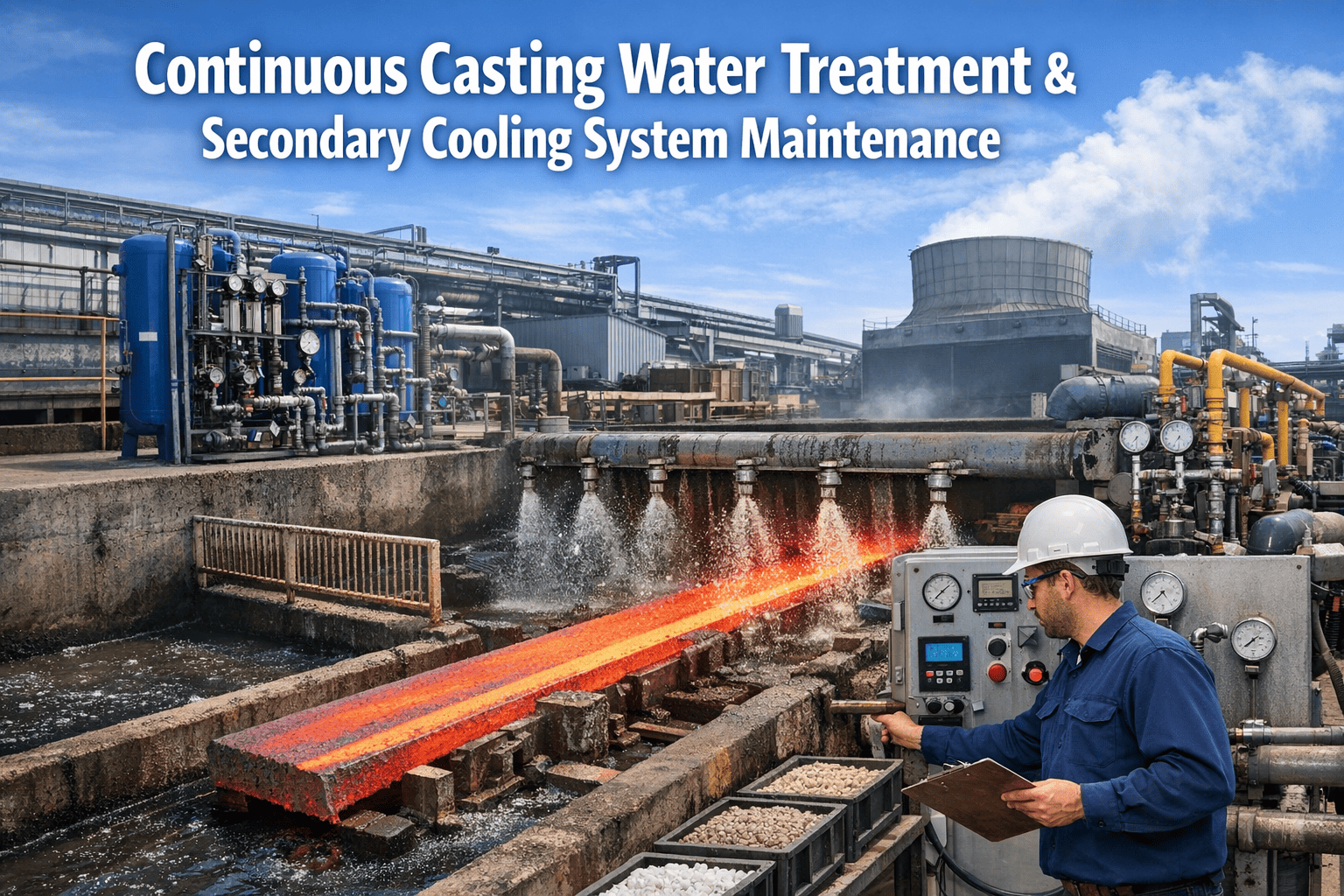
The continuous caster is where liquid steel becomes solid product — and where more quality defects originate than any other process stage in steelmaking. Internal cracks, surface defects, breakouts, and off-gauge slabs all trace back to caster equipment condition: mold oscillation accuracy, spray nozzle performance, segment alignment, roll bearing condition, and tundish refractory integrity. A single breakout event can destroy $500K-$2M in equipment, shut down a strand for 4-12 hours, contaminate 50-200 tonnes of steel, and in the worst case injure operators working near the machine.
Yet continuous casters are notoriously difficult to maintain. They operate 24/7 in an environment of extreme heat, steam, scale, and thermal cycling. Access for inspection is limited to narrow maintenance windows between sequences. And the sheer number of components — a typical 2-strand slab caster has 8,000-15,000 individual parts including 200-400 rolls, 2,000+ spray nozzles, hundreds of bearings, and kilometres of hydraulic piping — makes condition tracking without a dedicated system effectively impossible. Oxmaint's caster maintenance platform manages every component across every strand, tracks condition against quality outcomes, and ensures that maintenance windows are used with maximum efficiency to prevent breakouts and quality losses.
When the Caster Stops, the Entire Plant Backs Up
The 8 Critical Caster Subsystems
Each subsystem has unique failure modes, inspection requirements, and quality impacts. Oxmaint manages all eight in a single integrated platform, linking equipment condition to product quality in real time:
Mold Assembly
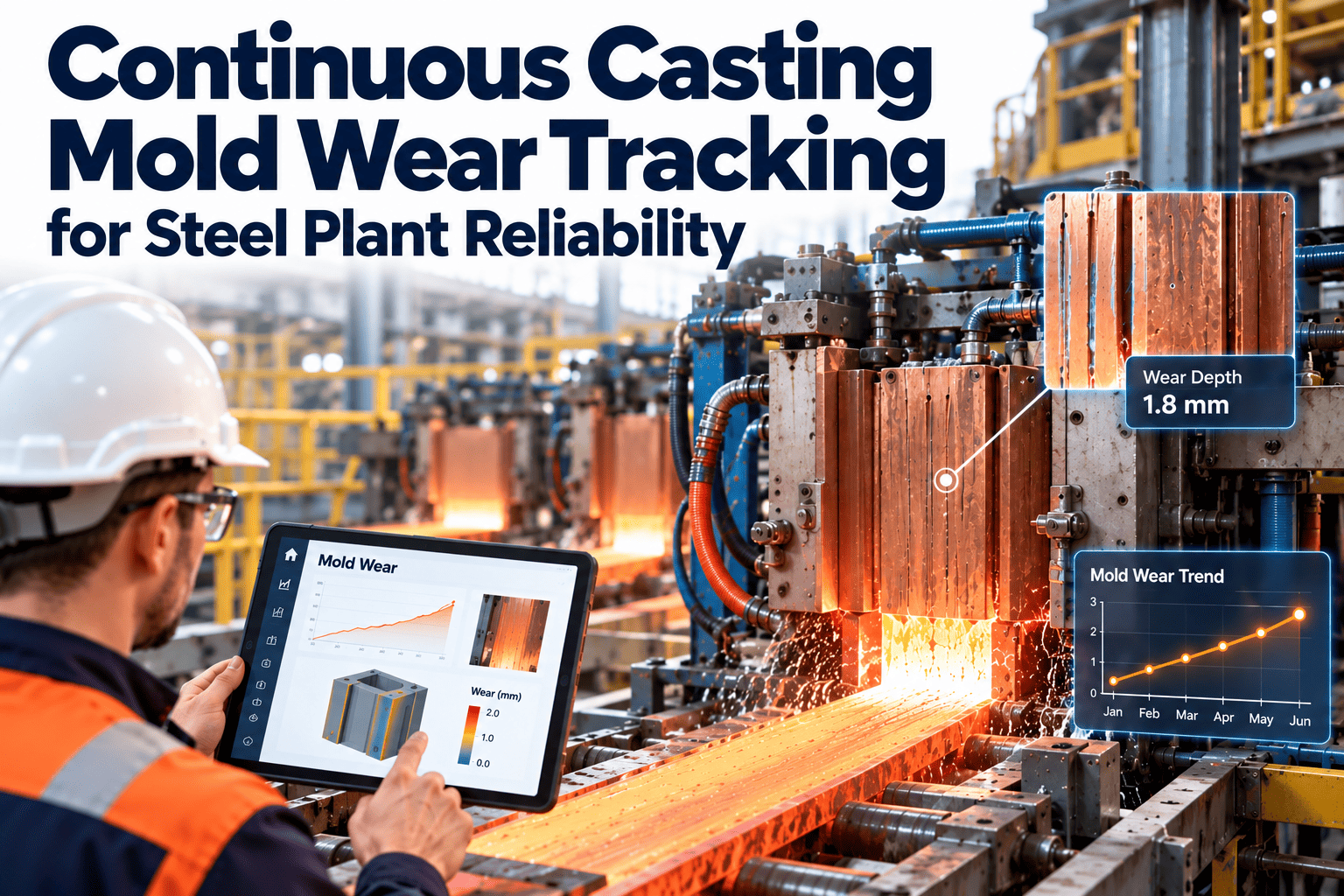
Oscillation, copper plates, water cooling, level controlCopper mold plates (narrow face and wide face) with Ni-Cr coating: 300-800 heats per set depending on steel grade and casting speed. Mold oscillation mechanism: spring/hydraulic system requiring precise stroke (2-10mm) and frequency (60-400 cpm) control. Mold water cooling: 6-10 m/s water velocity through channels, fouling reduces heat extraction and causes surface defects.
Mold is where 60-70% of surface defects originate. Worn mold plates cause longitudinal cracks, oscillation marks, and sticker breakouts. Mold level fluctuation >±5mm causes hook formation and inclusion entrapment. Thermocouple-based breakout detection systems (BODS) must maintain <0.5 second response time to prevent catastrophic breakouts.
Secondary Cooling (Spray System)
Spray nozzles, headers, water flow control, air-mist2,000-4,000+ spray nozzles across 10-20 cooling zones. Air-mist nozzles for fine-tuned cooling control. Nozzle failure modes: clogging from scale/debris (most common), wear from abrasion, mechanical damage during maintenance. Even 5% nozzle failure rate creates significant cooling non-uniformity.
Non-uniform cooling causes internal cracks (midway, triple-point, centreline), surface transverse cracks, and bulging between rolls. Overcooling causes surface cracks; undercooling causes bulging and internal quality issues. Each spray zone must deliver ±5% of target flow rate across the strand width.
Segment Rolls & Bearings
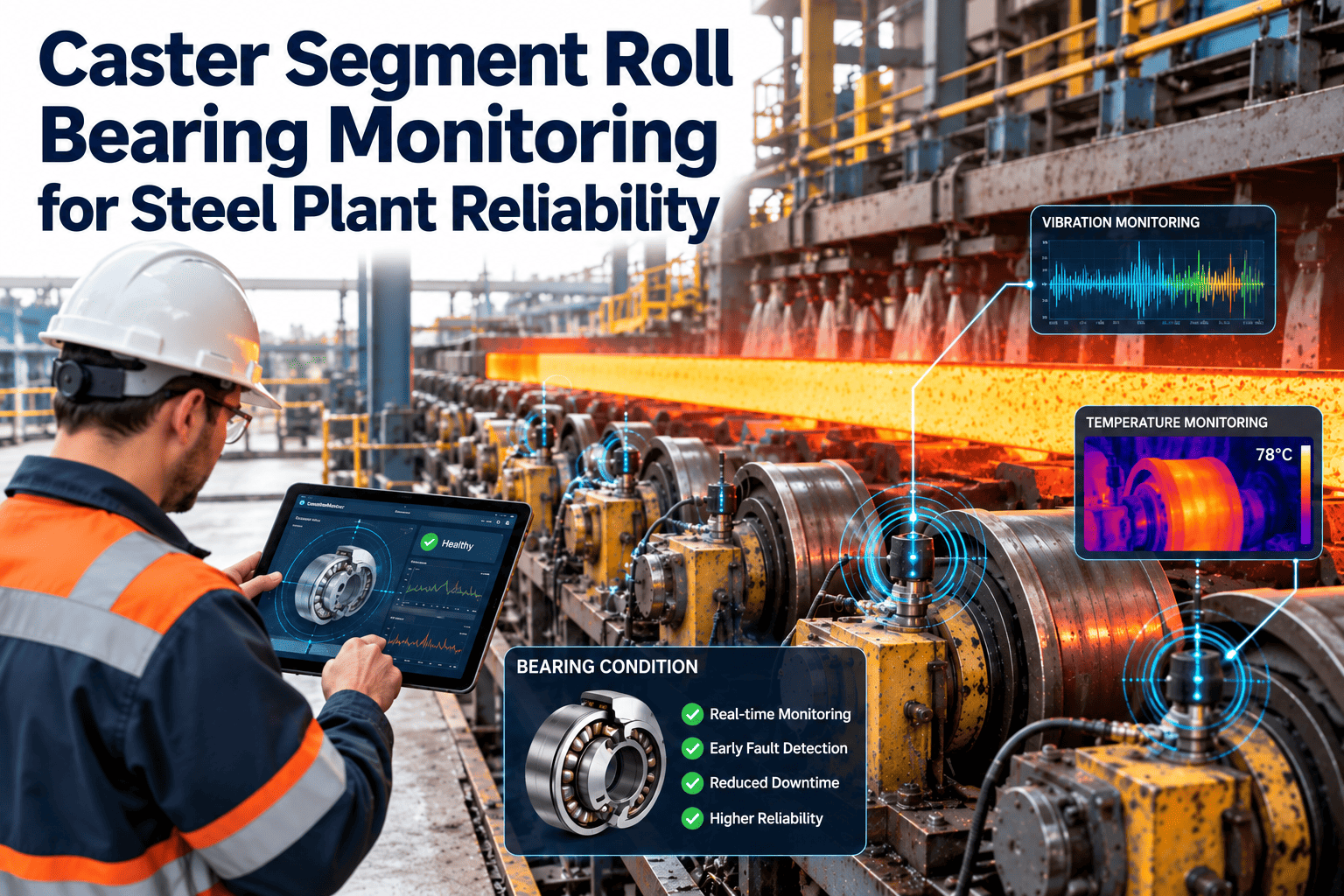
Containment rolls, drive rolls, idler rolls, split rolls200-400 rolls per caster, each with 2-4 bearings. Roll surface wear from contact with hot strand (700-1,100°C). Bearing failure from thermal cycling, water ingress, and high loads. Roll life: 10,000-50,000 heats depending on position and cooling. Bearing failure is the #1 cause of unplanned caster stoppages.
Worn or misaligned rolls cause bulging between support points, leading to internal cracks, centreline segregation, and off-gauge product. A single seized roll bearing can scratch every slab for hours before detection. Roll gap accuracy of ±0.3mm is required for premium flat product quality.
Segment Alignment & Hydraulics
Gap control, soft reduction, hydraulic cylinders, position sensorsHydraulic cylinders (4-8 per segment) control roll gap for containment and soft reduction. Position sensors verify actual gap vs. setpoint. Hydraulic system: 160-250 bar operating pressure, 2,000-10,000+ litres of fluid. Seal wear, cylinder rod scoring, and accumulator bladder failure are primary failure modes.
Soft reduction in the final solidification zone reduces centreline segregation and porosity by 50-80% when properly controlled. Loss of hydraulic pressure or position accuracy in the soft reduction zone directly produces internal defects that cannot be corrected downstream. Every mm of roll gap error translates to measurable quality degradation.
Tundish & Flow Control
Tundish car, refractory, stopper rod/slide gate, SENTundish refractory lining: 8-40 heats per campaign depending on steel grade. Submerged entry nozzle (SEN): 3-12 heats, alumina buildup is primary limiter. Stopper rod/slide gate: flow control accuracy within ±2% of setpoint. Tundish car positioning and ladle shroud seal integrity critical for preventing air pickup.
Tundish is the last vessel before solidification — inclusion cleanliness is determined here. SEN clogging causes asymmetric mold flow, leading to inclusion entrapment and surface defects. SEN erosion changes flow pattern, affecting mold level stability. Ladle-to-tundish stream reoxidation from poor shroud sealing adds 5-20 ppm oxygen as inclusions.
Strand Withdrawal & Straightening
Drive systems, pinch rolls, dummy bar, straightenerWithdrawal drive: 4-8 driven roll pairs with gearboxes, motors, and universal joints. Dummy bar system: chain or rigid bar for sequence start. Straightening section: multi-point unbending (3-7 point) with precise roll positioning. Drive system must maintain speed control within ±0.1% at casting speeds of 0.8-2.5 m/min.
Speed variations cause mold level fluctuations and shell thickness non-uniformity. Straightening at incorrect temperature produces transverse surface cracks (the "straightening crack" defect). Drive slip causes strand stalling risk, potentially leading to breakout. Proper unbending radius matching the solidification profile is critical for crack-free product.
Torch Cutting & Runout
Oxy-fuel torches, measuring systems, marking, transferOxy-fuel cutting torches: nozzle tip life 500-2,000 cuts. Torch carriage synchronization with strand speed. Length measuring systems (laser or encoder-based): ±10mm accuracy required. Slab marking systems (stamping or painting) for identification tracking. Transfer table rolls and cooling bed equipment.
Torch cut quality affects downstream processing — burrs, uneven cuts, and thermal damage at slab ends cause rolling mill cobbles. Length accuracy directly impacts yield: systematic 10mm short cutting across 100,000 slabs/year wastes 200-500 tonnes of steel. Identification marking errors cause grade mix-ups with catastrophic customer consequences.
Water Treatment & Utilities
Cooling water, scale pits, hydraulic power, lubricationClosed-loop mold cooling: 4,000-8,000 m³/hr, <30°C delta-T. Open-loop spray water: 8,000-15,000 m³/hr with scale removal. Hydraulic power units: 160-250 bar, redundant pumps, accumulator banks. Mold lubrication (oil or powder feeding) systems. Water quality: <200 ppm hardness for mold circuits to prevent fouling.
Mold water fouling reduces heat extraction, causing shell thinning and breakout risk. Spray water contamination blocks nozzles. Hydraulic power loss disables segment gap control and soft reduction — immediate quality and safety impact. Mold lubrication interruption causes sticking within seconds, triggering breakout detection alarms.
8,000+ Parts. Zero Excuses for Unplanned Stops.
Oxmaint tracks every component across every strand — linking equipment condition to quality outcomes so maintenance windows are used with maximum impact and breakout risk approaches zero.
Breakout Prevention: The Highest-Stakes Maintenance Priority
Breakouts are the most dangerous and expensive failure mode in continuous casting. Every maintenance decision on a caster should be evaluated through the lens of breakout risk reduction:
Defense Layer 1: Preventive Maintenance
Mold plate condition monitoring (wear measurement every campaign), oscillation mechanism PM (spring tension, hydraulic calibration), SEN condition tracking, and tundish refractory life management. These scheduled activities prevent the conditions that lead to breakouts from developing.
Defense Layer 2: Condition Monitoring
Mold thermocouple arrays (100-300+ thermocouples per mold) tracking heat flux patterns in real time. Roll bearing vibration monitoring. Hydraulic pressure and position trending. Spray nozzle flow verification. These systems detect degradation between PM intervals.
Defense Layer 3: Breakout Detection System (BODS)
Algorithm-based breakout prediction using mold thermocouple patterns. Detects sticker-type breakouts 2-8 seconds before shell failure by identifying characteristic temperature signatures. Automatically reduces casting speed or triggers strand stop. Must maintain <0.5 second response time and <2% false alarm rate.
Defense Layer 4: Emergency Response
If all prevention fails: automatic casting speed reduction, emergency strand stop, mold level flooding, and operator evacuation protocols. Post-breakout response: containment, damage assessment, repair, and root cause investigation. Oxmaint logs every breakout event with full equipment condition data for forensic analysis.
Maintenance Window Optimization
Caster maintenance windows are precious — typically 4-8 hours between sequences or 24-72 hours during planned stoppages. Oxmaint maximizes the value of every window:
Every Component Tracked. Every Window Maximized. Every Breakout Prevented.
Oxmaint manages the full complexity of continuous caster maintenance — 8,000+ parts, 8 subsystems, 3 maintenance tiers — so your caster runs at 96-99% availability with near-zero breakout rate.
Frequently Asked Questions
How does Oxmaint link caster equipment condition to slab quality?
Every slab produced is tagged with the equipment state at time of casting: mold plate heat count, spray nozzle status by zone, segment gap readings, roll bearing condition, and hydraulic system pressure. When downstream quality inspection (surface inspection, ultrasonic testing, or customer complaint) identifies a defect, Oxmaint automatically correlates the defect type with equipment conditions at the time and location of casting. Over time, this builds a defect-equipment correlation database that predicts which equipment conditions will produce which defects — enabling preventive action before defects occur.
What's the most cost-effective maintenance investment on a continuous caster?
Spray nozzle management delivers the highest ROI by far. A comprehensive nozzle audit and replacement program costs $50,000-$150,000/year but prevents cooling non-uniformity that causes internal cracks worth $2-5M/year in downgrades and rejections. The second-highest ROI is segment alignment: laser alignment verification during every planned stoppage ($20,000-$50,000/year in measurement costs) prevents bulging-related defects worth $1-3M/year. Both are simple, proven, and underinvested in most caster operations.
How many breakouts per year is acceptable?
World-class casters target fewer than 0.5 breakouts per 10,000 heats (or approximately 1-3 per year for a typical 2-strand slab caster producing 15,000-25,000 heats/year). The industry average is 1.0-2.5 per 10,000 heats. Achieving world-class breakout rates requires all four defense layers functioning: preventive maintenance >95% compliance, condition monitoring coverage >90%, BODS with <2% false alarm rate and <0.5 second response, and tested emergency procedures. Oxmaint tracks breakout rate as a primary KPI and links every event to root cause through equipment condition forensics.
Can Oxmaint manage segment workshop operations?
Yes. The segment workshop is a critical parallel operation — while segments are casting in the machine, spare segments must be rebuilt and ready for the next exchange. Oxmaint tracks each segment through its full lifecycle: in-machine service hours, removal, workshop disassembly, individual roll and bearing inspection/replacement, reassembly, alignment on the test stand, and staging for reinstallation. The system maintains a segment availability forecast ensuring that rebuilt segments are always ready ahead of planned exchange dates. This prevents the common failure of extending segment life in the machine because no spare is ready.
How does Oxmaint handle different maintenance requirements for different steel grades?
Different steel grades impose very different demands on caster equipment. Peritectic grades (0.08-0.16% C) are extremely crack-sensitive and require tighter mold oscillation control, more frequent mold plate replacement, and narrower spray cooling tolerance. High-carbon grades need slower casting speeds and different soft reduction profiles. Oxmaint maintains grade-specific PM templates: when the production schedule shows a campaign of peritectic steel, the system automatically applies tighter inspection intervals, lower wear limits, and additional quality checkpoints. This prevents the common mistake of applying standard maintenance standards to demanding grades.