Steel Plant RCM for Continuous Caster: Improving Availability
By Alex Jordan on June 23, 2026
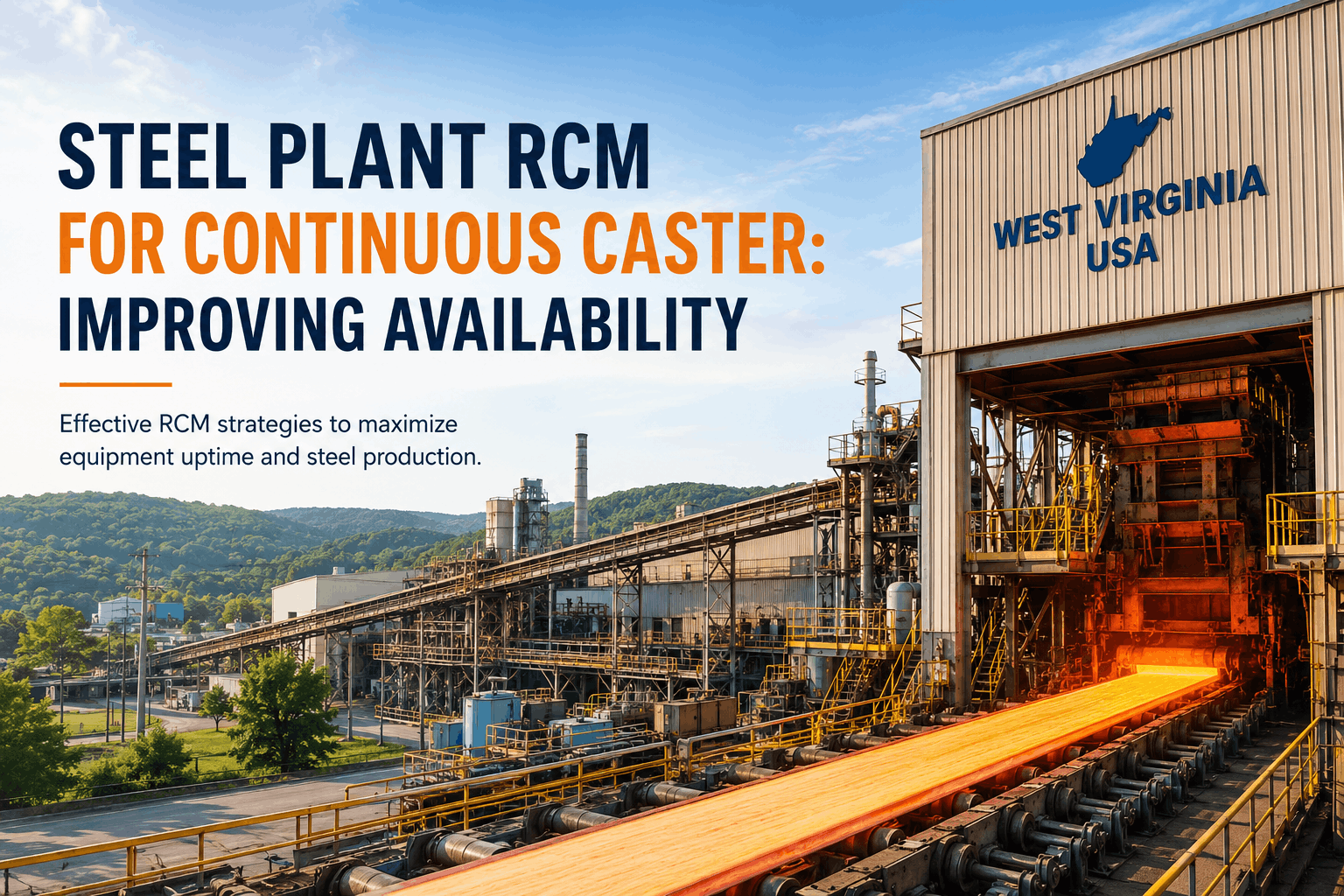
A continuous caster represents one of the most capital-intensive and operationally critical assets in modern steelmaking. Modern casting speeds exceed 1.8 meters per minute, meaning a single breakout doesn't just stop production — it destroys mold plates worth $150,000, damages strand guide rolls, contaminates the secondary cooling zone, creates a safety emergency for nearby operators, and halts the entire cast sequence. The economic penalty is immediate: at typical operating margins, a two-hour caster stoppage costs $250,000–$400,000 in lost production value, often exceeding the value of the damaged components themselves. Most steel plants manage continuous caster maintenance through time-based preventive maintenance — replacing mold plates every 1,500 heats, changing coolant every 30 days, and servicing strand guides on a calendar schedule. This approach prevents some failures but misses the reality that actual component condition varies wildly based on actual casting practice, steel grade, casting speed, and operating environment.
Maximize Continuous Caster Availability Through Reliability-Centered Maintenance Analysis
Average unplanned caster downtime per major failure event, equivalent to $250K–$400K in lost production value
12–18%
Availability improvement typical for casters transitioning from time-based to RCM-based maintenance schedules
25–35%
Reduction in unnecessary preventive maintenance tasks after RCM analysis identifies run-to-failure components with low consequence
The RCM Decision Logic: From Failure Consequences to Optimal Maintenance Strategy
Reliability Centered Maintenance is fundamentally different from other maintenance philosophies because it makes maintenance decisions based on failure consequence, not on tradition or supplier recommendations. For every critical asset on a continuous caster — mold plates, strand guides, pinch rolls, spray headers, coolant systems, guide level sensors, and structural elements — RCM asks a series of systematic questions: What function must this component perform? What are all the ways this component can fail and prevent that function? If this component fails, what are the operational, safety, and economic consequences? Can we detect this failure before it becomes a problem? Is there a preventive maintenance task that reduces the probability of this failure? If so, what task has the best RPN score and should be prioritized? For components with high consequences of failure (like mold plates where failure causes immediate breakout), RCM recommends intensive condition monitoring or preventive replacement. For components with low consequences (like spray header drain plugs where blockage has minor operational impact), RCM may recommend run-to-failure maintenance, since the cost of preventive replacement exceeds the cost of occasional reactive repair. This risk-based logic is what separates RCM from "maintain everything on a schedule."
Mold Plate Wear and Breakout Prevention
Critical consequence — immediate production stop
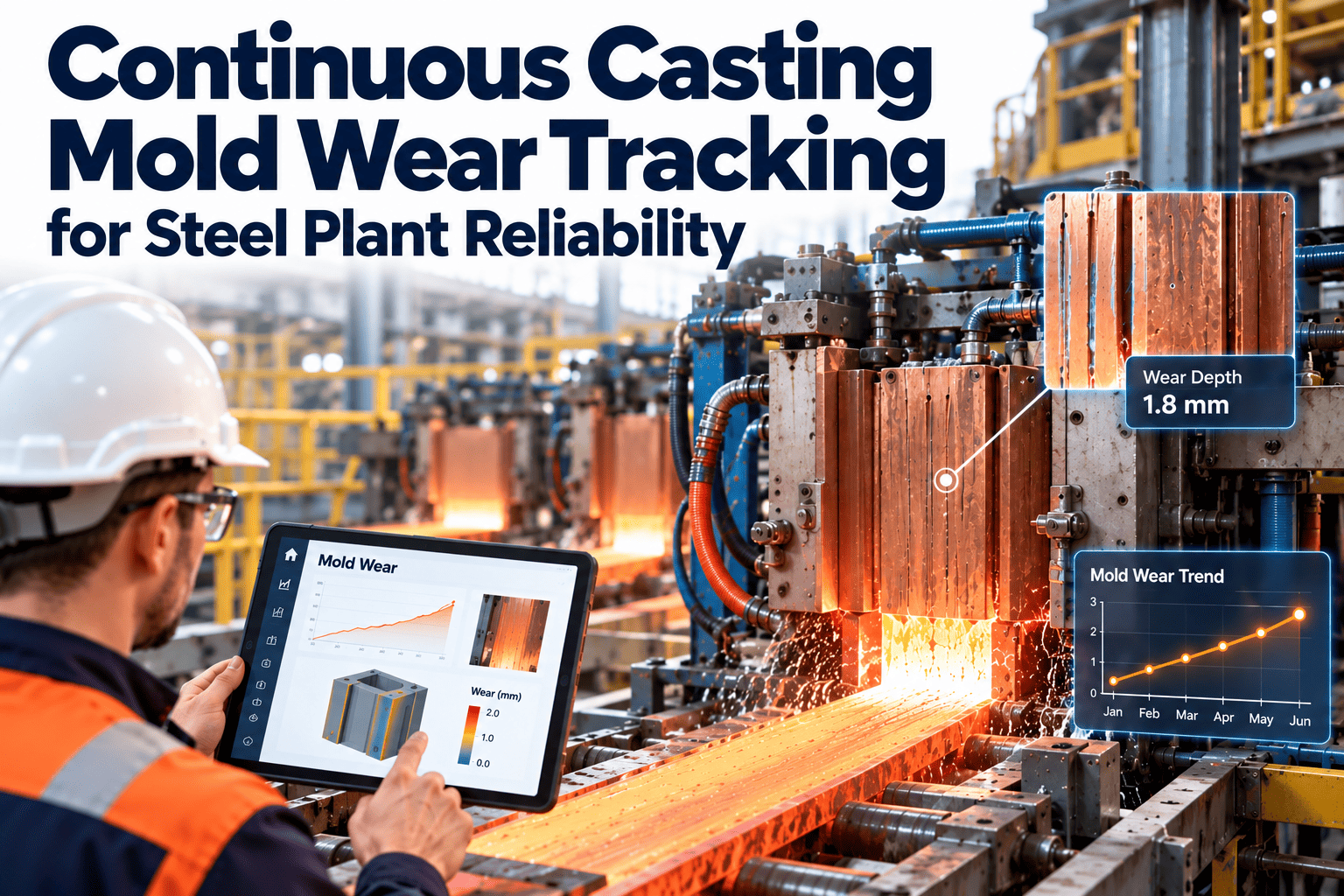
Mold plates are the direct containment boundary for the freshly solidifying steel shell. Wear, surface degradation, or mechanical damage to mold plates directly causes breakouts. RCM analysis of mold plates concludes that the failure consequence is catastrophic, the failure mode is predictable (progressive wear), and detection is possible (dimensional inspection every 100 heats). Recommended action: conditional maintenance with 100-heat inspection interval and preventive replacement before wear reaches critical threshold — typically 1,400–1,600 heat cycles depending on steel grade and casting speed.
Spray Cooling System and Secondary Zone Control
High consequence — quality and breakout risk
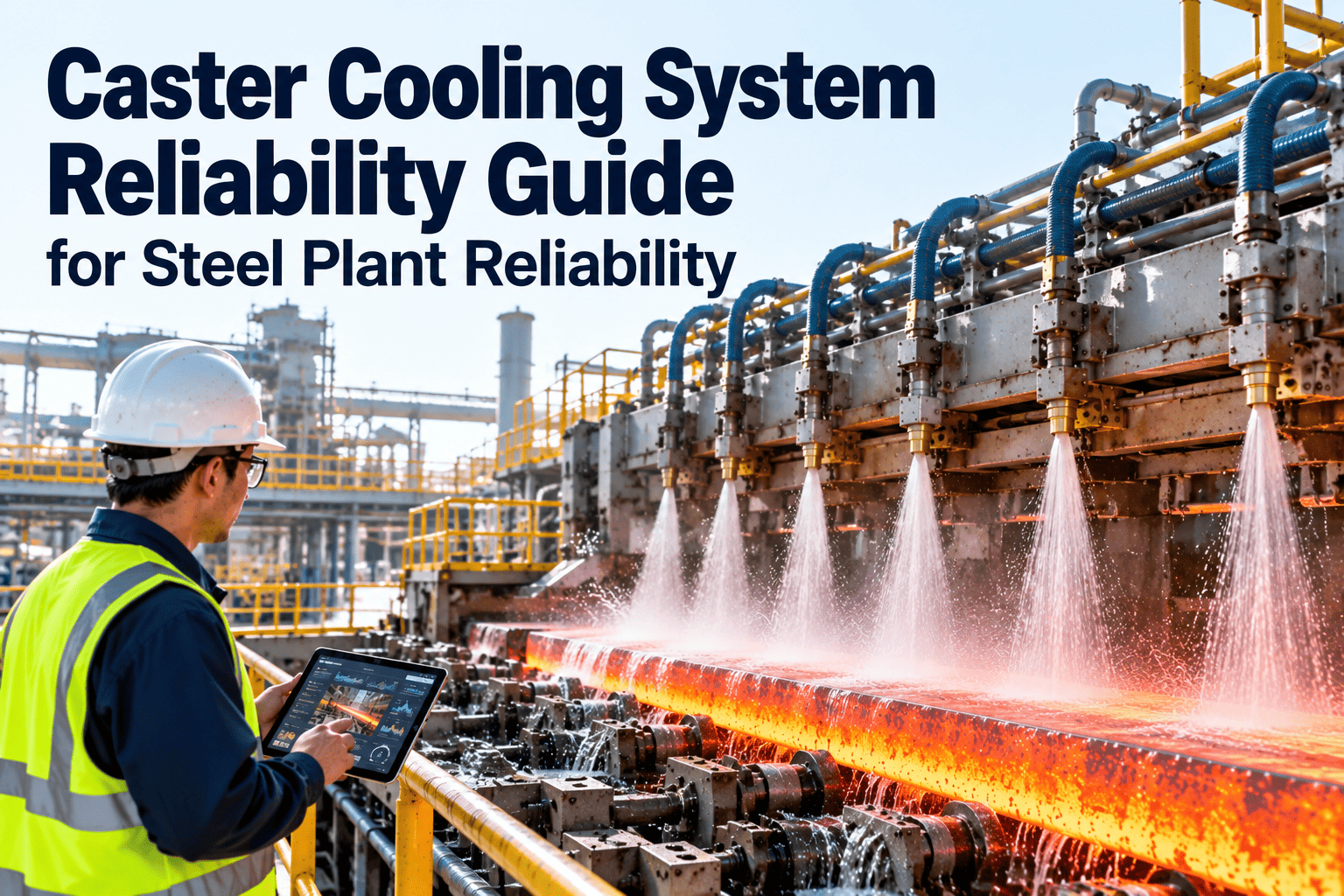
The secondary cooling zone spray headers control the solidification rate and surface temperature of the steel strand. Clogged or malfunctioning spray nozzles create hot spots that lead to longitudinal cracks, surface defects, or breakouts. RCM identifies spray system failures as high consequence (they propagate to finished product quality and breakout risk). The primary failure modes are nozzle blockage (predictable, from coolant contamination), and valve stiction (less predictable). Prevention action: condition-based maintenance with coolant quality monitoring (particle count, water content, viscosity) and monthly spray header visual inspection and pressure testing.
Strand Guide Rolls and Bearing Degradation
Medium consequence — production quality and bearing life
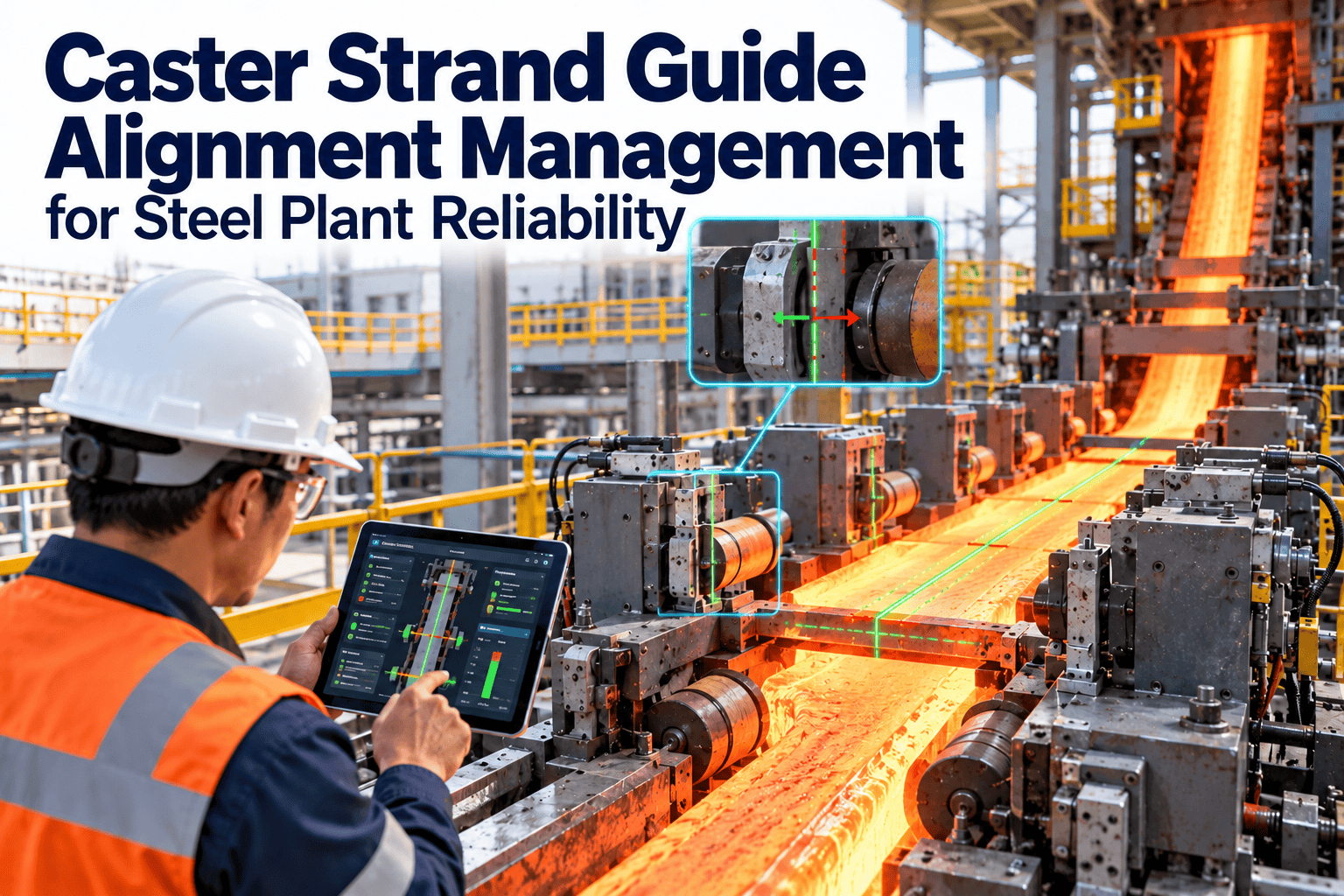
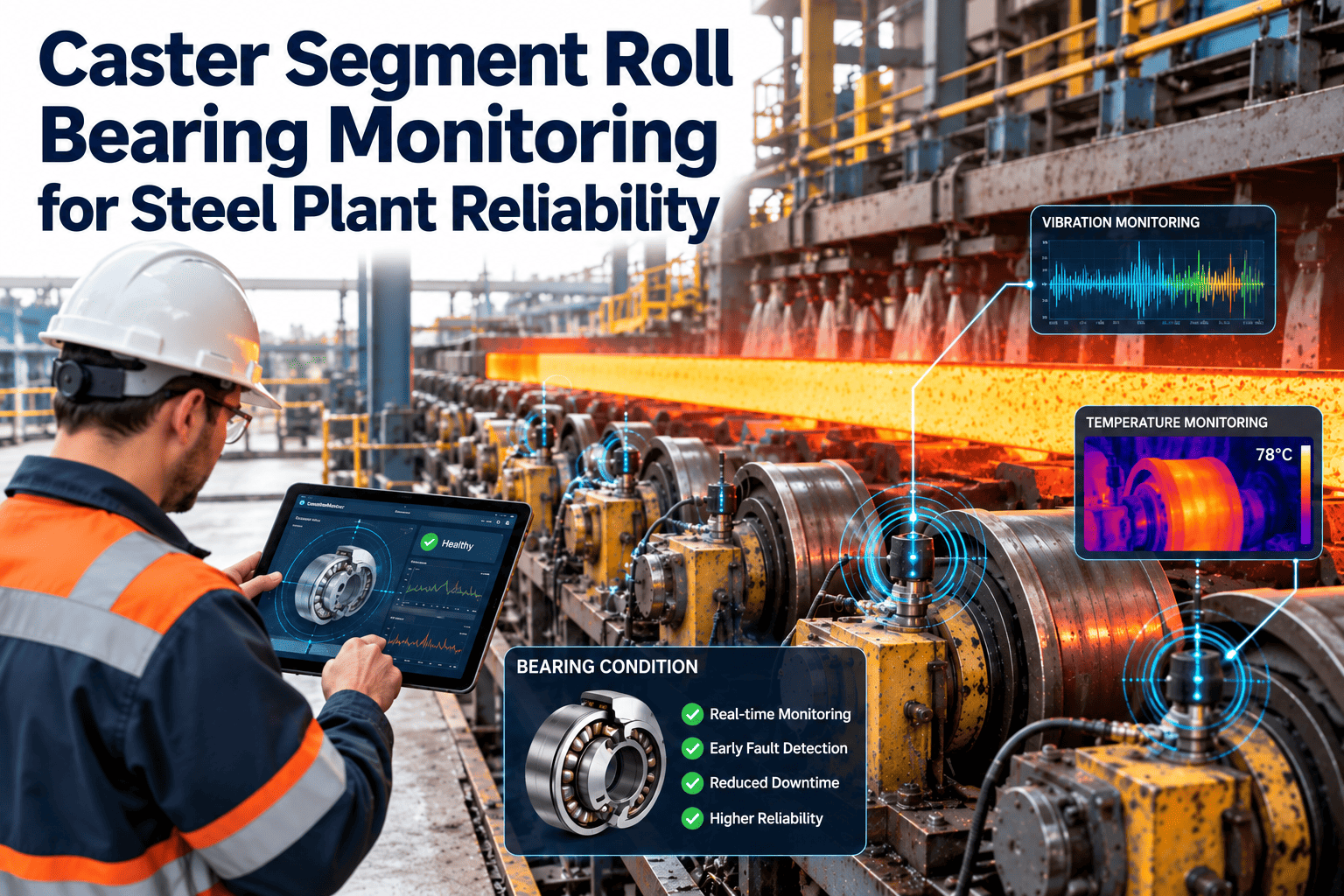
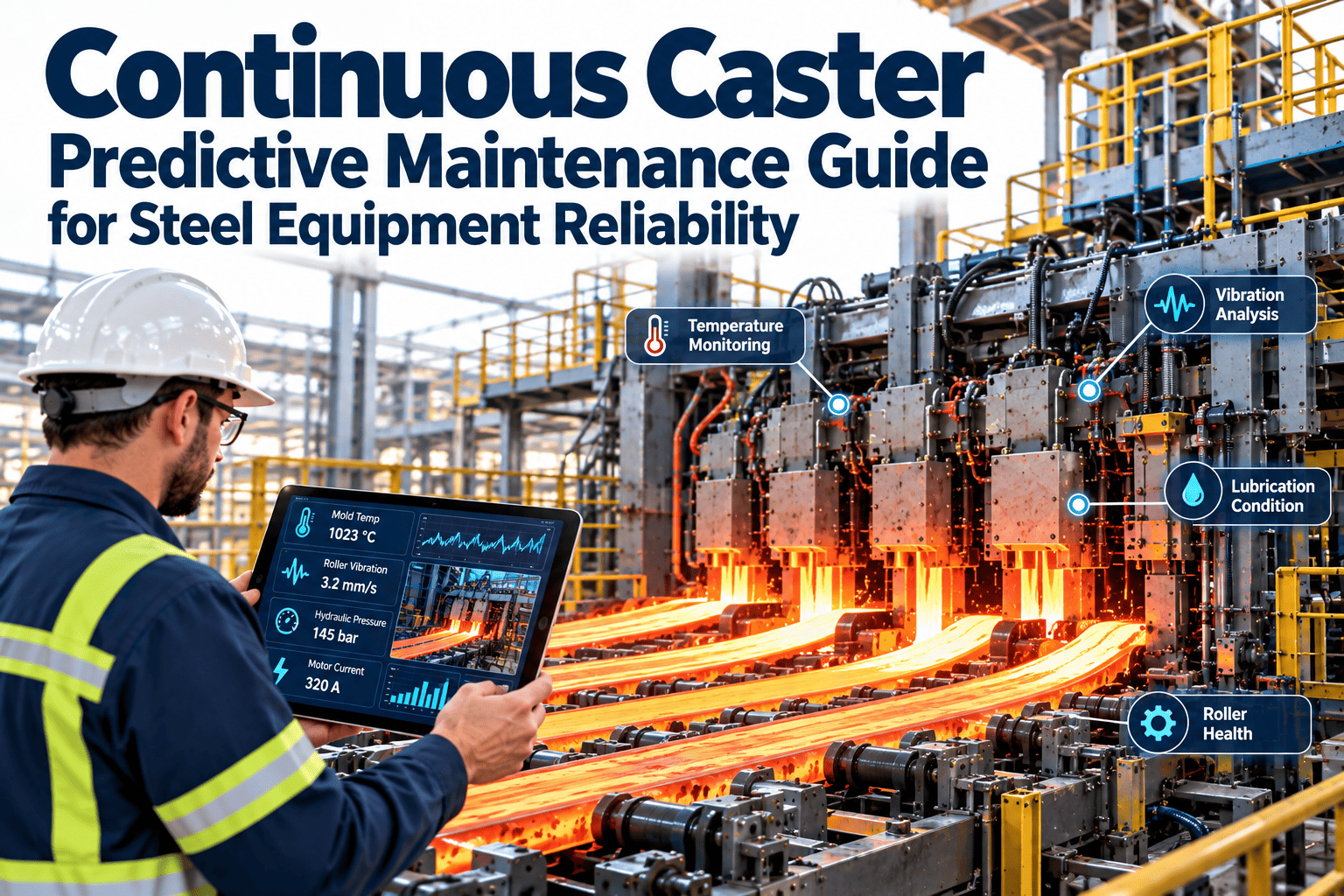
Strand guide rolls support the moving steel strand and prevent lateral oscillation and misalignment. Roll bearing failures are common under high-speed casting loads. RCM analysis reveals that while bearing failures do stop the caster, the stop is planned (we detect bearing wear via vibration or temperature before catastrophic seizure), the repair time is 4–8 hours, and bearing cost is moderate. Recommended action: condition-based monitoring with monthly vibration signature capture and bearing temperature trending. Preventive bearing replacement triggered when vibration amplitude exceeds threshold or temperature trend shows degradation trajectory.
Pinch Roll Hydraulics and Pressure System
Medium consequence — strand control system
Pinch rolls apply controlled pressure to the moving strand, supporting it against gravity and internal stress. Hydraulic pressure is supplied by central pump systems. RCM identifies hydraulic system failures as medium consequence (loss of pressure stops the caster but doesn't cause immediate breakout like mold plate failure). Prevention action: condition-based monitoring through oil analysis every 250 operating hours, pressure transducer trending, and temperature monitoring. Seal replacement and actuator servicing triggered by oil analysis particle count escalation or pressure loss trends rather than calendar schedule.
Guide Level Sensor Electronics and Caster Instrumentation
Low consequence — measurement only, no direct failure
Guide level sensors measure the position of guide rolls to maintain proper strand geometry. If a sensor fails, operators can maintain the caster manually or switch to backup sensor inputs. RCM concludes this is low consequence — losing one of four redundant sensor inputs doesn't stop the caster. Recommended action: run-to-failure maintenance with minimal preventive work. Only perform corrective repair when failure is detected; don't perform preventive replacement on a schedule. This avoids unnecessary capital spending on components whose failure has minimal operational impact.
Mold Level Control and Casting Speed Optimization
Operational efficiency — throughput and quality
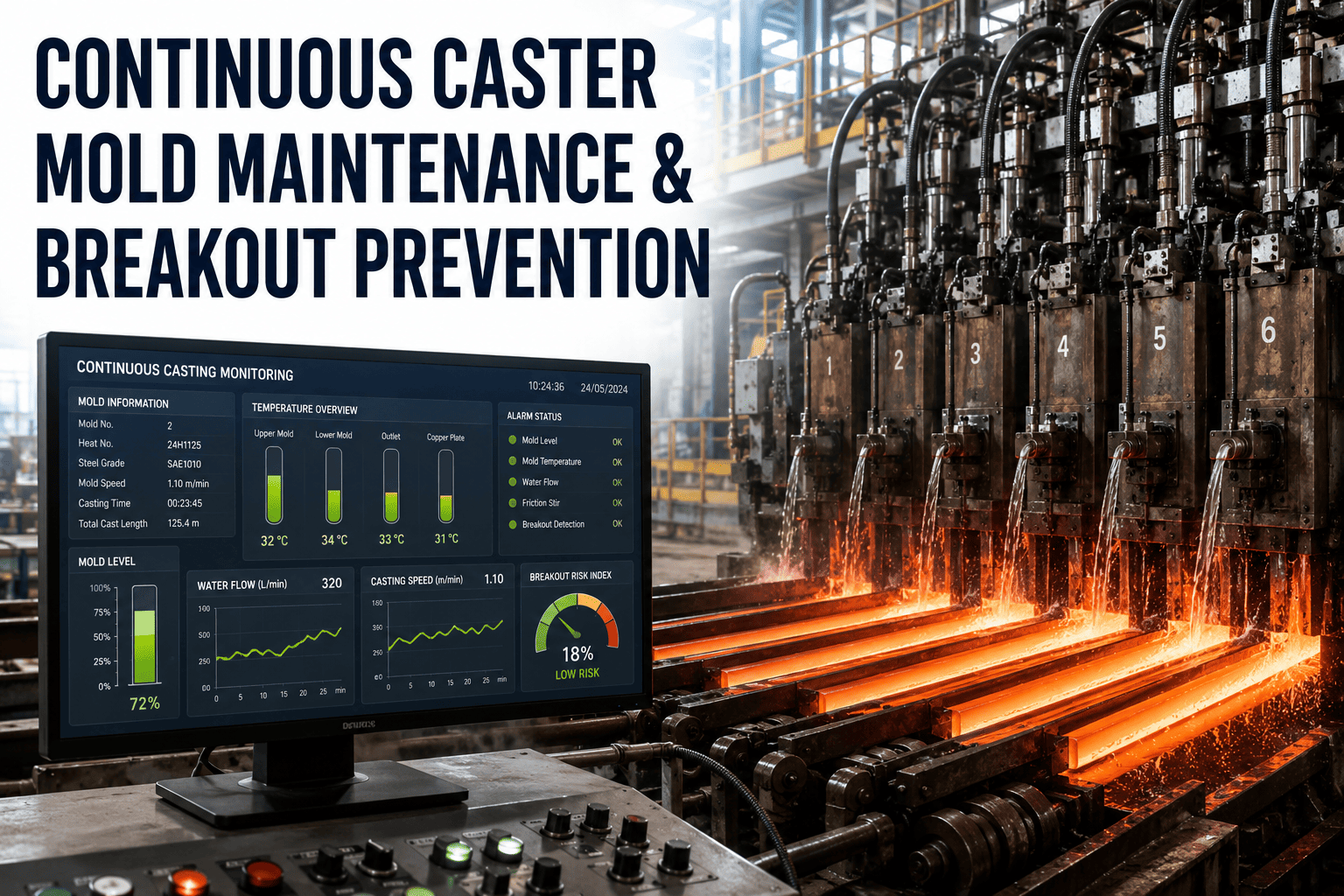
Proper mold level and casting speed control determine surface quality and breakout probability. RCM identifies that optimization of these control parameters itself improves equipment reliability — faster casting puts higher loads on pinch rolls and spray systems, while slower casting may extend campaign length but reduces throughput. RCM recommends that control optimization and maintenance interact: establish a baseline maintenance plan for your current operating envelope, then systematically test increased casting speed with corresponding changes to mold and spray maintenance intervals to find the optimal throughput-reliability balance.
RCM for Continuous Casters
Base Maintenance Decisions on Failure Consequence, Not Calendar Dates.
RCM transforms continuous caster maintenance from "maintain everything" to "maintain what matters." Eliminate low-consequence preventive tasks, intensify monitoring on high-consequence failure modes, and achieve 12–18% availability improvement while reducing unnecessary maintenance cost by 25–35%.
RCM Implementation for Continuous Caster: From Analysis to Maintenance Task Selection
Implementing RCM for continuous casters typically unfolds in four sequential phases, each building on the output of the previous phase. Phase 1 involves defining the caster system's functions from an operational perspective: strand containment without breakout, controlled solidification to specified geometry, controlled cooling to prevent surface defects, and mechanical support of the moving strand. Once functions are defined, the team identifies all failure modes that could prevent or degrade each function. For a mold plate, potential failure modes include wear (progressive surface erosion), spalling (localized material chipping), distortion (permanent shape change), and thermal cracking (from differential expansion). For each failure mode, the team estimates three scoring dimensions: Severity (how bad if it happens?), Occurrence (how often does it happen?), and Detectability (can we find it before it fails?). The product of these three scores (RPN) determines priority. High RPN failure modes receive intensive preventive or condition-based maintenance. Low RPN failure modes may be maintained on a run-to-failure strategy. This structured approach ensures that maintenance effort is concentrated on the components and failure modes that deliver the highest reliability value.
Phase 1: Caster Criticality Scoring (2–3 weeks)
Identify the 20% of assets causing 80% of downtime
Vibration pods on strand guide bearings, temperature sensors on spray headers, pressure transducers on hydraulic lines, coolant condition probe
Data collection frequency
Continuous stream from distributed sensors; local processing for threshold alerting; hourly summary upload to CMMS
Alarm and work order generation
Automated PM work order generation when sensor reading exceeds RCM-determined threshold; manual review before execution
Outcome
Real-time condition monitoring active; maintenance tasks triggered by actual component condition rather than calendar
RCM Performance Data: Continuous Caster Availability Improvements Across USA Integrated Mills
Three integrated steel mills in the USA implemented full RCM programs for continuous casters and achieved measurable improvements in availability, downtime costs, and maintenance efficiency. A 2.2 MTPA integrated mill in Pennsylvania experienced average caster availability of 86% before RCM, with 8–12 unplanned stoppages per month averaging 3–4 hours each. After 16 weeks of full RCM implementation including criticality scoring, FMEA analysis for top 20 assets, and condition monitoring deployment, availability improved to 94% — an 8-percentage-point gain equivalent to 576 additional production hours per year. More significantly, unplanned stoppages dropped to 3–4 per month, half the original frequency. The key insight: RCM analysis revealed that mold plate maintenance was over-aggressive (replacing every 1,200 heats when actual wear data showed 1,600 heats as optimal), while strand guide bearing maintenance was under-monitored (relying on reactive repair instead of early detection). Adjusting task selection based on RCM risk assessment eliminated unnecessary mold plate replacements while adding vibration monitoring that caught two bearing failures before catastrophic damage.
A second 1.5 MTPA electric arc furnace + caster operation in Ohio faced a different challenge: inadequate cold casting capacity during winter season when secondary water supply temperature drops. Before RCM, they managed secondary cooling through fixed spray header settings. After RCM analysis identified that spray system failures were concentration points for breakout risk, they added coolant condition monitoring and systematic spray header pressure testing. This allowed them to optimize secondary cooling parameters in real time, matching cooling to actual water supply temperature and casting conditions. Result: they eliminated the seasonal downtime premium and extended the typical casting window from 8 months to 10 months per year — adding $3.2M in annual production value with zero additional capital spending.
"RCM changed how we think about caster maintenance — we went from 'we must maintain everything' to 'we maintain what matters.' Eliminating unnecessary mold plate replacement freed up maintenance resources for early detection of bearing failures. The result: 8% availability improvement and lower total maintenance cost, simultaneously."
— Maintenance Director, Integrated Steel Mill, Pennsylvania, USA · 2.2 MTPA · Two caster strands
Frequently Asked Questions
Q1What is the difference between RCM and traditional time-based preventive maintenance?▼
Time-based PM maintains everything on a calendar schedule regardless of condition. RCM analyzes failure consequence and selects the maintenance strategy that best prevents high-consequence failures — which may be time-based PM for critical items, condition-based monitoring for medium items, or run-to-failure for low-consequence items. RCM eliminates unnecessary maintenance while intensifying effort where it delivers the most reliability value.
Q2How long does RCM analysis take for a continuous caster with two strands?▼
Baseline RCM including criticality scoring, FMEA for top 20 critical assets, and task selection typically requires 10–16 weeks of part-time analysis (one person equivalent, ~50% allocation). The schedule can be compressed by running parallel analysis tracks and by leveraging pre-built caster FMEA templates that pre-identify common failure modes for mold plates, strand guides, and spray systems.
Q3Can RCM be applied to casters while they are still running, or do we need a full shutdown?▼
RCM analysis can be conducted while the caster operates; no shutdown required. Condition monitoring sensors can be installed during normal maintenance windows or short production pauses. The analysis phase itself is desk-based and uses historical data. Only task implementation requires scheduling maintenance windows — which is planned as part of the RCM output anyway.
Q4What is the typical ROI timeline for RCM implementation on a continuous caster?▼
Most plants see measurable availability improvement within 8–12 weeks of deploying RCM-derived condition monitoring. Full ROI (implementation cost recovered through combined availability improvement and maintenance cost reduction) typically occurs within 6–12 months. At a 2.0 MTPA integrated mill, avoiding a single unplanned caster failure pays for the entire RCM implementation — making ROI highly favorable.
Q5How is RCM data integrated with enterprise SAP PM and CMMS systems?▼
RCM-selected maintenance tasks, intervals, and methods are configured in CMMS as PM schedules. Condition monitoring data flows from sensors → local edge processing → CMMS, triggering automated work order generation when thresholds are exceeded. SAP PM receives completed work orders and consumption data, maintaining enterprise-level asset history and cost tracking without manual intervention.
Q6Can RCM be applied to older casters that were designed before modern predictive maintenance was available?▼
Yes. RCM does not require new equipment; it optimizes maintenance strategies for existing casters based on their actual failure patterns. Older casters typically have 20+ years of work order history that provides rich data for RCM criticality scoring. Condition monitoring can be retrofitted with portable sensors and edge devices if permanent instrumentation is not possible.
Q7How frequently should RCM analysis be reviewed and updated?▼
Initial RCM is valid for 2–3 years assuming operating conditions remain stable. Significant changes (new steel grades, increased casting speed, major equipment upgrades) should trigger RCM review within 6 months. Annual RCM review sessions capture new failure data and validate that task intervals and thresholds remain optimal given actual equipment performance.
Q8What happens if RCM recommends run-to-failure maintenance for a component — does that mean we accept failures?▼
Yes, run-to-failure is appropriate for low-consequence components where preventive cost exceeds reactive cost. For a caster guide level sensor (low consequence, cost under $1K to replace, redundant input available), run-to-failure makes economic sense. RCM distinguishes between acceptable (low consequence, planned response) and unacceptable (high consequence) failures and applies corresponding maintenance strategies accordingly.
RCM for Continuous Casters
Optimize Caster Reliability. Base Maintenance on Consequence, Not Calendar.