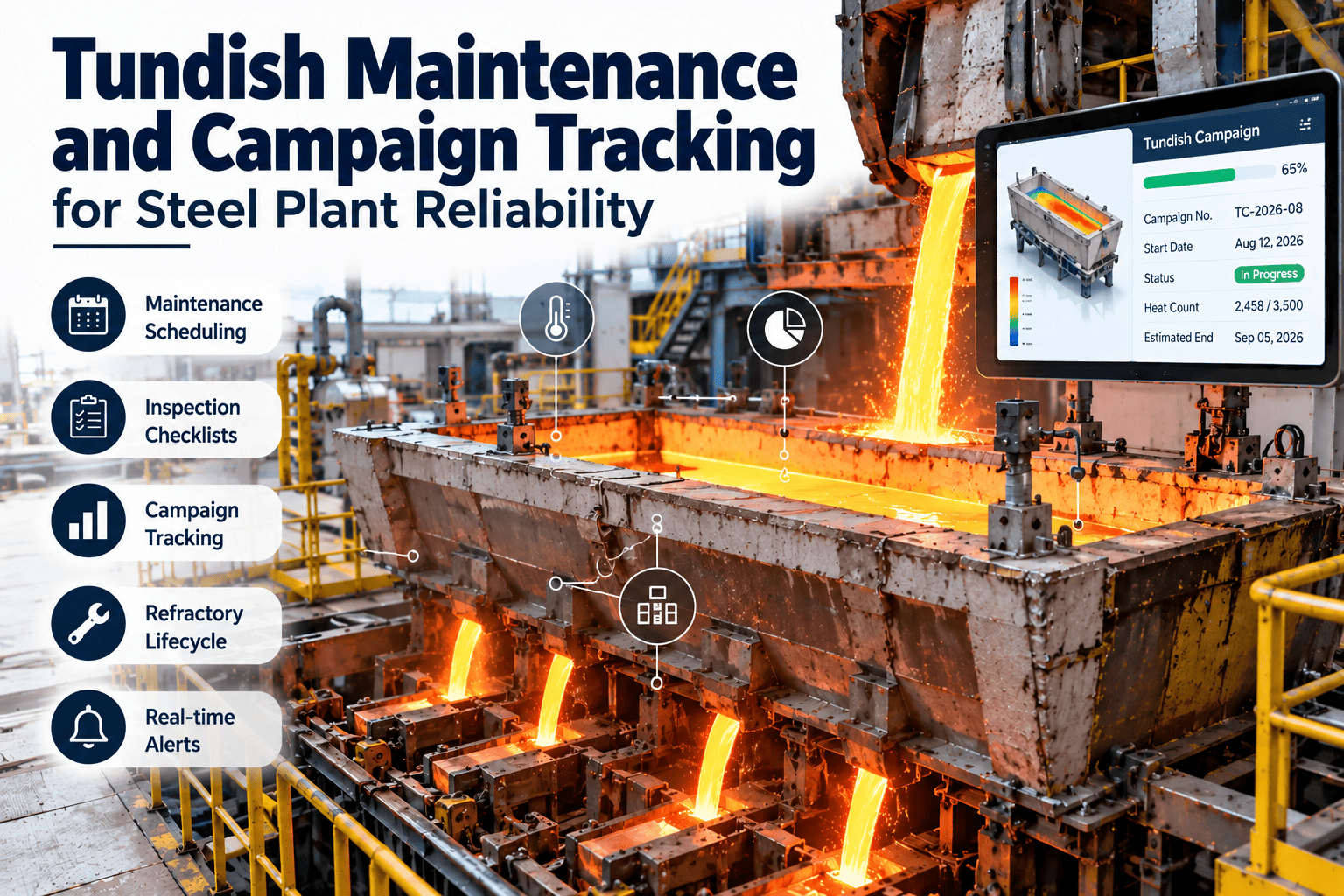
The tundish sits between the ladle and the mold, and its condition shapes casting stability, steel cleanliness, and sequence length. Each campaign wears the refractory lining, slide gates, stopper rods, and nozzles in a different way, so records kept on paper or in memory soon fall behind. Tracking heat count, lining condition, inspections, and relining work in one place helps crews decide when to continue and when to stop. See how steel mill maintenance software supports that record.
Tundish Maintenance and Campaign Tracking for Steel Plant Reliability
Track campaign life, refractory condition, heat count, relining work, inspection results, and consumable usage so every tundish returns to service ready and every campaign ends on purpose.
What a tundish campaign really includes
A campaign covers more than the number of heats cast. It is the full life of a lining set between one major reline and the next.
Common campaign tracking problems
Problems usually come from missing information at the moment a decision has to be made.
Unclear heat count
Different shifts record heats separately, leaving uncertainty about the true age of a lining.
Wear not documented
Operators remember an unusual erosion pattern, but the next crew never hears about it.
Inconsistent relining quality
Material batches, curing time, and installation steps vary without a record to compare.
Consumables ordered late
Stopper rods, nozzles, and gate plates run short because usage is not linked to campaign plans.
Lessons lost
After an early campaign end, the cause is discussed once and then forgotten.
Where to look in the tundish and what to record
Different zones wear for different reasons. Recording condition by zone makes patterns easier to see across campaigns.
| Zone or Part | Typical Wear Mechanism | What to Record |
|---|---|---|
| Impact pad | Erosion from the incoming ladle stream | Remaining thickness, cracking, number of heats |
| Working lining walls | Slag attack and gradual erosion | Wear profile, penetration, repair patches |
| Slag line | Chemical attack from covering powder and slag | Wear depth, material used, campaign length |
| Dams and weirs | Cracking and erosion that alters flow | Damage, displacement, replacement date |
| Stopper rod or slide gate | Wear, jamming, thermal stress, and nozzle clogging | Operating behavior, replacement, response problems |
| Submerged entry nozzle seating | Erosion and sealing problems | Alignment, seat condition, air ingress findings |
| Cover and lid | Heat damage and gaps that affect steel protection | Condition, fit, replacement |
Give every tundish a record that follows it from reline to reline
Track campaigns, inspections, and consumables in one place so planning is based on facts rather than recollection.
The campaign data worth capturing
A short, consistent set of fields supports both daily decisions and long-term analysis.
- Tundish number and type
- Campaign number
- Lining design and materials
- Heat count per sequence
- Steel grades cast
- Preheat and curing records
- Inspection results and photos
- Repairs and patching
- Reason for campaign end
- Consumables used
- Labor hours for relining
- Turnaround time
What changes when campaigns are tracked digitally
- Heat counts compiled at shift end
- Inspection notes passed along verbally
- Consumable usage estimated
- Reasons for early campaign end unclear
- Heat count updated against the tundish
- Inspection results saved with photos
- Consumables issued to the specific campaign
- Campaign end causes coded for review
Inspection points before, during, and after casting
Structured checks help catch issues while they can still be corrected, not after a sequence has been disrupted.
Confirm lining dryness and curing, check dam and weir positions, verify nozzle and flow control fit, and make sure preheat targets are met.
Watch flow control response, record unusual behavior, note slag or powder issues, and log heat count after each transfer.
Inspect lining after deskulling, photograph wear patterns, measure remaining thickness where possible, and decide on reuse or reline.
Making relining repeatable
Relining quality affects campaign life, so the steps and materials should be as standard as possible.
- Step 1Isolate the tundish and complete required safety permits before demolition begins.
- Step 2Remove old lining and inspect the shell and permanent lining for damage.
- Step 3Install new working lining following the refractory supplier's instructions and record material batch references.
- Step 4Fit dams, weirs, and flow control parts, then verify alignment and seating.
- Step 5Cure and preheat according to the approved schedule, then release the tundish with a signed checklist.
Why preheat records belong in the campaign file
A lining that is not properly dried or heated can crack, release moisture, or cause trouble at the first transfer of steel. Preheat discipline protects the lining and the quality of the first heat in a sequence.
Follow the lining supplier's schedule for dry-out time. Record start and finish, since shortcuts here often show up later as spalling or steel quality concerns.
Log burner settings, duration, and temperature targets. Note any interruptions, because a cold restart changes thermal stress on the lining.
Confirm the checklist is signed, fittings are secure, and any deviations are visible to the casting crew before the first ladle arrives.
Stopper rods, slide gates, and nozzles need their own history
Flow control components decide how steady the stream into the mold remains. Their behavior often gives the first sign that a campaign is nearing its limit, so it should be recorded rather than remembered.
| Observation | Possible Meaning | Suggested Action |
|---|---|---|
| Rising stopper position for the same casting speed | Nozzle clogging or erosion changing the flow path | Log the trend and prepare to change or inspect the component |
| Erratic flow control response | Mechanism wear, binding, or hydraulic problems | Raise a corrective job and check actuator condition |
| Steel leakage around gate or nozzle seat | Seating damage or poor installation | Stop use, inspect, and record cause for reline review |
| Unusual vibration at the control mechanism | Loose parts or damaged guides | Inspect fasteners and mechanism alignment |
Understanding why campaigns stop sooner than planned
Every early ending is a source of learning. When causes are coded consistently, patterns appear across tundishes, grades, and crews.
Refractory erosion
Wear at the impact area or slag line reaches a limit sooner than expected for the grades cast.
Flow control problems
Clogging, jamming, or leakage forces a nozzle or gate change that cannot wait.
Installation defects
Poor curing, gaps, or misaligned parts show up as cracks or leaks during casting.
Thermal shock
Delays, inadequate preheat, or sudden temperature changes damage the lining.
Operational changes
Longer sequences, grade changes, or different covering practice alter wear compared with the plan.
Material variation
Differences between refractory batches or suppliers change performance in ways only history can reveal.
Shortening the gap between campaigns without cutting corners
Turnaround time matters because spare tundishes are limited. Planning relining as a scheduled job helps crews avoid delays without skipping quality steps.
- Forecast reline dates from heat count
- Reserve crews and equipment
- Pre-stage refractory
- Use one checklist per tundish type
- Define curing hold points
- Record material batches
- Inspect before release
- Capture photos of key zones
- Sign off by an authorized person
- Compare turnaround times
- Review reasons for delays
- Update the standard work
Safe practice during deskulling and relining
Tundish work involves heat, heavy lifting, dust, and confined space exposure. Safety steps should be part of every work order, not a separate document.
- Confirm cooling time and surface temperature before entering or working close to a used tundish
- Use required respiratory protection when removing or installing dust-generating refractory materials
- Check lifting equipment and rigging before moving tundishes or large lining sections
- Control access during demolition and keep walkways clear of debris
- Store refractory materials dry and follow supplier handling instructions
- Record permits, isolations, and incident observations against the job
Keeping the right parts available
Campaign plans should drive stock levels. Running out of one critical part can stop a whole sequence.
- Working lining materialTrack batches, storage condition, and usage per campaign.
- Stopper rods, gates, and nozzlesLink replacement to heat count and observed behavior.
- Dams, weirs, and impact padsPlan quantities for each reline and keep a safety margin.
- Covers and covering powderMonitor consumption trends across grades.
Metrics for tundish reliability
How Oxmaint supports tundish maintenance
Oxmaint turns the campaign routine into structured work rather than scattered notes.
- Asset management: register each tundish with its history, drawings, and campaign records
- Work orders: create reline, repair, and inspection jobs with checklists and attachments
- Preventive maintenance: schedule gate, nozzle, and equipment checks based on heats or time
- Inventory: manage refractory, nozzles, and spares with reorder levels
- Reports: compare campaign results, downtime causes, and consumable cost trends
How tundish condition connects to product quality
The tundish is the last refractory vessel the steel meets before the mold. Its lining, flow pattern, and protection against air and slag influence inclusion levels and surface quality, so maintenance records are also quality records.
- Condition of impact pad, dams, and weirs that shape flow
- Sealing of covers, shrouds, and nozzle connections
- Cleanliness of the lining before the first heat
- Consistent installation of flow control parts
- Campaign number and heat position for each cast
- Observed erosion and repair history
- Material batches and supplier references
- Deviations noted during preheat and casting
Who decides when a campaign should end
Ending a campaign too early wastes refractory and time. Ending it too late risks a leak, a breakout, or a sequence interrupted at the worst moment. Clear criteria let crews decide consistently.
- Planned heat limitA target based on lining design and past performance for each grade group.
- Condition indicatorsObserved erosion, flow control behavior, and leakage signs that justify stopping early.
- Escalation pathA named person, such as the casting supervisor, who approves extensions beyond the plan.
- Record of the decisionThe reason for ending or extending is logged so the next review has facts rather than opinions.
Balancing the number of tundishes in rotation
Most casters rotate several tundishes between casting, cooling, relining, and preheating. Tracking where each unit sits in that cycle prevents bottlenecks and last-minute decisions.
Using campaign history to improve lining design and practice
After several campaigns, the data starts to answer practical questions. Is a different material worth testing? Does a certain grade wear the slag line faster? Which crew practices produce the longest campaigns?
- Compare campaign length by lining material, grade mix, and installation crew
- Review photos from similar campaigns to identify repeated wear locations
- Test one change at a time and record the result against the same measures
- Share findings with refractory suppliers so recommendations rest on plant evidence
Reports that casting and maintenance managers can act on
Reports are useful when they answer a decision. Keep the review short and focused on the questions managers ask most often.
- Which tundishes are approaching their planned heat limit this week
- Which campaigns ended early this month and for what recorded reason
- How reline turnaround compares with the target across crews
- Which consumables are trending toward shortage given the casting plan
- Which inspection tasks are overdue or missing photos and results
Tundish campaign tracking questions
What is tundish campaign tracking?
It is the recording of lining life, heat count, wear, repairs, and consumables from one reline to the next.
Why record wear photos?
Photos show erosion patterns across campaigns and support better lining design and reline decisions.
Can heat count trigger maintenance tasks?
Usage-based schedules can create inspection or replacement jobs at set counts. Book a demo to see how.
Who should own campaign records?
Maintenance and casting teams share responsibility, with refractory staff contributing inspection data.
How can a plant start?
Register tundishes and define a simple inspection checklist first. You can sign up to set up assets.
End every tundish campaign with better data than the last
Use one maintenance platform to plan relining, track heats, and learn from each campaign across the caster.