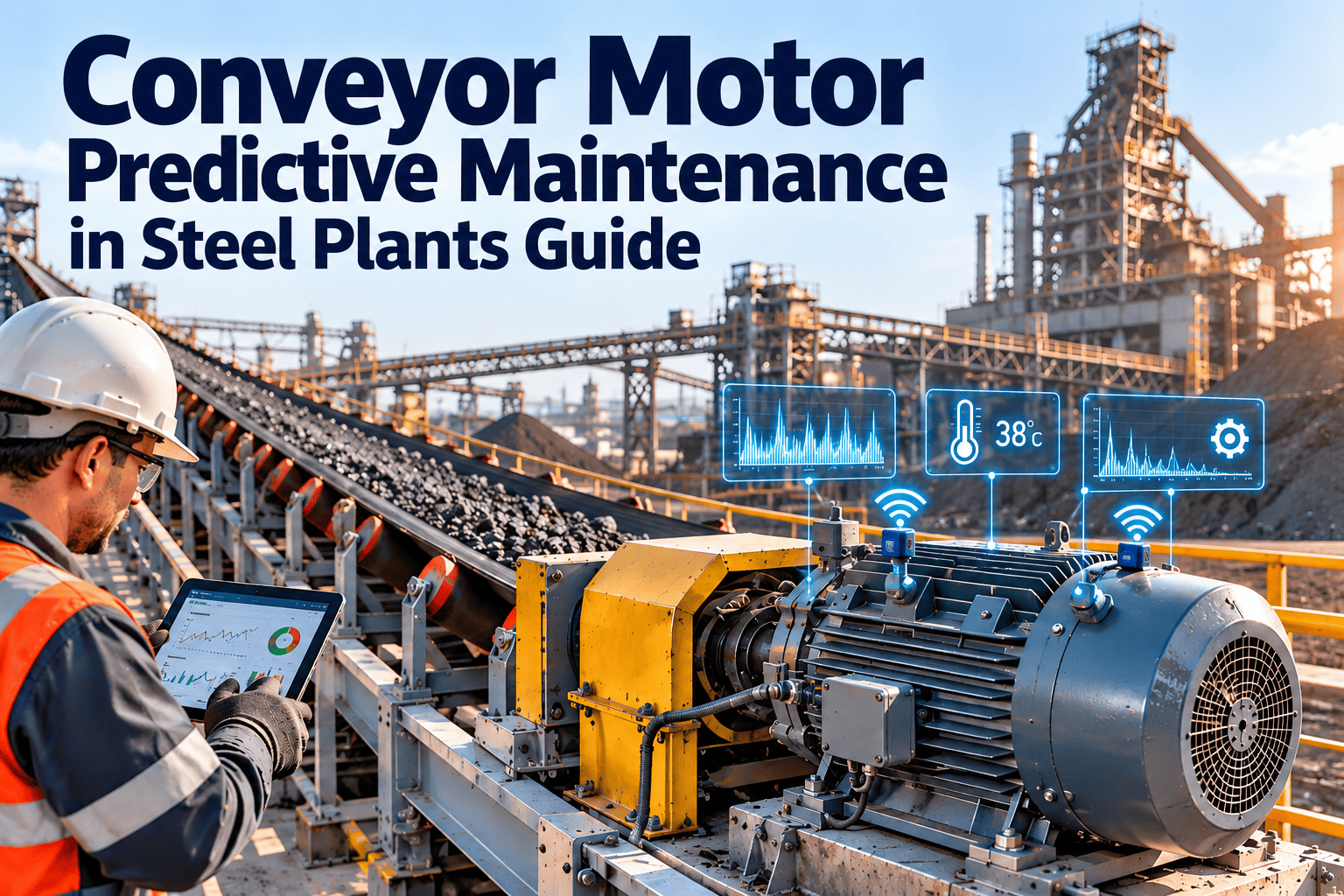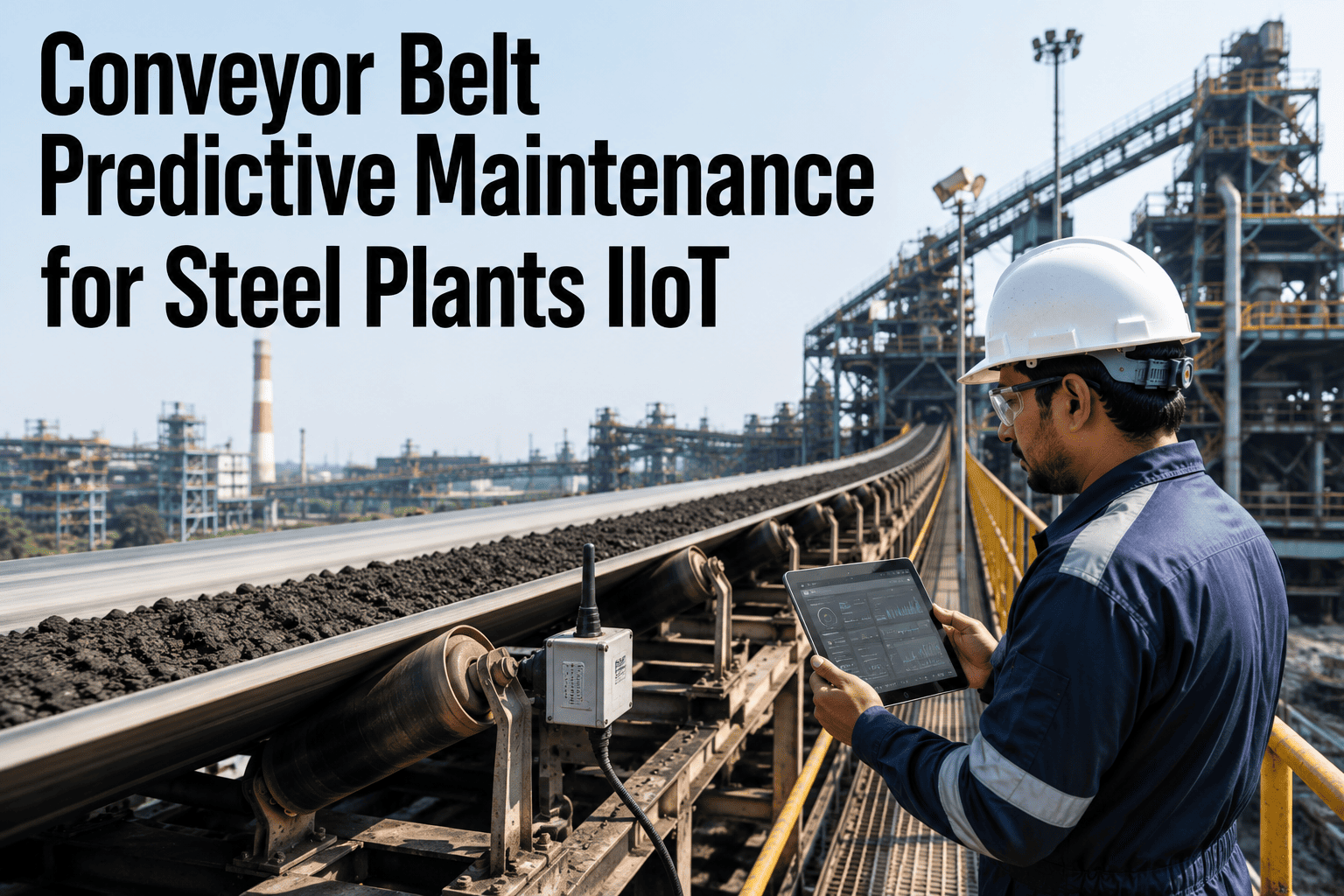
Conveyor belt predictive maintenance in steel plants leverages IIoT sensors and CMMS analytics to detect failures weeks before they cause unplanned downtime. In a steel mill handling 10,000+ tons of raw material daily, a single belt rupture can halt production for 6–12 hours and cost upwards of $250,000 per incident in lost output alone. By continuously monitoring belt tension, idler vibration, drive motor current and thermal signatures, maintenance teams can shift from reactive firefighting to condition-based interventions that extend belt life by 20–40%. OxMaint's AI-powered CMMS integrates these sensor streams into automated work orders and predictive alerts, giving reliability engineers a single platform to prevent conveyor failures before they happen. Start Free Trial to connect your conveyor assets and begin predictive monitoring today.
Conveyor IIoT for Steel Plants
Steel conveyor belts fail without warning — unless IIoT sensors catch the early signs first
Belt tension drift, idler bearing degradation and motor current anomalies appear days or weeks before a catastrophic failure. OxMaint's predictive CMMS turns those signals into automated work orders — cutting unplanned conveyor downtime by 30–50% and extending belt life beyond 40,000 hours.
Predictive Signals
Five IIoT sensor signals that predict steel conveyor belt failure
Conveyor belt failures in steel plants give measurable early warning across five distinct data streams. Monitoring each one — and correlating them inside a CMMS — is what separates predictive maintenance from reactive repair.
Belt Tension Monitoring
Load cells and tension transducers detect when belt stretch exceeds 2–3% of factory spec — a precursor to slippage, splice failure and eventual rupture. In steel conveyor systems operating at 3–5 m/s, tension drift of 15% or more increases motor draw by 12% and accelerates cover wear exponentially. OxMaint ingests tension telemetry every 30 seconds and triggers a predictive work order when deviation persists beyond 4 hours, allowing crews to re-tension during planned downtime rather than after a slip event.
Idler Vibration Analysis
Accelerometers mounted on idler frames capture bearing defect frequencies (BPFO, BPFI, BSF) in the 1–10 kHz range. A failing idler bearing typically shows a 3–6 dB RMS velocity increase 2–4 weeks before seizure. In a steel plant conveyor with 400+ idlers per kilometer, IIoT vibration monitoring pinpoints the exact failing unit so technicians replace one $45 idler instead of discovering it after it freezes and shreds a $28,000 belt.
Drive Motor Current Signature
Motor current signature analysis (MCSA) on conveyor drive motors detects mechanical overload, belt misalignment and pulley drag through phase-current harmonics. A 5–8% rise in steady-state amperage under constant load signals increased friction — often from a misaligned pulley or contaminated tail section. OxMaint's IIoT gateway logs current at 1 kHz and flags RMS deviations against a 7-day rolling baseline, correlating current spikes with tension and vibration data for tri-mode confirmation.
Thermal Belt Imaging
Infrared cameras and thermal line scanners detect hot spots along the belt surface and at splice joints. A splice temperature rising 15°C above ambient indicates internal separation — a failure that can snap a belt mid-cycle under a 2,000-ton load. Thermal imaging also catches overheated idlers before lubrication failure becomes bearing seizure. OxMaint stores thermal baselines per asset and auto-generates inspection work orders when any zone exceeds its temperature envelope for more than 10 minutes.
Acoustic Emission Monitoring
Contact acoustic sensors on conveyor structures detect high-frequency stress waves (100–400 kHz) emitted by micro-cracking in belt fabric, torn carcass plies and impact damage from oversized lump material. Acoustic emission (AE) is the earliest indicator of structural belt degradation — often preceding visible cover damage by 500+ operating hours. Integrated with OxMaint's asset health scoring, AE alerts let reliability teams schedule targeted belt inspections and localized repairs before a full-width tear propagates.
Cost of Inaction
What a single conveyor belt failure costs a steel plant
Consider a mid-sized steel plant operating six hot-belt conveyors transporting sinter, coke and scrap at 2,500 t/h each. A catastrophic belt failure on one line stops the furnace feed — and the costs compound fast.
With predictive conveyor monitoring deployed through OxMaint, the same plant typically reduces unplanned belt events by 60–70%, extends belt replacement intervals from 18 to 30 months, and cuts conveyor-related overtime by 40%. The payback period for sensor hardware + CMMS subscription averages 4–7 months on a single prevented rupture.
Detection Timeline
How early does conveyor IIoT detect belt failure in steel plants?
Predictive maintenance works because failure signatures emerge in a predictable sequence. Here is the typical 30-day warning window OxMaint users see before a conveyor belt failure would normally occur.
Micro-stress waves detect internal carcass fatigue at the fabric-ply level. Invisible to visual inspection and thermal imaging — this is the earliest possible warning.
Idler bearing defect frequencies rise 3–6 dB above baseline. OxMaint auto-generates a low-priority replacement work order targeting the specific idler position.
Drive motor RMS current increases 5–8% as friction rises. Correlated with vibration data, OxMaint's AI confirms mechanical drag — not load variation — and escalates priority.
Hot spot appears at splice or failing idler, 10–15°C above ambient. OxMaint triggers a high-priority inspection work order with thermal image attached for technician reference.
Belt tension drops below safe threshold; all five signals now correlated. OxMaint issues a critical work order, automatically reserves replacement parts from inventory and notifies the shift supervisor. Failure prevented during the next planned outage window.
Monitoring ROI
Predictive vs. preventive vs. reactive conveyor maintenance cost comparison
The economics are clear: reactive conveyor maintenance in steel plants costs 3–5x more than predictive, even before factoring lost production. Here is the annual cost breakdown for a typical 6-belt conveyor system.
| Cost Category | Reactive (Run-to-Failure) | Preventive (Time-Based) | Predictive (IIoT + CMMS) |
|---|---|---|---|
| Annual belt replacements | $168K (4 belts/yr) | $126K (3 belts/yr) | $84K (2 belts/yr) |
| Unplanned downtime cost | $930K (3 events × $310K) | $310K (1 event/yr) | $62K (0.2 events/yr) |
| Overtime labor | $58K | $32K | $18K |
| Idler + parts replacement | $42K | $28K | $19K |
| IIoT sensor + CMMS cost | $0 | $0 | $24K |
| Total annual cost | $1,198K | $496K | $207K |
OxMaint Solution
How OxMaint CMMS delivers predictive conveyor maintenance for steel plants
OxMaint is an AI-powered CMMS and EAM platform built for maintenance and reliability teams. It connects conveyor IIoT sensor data to work-order automation, asset health scoring and spare-parts management — so predictive insights become action without manual intervention.
IIoT Signal Ingestion + AI Health Scoring
OxMaint ingests belt tension, idler vibration, motor current, thermal and acoustic data from any IIoT gateway or PLC via MQTT, OPC-UA or REST API. The AI engine correlates all five signals into a 0–100 conveyor health score and triggers automated work orders when the score drops below threshold — cutting unplanned downtime 30–50%.
Automated Predictive Work Orders
When a conveyor anomaly is confirmed, OxMaint auto-generates a work order with the exact asset ID, sensor reading, diagnostic context and recommended repair procedure — then assigns it to the right technician based on skill, shift and location. Eliminates paper work orders and reduces mean-time-to-repair by 25–40%.
Spare-Parts Inventory + Belt Lifecycle Tracking
OxMaint tracks each conveyor belt by serial number, installation date, splice count and cumulative tonnage. When a predictive alert fires, the system auto-reserves the correct replacement belt, idlers and splice kits from inventory — and reorders if stock falls below safety minimum. Cuts parts stockouts by 70% and extends belt life by 20–40% through condition-based replacement.
Maintenance Analytics + Compliance Reporting
Real-time dashboards show MTBF, MTTR, OEE and conveyor availability by line, shift and material type. OxMaint maintains a full audit trail of every inspection, repair and sensor alert — aligned with ISO 55000 asset management standards — so you are always ready for internal audits and insurance reviews without rebuilding records from memory.
Proof
Steel plants cut conveyor downtime with OxMaint predictive CMMS
"After deploying OxMaint with IIoT vibration sensors on our 12 sinter-conveyor idler lines, we caught 14 bearing failures in the first quarter that would have caused belt damage. Unplanned conveyor downtime dropped 47% year-over-year — the system paid for itself in under five months."
"We switched from spreadsheet-based preventive maintenance to OxMaint's predictive CMMS for our scrap-handling conveyors. The motor current signature analysis flagged a misaligned tail pulley three weeks before it would have shredded a $31K belt. That single catch covered the entire annual software cost."
"Conveyor belt failures give measurable early warning — the question is whether your CMMS is listening. OxMaint makes sure you never miss the signal."
See OxMaint predict conveyor failures on your assets — book a 30-minute demo
Connect your IIoT sensors, import your asset register and watch OxMaint generate its first predictive work orders in days, not months. Bring your conveyor list to the demo and we will show you exactly how it works.
FAQ
Frequently asked questions about conveyor belt predictive maintenance in steel plants
What is conveyor belt predictive maintenance for steel plants?
Conveyor belt predictive maintenance uses IIoT sensors — including belt tension load cells, idler vibration accelerometers, drive motor current transducers, thermal imaging cameras and acoustic emission monitors — to continuously assess belt and component health in real time. A CMMS like OxMaint ingests these data streams, applies AI to detect failure signatures 2–4 weeks before breakdown, and auto-generates work orders so steel plant maintenance teams can repair or replace components during planned downtime instead of reacting to catastrophic failures.
How does IIoT conveyor monitoring work in a steel plant environment?
IIoT sensors mounted on conveyor components transmit data via wireless protocols (LoRaWAN, Wi-Fi 6) or wired connections (OPC-UA, Modbus) to an edge gateway, which forwards it to the CMMS cloud or on-premise server. OxMaint processes the telemetry at 30-second to 1 kHz intervals depending on signal type, correlates multiple sensor inputs to eliminate false positives, and scores each conveyor asset's health on a 0–100 scale. When the score crosses a threshold, the system triggers an automated, context-rich work order — no manual data review required. You can book a demo to see a live sensor-to-work-order flow.
How much does conveyor belt predictive maintenance cost for a steel plant?
A typical steel plant conveyor predictive monitoring deployment costs $20K–$35K annually for sensor hardware, IIoT gateways and OxMaint CMMS subscription across 6–12 conveyor lines. The payback period averages 4–7 months, because a single prevented belt rupture saves $250K–$310K in lost production and emergency repair costs. Most plants see 30–50% reduction in unplanned conveyor downtime and 20–40% extension in belt life within the first year.
Can OxMaint CMMS integrate with existing conveyor sensors and PLCs?
Yes. OxMaint supports MQTT, OPC-UA, REST API, Modbus TCP and direct SQL ingestion — covering virtually every industrial conveyor sensor, PLC and SCADA system used in steel plants. Whether you already have vibration sensors from SKF or Boger, motor current transducers from Fluke or ABB, or thermal cameras from FLIR, OxMaint can ingest the data without replacing your existing hardware. New sensor deployments are supported equally — the platform is hardware-agnostic.
How long does it take to deploy OxMaint for conveyor predictive maintenance?
Most steel plants are live on OxMaint within 2–4 weeks. The deployment includes importing your conveyor asset register, configuring sensor data streams, setting health-score thresholds based on your historical failure data, and training maintenance technicians on the mobile work-order app. If IIoT sensors are already installed, the first predictive alerts and automated work orders can appear within days of go-live. Start Free Trial to begin the onboarding process immediately.
Stop reacting to conveyor belt failures — start predicting them
Every hour you run conveyors without predictive monitoring is an hour closer to an unplanned $250K outage. OxMaint's AI-powered CMMS catches the early warning signals your team cannot see — and turns them into automated work orders that prevent failure before it stops production.
Free 14-day trial · No credit card