An overhead crane in a steel mill isn't just a piece of equipment — it's the single asset whose failure can kill someone in seconds. Every day, steel mill cranes lift 50-350 tonne ladles of molten metal at 1,600°C over workers, equipment, and production areas. A dropped ladle is catastrophic and unsurvivable. A bridge rail failure, wire rope snap, or brake malfunction at the wrong moment creates the kind of incident that shuts down plants permanently and ends careers. OSHA data shows that crane-related fatalities account for a disproportionate share of steel industry deaths, and 90% of crane accidents trace back to maintenance deficiencies — not operator error.
This isn't an area where "run to failure" is acceptable or where PM can be deferred for production pressure. Every inspection interval, every wire rope measurement, every brake test, and every load test exists because someone died when those things weren't done. Oxmaint's crane maintenance platform enforces the discipline that keeps cranes safe: mandatory inspection compliance, wire rope degradation tracking, brake performance trending, structural integrity monitoring, and complete audit trails that prove your program meets OSHA, ASME B30, and CMAA standards — every crane, every inspection, every time.
90% of Crane Accidents Trace to Maintenance Failures. Zero Tolerance Is the Only Standard.
Related
Steel Mill Crane Classification & Maintenance Intensity
Not all cranes carry equal risk. CMAA duty classifications and the material being handled determine inspection frequency, PM intensity, and component replacement schedules. Here's how a typical steel mill crane fleet breaks down:
The 6 Critical Crane Components That Kill When They Fail
These six components are responsible for virtually every crane-related fatality and serious injury in steel mills. Each requires specific inspection techniques, acceptance criteria, and replacement triggers:
Wire Ropes & Sheaves
The direct connection between load and crane. Failure mode: fatigue wire breaks, abrasion, corrosion, bird-caging, and core degradation. ASME B30.2 mandates rope replacement when visible broken wires exceed limits per rope lay length.
Braking Systems
Hoist brakes, bridge brakes, and trolley brakes. Hoist brakes are most critical — must hold 125-150% of rated load with adequate torque margin. Failure mode: lining wear, spring fatigue, adjustment drift, hydraulic/electric release failure.
Hooks & Hook Blocks
Forged steel hooks supporting full load weight. Failure mode: fatigue cracking (throat area), deformation/opening beyond 15% of original dimension, latch failure, bearing wear in hook block. NDE (magnetic particle or liquid penetrant) required periodically.
Structural Members
Bridge girders, end trucks, trolley frames, and runway beams. Failure mode: fatigue cracking at welded connections, corrosion in humid/chemical environments, deformation from overloads or collisions. Fatigue cracks propagate invisibly in welded structures.
Electrical Systems & Controls
Power supply (bus bars/festoon/cable reel), main contactors, VFDs, limit switches, and safety PLCs. Failure mode: contactor welding, limit switch failure (over-travel), VFD fault, control system crash. Electrical failures can cause uncontrolled motion.
Wheels, Rails & Travel
Bridge wheels, trolley wheels, runway rails, and rail clips. Failure mode: wheel flange wear, flat spots, rail head wear, rail clip loosening, rail joint misalignment. Rail/wheel failures can cause crane derailment — entire crane drops off the runway.
When the Load Is 250 Tonnes of Molten Steel, There's No Room for "Probably Fine"
Oxmaint enforces every inspection interval, tracks every measurement, trends every degradation curve, and generates audit-ready compliance records for every crane in your mill.
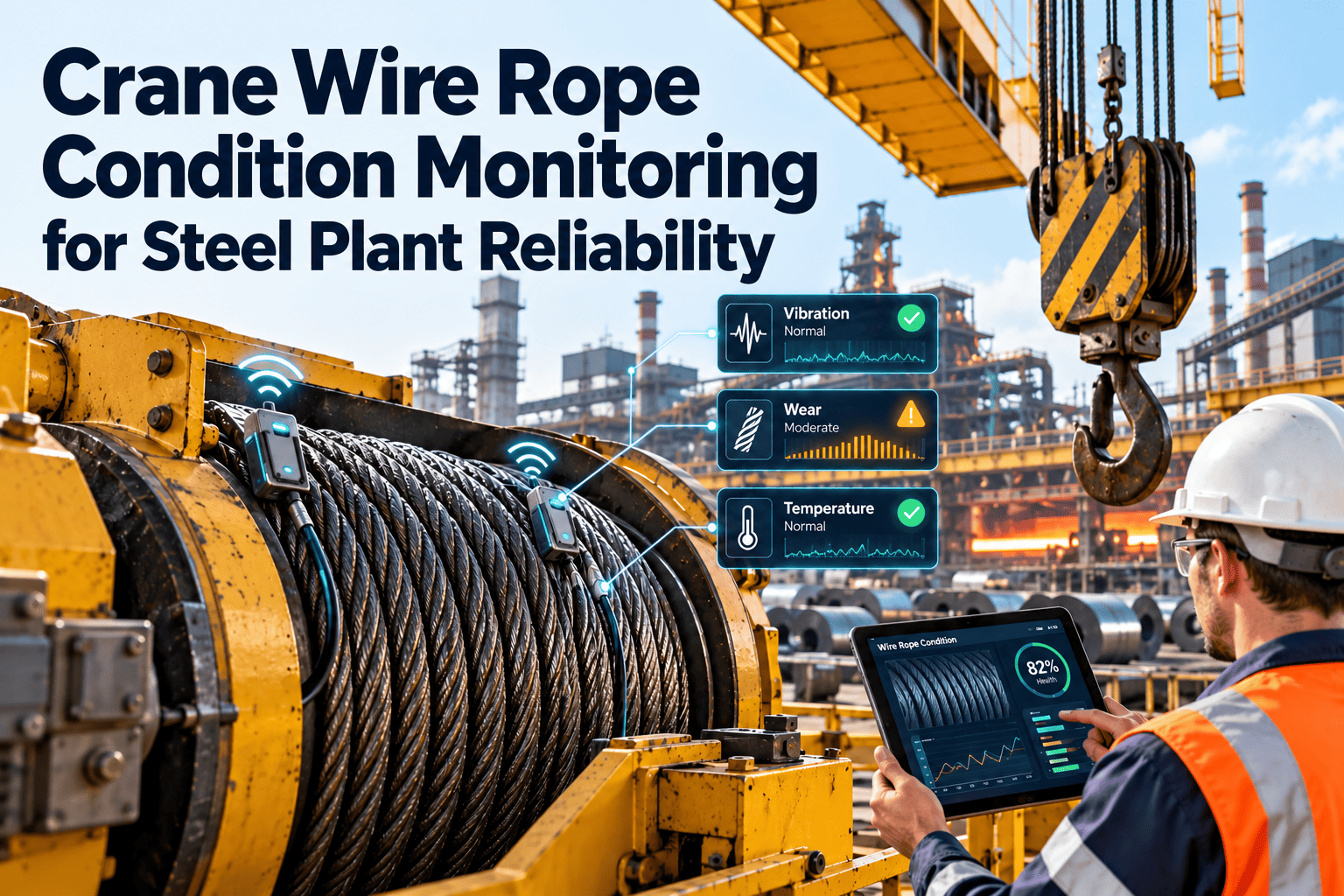
Wire Rope Degradation Tracking: The Most Important Trend in Your Mill
Wire rope doesn't fail without warning — it degrades over hundreds of cycles in measurable ways. Oxmaint tracks every data point and projects remaining rope life so replacements happen during planned windows, never under emergency conditions with a load in the air:
Diameter Reduction
Measure rope diameter at 5 points along working length. Track percentage reduction from nominal. Replace at 6-10% reduction (application-dependent). Oxmaint plots trend and projects the replacement date 3-6 months in advance.
Broken Wire Count
Count visible broken wires per rope lay length. B30.2 limits: 6 randomly distributed or 3 in one strand per rope lay. Oxmaint logs each inspection count and alerts when approaching 50% of the replacement threshold.
MRT (Magnetic Rope Testing)
Non-destructive testing that detects internal wire breaks and core degradation invisible to visual inspection. Captures metallic cross-section loss percentage. Oxmaint stores MRT reports and tracks loss progression over time.
Regulatory Compliance: OSHA, ASME B30 & CMAA
Crane maintenance in steel mills isn't optional — it's legally mandated. Non-compliance results in OSHA citations ($16,131 per serious violation, $161,323 per willful violation), insurance coverage denial, and personal criminal liability for responsible managers in the event of a fatality:
OSHA 1910.179
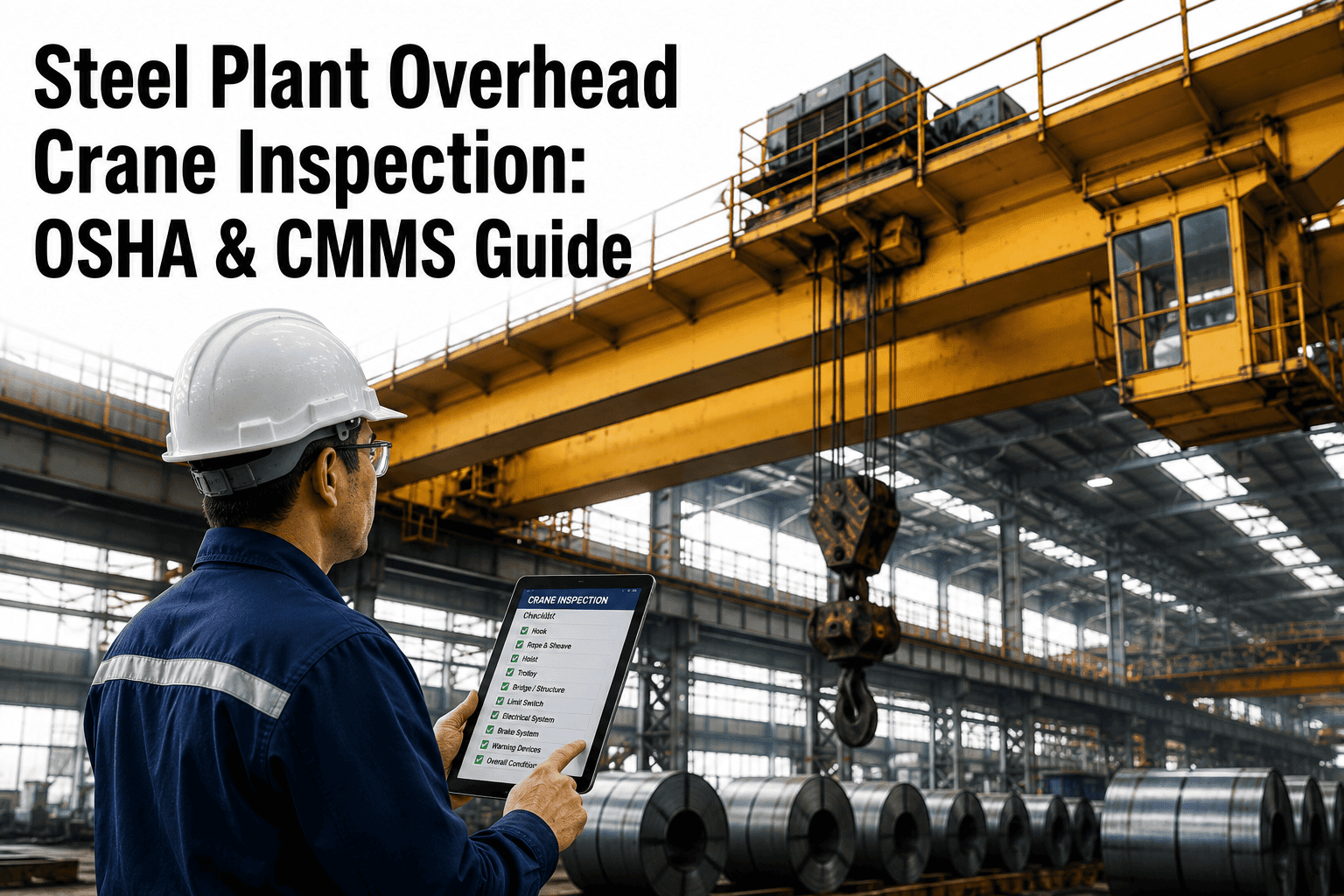
Federal standard for overhead and gantry cranes. Mandates: frequent (daily/monthly) and periodic (1-12 month) inspections, load testing after modifications, qualified operator training, and documented inspection records. Oxmaint auto-schedules both frequent and periodic inspections per crane classification and generates the documentation OSHA inspectors require.
ASME B30.2 / B30.17
Industry consensus standards for overhead cranes (B30.2) and overhead hoists (B30.17). Defines specific inspection criteria for each component, wire rope replacement criteria, load test requirements, and qualified inspector requirements. Oxmaint's inspection templates are built directly from B30 requirements with pass/fail criteria for every checkpoint.
CMAA 70 / 74
Crane Manufacturers Association of America specifications for top-running (70) and top-running single girder (74) cranes. Defines duty classifications (A through F) that determine design life and maintenance intensity. Oxmaint assigns PM templates based on CMAA classification so Class F cranes automatically receive more frequent and more detailed inspections than Class C cranes.
Prove Compliance. Prevent Incidents. Protect Your People.
Oxmaint generates audit-ready crane compliance records that satisfy OSHA inspectors, insurance auditors, and your own safety conscience. Every inspection, every measurement, every corrective action — documented and traceable.
Frequently Asked Questions
How does Oxmaint handle different inspection frequencies for different crane classes?
Every crane in Oxmaint is assigned its CMAA duty classification (A through F) during setup. The system automatically applies the corresponding PM template with inspection frequencies matched to the classification: Class F (continuous severe) gets daily visual, weekly functional, monthly detailed, and annual structural inspections. Class C (moderate) gets weekly visual, monthly functional, quarterly detailed, and annual structural. Each template contains the specific checkpoints, acceptance criteria, and measurement requirements defined by ASME B30 for that component and duty class. When a crane's actual usage increases (tracked by cycle counter or operating hours), Oxmaint can recommend reclassification to a higher duty class with correspondingly more frequent inspections.
What happens when a crane inspection finds a deficiency?
Oxmaint uses a three-tier deficiency response: Critical (immediate safety risk: crane is locked out and tagged out of service until repaired, production notified immediately, corrective work order created as emergency priority), Major (degraded but operable with restrictions: load restriction applied in the system, repair scheduled within defined timeframe typically 7-14 days, crane permitted to operate at reduced capacity), Minor (monitoring required: finding logged, next inspection interval shortened, repair planned for next maintenance window). Every deficiency is tracked from discovery through corrective action to verification, with timestamps, responsible persons, and photographs creating a complete audit trail.
How do you schedule crane maintenance without disrupting steel production?
Oxmaint coordinates crane PM with production scheduling through three mechanisms: Inter-heat windows (quick inspections during 30-45 minute gaps between heats when the crane is idle), planned production stoppages (detailed inspections and component replacements during scheduled shutdowns), and redundant crane coverage (where bays have multiple cranes, Oxmaint schedules one crane's PM while the other maintains production). For critical ladle cranes with no redundancy, maintenance windows are coordinated with melt shop scheduling to align with planned delays (tundish changes, ladle turnarounds). The system prevents scheduling two critical cranes in the same area for simultaneous PM.
Can Oxmaint manage load testing documentation?
Yes. Oxmaint manages the complete load test lifecycle: scheduling (after initial installation, after modification, after repair of load-bearing components, and periodic per your program requirements), test planning (test load calculation at 100% or 125% of rated capacity per B30 requirements, rigging plan, area clearance, qualified tester assignment), execution documentation (actual test loads, deflection measurements, brake holding test results, visual inspection findings during and after test), and certification (test certificate generation with all required data fields, tester qualification verification, and certificate expiration tracking for re-test scheduling). Load test records are permanently stored and retrievable for the life of the crane.
How many crane-related work orders does a typical steel mill generate?
A typical integrated steel mill with 20-30 overhead cranes generates 2,000-5,000 crane-related work orders per year: approximately 1,500-3,000 scheduled PM inspections (daily/weekly/monthly/quarterly/annual across all cranes), 300-800 corrective work orders from inspection findings, 100-300 component replacements (wire ropes, brake linings, wheels, contactors), and 50-150 emergency/unplanned repairs. Without a CMMS, this volume is impossible to manage with documented compliance. Oxmaint reduces administrative time per work order by 60-70% through template-based inspections, mobile completion, and automated scheduling — allowing crane maintenance teams to focus on the physical work rather than the paperwork.