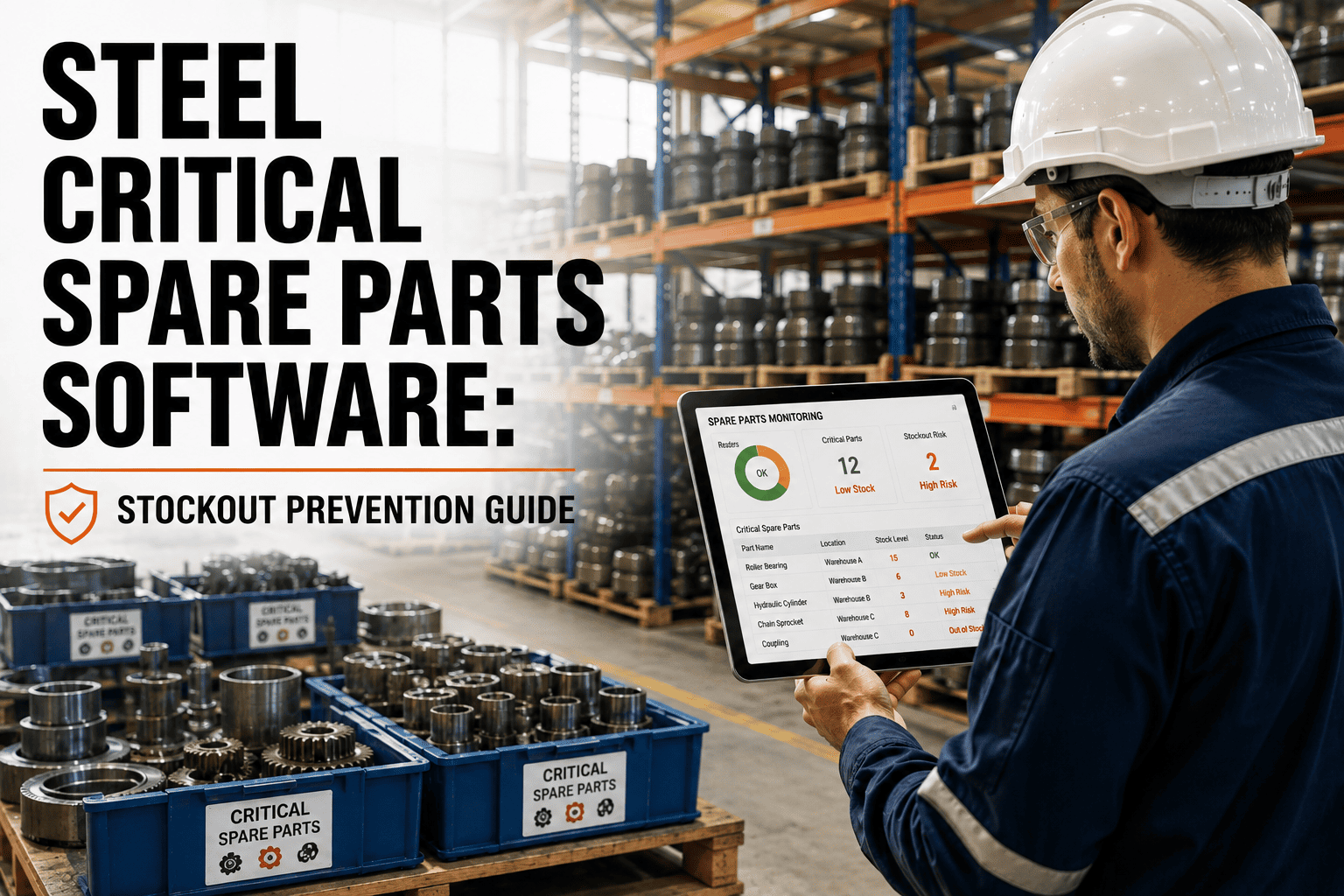
Most steel plant storerooms hold thousands of part numbers, yet the one that stops a caster or a mill stand is often the one nobody stocked. Value-based lists treat a cheap, slow-moving coupling the same as a fast-moving consumable, so critical items drift out of protection. A spare parts criticality matrix fixes this by scoring each part on the consequence of failure, the procurement lead time and the annual spend, then assigning a stocking rule to every cell. This checklist walks through building and maintaining that matrix for maintenance planning, and you can link parts to assets in Oxmaint so each score drives reorder points automatically.
Steel Plant Spare Parts Criticality Matrix for Maintenance Planning
Score every spare by consequence, lead time and value. Then stock the parts that protect production first, and stop tying up cash in parts that never matter.
Why a flat spares list fails in a steel plant
Two failures at the same time
Steel plants often stock out and overstock together. A bearing or drive card is missing at three in the morning, while shelves hold spares for equipment that was replaced years ago. Both come from one root cause: stocking decisions made without a consequence score.
Why consequence beats frequency
Many critical spares fail so rarely that usage history cannot justify holding them. A rolling mill main drive coupling may sit untouched for years, yet its absence can hold a mill down for weeks. Criticality must therefore be judged by what happens when the part is missing, not by how often it moves.
Three questions behind every score
The three lenses of the matrix
Consequence of stockout
- Vital: production stops or safety is at risk
- Essential: output is reduced or the process is degraded
- Desirable: little operational effect if missing
Procurement exposure
- Short: available within days from local stock
- Medium: several weeks from a regional supplier
- Long: months, custom-made or imported
Annual spend value
- A: small count of items, largest share of spend
- B: a middle group with moderate spend
- C: many items, a small share of spend
ABC analysis ranks parts by annual consumption value, which is unit cost multiplied by yearly usage. VED ranks by consequence. Combined, they produce a nine-cell grid in which each cell calls for its own stocking discipline. Adding lead time stops two parts of equal price and equal importance from being treated alike when one arrives in a week and the other in half a year.
The nine-cell ABC and VED grid with stocking rules
AV
Tight control. Hold the minimum safe quantity, review monthly and confirm lead time every cycle.AE
Reorder on forecast, with a modest buffer and quarterly review.AD
Order only when needed. Do not tie up cash.BV
Keep safety stock and a documented reorder trigger tied to lead time.BE
Standard minimum and maximum levels with periodic review.BD
Low stock, supplier-managed where possible.CV
Cheap but vital, so hold generous stock. Missing a small part must not stop a line.CE
Bulk buy and simple visual reorder checks.CD
Minimal stock and the lowest review effort.Stocking rules above are a starting framework. Adjust them to your plant, supplier base and risk appetite.
Build the matrix: the scoring checklist
Tick each item as it is completed for your part list. The boxes respond on screen, so the page doubles as a working review sheet for planners and reliability engineers.
1Consequence questions for each part
2Lead time and supply checks
3Data fields to capture on every part record
Turn the score into a stocking policy
Reorder point
Reorder point = (average daily usage x lead time) + safety stock Use the same time unit for usage and lead time. Mixing monthly usage with lead time in weeks is a common cause of wrong reorder points.Illustrative example
Monthly use4 units Supplier lead time3 months Demand during lead time12 units Safety stock for variabilityAdded on topFor rare, vital parts the formula breaks down, because there is not enough usage history. In those cases the stocking decision comes from the consequence of failure, the lead time and the installed base, which is how insurance spares are justified.
| Part family | Typical risk pattern | Suggested stocking approach |
|---|---|---|
| Insurance spares | Vital, long lead time, rare failure | Hold at least one, test and inspect on a schedule |
| Rotable assemblies | Repairable gearboxes, motors, chocks and spindles | Keep a pool tracked by serial number, plan repair turnaround |
| Wear and campaign items | Predictable use tied to production cycles | Order against campaign plans and planned outages |
| Electronics and drives | Obsolescence and import delay | Insurance spares with a regular obsolescence review |
| General consumables | Fast moving, easy to source | Min and max with supplier-managed replenishment |
Connect criticality scores to reorder alerts
Oxmaint links spare parts to assets, work orders and PM schedules, so criticality, usage and lead time sit in one inventory record.
Critical spares by steel plant area
| Plant area | Parts often scored Vital or Essential | Main planning concern |
|---|---|---|
| Raw materials and sinter | Crusher parts, fan rotors, conveyor drive gearboxes | Single conveyor feeding several downstream units |
| Blast furnace | Blower components, stove valve parts, casthouse crane drive parts | Continuous operation with limited outage windows |
| Melt shop | Transformer and electrode system parts, ladle crane brakes, hoist gearbox parts | Long lead time on large electrical items |
| Casting | Segment bearings, oscillator parts, mould drive components | Little buffer between caster and rolling |
| Rolling mills | Roll neck and chock bearings, couplings, pinions, spindles | Long lead times and outage dependence |
| Utilities | Pump and compressor parts, drive modules, seals | One failed utility can affect many areas |
How a missing part spreads through the plant
Part fails
A bearing, coupling or drive card stops working.Stock check
The store has none, or the wrong revision.Emergency buy
Premium cost and express freight apply.Line waits
The repair is quick, but waiting for the part is not.Upstream and downstream effect
Neighbouring units starve or back up.Scoring example: three parts, three different answers
The example below is illustrative and uses generic part types, not plant data. It shows why price, consequence and lead time must be read together before choosing a stocking rule. Treat each row as a prompt for your own planning meeting, where operations, maintenance and stores agree the consequence rating together, then record the decision and the date against the part.
| Illustrative part | Consequence | Lead time | Spend | Resulting policy |
|---|---|---|---|---|
| Main drive coupling for a mill stand | Vital, mill stops with no bypass | Long, often made to order | High value, rarely used | Insurance spare held permanently, inspected on a schedule |
| Proximity sensor on a conveyor | Essential, line slows or trips | Short, local supplier | Low value, used often | Min and max with a small buffer and visual reorder |
| Safety relay for a gas system | Vital, safety function | Medium, specialist supplier | Low value | Generous safety stock despite the low price |
| Cosmetic cover panel | Desirable, no process effect | Short | Low value | Order on demand, no stock held |
Reading the example
Cheap does not mean optional
The safety relay costs little, yet its absence can force a shutdown. Value-only ranking would have buried it.
Expensive does not mean frequent
The coupling is costly and rarely replaced. Its stocking comes from consequence and lead time, not usage history.
Review and governance checklist
4Keep the matrix alive
KPIs that show the matrix is working
Critical spares coverage
Share of top-criticality assets with a documented, stocked spare.Stockout events
Jobs delayed because a part was missing, tracked by criticality class.Emergency purchases
Count and cost of rush orders, expected to fall over time.Dead stock share
Value of parts with no movement and no vital role.Lead time accuracy
Gap between recorded and actual supplier delivery times.Common mistakes when building a criticality matrix
Scoring by price alone
A low-cost part can stop a mill. Keep value and consequence as separate scores.
Trusting quoted lead times
Recent deliveries often tell a different story, so check order history each year.
Scoring once and forgetting
Equipment, suppliers and risks change, so ratings need a review cycle.
Ignoring repairables
Gearboxes and motors need a pool and repair plan, not a one-off purchase.
Technicians keeping private stock
If the system is not trusted, hidden stock grows. Make the record accurate and visible.
How Oxmaint supports criticality-based planning
Asset-linked inventory
Attach each spare to the equipment it protects, so criticality can be inherited and reviewed.
Reorder points and alerts
Set minimum levels that reflect lead time and usage, and flag shortfalls early.
Work orders and PM
Reserve parts for scheduled jobs and see shortages before a technician arrives.
Reporting and dashboards
Follow stockouts, consumption and critical coverage in one view for planning meetings.
Frequently asked questions
What is the difference between ABC and VED analysis?
ABC ranks parts by annual spend value. VED ranks them by the consequence of a stockout, so the two views are combined for stocking.
Why add lead time to the matrix?
Two vital parts of equal cost need different protection if one arrives in days and the other in months. Lead time separates them.
How often should criticality ratings be reviewed?
Review Vital and Essential parts at least yearly, and after any major failure or equipment change. You can book a demo to see review dates tracked per part.
Should repairable gearboxes and motors be stocked like consumables?
No. Treat them as a rotating pool tracked by serial number, with repair turnaround planned, rather than a simple min and max item.
Can I start with only critical equipment?
Yes. Begin with the highest-consequence assets, then expand. You can get started and link their spares first.
Stock what protects production, not what is easy to count
Score your spares, apply the matrix and let planning follow consequence and lead time. Oxmaint connects the score to assets, work orders and reorder alerts.