Heat Stress Management for Steel Workers: Protect Your Team
By Michael Finn on February 22, 2026
At 2:15 p.m. on a July afternoon, a furnace helper at an integrated steel mill collapsed on the melt shop floor. The ambient temperature was 97°F. At his work station — 40 feet from a BOF vessel mid-blow — the radiant heat pushed the effective temperature past 150°F. He'd been working a double shift. He hadn't taken a water break in 90 minutes. He wasn't wearing a cooling vest. Nobody was monitoring his core body temperature. He survived — but the investigation revealed that every layer of protection that should have prevented the incident had failed: inadequate hydration protocols, no formal work-rest scheduling, no wearable heat monitoring, and a culture where "toughing it out" was the unspoken expectation. Steel workers operate in some of the most extreme thermal environments in any industry. Blast furnaces radiate heat above 200°F at working distance. Ladle and tundish operations expose workers to molten metal splashes at 2,800°F. Even "cool" areas like rolling mills sustain 110–130°F during summer months. OSHA doesn't set a specific permissible exposure limit for heat — but it enforces heat illness prevention under the General Duty Clause, and the proposed federal heat standard will make formal heat stress management programs mandatory. The question isn't whether your plant needs a heat stress program. It's whether your current program is comprehensive enough to protect your workers and survive regulatory scrutiny.
EXTREME
>130°F WBGT
VERY HIGH
115–130°F
HIGH
103–115°F
MODERATE
91–103°F
LOW
<91°F
36
Steel worker heat-related fatalities reported to OSHA in the last 5 years — the highest of any manufacturing sector
2,800+
Recordable heat illness incidents in steel and primary metals annually — many more go unreported
$1.2B
Estimated annual cost of heat-related productivity loss, medical claims, and absenteeism in U.S. steel operations
How Heat Stress Progresses: The Warning Signs Your Team Must Recognize
Heat stress doesn't happen all at once — it escalates through predictable stages, each with identifiable symptoms. The window between "I feel a little off" and "medical emergency" can be as short as 15 minutes in a steel plant's extreme radiant heat environment. Training every worker and supervisor to recognize these stages is the most basic — and most often neglected — element of a heat stress program.
Response: Move to shaded rest area. Hydrate with electrolytes. Resume work in 15–20 minutes if symptoms resolve.
Recognition window: Wide — symptoms persist for 30+ minutes
STAGE 2
Heat Exhaustion
Heavy sweatingNausea / dizzinessMuscle crampsRapid weak pulseCool clammy skin
Response: Stop all work immediately. Move to cool area. Apply cool cloths. Hydrate slowly. Monitor for 30 minutes. Seek medical attention if no improvement.
Recognition window: Moderate — 15–30 minutes before escalation
STAGE 3
Heat Stroke
Confusion / slurred speechHot dry skin (no sweating)Core temp >104°FLoss of consciousnessSeizures possible
EMERGENCY: Call 911 immediately. Move to coolest area available. Apply ice packs to neck, armpits, groin. Do NOT give fluids if unconscious. This is a life-threatening condition — brain damage begins within minutes.
Recognition window: Minutes — delay is fatal
WBGT-Based Work-Rest Scheduling
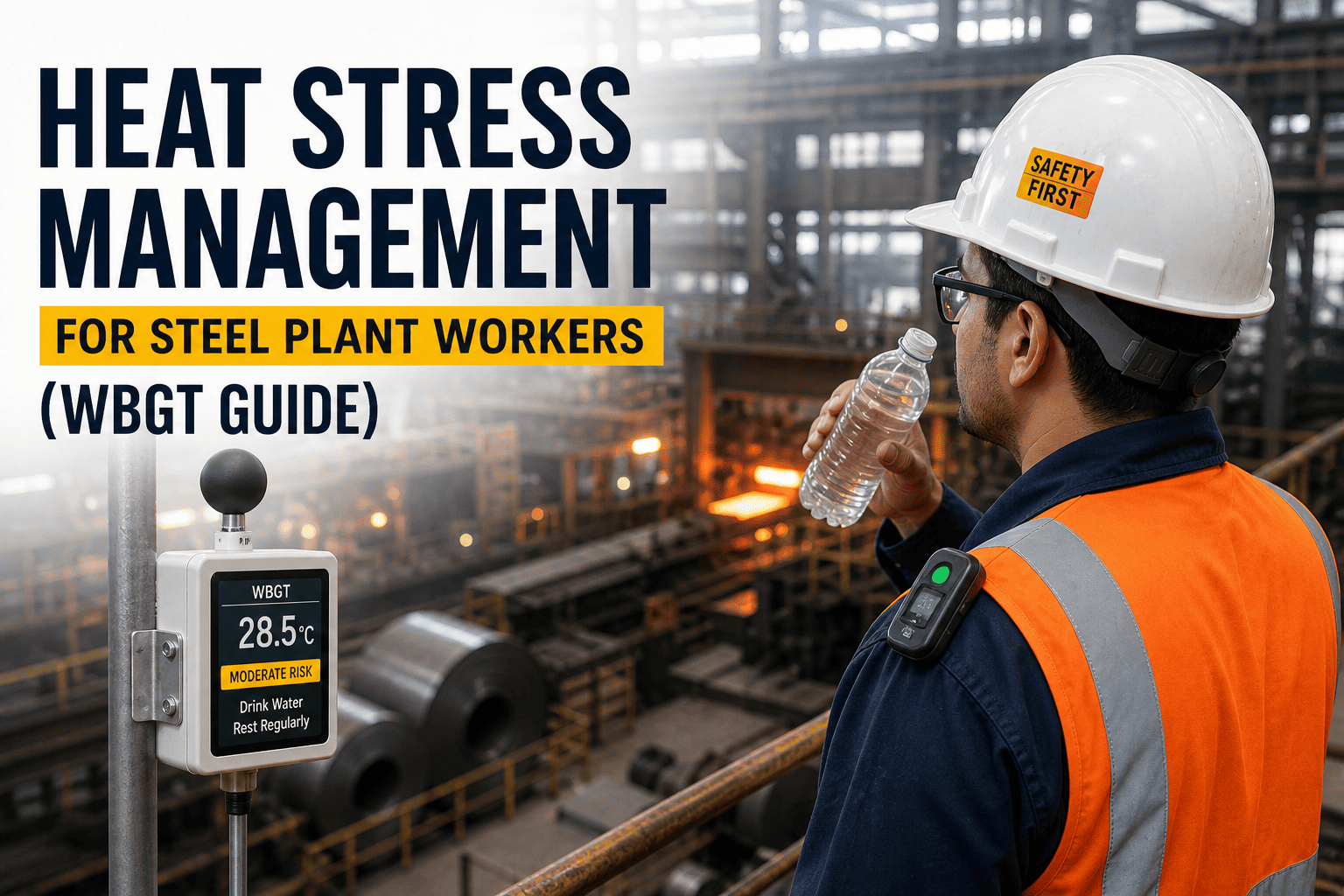
The Wet Bulb Globe Temperature (WBGT) index is the gold standard for measuring heat stress risk because it accounts for temperature, humidity, wind speed, and radiant heat — all factors that are extreme in steel plant environments. OSHA and ACGIH use WBGT thresholds to determine safe work-rest ratios. Steel operations that sign up for heat stress monitoring can automate WBGT tracking and trigger work-rest schedule adjustments in real time based on actual conditions at each work station.
ACGIH Work-Rest Recommendations by WBGT and Workload
81°F
Work-Rest Ratio
Light Work
Moderate Work
Heavy Work
Very Heavy Work
Continuous
86°F
82°F
77°F
—
75% Work / 25% Rest
87°F
84°F
81°F
78°F
50% Work / 50% Rest
89°F
86°F
84°F
25% Work / 75% Rest
90°F
88°F
86°F
84°F
Most steel plant operations near furnaces, ladles, and casters fall into the "Heavy" or "Very Heavy" categories — requiring mandatory rest periods at WBGT levels that office workers would consider comfortable.
The Five Pillars of Steel Plant Heat Stress Management
An effective heat stress program isn't a single intervention — it's a layered system where each pillar reinforces the others. Remove any one layer and the entire program weakens. Here's the complete framework that OSHA expects and that actually prevents heat illness in the most demanding thermal environments in industry.
Environmental Monitoring
Continuous WBGT measurement at every work zone with real-time dashboards and automated alert escalation when thresholds are approached.
Area WBGT sensors at melt shop, caster, rolling mill, and furnace stationsReal-time display boards visible to all workers in each zoneAutomated supervisor alerts at 80%, 90%, and 100% of action limits
Hydration Program
Structured hydration protocol ensuring workers consume adequate fluids before, during, and after shifts — not just when they feel thirsty.
Chilled water and electrolyte stations within 50 feet of every hot-zone workstationMinimum 8 oz every 15–20 minutes during high-heat exposurePre-shift hydration check and education on caffeine/alcohol effects
Work-Rest Cycles
Mandatory rest periods calculated from WBGT readings, workload category, and PPE encumbrance — adjusted dynamically as conditions change throughout the shift.
WBGT-driven work-rest schedules posted and enforced at every zoneAir-conditioned or shaded rest areas with seating within 2-minute walkAcclimatization schedules for new and returning workers (7–14 day ramp-up)
Physiological Monitoring
Wearable technology that tracks individual worker core body temperature, heart rate, and activity level — providing objective data instead of relying on self-reporting.
Ingestible or wearable core temp sensors with real-time dashboard monitoringHeart rate variability tracking for early fatigue detectionAutomated alerts when individual physiological limits are approached
Training & Response
Annual heat stress training for all workers and supervisors, plus documented emergency response procedures with assigned roles and staged equipment.
Symptom recognition training with hands-on scenario exercisesEmergency cooling kits staged at every hot-zone stationBuddy system protocols — no one works alone in extreme heat zones
Protect Every Worker. Monitor Every Zone. Document Every Action.
OXmaint tracks heat stress management from environmental monitoring through work-rest scheduling, hydration compliance, training records, and incident documentation — giving you the complete, auditable heat stress program that OSHA requires and your workers deserve.
The most advanced steel plants have moved beyond area-level temperature monitoring to individual worker monitoring — because two workers in the same zone can have dramatically different heat stress responses based on fitness, acclimatization, hydration, medication, and PPE configuration. Here's what a real-time heat monitoring dashboard looks like when it's integrated with your safety management system.
Worker Heat Stress Monitor — Melt Shop Zone
Zone WBGT: 94°FHIGH ALERT
M. Rodriguez
Core99.1°F
HR92 bpm
Duration42 min
OK — Rest in 18 min
J. Thompson
Core99.6°F
HR108 bpm
Duration38 min
OK — Rest in 22 min
K. Williams
Core100.8°F
HR128 bpm
Duration55 min
WARNING — Mandatory rest NOW
A. Patel
Core98.4°F
HR76 bpm
Rest12 min
Resting — Return in 8 min
Cooling Technologies for Steel Plant Workers
Engineering controls and PPE technologies have advanced significantly — steel workers no longer have to choose between heat protection and heat exposure. Modern cooling solutions work within the PPE requirements of steel plant operations. Teams evaluating cooling technology options can book a free demo to see how cooling equipment is tracked in the maintenance system.
Phase-Change Cooling Vests
Vests with phase-change inserts that maintain a consistent 59°F cooling surface for 2–3 hours. Recharged by placing inserts in cooler or freezer. No batteries, no pumps, no maintenance.
Core temp reduction: 1.5–2.5°FDuration: 2–3 hours per charge
Circulating Water Systems
Wearable vests with tubing that circulates chilled water from a portable reservoir. Highest cooling capacity of any personal system. Used for the most extreme heat exposures near furnaces and ladles.
Core temp reduction: 3–5°FDuration: Continuous with reservoir
Spot Cooling & Air Showers
Fixed or portable forced-air systems directing cooled air at specific work positions. Effective for stationary tasks like crane operation, control rooms, and inspection stations.
Temperature reduction: 15–25°F at workstationCoverage: 6–10 ft radius
Reflective Radiant Heat Barriers
Aluminized curtains, shields, and personal reflective suits that block radiant heat from furnaces, ladles, and molten metal. Reduces radiant heat exposure by up to 95% without blocking airflow.
Radiant heat reduction: up to 95%Application: Furnace-facing positions
Measuring Heat Stress Program Effectiveness
A heat stress program that isn't measured is a heat stress program that isn't improving. These metrics tell you whether your program is actually protecting workers or just creating paperwork. Facilities that sign up for safety-integrated maintenance management track these metrics alongside equipment reliability and compliance data in a single platform.
Heat Stress Program Performance Metrics
Heat-Related Incident Rate (TRIR)
Target: 0
0.4
Recordable heat illness incidents per 200,000 work hours. Industry average: 1.8. Target is zero.
Work-Rest Compliance Rate
Target: 100%
92%
Percentage of required rest periods actually taken on time. Gaps indicate cultural or scheduling barriers.
Hydration Station Utilization
Target: >90%
78%
Measured via station usage counters or consumption tracking. Below 80% suggests access or culture issues.
Training Completion Rate
Target: 100%
96%
All workers and supervisors in hot zones must complete annual heat stress training before summer season begins.
Acclimatization Protocol Adherence
Target: 100%
84%
Percentage of new and returning workers who complete the full 7–14 day acclimatization schedule before full-duty assignment.
Expert Perspective: Heat Stress Is a Leadership Problem, Not a Weather Problem
Every heat stress fatality I've investigated had the same root cause: not the temperature, not the workload, not the equipment — the culture. Workers who felt they couldn't take a water break without being seen as weak. Supervisors who scheduled mandatory overtime on 100-degree days because production was behind. New hires put on furnace duty without acclimatization because the crew was short. Heat stress management is a leadership problem. The technology — sensors, wearables, cooling vests, WBGT monitors — is all available and affordable. What separates plants with zero heat incidents from plants with recurring incidents is whether leadership creates and enforces a culture where stopping work because of heat is not just permitted but expected. The moment a supervisor says "we'll take a break after this heat" instead of enforcing the scheduled rest, the program has failed. Not the equipment. The leadership.
Make Rest Non-Negotiable
Scheduled rest periods are not suggestions — they're safety controls. Supervisors who skip or delay them should be held to the same standard as those who bypass machine guards.
Acclimatize Every Single Time
Workers returning from vacation, illness, or any absence longer than 7 days need to re-acclimatize. This is where most incidents happen — experienced workers who lost their heat tolerance during time away.
Document Like Your Program Depends on It
Because it does. WBGT readings, rest periods taken, hydration availability, training records, incident investigations — all documented, all auditable, all proving your program works.
Protect Your Workers. Prove Your Compliance. Prevent Every Incident.
OXmaint integrates heat stress management with your complete safety and maintenance platform — WBGT monitoring, work-rest scheduling, training tracking, cooling equipment maintenance, incident documentation, and regulatory reporting. One system protecting your team and your operation.
What are the OSHA requirements for heat stress management in steel plants?
OSHA does not currently have a specific heat stress standard with a defined permissible exposure limit. However, OSHA enforces heat illness prevention under the General Duty Clause (Section 5(a)(1)), which requires employers to provide a workplace free from recognized hazards that are causing or likely to cause death or serious physical harm. For steel plants, this means a comprehensive heat stress program is effectively mandatory. OSHA has issued a proposed rule for a federal heat standard that would formalize requirements including action trigger temperatures, mandatory water access, rest breaks, acclimatization protocols, monitoring, and emergency response plans. Even before the formal rule takes effect, OSHA's National Emphasis Program on Heat Illness targets workplaces with high heat exposure for priority inspections — and steel plants are among the highest-risk environments on that list.
What is WBGT and why is it important for steel workers?
WBGT (Wet Bulb Globe Temperature) is a composite heat stress index that combines air temperature, humidity, wind speed, and radiant heat into a single number that reflects the actual physiological heat load on a worker. It is critical for steel plants because standard air temperature readings dramatically understate the heat stress in environments with high radiant heat from furnaces, ladles, and molten metal. A work area might show 95°F on a standard thermometer but register 120°F+ on a WBGT meter due to radiant heat. ACGIH and OSHA use WBGT thresholds to determine safe work-rest ratios based on workload intensity. Without WBGT measurement, steel plants are guessing at heat exposure — and consistently underestimating it, which is a primary contributor to heat illness incidents.
How does worker acclimatization work and why does it matter?
Acclimatization is the physiological adaptation process that improves a worker's ability to tolerate heat stress over a period of gradual exposure. A properly acclimatized worker sweats more efficiently, has a lower resting core temperature, and maintains cardiovascular stability under heat load. For new workers, OSHA and NIOSH recommend a minimum 7-day acclimatization schedule starting at 20% of normal heat exposure on day one and increasing by 20% each subsequent day. For returning workers (after illness, vacation, or absence of 7+ days), a 4-day schedule starting at 50% and increasing by 20% per day is recommended. Acclimatization matters because unacclimatized workers account for approximately 70% of heat-related fatalities in the first week of exposure. In steel plants, this means any worker who has been away from the hot zone for more than a week must be re-acclimatized before returning to full duty.
What wearable technology is available for monitoring steel worker heat stress?
Several categories of wearable technology are now used in steel plant heat stress monitoring. Ingestible core temperature sensors (pills with internal thermometers that transmit real-time core body temperature wirelessly) provide the most accurate physiological data. Skin-worn temperature patches estimate core temperature from surface readings using calibrated algorithms. Heart rate monitoring wristbands and chest straps track cardiovascular strain that correlates with heat stress. Some integrated systems combine multiple physiological signals — temperature, heart rate, heart rate variability, and activity level — into a single heat strain index displayed on a supervisor dashboard. These systems provide objective, continuous data that eliminates reliance on worker self-reporting, which is unreliable because heat stress impairs the cognitive function needed to recognize and report symptoms.
How does heat stress management software integrate with a steel plant CMMS?
Heat stress management integrates with a CMMS at multiple levels. Environmental monitoring data (WBGT readings by zone) feeds into the work order system, automatically adjusting work-rest scheduling for maintenance tasks in hot zones. Training records for heat stress awareness are tracked alongside other safety certifications in the employee profile. Cooling equipment (vest inventories, phase-change insert cycling, spot cooler maintenance) is managed as facility assets with PM schedules. Incident documentation when heat events occur is captured in the CMMS incident module with root cause analysis, corrective actions, and follow-up tracking. Hydration station maintenance and restocking is managed through the facilities work order system. This integration means heat stress management is not a separate paper program — it is embedded in the same operational platform that manages every other aspect of plant maintenance and safety.