This article is published by OxMaint as part of its Workforce Safety Monitoring resource series. Steel plant workers operate in some of the most thermally demanding environments in any industry. Blast furnace perimeters, rolling mill floors, coke ovens, and casting areas expose workers to radiant heat sources that routinely produce globe temperatures exceeding 60°C — far above the ACGIH Threshold Limit Values for any workload category. Research on steel plants in southern India found that 90% of WBGT measurements exceeded recommended threshold limits during production. This guide provides steel plant safety officers, operations managers, and health professionals with the regulatory WBGT framework, work-rest schedules, hydration requirements, and wearable monitoring systems needed to protect workers and meet occupational health obligations.
Article · Workforce & Safety · Steel Industry
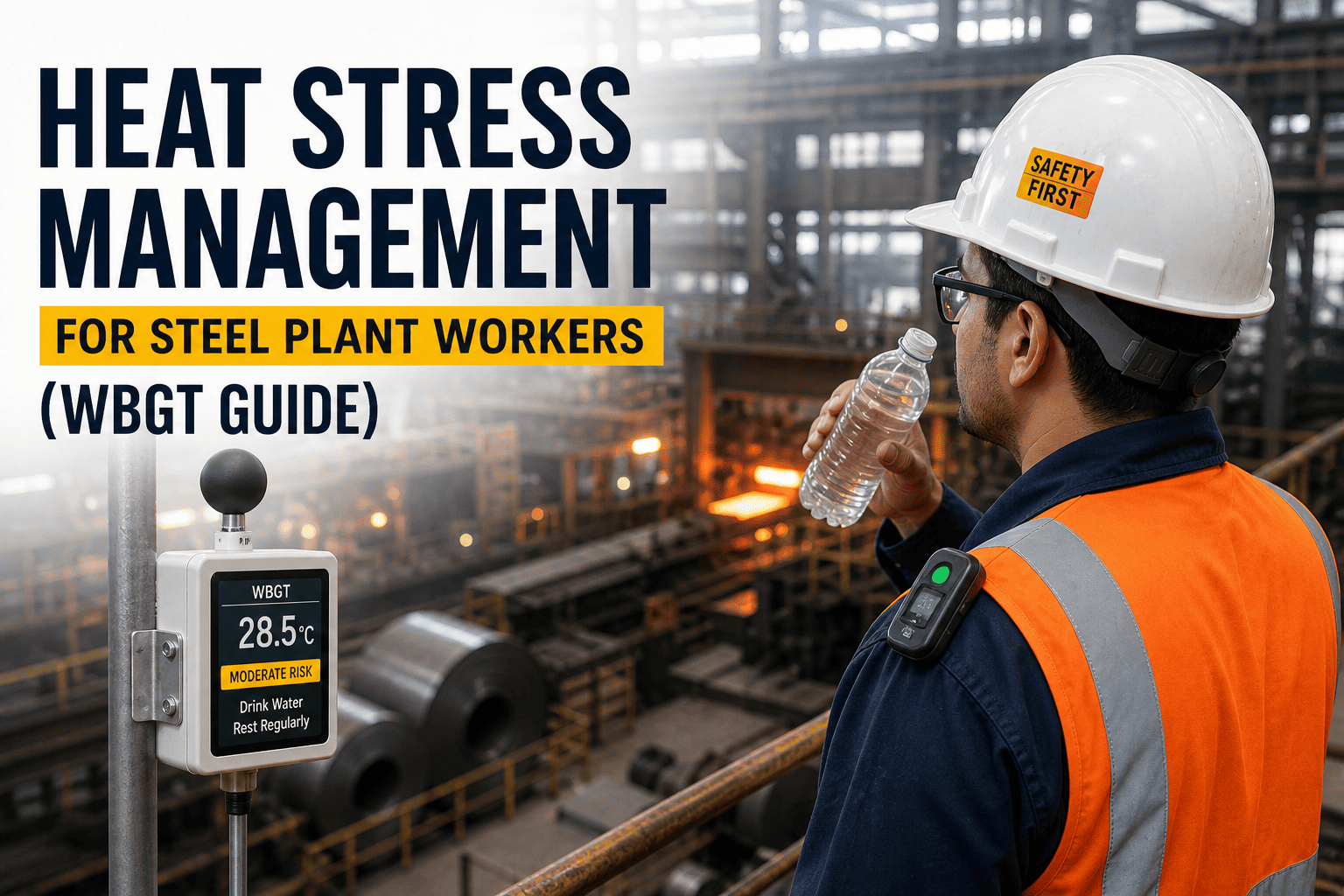
Heat Stress Management for Steel Plant Workers: Complete WBGT Guide
Protect workers in blast furnace perimeters, rolling mills, coke ovens, and casting areas using WBGT monitoring thresholds, ACGIH work-rest schedules, hydration protocols, and real-time wearable safety systems.
90%
of WBGT readings in steel plants exceed ACGIH threshold limit values
67.6°C
globe temperature recorded in coke oven / blooming mill environments
50%
of steel workers report excessive sweating, fatigue and tiredness
38°C
core body temperature limit — the physiological threshold all WBGT systems protect
Why WBGT Is the Correct Metric for Steel Plants
WBGT is recommended by OSHA, NIOSH, ACGIH, ISO (ISO 7243), and the US military as the most accurate field measurement of occupational heat stress. Unlike air temperature or heat index, WBGT accounts for all four factors that drive heat illness in industrial environments: air temperature, humidity, radiant heat from furnaces and hot metal, and air movement. In steel plants, radiant heat from production processes — not ambient air temperature — is the primary hazard. Ordinary thermometers miss it entirely. WBGT captures it through the globe thermometer component, which is why the globe temperature in coke ovens can reach 67.6°C even when air temperature appears moderate.
1 ACGIH WBGT Threshold Limit Values for Steel Plant Zones
The ACGIH Threshold Limit Values (TLVs) define the maximum WBGT at which workers can continue without mandatory rest, for each work intensity level. These are the industry-standard regulatory thresholds referenced by OSHA, NIOSH, and ISO 7243. Steel plant zone assignments are based on documented thermal measurements from peer-reviewed occupational health studies.
| Work Intensity |
Continuous Work TLV |
75% Work / 25% Rest |
50% / 50% |
25% Work / 75% Rest |
Steel Plant Zone Match |
Light
Office, seated tasks |
30°C (86°F) |
30.6°C |
31.4°C |
32.2°C |
Control rooms |
Moderate
Walking, lifting, operating |
26.7°C (80°F) |
28.0°C |
29.4°C |
31.1°C |
Rolling mill floor |
Heavy
Shovelling, manual steel work |
25°C (77°F) |
26.1°C |
27.9°C |
30.0°C |
Casting floor, tapping |
Very Heavy
Furnace work, forced postures |
No safe continuous work |
– |
25°C max |
27.9°C |
Blast furnace, coke ovens |
Source: ACGIH TLVs & BEIs 2025. Note: An unacclimatised worker performing heavy work in a coke oven where WBGT exceeds 28°C must operate on a 50% work / 50% rest cycle minimum. At 67.6°C globe temperature, no safe continuous work is possible.
2 Measured Heat Exposure by Steel Plant Zone
The following measurements are drawn from peer-reviewed occupational health studies of integrated steel plants, including the ScienceDirect study of a southern India steel plant (WBGT range: 27.2–41.7°C across zones). All measurements exceed ACGIH TLVs for heavy workload in the zones marked critical.
| Zone |
Typical WBGT (°C) |
Globe Temp Peak |
ACGIH Status |
Mandatory Work-Rest |
| Coke Ovens |
35–41.7°C
|
Up to 67.6°C |
Exceeds all TLVs |
50% work / 50% rest minimum |
| Blast Furnace Perimeter |
32–40°C
|
55–65°C |
Exceeds all TLVs |
25% work / 75% rest for heavy tasks |
| Casting / Tapping Floor |
30–38°C
|
45–55°C |
Exceeds moderate TLV |
50% work / 50% rest (heavy load) |
| Rolling Mill Floor |
27–34°C
|
35–45°C |
Exceeds moderate TLV |
50% work / 50% rest |
| Blooming Mill |
28–36°C
|
50–67°C |
Critical — high radiant |
25% work / 75% rest |
| Maintenance & Inspection Areas |
27–32°C
|
30–40°C |
Exceeds moderate TLV |
75% work / 25% rest |
| Control Rooms (cooled) |
20–24°C
|
<28°C |
Within TLV |
Standard schedule — rest recovery point |
3 Work-Rest Cycle Schedule by WBGT Level
Work-rest ratios are not suggestions — they are the primary administrative control for heat stress when engineering controls cannot reduce WBGT below threshold. ACGIH research confirms that compliant work-rest cycles maintain core body temperature below 38°C for acclimatised workers performing moderate to heavy tasks. For steel plant zones where WBGT exceeds 35°C, rest periods must be taken in cooled or shaded recovery areas, not in the adjacent work zone.
75% Work
Light Hazard
WBGT: 26–28°C
45 min work / 15 min rest
50% / 50%
Moderate Hazard
WBGT: 28–32°C
30 min work / 30 min rest
25% Work
High Hazard
WBGT: 32–38°C
15 min work / 45 min rest
Stop Work
Extreme Hazard
WBGT: >38°C
No safe work period exists
Critical: Rest breaks must follow measured WBGT values — not clock schedules or supervisor discretion. Research shows that rest breaks not tied to actual WBGT readings significantly underestimate heat exposure risk and allow core temperature to approach dangerous levels undetected.
4 Hydration Protocol for Steel Plant Workers
Dehydration is the primary physiological pathway from heat exposure to heat illness. Research on steel plant workers found 59% showing signs of dehydration during shifts — and water consumption well below NIOSH recommendations, with no electrolytes provided. This protocol corrects those gaps.
250ml
Every 20 Minutes
NIOSH recommended fluid intake during heavy work in heat. Workers should not wait until thirsty — thirst indicates dehydration has already begun.
Cool Water
15–20°C Optimal
Cooler water is absorbed faster than warm water and helps reduce core body temperature. Cold beverages (<10°C) cause gastric discomfort and slow intake.
Electrolytes
Beyond 2 Hours
Workers sweating heavily for more than 2 hours require electrolyte replacement — sodium, potassium, and magnesium — to prevent hyponatraemia from water-only consumption.
Monitor Heat Stress Across Your Steel Plant in Real Time
OxMaint's Workforce Safety Monitoring module integrates WBGT sensor data, wearable alerts, and work-rest schedule compliance into a single platform — keeping safety teams ahead of heat illness before it happens.
5 Heat Illness Recognition & Emergency Response
Supervisors and all site personnel must be trained to recognise the difference between heat exhaustion and heat stroke — the latter is a life-threatening emergency requiring immediate aggressive cooling before medical arrival.
Heat Stroke — Medical Emergency
Core body temperature above 40°C. Confusion, disorientation, or unconsciousness. Hot, dry skin (classic) or heavy sweating (exertional). Rapid heart rate, slurred speech, loss of coordination. Worker may collapse without warning.
ACTION: Call emergency services immediately. Aggressive cooling NOW — remove from heat, apply ice packs to neck, armpits, groin. Do not wait for medical team to begin cooling.
Heat Exhaustion — Urgent Intervention
Core temperature below 40°C but rising. Heavy sweating, extreme fatigue, weakness, nausea, headache, pale and moist skin. Dizziness and possible fainting. Worker can still communicate but is deteriorating rapidly.
ACTION: Remove to cool area immediately. Provide cool fluids with electrolytes if conscious. Monitor continuously — heat exhaustion can progress to heat stroke within minutes.
Heat Cramps — Early Warning
Painful muscle spasms — typically legs, abdomen, arms. Caused by electrolyte depletion from heavy sweating. Worker is alert. Most common in workers performing heavy tasks in their first two weeks on site (unacclimatised).
ACTION: Rest in cool area. Electrolyte replacement. Do not return to heavy work until cramps resolve completely. Treat as an early warning that the worker is at elevated risk for heat exhaustion.
Heat Syncope & Rash — Monitor
Fainting or near-fainting due to blood pooling in lower extremities when standing in heat. Heat rash (prickly heat) from prolonged skin wetness. Indicates thermal regulation is being stressed beyond comfortable range.
ACTION: Lie worker flat, elevate legs, move to cool area. Prevent from returning to same work intensity. Review work-rest schedules and WBGT readings for that zone immediately.
6 Heat Stress Controls — Hierarchy of Interventions
OSHA's hierarchy of controls applied to heat stress — from most to least effective. Steel plants should implement all feasible controls simultaneously, not rely on a single intervention.
1
Engineering Controls — Eliminate or Reduce the Heat Source
Install radiant heat shields and reflective barriers between furnaces and worker positions. Provide local exhaust ventilation for heat-generating processes. Air-condition control rooms and rest areas to WBGT below 25°C. Automate tasks in zones where WBGT consistently exceeds heavy-work TLV — robotic inspection and handling removes humans from the highest-heat zones entirely.
2
Administrative Controls — Work-Rest Schedules & Acclimatisation
Enforce ACGIH work-rest ratios based on real-time WBGT readings — not fixed clock schedules. Implement a 7–14 day acclimatisation programme for all new workers and returning workers after 2+ week absences, starting at 20% of normal work intensity and increasing by 20% each day. Schedule the most physically demanding work during cooler morning hours and night shifts where possible.
3
Real-Time Monitoring — WBGT Sensors & Wearables
Deploy fixed WBGT monitors at each zone — coke ovens, blast furnace perimeter, casting floor, rolling mill — and connect readings to a central safety dashboard. Wearable monitors that track core body temperature, heart rate, and sweat rate in real time allow supervisors to identify individuals approaching physiological limits before symptoms appear. Connect monitoring to automated work-rest alerts pushed to supervisors' devices.
4
Personal Protective Equipment — Cooling PPE
Cooling vests with ice packs or phase-change materials reduce thermal load during work periods. Note that PPE adds clothing resistance — ACGIH requires WBGT correction factors for each additional clothing layer (cotton coveralls: 0 correction; water barrier garments: minus 4°C correction to TLVs). PPE is the last line of defence, not a substitute for engineering and administrative controls.
PS
The most consistent failure I see in steel plant heat stress programmes is the disconnect between WBGT measurement and work-rest compliance. Plants install good WBGT monitors but then run fixed break schedules — a 10-minute break at 10am regardless of whether the blast furnace zone is reading 38°C or 28°C that morning. That is not heat stress management, it is heat stress paperwork. The standard from ACGIH is explicit: rest periods must be determined by actual measured WBGT combined with workload category, not by a schedule that was written in January. When you add real-time wearable monitoring that flags individual workers approaching physiological limits, you catch the people whose personal risk factors — recent illness, medication, dehydration from the previous shift — make them more vulnerable than the group WBGT assessment would predict. That is where the serious incidents are prevented.
Dr. Priya Sharma
Occupational Physician & Industrial Hygienist · WBGT Implementation Specialist · 19 years in Steel & Heavy Industrial Health
7 Frequently Asked Questions
What WBGT level is considered dangerous for steel plant workers doing heavy physical work?
For workers performing heavy physical work — which includes manual furnace operations, casting, tapping, and shovelling — the ACGIH Threshold Limit Value for continuous work is 25°C WBGT (77°F). At 26.1°C, a 75% work / 25% rest cycle is mandatory. At 27.9°C, the cycle must be 50% work / 50% rest. Above 30°C WBGT for heavy work, no productive continuous work schedule is considered safe without additional engineering controls. In documented steel plant measurements, coke ovens and blast furnace zones routinely record WBGT values of 35–41.7°C — exceeding the heavy-work threshold by 10–15°C. These zones require mandatory rest cycles, cooling PPE, continuous wearable monitoring, and acclimatisation programmes as minimum controls. See the OSHA heat hazard recognition guidance and ACGIH TLVs & BEIs 2025 booklet for authoritative threshold values.
How does acclimatisation affect heat stress risk for new steel plant workers?
Acclimatisation is the physiological adaptation process through which the body becomes more efficient at dissipating heat — increasing sweat rate, reducing core temperature rise at a given workload, and reducing cardiovascular strain. Unacclimatised workers have substantially lower heat tolerance than the same person after 7–14 days of graduated heat exposure. ACGIH and NIOSH both publish lower Alert Limits (ALs) for unacclimatised workers than for acclimatised workers — the difference is typically 2–3°C WBGT. This is why new starters and workers returning after illness or extended leave are at highest risk. Steel plants must implement a formal acclimatisation schedule: starting at no more than 20% of a typical shift in hot zones on day one, increasing by 20% increments over 5–7 days for physically fit new workers, and over 10–14 days for workers with personal risk factors (age, fitness level, medication). WBGT monitoring during acclimatisation should be daily, not intermittent.
What is the difference between WBGT and heat index, and why does it matter in steel plants?
The heat index estimates perceived temperature by combining air temperature and relative humidity — but it is calculated in the shade and does not account for radiant heat, wind speed, or workload. In steel plants, radiant heat from furnaces, molten metal, and hot structural steel surfaces is often the dominant heat stress factor — not air temperature or humidity. Globe temperature readings in coke ovens and blooming mills can reach 67.6°C even when air temperature appears moderate. The WBGT formula specifically includes globe temperature (weighted at 20%) to capture radiant heat exposure, which is why OSHA, NIOSH, and ACGIH all require WBGT for industrial heat stress assessment rather than heat index. Using heat index in a steel plant systematically underestimates heat stress risk and produces work-rest schedules that are insufficiently protective for workers near high-temperature radiant sources. For accurate WBGT measurement, dedicated WBGT monitors must be placed at worker breathing zone level within each production zone.
How can OxMaint help manage heat stress compliance across a steel plant?
OxMaint's Workforce Safety Monitoring module connects to fixed WBGT sensors and wearable safety devices across steel plant zones, displaying real-time heat stress status for each work area on a central safety dashboard. When WBGT readings approach or exceed zone-specific TLVs, automated alerts are pushed to zone supervisors' mobile devices, triggering mandatory work-rest cycle enforcement. The system logs all WBGT readings, rest periods, and wearable physiological data to create a complete, tamper-proof occupational health record that satisfies OSHA documentation requirements and supports internal heat stress programme audits. For plants conducting acclimatisation programmes, OxMaint tracks individual workers' scheduled heat exposure progression and flags anyone deviating from the programme. The platform also integrates with incident reporting — allowing heat-related events to be linked directly to the WBGT readings and work schedules active at that time, creating evidence for root cause analysis and corrective action.
Book a demo to see the heat stress monitoring dashboard configured for a steel plant environment.
Protect Every Worker. Track Every Zone. Comply Every Shift.
OxMaint's Workforce Safety Monitoring gives steel plant safety teams real-time WBGT dashboards, wearable alerts, and automated compliance records — built for the most demanding industrial environments.