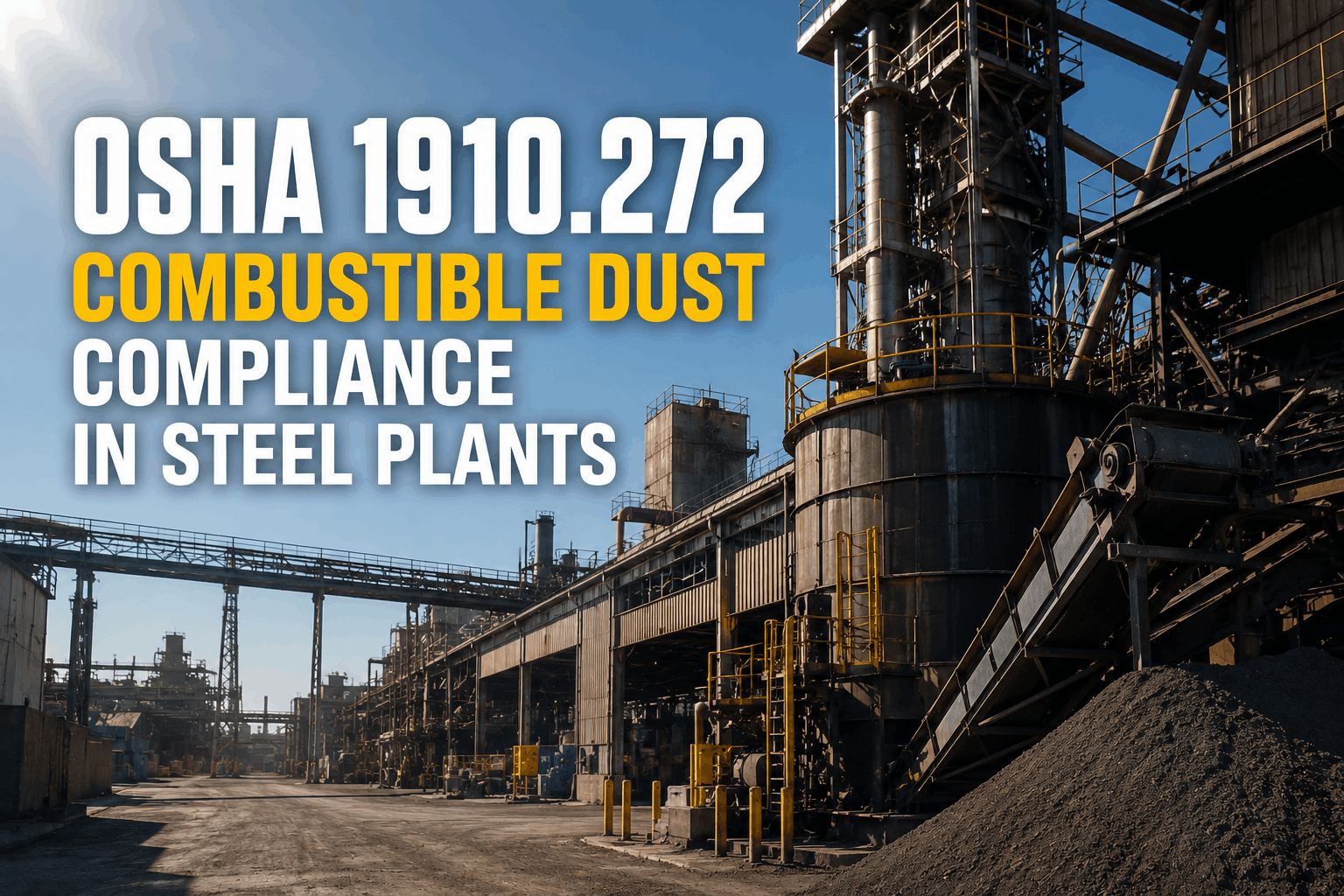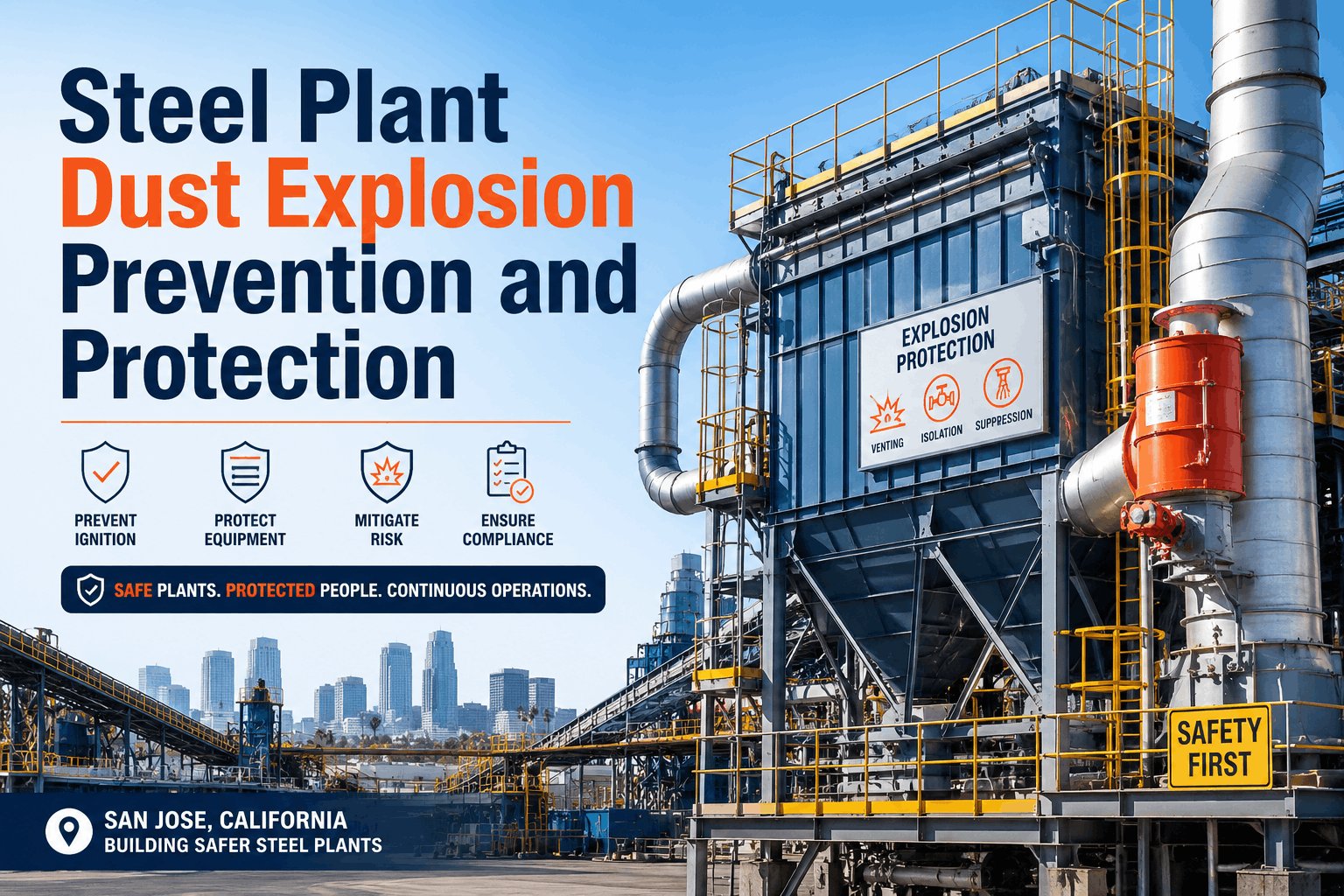
Dust explosions at steel mills occur when five elements combine: combustible dust, dispersion in air, confinement of resulting cloud, oxidant (typically oxygen), and ignition source. Primary explosions from dust clouds suspended in baghouse filters or material handling equipment can release enough energy to destroy equipment worth millions and kill workers instantly. Secondary explosions follow when the primary blast disturbs accumulated dust layers on beams and equipment, creating a new, larger dust cloud that ignites from residual heat. Steel plants producing iron oxide pellets, grinding fines, spray-dried materials, and coal handling operations face continuous combustible dust risk. Yet many facilities treat dust explosion prevention as a one-time engineering study instead of continuous operational discipline. OxMaint integrates dust hazard analysis compliance, housekeeping tracking, explosion protection equipment testing, and ignition source control into one platform—so your team treats combustible dust management as a measurable, continuously monitored risk like equipment condition or safety incidents.
Prevent Catastrophic Dust Explosions That Kill Workers and Destroy Equipment
Dust explosions are 100% preventable through systematic control of combustible dust, housekeeping discipline, and explosion protection equipment maintenance. OxMaint automates dust hazard documentation, housekeeping schedules, equipment testing, and compliance reporting so your team stays ahead of secondary explosions and regulatory exposure.
The Combustible Dust Explosion Pentagon: Five Elements That Must Coexist
Dust explosions are completely predictable—they occur only when all five elements align simultaneously. Break any single element and the explosion cannot occur. OxMaint tracks all five control points so your team maintains multiple independent defenses against ignition and dust accumulation rather than relying on any single barrier that can fail.
Combustible Dust
Any finely divided solid that burns when dispersed—iron oxide, coal fines, polymer dust, grain flour, sugar powder. Control: identify all combustible materials in your process; restrict access to materials below their minimum explosible concentration (MEC); use enclosed conveying where practical. OxMaint tracks material inventory, process changes, and new dust sources quarterly through facility walk-throughs.
Dust Dispersion
Dust suspended in air at or above minimum explosible concentration (MEC). Control: dust must be airborne AND above MEC threshold, typically 50–500 g/m³ depending on material. Control dispersion by using collection systems, maintaining negative pressure in baghouses, and avoiding excess air velocity through open piping. OxMaint monitors baghouse pressure drop and ductwork integrity so dust collection efficiency is verified continuously.
Confinement
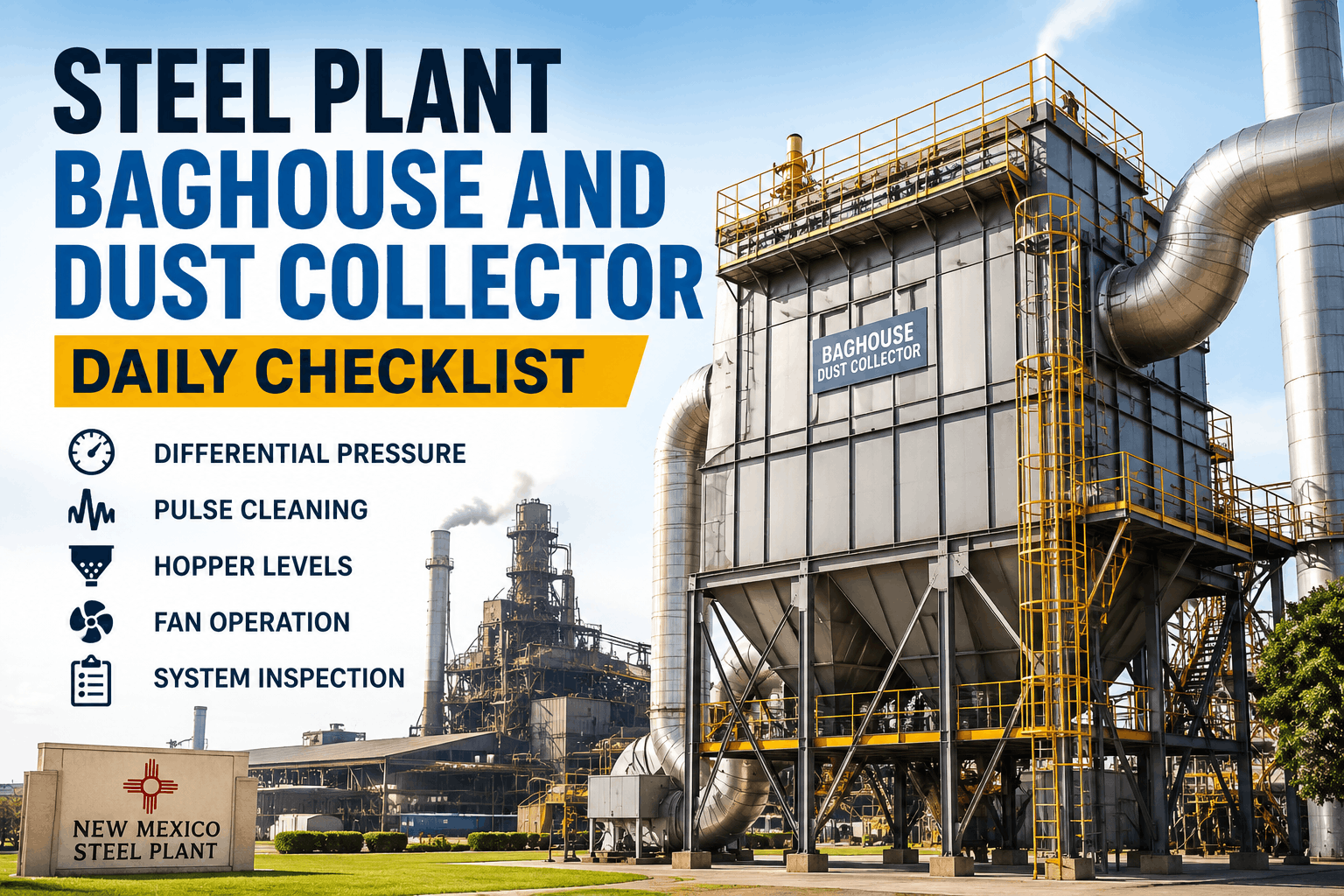
Enclosed space (baghouse, silo, ductwork, room) that allows pressure buildup during explosion. Control: baghouses must have explosion venting (NFPA 68) or isolation valves preventing flame propagation back into facility. Check valves in ductwork prevent reverse flow during explosion. OxMaint schedules annual vent inspection and isolation valve function testing so confinement protection remains effective.
Oxidant (Oxygen)
Typically atmospheric oxygen, though some combustible dusts ignite in lower oxygen environments. Control: inert gas systems (nitrogen) used in some applications replace oxygen in hazardous zones, but are uncommon in steel mills. Primary control is to eliminate or control ignition sources and dust accumulation. OxMaint tracks locations where inert systems operate and verifies purge/fill timing before operations resume.
Ignition Source
Spark, hot surface (>250°C typical), friction, static discharge, or open flame. Control: hot work permits required before welding in or near dust areas; spark detection/extinguishing systems on conveyors and grinders; static dissipation through bonding and grounding; proper maintenance of bearings to prevent friction heat. OxMaint tracks hot work permits, spark detector testing, and bearing temperature monitoring continuously.
NFPA 660 and ATEX Compliance Framework for Combustible Dust
NFPA 660 (effective December 2024) consolidates six previously separate combustible dust standards into one unified requirement. All facilities handling combustible dust must perform Dust Hazard Analysis (DHA) documenting dust locations, accumulation risks, and hazardous areas. ATEX (European directive) requires equivalent hazard zone classification and protection measures. OxMaint organizes compliance requirements by hazardous area so larger facilities manage multiple zones with clear accountability and verification.
Dust Explosion Prevention Tasks and Testing Frequency
Combustible dust control is not maintenance—it is operational discipline executed consistently across all shifts and all seasons. OxMaint schedules housekeeping rounds, equipment inspections, and testing so no area falls through the cracks during transition periods, vacation coverage, or emergency overtime.
| Dust Control Activity or Component | Required Action or Test | Frequency / Standard |
|---|---|---|
| Baghouse Explosion Vent Inspection | Visual inspection for damage, blockage, or bent deflector panels; verify vent membrane not stuck; test vent panel release pressure | Annually, or after any equipment change |
| Isolation Check Valves in Ductwork | Function test to confirm closure under backward flow simulation; inspect seat for corrosion or binding | Annually |
| Spark Detection and Extinguishing System | Function test of infrared sensors on conveyor belts and mill outlets; water spray nozzle coverage and pressure verification | Semi-annually or per manufacturer recommendations |
| Housekeeping Inspections in Dust Collection Areas | Dust accumulation removal from horizontal surfaces, roof beams, ledges, and electrical equipment; ensure no visible dust layers exceed 1/32 inch | Weekly minimum; daily during high-production periods |
| Hot Work Permit System | Issue hot work permit only if grinding/welding area is outside dust hazard zones or dust has been cleaned and water-suppressed within 24 hours prior to work | Per-incident; all hot work in or near dust areas prohibited without documented permit |
| Static Dissipation and Bonding | Resistance measurement on bonded metal equipment connections; verify connections clean and not corroded; test grounding rod continuity to earth | Annually or after any equipment relocation |
| Bearing Temperature Monitoring on Rotating Equipment | Infrared temperature scan of all mill, grinder, conveyor drive bearings operating with combustible material handling; alert if any bearing exceeds 80°C | Weekly during production |
| Dust Hazard Analysis (DHA) Update | Review DHA for changes: new equipment added, process modifications, staffing changes affecting housekeeping; document any control adjustments | Annually at minimum; immediately after process changes |
Make Combustible Dust Control Measurable and Documented
OxMaint automates housekeeping schedules, explosion equipment testing, hot work permits, and DHA compliance documentation. Every dust control action creates an audit trail so your team proves to OSHA and insurance auditors that dust explosion prevention is a continuous discipline, not a one-time checklist.
Three Conditions That Predict Imminent Dust Explosion Risk
These patterns indicate that your combustible dust control program is failing and explosion risk is elevated. Immediate action is required to break the pentagon and restore safety margins.
Any dust layer exceeding 1/32 inch (0.8mm) thickness indicates housekeeping failures and second-explosion risk. Accumulated dust on beams and ledges will be disturbed and suspended during primary explosion, forming larger secondary cloud. Halt production until all horizontal surfaces within 35 feet of baghouse and material handling equipment are cleaned.
If vent panel does not open freely during manual test or does not reseal after opening, confinement protection has failed. Equipment will rupture instead of venting safely during explosion. Stop baghouse operation immediately and schedule vent replacement before resuming collection.
Elevated bearing temperatures on pulverizers, mills, and conveyor drives indicate friction heat accumulation—a potential ignition source if dust cloud forms. Increase bearing temperature monitoring frequency to every shift. If bearing reaches 90°C, shut down immediately for inspection and cooling.
Combustible Dust Explosion Prevention: Frequently Asked Questions
What is the Dust Hazard Analysis (DHA) and who is responsible for updating it?
Can we reduce housekeeping frequency in low-dust areas if we monitor more closely?
How do we determine if baghouse explosion venting is directed to a safe area?
What happens if we detect a static electrical discharge in a dust collection area?
Are grinding operations at steel mills high-risk for combustible dust explosions?
What is ATEX Category 2 and Category 3 equipment, and where is each required?
How often should spark detection systems on conveyors be tested and maintained?
Which USA OSHA regions are most aggressive about combustible dust enforcement?
OxMaint Dust Explosion Prevention Integration Features
OxMaint connects all five elements of the dust explosion pentagon—combustible dust inventory, dispersion control, confinement protection, oxidant management, and ignition source control—into one unified compliance platform where every action creates audit-ready evidence of continuous dust safety management.
Dust Hazard Analysis (DHA) Compliance Tracking
OxMaint organizes your facility by hazardous areas (Zones 20, 21, 22 under ATEX or equivalent risk classification). Every dust source is inventoried with control strategy assigned. Whenever process changes occur, DHA is updated and change is logged with timestamp and approval. Audit trail proves continuous compliance with NFPA 660 and ATEX requirements.
Housekeeping Schedule and Completion Tracking
OxMaint schedules weekly housekeeping rounds for all combustible dust areas. Mobile app allows technicians to log dust removal completion with photographs documenting cleaned surfaces. If any scheduled round is missed, system escalates automatically. Year-long audit trail proves consistent housekeeping discipline.
Explosion Equipment Testing and Certification
OxMaint auto-schedules annual testing of explosion vents, isolation check valves, spark detection systems, and bearing temperature monitoring. Test results (vent panel release pressure, valve closure confirmation, sensor response time) log automatically with technician signature. Any failed test triggers immediate corrective work order before equipment returns to service.
Hot Work Permit Integration and Tracking
OxMaint issues hot work permits only if grinding/welding location is outside combustible dust hazard zones OR dust has been cleaned and suppressed within 24 hours. Permit requires photographic evidence of cleaned area and water suppression. All hot work logged with location, date, and operator name so enforcement patterns are visible.
Case Study: Iron Oxide Pellet Facility Prevents Secondary Explosion Through DHA Update
A 400,000-ton-per-year iron oxide pellet manufacturer in the Great Lakes region discovered during routine OSHA inspection that accumulated dust on beams and ledges exceeded NFPA limits and secondary explosion risk was uncontrolled.
"OSHA cited us for accumulation exceeding 1/32 inch in multiple locations, with willful citation penalty of $25,000. The inspector explained that a primary explosion in our baghouse, even if vented safely, would disturb settled dust on overhead beams and equipment ledges, creating a secondary cloud three to five times larger than the primary event. Before OxMaint, housekeeping was managed manually with no accountability. Cleaners worked different schedules, and nobody tracked what was actually cleaned. After OxMaint implementation, housekeeping is scheduled weekly for every dust-bearing area. Mobile app captures photographs of cleaned areas so cleanup is verified, not just reported. During the first year, we never missed a scheduled cleaning, and OSHA found zero accumulation violations. More importantly, we installed spark detection on our mills and grinding operations, linked to OxMaint for testing schedules and result logging. We also updated our DHA to clarify all hazard zones and assigned control responsibility to each. The combination of monthly DHA review in OxMaint, automatic housekeeping scheduling, and equipment testing verification transformed combustible dust from a compliance risk into a managed operational discipline."
— Operations Manager, Iron Oxide Pellet Facility, Great Lakes Region, USA
Prevent Dust Explosions Before They Destroy Your Facility
OxMaint automates Dust Hazard Analysis compliance, housekeeping schedules, explosion equipment testing, and hot work permits—so your team proves to OSHA and insurance auditors that combustible dust management is a continuous discipline with measurable evidence of effectiveness. Break any one element of the dust explosion pentagon and you eliminate explosion risk entirely. Schedule a consultation to see how OxMaint prevents the catastrophic failures that kill workers and destroy facilities worth $10M+ in equipment.