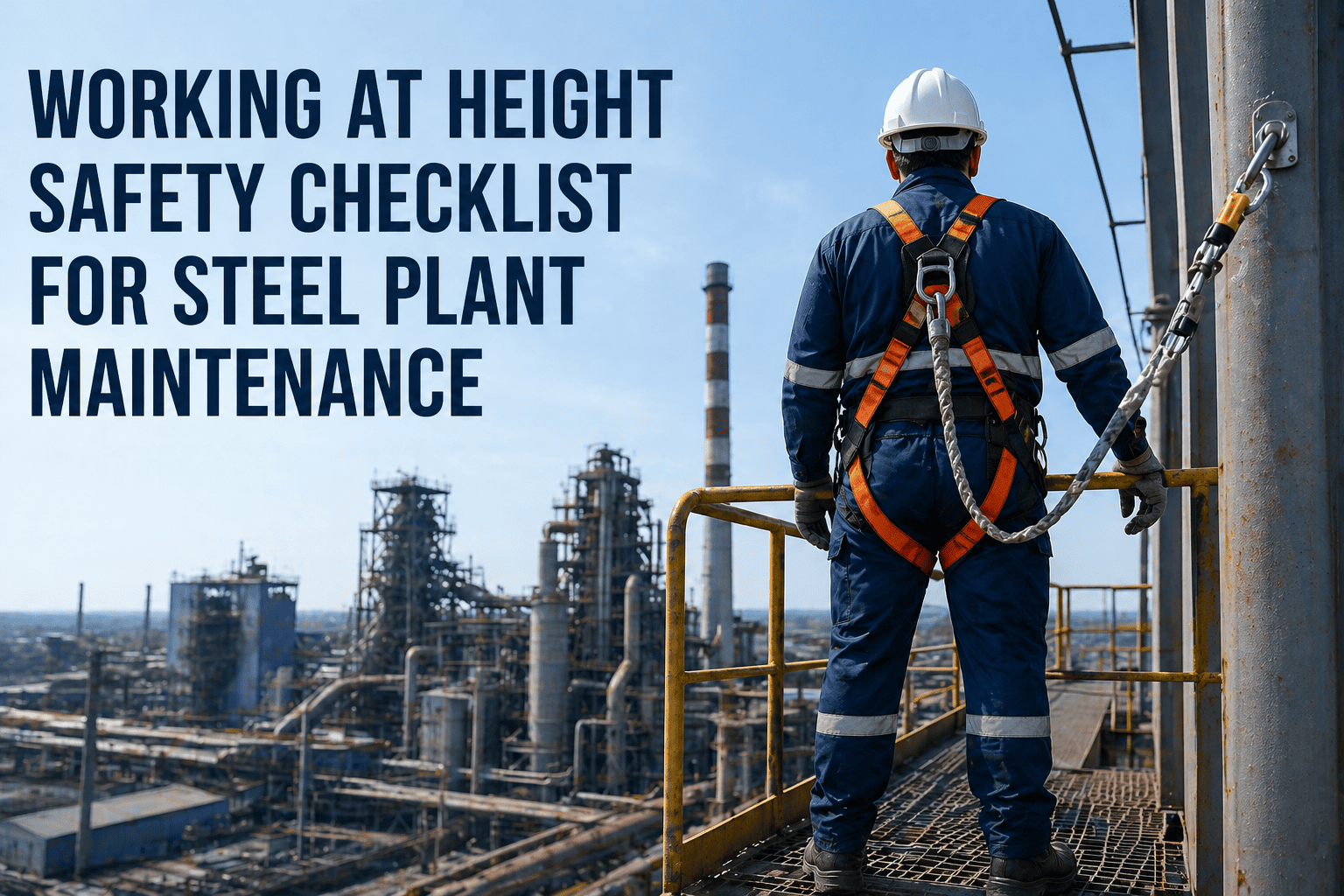
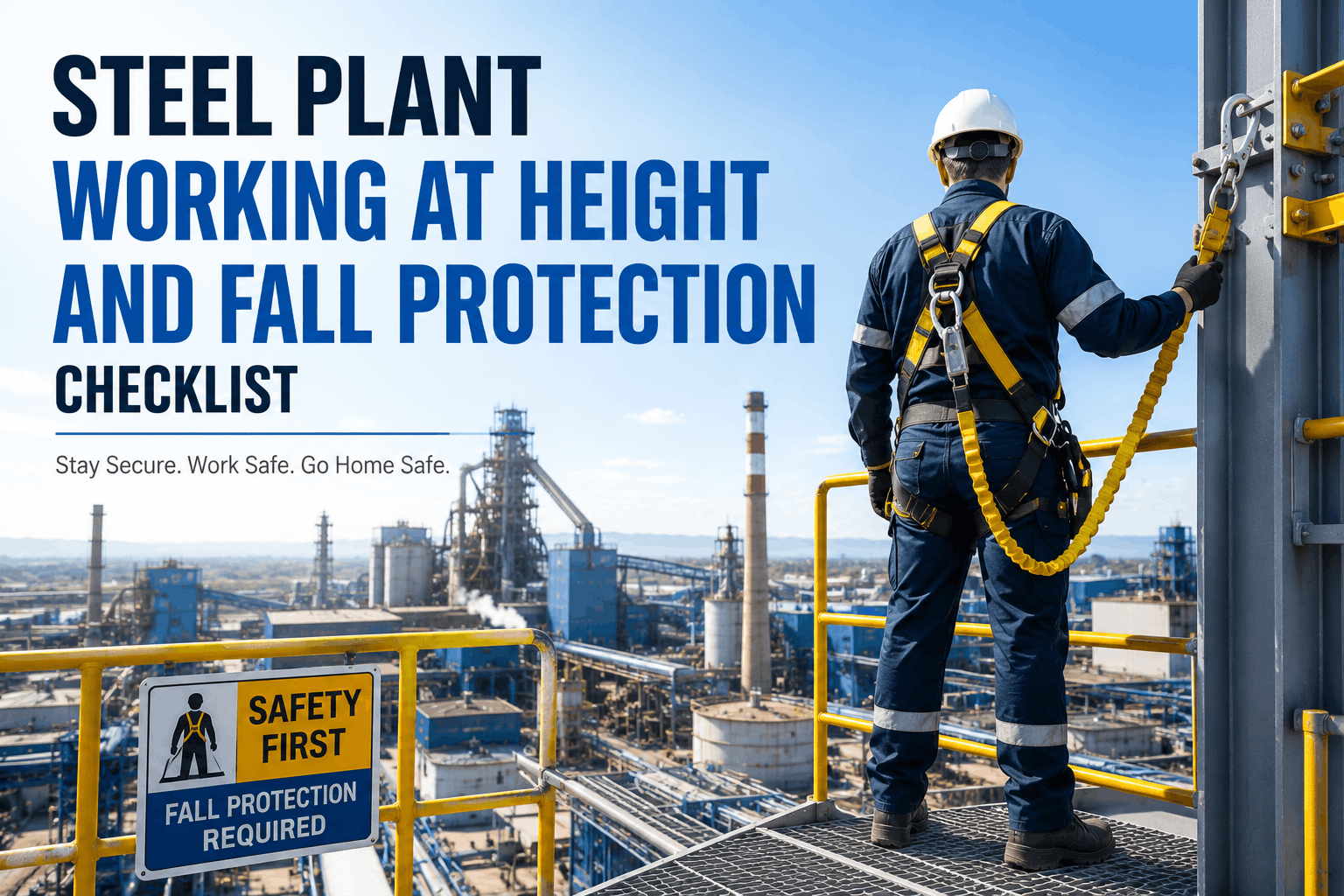
Working at Height Safety Checklist for Steel Plant Maintenance
By james smith on April 28, 2026
Falls are the leading cause of fatalities in American industry — and for the 15th consecutive year, Fall Protection – General Requirements (29 CFR 1926.501) topped OSHA's most frequently cited violations list, with 5,914 citations recorded in FY2025 alone. In a steel plant, the height hazard profile is more complex than most industrial environments: maintenance technicians work on blast furnace platforms, hot-metal transfer gantries, coke oven battery tops, converter platforms, rolling mill overhead structures, and elevated conveyor galleries — often in high-temperature, high-vibration, and corrosion-accelerated conditions that degrade fall protection equipment faster than calendar-based inspection intervals would detect. The difference between a compliant working-at-height programme and a non-compliant one is almost never the equipment specification. It is whether the inspection records, permit documentation, anchor certification, and harness pre-use verification are consistently executed and consistently documented. Book a demo to see how OxMaint's Compliance Tracking manages working-at-height permit records, anchor inspection schedules, harness certification tracking, and fall protection documentation across your steel plant operations.
Working at Height Safety Checklist for Steel Plant Maintenance
OSHA 1926.501 / 1910.28 fall protection requirements, anchor point load ratings, ANSI Z359 harness inspection standards, permit-to-work integration, and steel-plant-specific elevated work hazards — a complete compliance framework for maintenance at height in integrated steel facilities.
#1OSHA violation for 15 consecutive years — Fall Protection (29 CFR 1926.501) — 5,914 citations in FY2025
4 ft / 6 ftOSHA fall protection trigger height — 4 ft in general industry (1910.28), 6 ft in construction (1926.501)
5,000 lbsMinimum anchor point load capacity per attached worker per OSHA 1910.140(c)(13) and 1926.502(d)(15)
AnnualANSI Z359.2 formal harness inspection by Competent Person — plus pre-use visual check before every single use
Critical — unguarded edges, hot surfaces, gas exposure; OSHA 1910.28 + 1910.1000 co-application
Converter/BOF Platform
High — molten metal splatter risk; anchor corrosion from process gases; heat stress impact on PPE
Rolling Mill Overhead
High — vibration from rolling operations; oil mist on walking surfaces; overhead crane exclusion zones
Conveyor Galleries
Medium — elevated gantries with unprotected sides; dust accumulation on walking surfaces
Zone 01
Pre-Work Hazard Assessment — Before Any Elevated Work Begins
OSHA 1926.501 requires employers to determine if walking and working surfaces have the strength and structural integrity to support employees safely before allowing work to proceed. In steel plant environments where structures are exposed to thermal cycling, vibration, corrosive process gases, and mechanical stress, this assessment cannot be assumed from previous inspections — it must be performed as part of the permit-to-work process for each elevated task.
Pre-Work Assessment TasksOSHA 1926.501 / 1910.28 — Before Each Elevated Task
Working surface integrity verified — platform grating, handrails, and structural supports inspected for corrosion, mechanical damage, and thermal distortion; any section where corrosion has reduced plate thickness must be load-rated before permitting workRecord: Surface inspection on PTW form · Role: Competent Person / Safety Officer
Fall hazard identification documented — all unprotected edges, openings, holes, and areas where guardrails are absent or compromised identified and recorded; fall distance calculated for each identified hazard to determine appropriate arrest systemRecord: Hazard identification on PTW · Role: Competent Person
Thermal and atmospheric hazards assessed — areas near blast furnace casthouse, BOF converter, or ladle transfer stations require assessment of ambient temperature impact on webbing, fall distance calculation at high temperature, and co-application of hot work permit where applicableRecord: Environmental conditions log · Role: Safety Officer / Industrial Hygienist
Overhead crane exclusion zone confirmed — no elevated work to proceed within crane travel path unless crane operations are locked out and exclusion zone barriers are installed; coordinate with crane operator and operations supervisor before permit issuanceRecord: Crane exclusion on PTW · Role: Crane Supervisor + Safety Officer
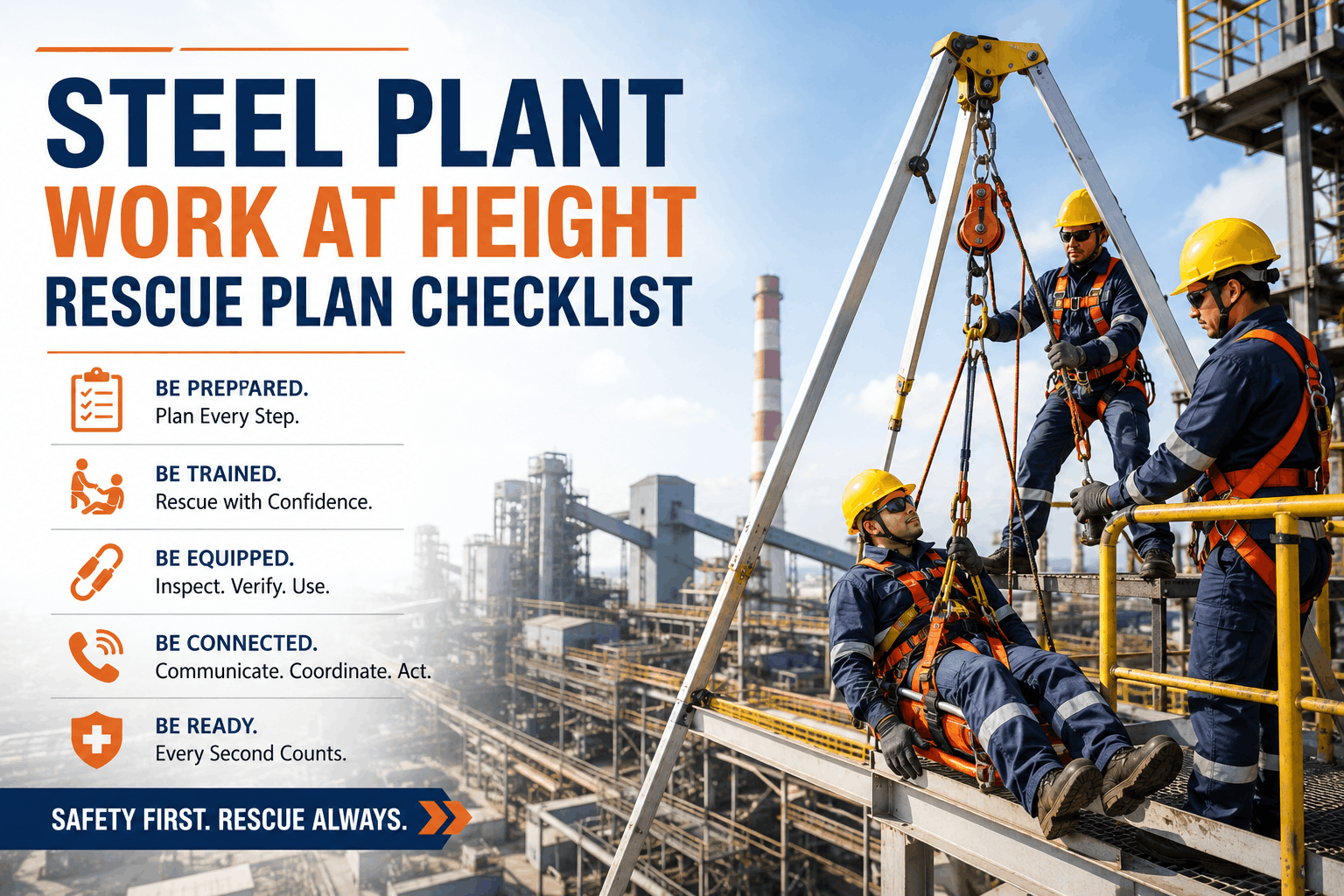
Rescue plan confirmed — a written rescue plan for prompt retrieval of a fallen and suspended worker is required before work at height begins; rescue must be achievable within minutes to prevent suspension trauma; confirm rescue equipment is in location and rescue team is availableRecord: Rescue plan document attached to PTW · Role: Safety Officer
Zone 02
Anchor Point Inspection — OSHA Load Requirements and Steel-Plant Corrosion Risk
OSHA 1910.140(c)(13) and 1926.502(d)(15) both require anchor points to be capable of supporting at least 5,000 pounds (22.2 kN) per attached worker — or to be part of an engineered system with a safety factor of at least two, designed under the supervision of a qualified person. In steel plant environments, permanent anchor points are subject to accelerated corrosion from process gases (SO₂, H₂S, HCl), thermal cycling, and scale accumulation that can reduce load-bearing capacity below the 5,000-pound threshold without visible deterioration. Annual third-party anchor certification is the minimum — and in corrosive zones such as acid pickling areas and coke oven batteries, semi-annual inspection is operationally justified.
Anchor Point Inspection TasksOSHA 1910.140(c)(13) — 5,000 lbs Per Worker
Permanent anchor visual inspection — corrosion assessment at base plate welds, bolt holes, and load-bearing connections; any visible section loss, cracking, or weld defect requires anchor to be taken out of service pending engineering assessmentRecord: Anchor inspection form with photo documentation · Role: Competent Person
Annual certification by qualified person — each permanent anchor must be certified as capable of supporting 5,000 lbs per attached worker; certification record retained showing date, inspector identity, anchor ID, and load rating confirmed; OxMaint tracks certification expiry per anchor assetRecord: Annual certification document per anchor in OxMaint · Role: Qualified Person (PE or anchor-certified inspector)
Anchor hardware condition check — D-ring, shackle, or carabiner condition at attachment point; locking mechanisms functional; no visible deformation, scoring, or corrosion on load-bearing surfaces; replace any connector showing surface defects regardless of inspection intervalRecord: Hardware inspection form · Role: Competent Person
Horizontal lifeline system certification — engineered horizontal lifeline systems (traveller systems) require formal re-certification per manufacturer specifications; OSHA 1910.66(g)(2) requires certification records including date, inspector signature, and equipment identifier to be retained by the building ownerRecord: Lifeline certification document per system in OxMaint · Role: Qualified Person / Manufacturer-Certified Inspector
Anchor use restriction signage verified — each permanent anchor labelled with maximum worker capacity, certification date, and any use restrictions; unlabelled or out-of-certification anchors tagged out of service and physically blocked from useRecord: Signage inspection log · Role: Safety Officer
OxMaint tracks every anchor point as an individual asset — storing certification dates, load ratings, inspection history, and expiry alerts. Overdue anchor certification is flagged before the permit is issued, not discovered during an OSHA visit.
Harness & Personal Fall Arrest Equipment — ANSI Z359 Inspection Requirements
ANSI Z359.2 establishes two mandatory inspection levels for personal fall arrest equipment: a visual pre-use check before every single use by the worker, and a formal documented inspection at least every 12 months by a Competent Person. In steel plant environments, the pre-use check is not a procedural courtesy — it is a safety-critical step. Harness webbing exposed to heat radiation near the blast furnace or BOF platform can degrade without visible surface damage. Any harness component subjected to arrest forces must be immediately removed from service and destroyed — regardless of visual appearance, as internal fibre damage cannot be assessed without destructive testing.
Pre-Use Check — Before Every Use (Worker)ANSI Z359.2 — Pre-Use Inspection Required
Webbing condition — inspect entire harness webbing for cuts, abrasions, burns, chemical damage, heat damage, or UV degradation; any fraying, discolouration, or stiffness indicates potential webbing compromise; do not use if webbing shows any defectRecord: Pre-use check log · Role: Worker (self-inspection)
Hardware inspection — buckles, D-rings, snaphooks, and all connectors checked for corrosion, deformation, and locking mechanism function; locking snaphooks (mandatory since January 1, 1998 per OSHA 1926.502) must close and lock positively with audible clickRecord: Pre-use check log · Role: Worker (self-inspection)
Shock absorber deployment indicator checked — inspect deployment indicator on shock-absorbing lanyard; any deployment of the shock absorber (even partial) means the lanyard has been subjected to arrest forces and must be immediately removed from service — it cannot be reset or reusedRecord: Pre-use check log · Role: Worker (self-inspection)
SRL (self-retracting lifeline) condition and retraction test — lifeline retracts smoothly under light tension; braking mechanism locks when lifeline is pulled sharply; no visible damage to housing or lifeline; clean and lubricate per manufacturer's scheduleRecord: Pre-use check log · Role: Worker (self-inspection)
Full documented inspection of all harness components — harness serial number recorded; each webbing section, all hardware, stitching patterns, fall indicator tags, and label legibility assessed against removal-from-service criteria; findings documented per componentRecord: Annual harness inspection form per serial number in OxMaint · Role: ANSI Z359-qualified Competent Person
Post-arrest protocol enforced — any harness, lanyard, or SRL subjected to arrest forces during a fall event must be removed from service immediately and destroyed or tagged "Post-Fall — Do Not Use"; a new unit issued and the incident recorded in OxMaint with the equipment serial numberRecord: Post-arrest equipment disposition record · Role: Safety Officer
Zone 04
Permit to Work Integration — Elevated Work Authorisation
In an integrated steel plant, working at height is not a standalone activity — it almost always occurs in conjunction with hot work, LOTO (lockout/tagout), confined space, or crane exclusion requirements. An effective permit-to-work system for elevated work must capture the fall protection system selected, the anchor point identification and certification status, the harness and lanyard serial numbers deployed, and the rescue plan in force — before any work begins. A maintenance event where these elements cannot be verified should not proceed.
Permit to Work — Required InformationOSHA General Duty Clause / Company SMS
Fall protection method specified — guardrail, safety net, personal fall arrest, or travel restraint; method must match the task type and working surface; if PFAS is selected, the specific anchor point ID and its current certification status must be confirmed in OxMaint before permit is issuedRecord: Fall protection method on PTW · Role: Permit Issuer
Harness serial numbers recorded — each worker's harness serial number and last annual inspection date recorded on the PTW; harnesses with expired annual inspection must not be used; OxMaint generates automatic alert when any assigned harness has an inspection overdueRecord: Equipment serial numbers on PTW · Role: Permit Issuer / Safety Officer
Co-permit dependencies confirmed — hot work permit (if welding or grinding at height), LOTO verification (if working near energised equipment), crane exclusion confirmation, and confined space permit (if accessing elevated enclosed spaces) all referenced and cross-checked before elevated work PTW is issuedRecord: Co-permit reference numbers on elevated work PTW · Role: Permit Issuer
Toolbox talk completed and recorded — pre-task toolbox talk covering hazards specific to the location, fall distances, anchor points in use, emergency contact, and rescue procedure; all attendees sign acknowledgement; record retained in OxMaint against the work orderRecord: Toolbox talk sign-off sheet attached to work order · Role: Supervisor / Safety Officer
Zone 05
Steel-Plant-Specific Elevated Hazards
Steel plant elevated work environments present hazard combinations that are not present in other industrial settings. Standard fall protection equipment and procedures require adaptation to remain effective in these conditions — a fact that is often underestimated by contractors and temporary workers unfamiliar with integrated steelmaking operations.
Radiant Heat — Harness Webbing Degradation
Synthetic webbing (polyester, nylon) used in harnesses and lanyards degrades at sustained temperatures above 150–180°C. Work near the blast furnace casthouse, BOF tapping platform, or ladle transfer station can expose webbing to radiant heat exceeding these thresholds even without direct contact. Pre-use webbing inspection in these zones must specifically check for heat-induced stiffening, discolouration, or glazing — indicators of thermal degradation that compromises tensile strength without visible fibre damage. Heat-resistant harnesses rated to higher temperatures are available and should be specified for routine work in thermal zones.
Process Gas Corrosion — Anchor and Hardware Degradation
Coke oven batteries, acid pickling lines, and desulphurisation systems produce atmospheric concentrations of SO₂, H₂S, HCl, and CO that accelerate corrosion of anchor base plates, D-ring hardware, and lifeline components at rates significantly above general industrial environments. Anchors in these zones should be inspected at semi-annual intervals minimum — not annual — and hardware should be stainless or hot-dip galvanised rather than standard zinc-plated. OxMaint allows zone-specific inspection intervals to be configured per anchor location, so corrosive-zone anchors receive higher-frequency work orders than general plant anchors.
Vibration — Walking Surface and Anchor Fatigue
Rolling mill gearboxes, pellet plant vibrating screens, and blast furnace charging equipment transmit continuous vibration to elevated platforms and their structural connections. Vibration accelerates fatigue crack formation in anchor base plate welds and can loosen anchor fasteners between inspection intervals. Any anchor on a vibrating structure requires more frequent pre-use inspection of fastener torque and weld condition than anchors on static structures. Include vibration exposure level in the anchor location risk classification recorded in OxMaint.
Overhead Crane Interference — Exclusion Zone Compliance
Elevated maintenance in crane-served bays — casthouse, melt shop, rolling mill, and warehousing — must be coordinated with crane operations. A worker on an elevated gantry within an active crane travel path is at risk from both direct strike and from load swing if the crane stops or starts while a load is positioned nearby. The PTW must confirm crane operations are suspended, locked out, or restricted to a defined exclusion zone that does not intersect the elevated work area. This coordination must be re-confirmed if the permit period extends past a crane shift change.
Zone 06
Documentation & Compliance Records — What OSHA Requires You to Keep
Record Type
Required Content
Retention
OSHA / Standard Reference
OxMaint Module
Anchor certification record
Date, inspector identity and qualification, anchor ID, load rating confirmed
Duration of use + 3 years
OSHA 1910.66(g)(2)(iii); 1910.27(b)(1)(ii)
Anchor asset record per unit; expiry alert
Annual harness inspection
Serial number, inspection date, Competent Person name, findings, pass/fail per component
Life of equipment + 1 year
ANSI Z359.2 §6.2
PPE asset record per serial; annual inspection WO
Permit to work records
Work location, fall protection method, anchor IDs used, harness serials, rescue plan, co-permits, sign-off
Minimum 3 years
OSHA General Duty Clause; company SMS
Work order linked documents; searchable by location
Post-fall equipment disposition
Equipment serial numbers, fall event date, disposition (destroyed/quarantined), replacement issued
5 years minimum
ANSI Z359.2 removal-from-service criteria
Incident-linked equipment record in OxMaint
Horizontal lifeline recertification
System ID, test date, inspector, load ratings, any deficiencies found
Duration of use + 3 years
OSHA 1910.66(g)(2); manufacturer specification
Lifeline system asset record; recertification WO
Worker training records
Worker name, training date, trainer, topics covered, and competency assessment result
Duration of employment + 3 years
OSHA 1926.503; 1910.30
Worker training record in Workforce Management; expiry alert
"
The most dangerous moment in steel plant working-at-height is not when the worker is 30 metres up on the blast furnace platform. It is the moment before they leave the ground, when the permit to work is issued without a proper check of whether the anchor point they are about to attach to has a current certification. In fifteen years of safety auditing in integrated steel facilities, I have found uncertified anchors — anchors that have never been load-tested, anchors whose certification lapsed two years ago, anchors in corrosion-accelerated zones that were last inspected under a general plant schedule that did not account for the aggressive chemical environment they were operating in. Every one of those anchor points had workers attached to it. OxMaint's anchor asset tracking with zone-specific inspection intervals is exactly the system that closes this gap — and it is a gap that OSHA citations confirm is still open in facilities across the industry.
Priya Venkataraman, NEBOSH IGC, CMIOSH · Senior Safety Engineer, Tata Steel Long Products · 17 Years Steel Plant Safety Management · Specialist in working-at-height programmes, permit-to-work systems, and OSHA compliance for integrated steelmaking operations
FAQs
Frequently Asked Questions
Does every fall protection anchor in a steel plant need to be rated at exactly 5,000 lbs?
Under OSHA 1910.140(c)(13), anchor points must either be capable of supporting 5,000 lbs per attached worker, or be part of a complete engineered fall protection system designed by a qualified person with a minimum safety factor of two. The 5,000-lb standard is the prescriptive path; an engineered system with documented safety factor of two satisfies OSHA through the performance path. In practice, in steel plant environments where structural modifications are common and some attachment points are not purpose-designed fall protection anchors, using an engineered system assessed by a qualified person is often more feasible than certifying every potential attachment point to the 5,000-lb prescription. OxMaint records both the load rating and the compliance path (prescriptive or engineered) for each anchor asset. Book a demo to see OxMaint's anchor certification tracking module.
What must happen immediately when a harness or lanyard is subjected to fall arrest forces?
Under ANSI Z359.2 removal-from-service criteria, any component of a personal fall arrest system that has been subjected to fall arrest forces must be immediately removed from service and destroyed or permanently quarantined — this includes the harness, lanyard, shock absorber, and any connecting hardware. This applies even if the equipment shows no visible damage, because internal fibre and component damage cannot be assessed without destructive testing. The equipment serial numbers must be recorded in the incident record, a replacement unit issued, and the incident documented in OxMaint with the work order that generated it. See OxMaint's post-arrest equipment disposition workflow.
How does OxMaint integrate fall protection compliance with the permit-to-work system?
OxMaint links anchor certification records and harness inspection records to the permit-to-work module so that permit issuers can verify compliance status at the time of permit issue — not after the fact. When a work order is created for elevated work, OxMaint identifies the work location, retrieves the anchor certification status for anchors in that zone, and checks whether assigned workers' harnesses have current annual inspections. If any element is expired or missing, the permit issuance workflow generates a compliance gap alert before the work proceeds. The PTW record with all referenced equipment serial numbers and certification records is stored against the work order for the retention period required by OSHA.
Compliance Tracking · OxMaint · Working at Height
Every Anchor Certification. Every Harness Inspection. Every Permit Record. One Compliance Trail.
OxMaint's Compliance Tracking links anchor asset certification schedules, harness annual inspection records, and permit-to-work documentation into a single audit-ready system — so your steel plant's working-at-height programme can demonstrate compliance to OSHA inspectors in minutes, not days of record assembly.