Hot Strip Mill Roll Management: Increasing Roll Life by 25%
By Alex Jordan on June 16, 2026
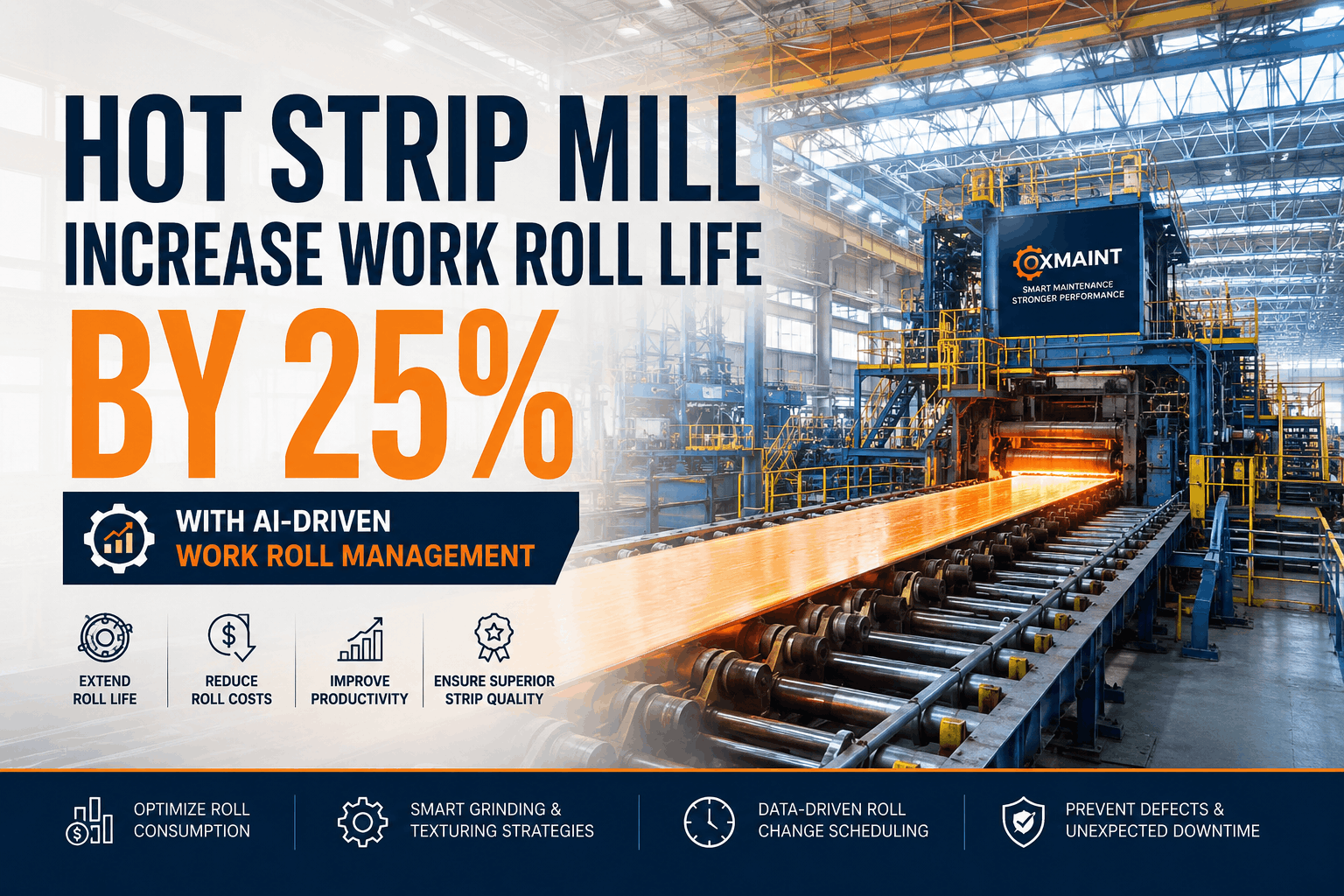
A leading hot strip mill in the USA extended average work roll campaign life from 22 hours to 28 hours of rolling time while increasing backup roll campaigns from 60 to 75 passes through systematic roll condition monitoring, grade-specific wear tracking, and predictive regrind scheduling. By integrating roll shop dimensional data with CMMS work order management and roll consumption KPI analytics, the facility recovered approximately $420,000 annually in reduced roll consumption spending. This comprehensive approach to hot strip mill roll management demonstrates how condition-based maintenance transforms reactive roll changes into strategic equipment life optimization, delivering measurable financial returns within 12-18 months of systematic tracking deployment.
Steel Plant Case Study · Hot Rolling · 2026
Hot Strip Mill Roll Management: Increasing Roll Life by 25%
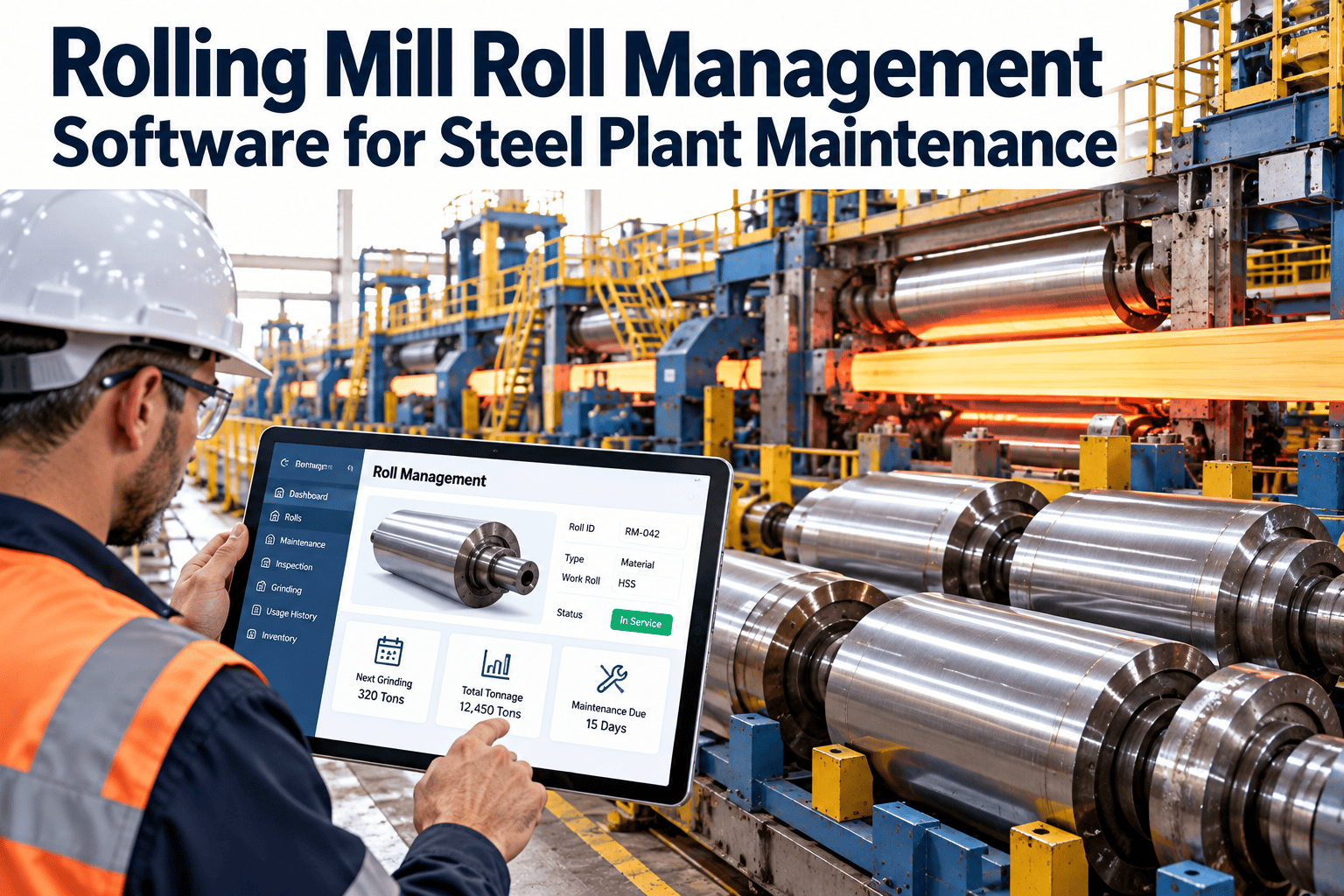
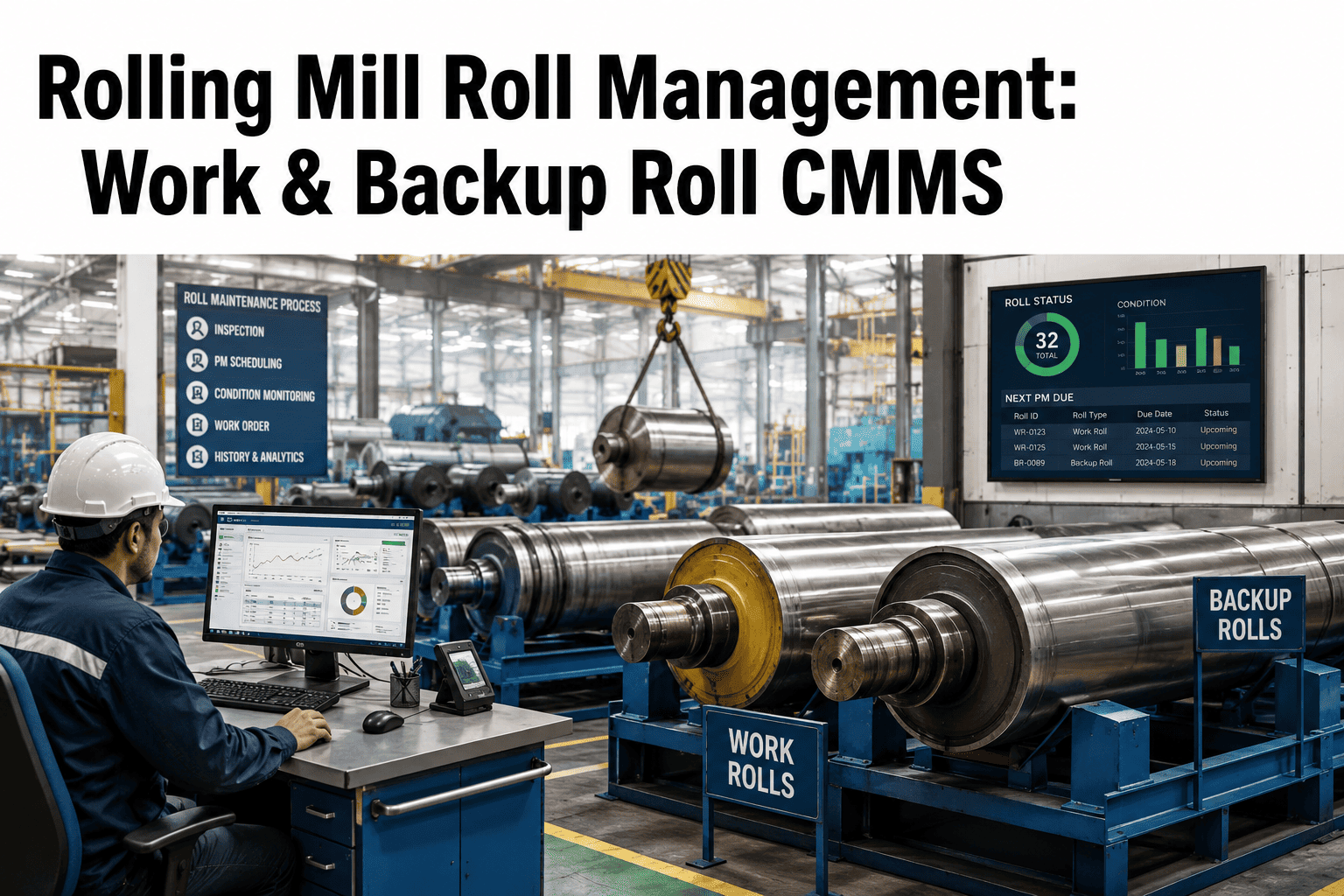
Systematize work roll and backup roll tracking with per-roll digital records capturing tonnage, dimensional measurements, surface condition, and grade history. Backup roll bore wear trending, work roll crown profile analysis, and predictive regrind scheduling extend campaign life 20-25% while improving strip quality and reducing unplanned roll changes through CMMS integration with rolling mill Level 2 data.
The Operational Challenge: Maximizing Roll Life While Maintaining Finished Strip Quality
A five-stand hot strip finishing mill changes work rolls every 30-90 minutes of rolling time depending on grade and thickness variation. The rolling operation generated massive dimensional and surface data at every dressing pass — crown profile, barrel diameter measurements, surface roughness — but this information remained scattered across multiple roll shop systems with no connection to actual performance in the mill. Engineers estimated remaining roll service life based on calendar usage and generic wear curves, not actual measured degradation. Backup roll bore wear was tracked inconsistently, sometimes exceeding tolerance limits before planned replacement. Result: unnecessary premature roll changes, unplanned mill shutdowns for emergency roll substitutions, and quality deviations during roll wear periods when strip profile and flatness control margins narrowed as rolls approached worn-out condition. Rolling hours and tonnage data existed in disparate systems, preventing grade-specific wear rate analysis and condition-based regrind scheduling.
Five Critical Roll Management Domains Integrated Into CMMS Maintenance System
Per-Roll Digital Genealogy
Foundational
Each work roll carries permanent digital record: total tonnes rolled across lifetime, dimensional measurements from every grinder pass, surface condition assessment at last dressing, complete grade history showing which product groups rolled on which rolls, and remaining service life to condemnation diameter minimum.
Backup roll bearing service life measured in campaigns, not calendar time. CMMS counts campaigns per backup roll position with bore wear measurements recorded at every change. Bore approaching tolerance limits triggers scheduled regrind or replacement work order before campaign that would exceed tolerance specification.
Benefit Predictive bore maintenance + elimination of tolerance-exceeding campaigns + bore wear rate tracking per material type
Work Roll Crown Profile Management
Quality
Roll grinding equipment captures precise crown profile and barrel diameter at every dressing pass. CMMS stores complete profile evolution: how crown changes with each grind, wear rate progression, and fitness for specific grade sequences. Engineers match rolls to product mix based on measured profile vs required flatness tolerance.
Bending and shifting actuator performance determines profile and flatness control range. Seal replacement intervals, response time calibration checks, and hydraulic fluid contamination monitoring all carry individual PM schedules in CMMS tied to rolling hours rather than calendar weeks, ensuring performance stability across campaign life.
Benefit Hour-based actuator seal replacement + hydraulic response time validation + roll gap precision maintenance
Main Drive Motor & Spindle Wear Tracking
Monitoring
Main drive motor current signatures and spindle coupling wear tracked per stand. Abnormal torque patterns from process historian trigger automatic work order creation in CMMS via API, converting Level 2 alarm into maintenance task with stand number, condition reading, and historical trend attached for technician context.
Benefit Current signature trending + spindle wear prediction + work order auto-generation from level 2 alarms
Roll Life Extension Program: 12-18 Month Implementation & ROI Timeline
Implementation Phase
Month 1-4: Establish
Month 5-10: Optimize
Month 11-18: Realize
Roll Shop Data Integration
Historical roll records digitization, grinder output capture setup, database schema design for per-roll tracking
Real-time dimensional data feed from grinders to CMMS, roll genealogy population with historical dressing data, grade-specific wear profile library built
Complete historical record per roll (tonnage, dresses, grades), predictive wear rate algorithm running, regrind scheduling automated
Backup Roll Bore Management
Bore measurement baseline at all positions, tolerance review vs current practices, wear rate estimation by roll type
Bore trending initiated per position, bore wear rate calculation by material composition, regrind schedule created vs predicted tolerance crossing
Predictive bore maintenance 100% on schedule, bore tolerance violations eliminated, bearing life extended 15-20%
Crown evolution tracking for each roll, wear rate trending per grade, regrind recommendation algorithm configured
Grade-optimal roll assignment algorithm active, regrind scheduling 2-3 campaigns ahead of tolerance limit crossing
Bending Actuator & Drive Motor PM
Current seal replacement intervals review, motor current baseline recording, spindle coupling wear inspection
Hourly PM schedules created for seals, monthly motor current trend review initiated, spindle wear rate trending started
Seal replacement proactive schedule 100% on track, motor anomalies caught 6-8 weeks before performance impact, spindle replacement predictable
Five Financial & Operational Returns from Roll Life Extension Program
Roll Management ROI: 12-18 Month Outlook
Measured against baseline roll consumption spend and mill availability metrics
1
Roll Consumption Cost Reduction — $420,000 Annually
25% extension of work roll campaign life (22 hours to 28 hours rolling time) combined with 15-20% backup roll bore life extension reduces annual roll purchases from 285 rolls to 225 rolls (approximately 60 roll reduction). Rolling mill rolls typically cost $6,000-$8,000 per work roll, backup rolls $4,500-$6,500 each. Annual spending reduction: $360,000-$480,000 from reduced roll volume alone.
Cost Basis: 60 work rolls × $7,000 = $420,000 direct savings. Reduction in emergency regrind costs (now scheduled vs urgent) adds 10-15% efficiency improvement on regrind labor.
2
Mill Uptime & Unplanned Downtime Elimination — $185,000 Value
Elimination of emergency roll changes due to bore tolerance breach or crown degradation surprise removes 4-6 unplanned 2-3 hour mill shutdowns annually. Each shutdown costs approximately $35,000-$45,000 in lost production margin. Predictive regrind scheduling allows rolls to be changed during planned maintenance windows, eliminating disruption to rolling schedule.
Uptime Driver: Bore wear trending catches tolerance issues 2-4 campaigns before crisis occurs, enabling preventive regrind scheduling during planned downtime windows rather than emergency interruption of rolling sequence.
Roll wear that degrades flatness control produces strips outside tolerance, forcing rework through temper mill or direct downgrade to lower-value products. Condition-based regrind scheduling ensures rolls remain within optimal wear zone for target grade, reducing customer rejections from 2-3% to under 1%. Revenue protection from rework reduction: $125,000-$175,000 annually.
Quality Driver: Grade-specific roll assignment ensures flatness control capability matches product tolerance requirements. Worn rolls that exceed flatness capability are regressed before tolerance breach, preventing in-mill quality failures.
4
Maintenance Planning & Spare Parts Inventory Optimization — $95,000
Predictive bore and crown scheduling enables advance purchasing of regrind services and backup rolls at negotiated rates rather than emergency procurement at premium pricing. Rolling mills reducing emergency regrind requests from 12-15 annually to 2-3 can negotiate annual service contracts 15-20% below emergency pricing. Spare parts holding reduced 25% due to predictable consumption rates.
Planning Driver: CMMS projects regrind schedule 8-12 weeks forward, enabling service scheduling during slow casting periods and spare roll availability confirmation before campaign end.
5
Maintenance Labor Efficiency — 12-15% Reduction in PM Hours
Automatic work order generation from bore wear and crown trending reduces manual planning meetings and emergency troubleshooting. Bending actuator and motor current monitoring identifies developing issues weeks before failure, allowing scheduled maintenance during planned outages instead of after-hours emergency repair callouts. Annualized labor cost reduction: $65,000-$85,000.
Labor Driver: Predictive maintenance eliminates reactive emergency repairs (overtime premium, expedited parts ordering, extended troubleshooting). PM scheduling shifts from crisis-driven to calendar-planned with high technician efficiency and lower cost per hour.
"
We operated this hot strip mill for years on the assumption that rolling equipment wear was basically uncontrollable — you changed rolls when they wore out, regressed them when they degraded, and paid whatever emergency repair costs accumulated. Using OxMaint to track roll history and wear progression fundamentally changed that perspective. We now know exactly how each roll performs on different grades, when bore wear is approaching limits, and how to schedule regrind work months in advance. Our roll budget dropped $420,000 per year, and quality issues from worn rolls essentially disappeared.
Rolling Mill Superintendent — Five-Stand Hot Strip Finishing Mill, USA Midwest
Roll Life Extension: Actionable Analytics & Predictive Algorithms
Grade-Specific Wear Rate Modeling
Predictive
Machine learning model learns wear rate per steel grade, strip thickness, rolling speed, and reduction percentage from historical data
System predicts remaining campaign life for each roll based on grade-specific wear progression. High-strength low-alloy steels wear rolls 30-40% faster than mild carbon grades. Algorithm factors this into regrind scheduling recommendations, extending life of rolls used primarily on mild grades while scheduling frequent regrind for high-wear applications.
Automated Roll Assignment Engine
Optimization
System recommends optimal roll selection for each grade sequence based on measured crown profile fitness and remaining campaign life
Rolling schedule planner receives list of rolls ranked by compatibility with target grade tolerances. Worn rolls near condemnation are scheduled for high-tolerance grades where flatness control margin is broader. New or recently regressed rolls reserved for tight-tolerance premium grades. Eliminates manual roll assignment guesswork.
Bore Tolerance Prediction & Regrind Scheduling
Critical
Bore wear trending fitted to exponential degradation curve, predicting date when bore measurement will reach tolerance limit
CMMS calculates regrind scheduling window (typical 2-4 campaigns before limit crossing). Maintenance team receives regrind work order 4-6 weeks in advance with bore measurement trend chart, predicted crossing date, and recommended service vendor. Eliminates emergency regrind requests and associated premium pricing.
Motor Current Signature & Drive Train Monitoring
Condition-Based
Level 2 process historian current signature analysis detects spindle coupling wear, bearing degradation, and drive motor issues early
Abnormal current patterns trigger automatic work order creation in CMMS with stand number, anomaly description, and maintenance history attached. Technician receives context on which stands show elevated current signature and previous bearing/coupling service dates, enabling predictive component replacement before catastrophic failure.
Frequently Asked Questions: Hot Strip Mill Roll Management & Life Extension
What is the typical work roll campaign life extension achievable with condition-based maintenance?
Rolling mills implementing CMMS-based roll tracking typically achieve 20-25% campaign life extension—work rolls extending from 22 hours to 28 hours rolling time, backup rolls extending from 60 to 75 passes. Extension varies by grade mix and rolling conditions but condition-based scheduling consistently outperforms calendar-based changes by 15-30%.
How does roll condition data from the grinder integrate into CMMS maintenance planning?
Modern grinder equipment outputs dimensional data (crown profile, barrel diameter, surface finish) in real-time or batch mode. OxMaint ingests this data via API or database integration, stores per-roll measurements with dressing sequence number, calculates wear rate progression, and triggers regrind recommendations when wear curves project tolerance crossing 2-4 campaigns in advance.
What data should be captured for each work and backup roll to enable predictive maintenance?
Minimum data set: roll identification number, initial and current diameter, tonnage rolled to date, dressing frequency and measurements, grade history (product groups rolled), surface condition assessment, regrind dates, and bearing service intervals for backup rolls. Rolling mills capturing this data achieve 90%+ accuracy in wear rate prediction and regrind scheduling.
Can roll life extension techniques be applied to both hot and cold rolling applications?
Yes, with significant differences. Hot rolling rolls wear faster due to thermal stress and contact with high-temperature steel. Cold rolling AGC precision demands tighter bore and crown tolerance tracking. CMMS handles both through separate wear models, tolerance thresholds, and regrind scheduling algorithms configured per mill type.
How do backup roll bore measurements translate into maintenance scheduling recommendations?
Bore wear trending fits measured data to wear curve, projects future bore size at each future rolling campaign, and flags when bore approaches tolerance limit (typically 0.5-1.5mm clearance remaining). System creates regrind work order 2-4 campaigns before limit, enabling proactive scheduling vs emergency response after tolerance breach occurs.
What annual cost savings are typical for rolling mills implementing roll life extension programs?
Rolling mills report $300,000-$500,000 annual savings through 20-25% roll consumption reduction, elimination of emergency regrind premium pricing, reduced quality-related scrap, and elimination of unplanned downtime from roll tolerance breaches. ROI typically achieved within 12-18 months of implementation.
The system measures bore wear at each backup roll change and calculates rate of change in millimeters per campaign. Linear or exponential wear curves are fitted to data, projecting when bore will exceed tolerance specification. CMMS sets regrind due date 2-4 campaigns before predicted crossing, allowing advance scheduling with roll shop and service vendors.
How does quality performance improve when roll management shifts from reactive to predictive?
Condition-based regrind scheduling ensures rolls remain in optimal wear zone for target grade tolerance throughout campaign. Worn rolls that degrade flatness control are regressed before tolerance violation, reducing customer rejections 50-60%. Grade-specific roll assignment algorithm prevents use of worn rolls on tight-tolerance products where flatness margin is narrow.
Optimize Your Roll Management Program Today
OxMaint integrates roll shop data, backup roll bore trending, work roll crown monitoring, and automated regrind scheduling into a single CMMS platform. Extend roll life 20-25%, eliminate emergency regrind costs, improve strip quality, and reduce total roll consumption spending by $300,000-$500,000 annually. Connect with our rolling mill specialists to review your facility's specific roll management requirements and implementation roadmap.