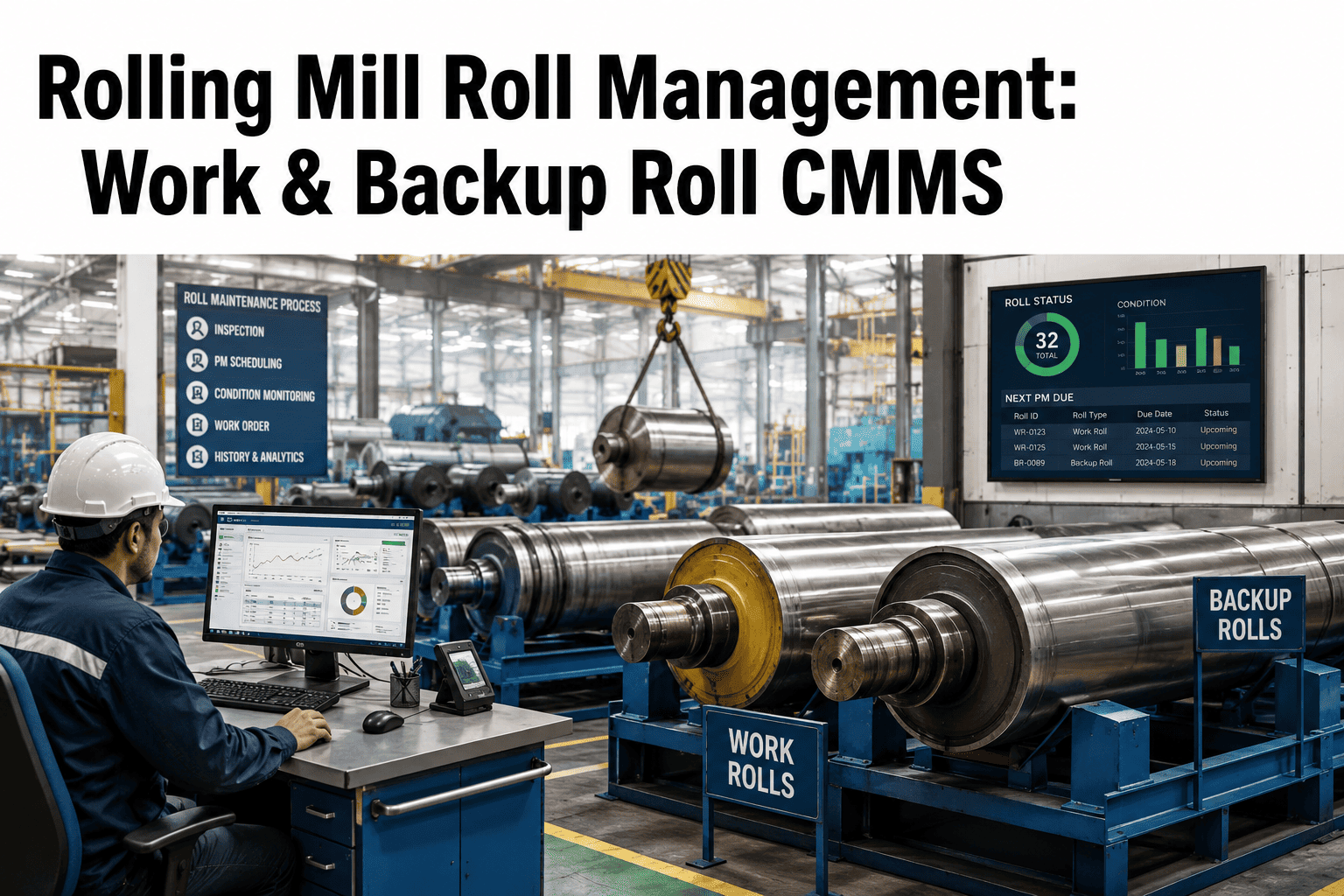
Rolling mill roll management governs work rolls, backup rolls, and intermediate rolls across every stand in a hot or cold mill — and it is the single variable that dictates strip quality, yield, and cost per tonne. Mills that track individual roll assets, regrind history, bearing temperature logs, and campaign performance per stand consistently outperform those relying on spreadsheets and whiteboards, cutting unplanned roll failures by up to 40% and extending campaign life by 15–20%. OxMaint delivers a purpose-built CMMS for rolling mill roll tracking, giving maintenance and reliability teams real-time visibility into roll condition, grind schedules, and change discipline so the roll shop never becomes the bottleneck. If you want to replace reactive roll changes with data-driven preventive maintenance, Start Free Trial today or book a tailored demo.
Is your roll shop still the bottleneck?
Every tonne you roll depends on work roll surface condition, backup roll crown, and bearing health. When roll changes run late and grind schedules slip, product quality drops and cost per tonne climbs. OxMaint digitizes the entire roll lifecycle — from campaign tracking to regrind scheduling — so your mill runs at full OEE.
How to structure rolling mill roll management with a CMMS
A mill rolling 2.5 million tonnes per year may rotate 400+ individual work and backup rolls through its stands — each with a unique grind history, bearing set, and wear profile. Managing that on spreadsheets costs mills an average of $180K annually in premature roll discard, excess inventory, and unplanned stand downtime.
Assign every work, backup, and intermediate roll a unique asset ID in OxMaint. Capture diameter, shell length, material grade, manufacturer, bearing seat tolerances, and incoming inspection data. Without this master record, grind history and campaign tracking are impossible.
Each time a roll enters a stand, log the campaign: stand number, product grade, rolling tonnage, entry/exit surface profile, and rolling force profile. OxMaint links the campaign record to the roll's asset history, building a complete wear curve over dozens of campaigns.
When a roll exits the mill, the CMMS triggers a regrind work order with target diameter, crown profile, and surface finish spec. Every grind removes 0.3–1.5mm of shell — tracking cumulative removal against the manufacturer's discard diameter prevents catastrophic in-stand failure.
Work roll and backup roll bearings fail catastrophically when temperatures exceed 70–80°C. OxMaint logs temperature readings, vibration spot-checks, and oil-sample results against the roll assembly, flagging trending anomalies before they become stand fires.
Plan roll changes based on actual campaign tonnage, surface wear limits, and grind-shop capacity — not shift handshakes. The CMMS generates a rolling 7-day change schedule that syncs with production planning and spare-roll availability.
When a roll reaches its discard diameter, OxMaint closes the lifecycle with a full history report: total tonnes rolled, number of grinds, bearing replacements, and cost per tonne. This data drives spare-roll purchasing and identifies underperforming roll manufacturers.
Work roll vs backup roll maintenance: what differs and why it matters
Work rolls contact the strip directly and wear fastest; backup rolls carry the rolling force and govern mill rigidity. Treating them identically in your CMMS wastes grind-shop capacity and shortens backup roll life by up to 25%.
| Parameter | Work Rolls | Backup Rolls |
|---|---|---|
| Typical campaign life | 2,000–6,000 tonnes per campaign | 50,000–150,000 tonnes per campaign |
| Grind frequency | Every 2–5 days (hot mill) | Every 3–8 weeks |
| Key failure mode | Surface fatigue, spalling, thermal cracks | Sub-surface fatigue, bearing seat wear |
| Diameter removal per grind | 0.3–0.8 mm | 0.5–1.5 mm |
| Critical monitoring | Surface profile, crown, roughness | Bearing temperature, vibration, oil analysis |
| Roll change driver | Surface wear limit / strip quality | Tonnage threshold / bearing health |
The true cost of poor roll management — and the CMMS payback
A typical 5-stand hot strip mill with 400 active rolls spends $3.2M annually on roll grinding, bearing replacement, and spare roll inventory. Moving from spreadsheet tracking to OxMaint CMMS recovers 12–18% of that spend within the first year.
Every tonne of strip carries a fraction of roll wear. Without per-roll tonnage tracking, mills over-grind healthy rolls and under-grind worn ones — inflating cost per tonne by 8–15%.
A single avoided catastrophic backup roll failure saves $45K–$120K in roll repair plus 4–8 hours of mill downtime at $8K–$15K per hour.
| Roll Management Metric | Spreadsheet / Manual | OxMaint CMMS | Annual Savings |
|---|---|---|---|
| Unplanned roll changes per year | 22–30 | 8–12 | $210K–$340K |
| Average roll change duration | 85 min | 62 min | $95K–$140K |
| Premature roll discards | 6–9 per year | 1–3 per year | $120K–$200K |
| Spare roll inventory carrying cost | $340K | $220K | $120K |
| Total estimated annual savings | — | — | $545K–$800K |
Stop losing tonnes to roll-shop chaos
See how OxMaint digitizes roll campaigns, regrind schedules, and bearing health in one CMMS — built for maintenance and reliability teams in steel and aluminum mills.
How OxMaint solves rolling mill roll tracking and maintenance
OxMaint is an AI-powered CMMS and EAM platform built for maintenance and reliability teams. For roll shops, it replaces spreadsheets, whiteboards, and siloed condition-monitoring dashboards with a single system of record for every roll asset.
Individual Roll Asset Records
Every work, backup, and intermediate roll gets a complete digital twin: diameter, grind history, bearing sets, campaign tonnage, and condition data — searchable and audit-ready. Eliminates lost grind records and misidentified rolls.
Automated Regrind & Roll Change Scheduling
OxMaint generates regrind work orders the moment a roll exits the stand, scheduling them against grind-shop capacity. Roll change schedules sync with production planning and spare-roll availability, reducing change duration by 20–30%.
Predictive Bearing & Condition Monitoring
AI-driven analytics on bearing temperature, vibration, and oil-sample trends flag developing failures 7–21 days before catastrophic failure. Maintenance teams intervene during planned outages, not mid-campaign.
Roll Shop Analytics & KPI Dashboards
Real-time dashboards show campaign life by stand, grind-shop throughput, cost per tonne by roll, and discard rates by manufacturer. Reliability engineers spot trends in days, not month-end spreadsheet reviews.
A mid-size hot strip mill cut unplanned roll changes 40% in 6 months
A 2.8M-tonne-per-year hot strip mill with 5 finishing stands and 380 active rolls was running 26 unplanned roll changes annually — each costing 78 minutes of downtime plus $4K in emergency grind labor.
- Spreadsheet-based campaign tracking with 15% data-entry lag
- No bearing temperature trend analysis — failures detected in-stand
- Average roll change: 82 minutes
- 7 premature discards due to over-grinding
- Real-time campaign tracking with automated grind triggers
- AI bearing analytics flagged 9 developing failures pre-campaign
- Average roll change: 58 minutes
- 2 premature discards — $145K in roll savings
"OxMaint gave our roll shop a single source of truth. We stopped grinding rolls that didn't need it, caught two backup roll bearing failures before they destroyed the chock, and cut our change time by nearly 25%. The payback was under four months."
Rolling mill roll management FAQs
What is rolling mill roll management in a CMMS?
Rolling mill roll management in a CMMS is the digital tracking of every individual work roll, backup roll, and intermediate roll as a unique asset — with complete lifecycle records including grind history, campaign tonnage per stand, bearing temperature logs, and discard data. It replaces spreadsheet tracking and whiteboard scheduling with a single system that automates regrind work orders, roll change scheduling, and condition-based monitoring so the roll shop supports rolling operations without becoming a bottleneck.
How does roll campaign tracking improve mill performance?
Roll campaign tracking records the exact tonnage, product grade, rolling force, and surface profile for every roll in every stand campaign. This data reveals which rolls deliver the longest campaign life, which stands are hardest on roll surfaces, and when a roll should be pulled for regrind before quality degrades. Mills using OxMaint for campaign tracking extend average campaign life 15–20% and reduce unplanned strip-quality roll changes by 30–40%. Book a Demo to see campaign tracking on your mill's data.
How often should work rolls and backup rolls be reground?
Work rolls in hot strip mills are typically reground every 2–5 days or after 2,000–6,000 tonnes per campaign, while backup rolls are reground every 3–8 weeks or after 50,000–150,000 tonnes. The exact interval depends on product mix, rolling force, and surface-quality requirements. OxMaint uses actual campaign tonnage and surface-wear limits to trigger regrind work orders automatically — eliminating both premature grinds and overdue rolls that cause strip defects.
What temperature and condition data should a roll CMMS track?
A roll CMMS should log bearing temperature at each chock (with alarms above 70–80°C), vibration readings on roll bearing housings, oil-sample analysis results (wear metals, viscosity, water content), and roll surface temperature profiles during rolling. OxMaint stores all condition data against the individual roll asset and uses AI analytics to trend anomalies over time — flagging developing bearing failures 7–21 days before catastrophic failure so maintenance can intervene during planned outages.
How long does it take to implement OxMaint for roll management?
Most rolling mills go live with OxMaint roll management in 4–8 weeks, including roll asset registration, grind-shop workflow configuration, bearing monitoring integration, and team training. OxMaint imports existing roll data from spreadsheets or legacy systems, and the platform is designed for rapid adoption by roll-shop operators and maintenance technicians. You can Start Free Trial immediately or schedule a 30-minute demo to see a tailored implementation plan.
Digitize your roll shop with OxMaint
Join mills that cut unplanned roll changes by 40%, extended campaign life by 20%, and saved $500K+ annually — all from one AI-powered CMMS built for maintenance and reliability teams.
Free 14-day trial · No credit card