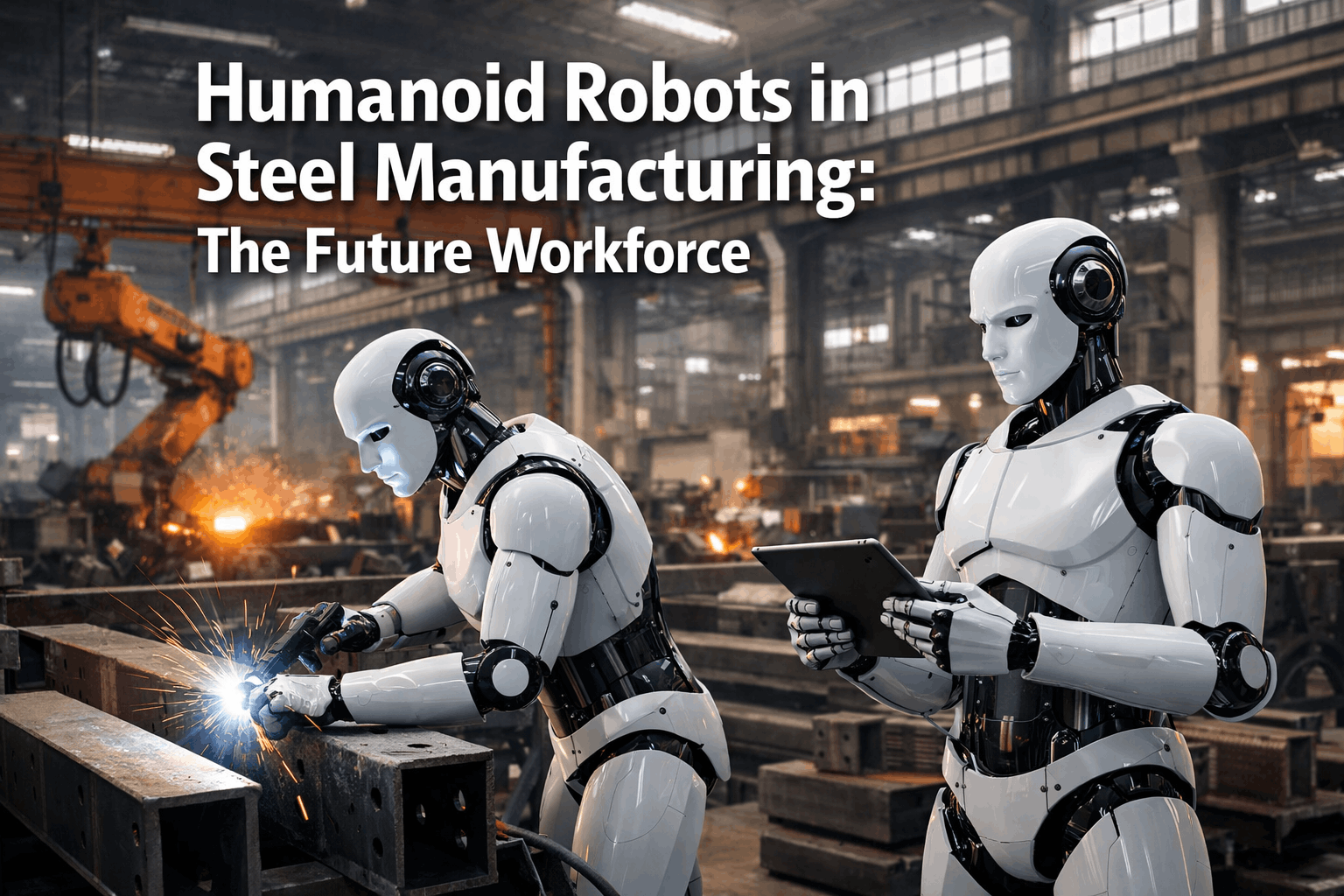
The steel industry has automated every process it could bolt a machine to — continuous casters pour without pause, rolling mills sequence autonomously, and ladle metallurgy stations follow programmed treatment cycles. But walk through any steel plant's maintenance bays, material staging areas, or quality labs and you'll find the same scene you'd have found 30 years ago: people carrying, sorting, inspecting, and loading in environments that routinely exceed 120°F with airborne particulate, radiant heat from molten metal, and noise levels above 95 dB. These are the tasks automation couldn't reach — until now. Humanoid robots are entering heavy manufacturing not as science fiction curiosities but as engineered solutions for the physical tasks that are too unstructured for fixed automation, too hazardous for sustained human exposure, and too variable for conventional robotic arms. The global humanoid robot market is projected to reach $38 billion by 2035, and steel manufacturing is among the first industrial sectors testing real deployments because its combination of extreme conditions and chronic labor shortages creates an economic urgency that other industries don't yet face.
$38B
Projected humanoid robot market by 2035 — heavy industry leads early adoption
62%
Of steel manufacturers report chronic difficulty filling physically demanding maintenance roles
24/7
Operational endurance in environments where human shifts are limited to 4–6 hours by heat exposure
2026–28
Expected window for first full-scale humanoid deployments in integrated steel operations
The Evolution: From Fixed Automation to Humanoid Flexibility
Steel manufacturing has progressed through distinct automation eras — each one solving the limitations of the last. Humanoid robots represent the next logical step: machines that can operate in spaces designed for human bodies, use human tools, and adapt to the unstructured variability that has kept certain tasks manual for decades.
Fixed Automation
PLCs, conveyor systems, automated rolling sequences. Massive productivity gains on repetitive, structured production tasks. Zero flexibility — any change requires re-engineering.
Industrial Robotics
Robotic arms for welding, material handling, and surface treatment. High precision in defined workspaces. Still requires structured environments, safety caging, and dedicated programming per task.
Cobots & Inspection Robots
Collaborative robots working alongside humans. Crawlers, drones, and robotic arms for inspection and measurement. Flexible deployment but limited to specific sensor or manipulation tasks.
Humanoid Robots
Bipedal or human-form-factor robots that navigate unstructured environments, use standard tools, climb stairs, open doors, and perform multi-step physical tasks. The first machines that can go anywhere a human worker goes — without the biological limitations.
Why Humanoid Form Factor Matters in Steel Plants
The steel plant wasn't designed for robots — it was designed for people. Staircases, catwalks, ladders, valve wheels, hand tools, control panels, doorways, and workbenches all assume a human body shape and human-scale dexterity. Conventional robots need the environment rebuilt around them. Humanoid robots operate in the environment as it exists. This distinction is what makes the humanoid form factor uniquely suited to steel manufacturing — and why facilities that sign up for robotics-integrated maintenance platforms are already building the digital infrastructure to manage these assets alongside their human workforce.
Navigation
Walk on uneven surfaces, climb stairs and ladders, navigate narrow catwalks, traverse between production bays through standard doorways and corridors
Steel relevance: Access every maintenance location without infrastructure modification
Manipulation
Grasp and operate hand tools, turn valve wheels, connect hoses, lift and carry 25–50 kg loads, perform precision assembly and fastening tasks
Steel relevance: Use existing maintenance tools without specialized end-effectors
Perception
Visual object recognition, thermal sensing, depth mapping, audio anomaly detection, spatial awareness in cluttered environments with dynamic obstacles
Steel relevance: Detect defects, hazards, and abnormal conditions in real time during task execution
Endurance
Operate continuously in extreme heat, toxic atmospheres, high noise, and dust without fatigue, PPE limitations, or shift rotation requirements
Steel relevance: Sustained presence in zones where human exposure is limited to hours
Adaptability
Learn new tasks through demonstration or instruction, adapt to layout changes, handle novel objects, and modify behavior based on real-time environmental feedback
Steel relevance: Handle the task variability that makes conventional automation uneconomical
Connectivity
Stream task data to CMMS, receive work orders wirelessly, report completion status, upload inspection imagery, and integrate with plant safety systems
Steel relevance: Every task becomes a documented, tracked, auditable maintenance record
Day in the Life: Humanoid Robot in a Steel Plant — 2028
What does a humanoid robot's shift actually look like in a steel manufacturing environment? This isn't speculative fiction — it's a projected operational scenario based on capabilities already demonstrated by leading humanoid platforms in testing environments, scaled to the steel plant context.
06:00
Shift Start — Work Order Download
HR-04 connects to the CMMS and receives 14 prioritized tasks: 6 visual inspections, 3 material staging jobs, 2 sample deliveries, 2 valve operations, and 1 equipment cleaning task.
06:15
Roll Change Area — Material Staging
Walks to spare roll storage, identifies correct rolls by barcode, stages 4 backup rolls on the change cart. Confirms staging completion to CMMS. Task time: 35 minutes vs. 55 minutes manual.
07:30
Furnace Area — Walking Beam Inspection
Enters reheat furnace zone during production pause. Performs visual and thermal inspection of walking beam rails and skid pipes. Captures 240 images and 18 thermal readings. Flags 2 anomalies → auto-generates work orders in CMMS.
09:00
Quality Lab — Sample Delivery
Picks up metal samples from the caster floor, navigates stairs to the quality lab two levels up, delivers samples to the spectrometer station. Eliminates a manual runner role that consumed 3 hours per shift.
11:00
Hydraulic Room — Valve Operations
Navigates to the hydraulic basement, identifies tagged valves, operates manual isolation valves per lockout procedure. Photographs valve position and confirms LOTO completion digitally. Zero confined-space or heat-exposure risk.
17:45
Shift Close — Report & Charge
13 of 14 tasks completed. 1 deferred (access blocked by ongoing repair). Full shift data uploaded: 420 inspection images, 6 work orders generated, 4 staging confirmations, 2 sample delivery receipts. HR-04 returns to charging station.
Build the Digital Infrastructure for Your Future Workforce
OXmaint provides the maintenance platform that connects human workers, cobots, and humanoid robots to a single work order system — so every task is assigned, tracked, and documented regardless of whether it's executed by a person or a machine.
Current Workforce vs. Augmented Workforce: The Operational Shift
Humanoid robots don't create a parallel workforce — they augment the existing one. The operational model shifts from "humans do everything" to "humans do what humans do best, and robots handle the rest." Here's how specific steel plant functions change when humanoid robots enter the labor model.
Material Staging & Transport
Current
Manual labor, physically demanding, 3–4 workers per shift dedicated to moving parts and materials between bays
Augmented
Humanoids handle routine staging and transport. Humans redirect to skilled setup, quality verification, and exception handling
Hazardous Zone Inspection
Current
Confined space permits, atmospheric monitoring, rescue standby. 2 hours of setup for 30 minutes of actual inspection work
Augmented
Humanoid enters independently, inspects for 2+ hours continuously, streams data live. Human reviews from control room and plans response
Routine Equipment Cleaning
Current
Assigned to lowest-seniority workers. High turnover task. Often deferred when staffing is short, leading to accelerated equipment degradation
Augmented
Humanoids execute cleaning routines on schedule every shift. Never deferred. Workers reassigned to condition monitoring and preventive tasks
Sample Collection & Delivery
Current
Dedicated runner role moving samples between production floor and quality lab. Low-skill, high-exposure, universally disliked assignment
Augmented
Humanoid navigates between floors autonomously with samples. Runner role eliminated. Personnel reassigned to analytical or technical support
Readiness Assessment: Is Your Plant Ready for Humanoid Integration?
Not every steel plant is equally prepared for humanoid deployment. The facilities that will adopt first — and benefit most — share specific infrastructure, digital, and organizational characteristics. This assessment framework helps you identify where your operation stands and what needs to happen before deployment becomes practical. Plants already building their digital foundation can sign up to establish the CMMS backbone that humanoid integration will require.
CMMS with API integration capability
Essential
Plant-wide Wi-Fi or 5G connectivity
Essential
Digital asset registry with location mapping
Important
Floor surfaces suitable for bipedal locomotion
Important
Charging station locations in each production bay
Moderate
Defined navigation pathways mapped digitally
Important
Maintenance team trained on human-robot workflows
Essential
Safety protocols updated for humanoid coexistence
Essential
Change management program for workforce integration
Important
Investment Roadmap: From First Pilot to Full-Fleet Operations
Humanoid deployment in steel isn't a single purchase decision — it's a multi-year investment roadmap. The economics improve dramatically at scale, but the first step is always a controlled pilot that proves value in your specific environment. Facilities that book a free demo to see robotics-ready maintenance platforms can start building the digital layer that makes humanoid integration seamless when the hardware arrives.
Y1
Foundation
Investment: $150K–$300K
Deploy CMMS with API readiness. Map plant navigation pathways. Install connectivity infrastructure. Begin vendor evaluation for humanoid pilot. Establish baseline metrics for target tasks.
Y2
Pilot Deployment
Investment: $500K–$1.2M
Deploy 1–2 humanoid units on highest-value tasks. Integrate with CMMS for work order receipt and completion reporting. Measure task completion rates, safety impact, and labor reallocation benefits.
Y3
Scaling
Investment: $1M–$3M
Expand to 5–10 units across multiple production areas. Introduce task specialization. Establish humanoid maintenance program. Deploy predictive analytics on robot performance data.
Y5
Full Fleet Operations
Investment: $3M–$8M
20+ humanoid units operating across all bays. Autonomous task scheduling. Full integration with human workforce planning. Continuous improvement cycle driven by combined human + robot performance data.
Expert Perspective: What Steel Leaders Need to Understand About Humanoid Robotics
The steel executives who will lead this transition understand something their peers don't: humanoid robots aren't a labor cost play — they're an access play. The problem in steel isn't that workers are too expensive. It's that you can't find them, you can't keep them in extreme environments for full shifts, and you can't send them into spaces that require hours of preparation and safety protocols. Humanoid robots solve the access problem. They go where humans can't sustain presence, they work the shifts nobody wants, and they collect data that humans never could because they never had the endurance to stay in one place long enough. The companies building their CMMS infrastructure, their connectivity layers, and their workforce integration plans now will deploy humanoids in 2027. The companies that wait until the technology is "proven" will deploy in 2032 — and spend those five years losing ground to competitors who started early.
01
Solve Access, Not Just Labor
The highest-value humanoid applications aren't replacing workers — they're enabling tasks that currently can't be done at all due to environmental constraints, access limitations, or exposure risks.
02
Build Digital First
A humanoid without a CMMS is a very expensive walking camera. The value comes from connecting every task, every finding, and every data point to your maintenance decision-making infrastructure.
03
Plan for Coexistence
The workforce model of 2030 isn't all-human or all-robot. It's a blended team where task assignment is based on capability matching — who (or what) is best suited for each specific job.
The Future Workforce Runs on Smart Maintenance Infrastructure
Whether your next maintenance worker walks on two legs or runs on batteries, OXmaint manages the work. Build the CMMS foundation today that connects humans, cobots, and humanoid robots to a single operational intelligence platform — ready for whatever workforce model tomorrow demands.
Frequently Asked Questions
What tasks can humanoid robots perform in steel manufacturing?
Humanoid robots in steel plants are being developed and tested for a range of physically demanding and hazardous tasks including material staging and transport between production bays, visual and thermal inspections in high-temperature zones, sample collection and delivery between production floors and quality labs, routine equipment cleaning in dusty and hot environments, manual valve operations during lockout/tagout procedures, and basic tool-assisted maintenance tasks like tightening, adjusting, and lubricating. The key advantage of the humanoid form factor is that these tasks can be performed in environments designed for human bodies — navigating stairs, doorways, catwalks, and uneven surfaces — without requiring facility modifications.
When will humanoid robots be commercially available for steel plants?
Several humanoid robot manufacturers — including Figure AI, Tesla (Optimus), Agility Robotics (Digit), Apptronik (Apollo), and Boston Dynamics (Atlas) — are in advanced testing phases with commercial pilots expected between 2025 and 2027. Full-scale commercial availability for heavy industrial applications like steel manufacturing is projected for 2027–2030, with early adopters in controlled pilot deployments beginning as early as 2026. The timeline for any specific plant depends on the maturity of their digital infrastructure, the complexity of target tasks, and the readiness of their workforce integration plans.
Will humanoid robots replace steelworkers?
Humanoid robots are designed to augment the steel workforce, not replace it. The tasks targeted for humanoid deployment are those that are physically hazardous, environmentally extreme, or chronically understaffed — material handling in high-heat zones, confined space inspections, repetitive cleaning, and sample running. Human workers retain all diagnostic, decision-making, complex repair, and supervisory functions. Most workforce models project that humanoid adoption will shift worker roles from physical execution to supervision, programming, data interpretation, and exception management — higher-skilled, higher-value work. The chronic labor shortage in steel maintenance, where 62% of plants report difficulty filling physically demanding roles, means humanoids are more likely to fill open positions than displace existing workers.
What infrastructure does a steel plant need before deploying humanoid robots?
Successful humanoid deployment requires three infrastructure layers. First, digital infrastructure: a CMMS with API integration for work order exchange, plant-wide wireless connectivity for real-time communication, and a digital asset registry with location data. Second, physical infrastructure: floor surfaces that support bipedal locomotion, charging stations positioned across production areas, and defined navigation pathways mapped digitally. Third, organizational infrastructure: safety protocols updated for human-robot coexistence, maintenance team training on blended workforce operations, and a change management program that addresses workforce concerns proactively. Of these, digital infrastructure is the most critical starting point because it enables integration with existing operations from day one.
How do humanoid robots integrate with CMMS and maintenance management?
Humanoid robots connect to CMMS platforms through standardized APIs, functioning as digital workers within the existing maintenance management framework. The CMMS assigns work orders to humanoid units based on task type, location, priority, and capability matching — the same way it assigns work to human technicians. The robot receives the work order, navigates to the task location, executes the assigned work, and reports completion with supporting data (images, measurements, timestamps) back to the CMMS. This creates a unified work history where tasks performed by humans and robots are tracked in the same system, enabling consistent KPI measurement, audit trails, and continuous improvement analysis regardless of who — or what — executed the work.