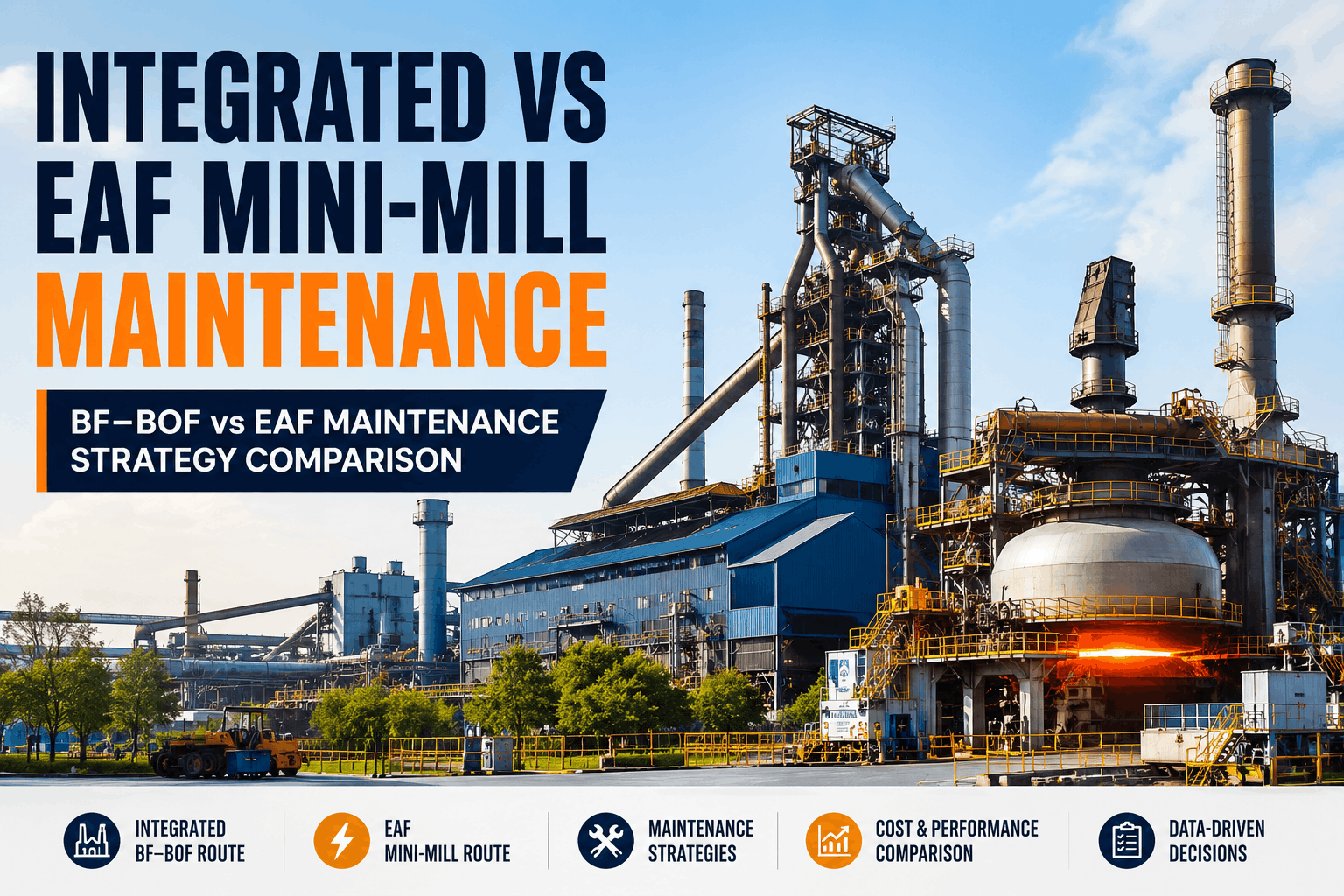
Two fundamentally different steelmaking routes dominate the global industry, and their maintenance organizations face challenges as different as the metallurgy they manage. The integrated BF-BOF route—with its blast furnace campaigns spanning decades, coke oven batteries operating at 2,000°F for 30+ years, and continuous casters processing hundreds of tons per hour—demands a maintenance strategy built around long-asset-life preservation, campaign extension, and the staggering cost of unplanned downtime measured in millions per day. The EAF mini-mill route—with its electric arc furnace cycling every 40–60 minutes, its electrode consumption measured in pounds per ton, and its thin-slab caster running synchronized to the furnace tap—demands a maintenance strategy built around rapid turnaround, electrode system reliability, and the flexibility to stop and start production in response to market conditions. Understanding the integrated versus EAF mini-mill maintenance comparison is essential for any steel company operating or planning both route types, because applying integrated-plant maintenance assumptions to an EAF minimill—or vice versa—leads to mismatched PM intervals, misallocated resources, and reliability programs that fail to address each route's dominant failure modes. Sign Up Free to see how OxMaint supports both integrated and EAF maintenance strategies with route-specific asset tracking, PM scheduling, and reliability analysis.
Manage Both Integrated and EAF Maintenance Strategies in One CMMS Platform
OxMaint supports blast furnace campaign tracking and EAF electrode management, BOF vessel reline scheduling and minimill caster segment tracking—all in a single maintenance management system built for steel.
Why Integrated and EAF Maintenance Strategies Must Be Fundamentally Different
The maintenance strategy differences between integrated and EAF steelmaking flow directly from the physics and chemistry of each process. An integrated plant's blast furnace operates continuously—24 hours a day, 365 days a year, for campaign lives of 15–20 years—and a single unplanned stop not only costs the furnace's own production but starves the downstream BOF, caster, and rolling mill of hot metal. The maintenance imperative is absolute reliability of the systems that could stop the furnace: cooling staves, top gas equipment, charging system, and tap hole management. In contrast, an EAF minimill is designed around a batch process—40 to 60-minute tap-to-tap cycles—where the furnace can be idled between heats for electrode additions, slag door maintenance, or refractory patching without cascading downstream consequences. The maintenance imperative shifts from "never stop" to "complete the planned work in the available window and restart reliably." Facilities that Book a Demo with OxMaint see how route-specific asset hierarchies, PM templates, and reliability metrics are configured to match each steelmaking route's operational reality rather than forcing one route's assumptions onto the other.
OxMaint supports continuous campaign monitoring for the BF and batch-window PM scheduling for the EAF—matching the CMMS workflow to each route's fundamental operational pattern rather than forcing a single approach.
BF/BOF refractory strategy centers on decade-scale campaign extension; EAF refractory strategy centers on daily patching and zoned replacement. OxMaint tracks both approaches with route-specific refractory life metrics.
EAF maintenance is dominated by electrode arm, mast, and regulation system reliability; integrated plant maintenance is dominated by top gas bleed valve and charging system reliability—different critical spares, different PM intervals.
Integrated plants typically run thick-slab casters with multiple segments; minimills often run thin-slab or beam-blank casters with different segment geometries and life patterns. OxMaint tracks both configurations.
Integrated plants manage BFG/COG gas networks; minimills manage substations, transformers, and the electric utility interface. OxMaint schedules and tracks maintenance for both utility configurations.
Integrated plants schedule multi-year campaign relines; minimills schedule more frequent but shorter maintenance windows. OxMaint shutdown management adapts to both the decades-scale and weeks-scale planning horizons.
Head-to-Head: Integrated BF-BOF vs EAF Mini-Mill Maintenance by System
This is the defining maintenance strategy divergence between the two routes. The blast furnace operates continuously at high pressure and temperature, with campaign life measured in decades, and every system that can stop the furnace—cooling staves, tap hole drill and mud gun, top gas recovery, charging bells or rotating chute—receives absolute maintenance priority because a trip thermally shocks the refractory and reduces campaign life. The EAF operates in discrete 40–60 minute batches, with the furnace lid opened between heats for charging, electrode inspection, and slag door maintenance. The EAF maintenance team works with the predictable inter-heat window: electrode additions and adjustments happen between heats, slag door refractory patching is performed during planned delays, and the furnace can be taken offline for a few hours without disrupting an entire downstream plant. The maintenance metrics differ fundamentally: blast furnace success is measured in years between trips and campaign life extension; EAF success is measured in heats between electrode changes, tap-to-tap time reliability, and refractory cost per ton. OxMaint supports both by tracking BF cooling system parameters and campaign milestones on one side, and EAF electrode consumption, roof delta life, and heat count on the other—all within the same platform. Facilities that Sign Up Free can configure route-specific asset tracking from day one.
Refractory maintenance represents one of the largest maintenance cost categories in both routes, but the management approach is completely different. In an integrated plant, the blast furnace lining must survive a 15–20 year campaign, monitored through shell temperature mapping, stave heat flux trending, and periodic acoustic sounding—there is no opportunity to "patch" the BF hearth or bosh from the inside during a campaign. The BOF vessel lining is replaced on a campaign basis (typically 15,000–25,000 heats), with zoned wear monitoring guiding gunning maintenance between relines. In an EAF minimill, refractory management is a daily operational activity: the slag line is patched between heats using a gunning machine, the eccentric bottom tapping (EBT) system is inspected and patched on a scheduled cycle, and the furnace roof delta section is replaced as a discrete component when its life is reached. EAF refractory strategy is zonal—different areas of the furnace (slag line, hot spots, tap hole, roof) have different wear rates and are replaced on different schedules—while BF/BOF refractory strategy is holistic campaign management. OxMaint tracks BF shell temperatures and campaign milestones; it tracks EAF zonal refractory consumption by area, gunning material usage per shift, and roof delta life in heats—supporting both management approaches with the appropriate data structures. Teams that Book a Demo can see how refractory tracking is configured for both routes.
Each route has equipment with no counterpart in the other—and these are among the highest-maintenance-intensity systems on each plant. The EAF electrode system—electrode arms, masts, hydraulic regulation cylinders, electrode holders, and the electrical connections carrying 80,000+ amps—operates in an environment of extreme heat, electromagnetic forces, and mechanical vibration. Electrode regulation response time directly affects melting efficiency and energy consumption; a failed electrode clamp or broken electrode during a heat can cause a complete heat loss and potential equipment damage. The BF top gas and charging system—bleed valves that must seal against furnace pressure, a rotating chute or bell system operating in a dusty, high-temperature gas stream, and the gas cleaning train that recovers BFG for plant-wide energy use—is the most maintenance-intensive area of the blast furnace because failures here can force a furnace trip. Both systems demand specialized PM programs, critical spare parts management, and failure history tracking—but they are completely different equipment sets requiring completely different maintenance skills and schedules. OxMaint manages PMs, spare parts, and failure history for both EAF electrode systems and BF top gas systems within the same CMMS, with equipment-specific checklists and acceptance criteria.
While both routes employ continuous casting, the caster configurations—and therefore the maintenance challenges—differ substantially. Integrated plants typically cast thick slabs (200–250mm) on conventional casters with multiple bending, straightening, and horizontal segments, each with its own roll set, bearing assembly, and cooling spray system. Segment life tracking is tonnage-based, and segment changeouts require crane lifts and significant downtime. EAF minimills increasingly employ thin-slab casting (50–70mm) with tunnel furnace connection direct to the hot strip mill, or beam-blank casting for structural products. Thin-slab caster segments are lighter, change out faster, but experience higher thermal cycling stress due to the rapid solidification. Beam-blank casters have complex mold geometries with additional wear points at the flange-web intersections. Both caster types require segment life tracking, but the segment designs, life expectancies, changeout procedures, and spare parts inventories are different. OxMaint supports both configurations with tonnage-based life tracking, segment-specific dimensional records, and repair shop workflow management for whichever segment design the plant operates.
The utility infrastructure supporting each route creates entirely different maintenance organizations. Integrated plants operate a complex by-product gas network—blast furnace gas, coke oven gas, and basic oxygen furnace gas—with gas holders, booster stations, mixing stations, and a distribution piping network spanning the entire facility. This network requires its own maintenance team managing leak detection, gas holder integrity, valve station PMs, and the safety protocols for CO-containing gases. EAF minimills are electrically intensive—the furnace transformer (often 100–150 MVA), the ladle furnace transformer, the static VAR compensation or STATCOM system for flicker control, and the high-voltage switchyard all require specialized electrical maintenance skills including dissolved gas analysis on transformer oil, infrared thermography on bus connections, and protection relay testing. These are fundamentally different utility maintenance organizations. OxMaint manages both: gas network PMs including pipeline leak surveys, valve station lubrication, and holder seal inspections for integrated plants; and substation PMs, transformer DGA trending, breaker timing tests, and protection system verification for EAF plants—within the same CMMS platform.
The shutdown management philosophy difference between the two routes is stark. An integrated plant plans for a blast furnace reline once every 15–20 years—a multi-hundred-million-dollar project spanning months, with years of advance planning, contractor mobilization, and material procurement. In between relines, the furnace gets short scheduled maintenance windows (typically 8–24 hours every few months for tap hole maintenance, top equipment work, and stave repair) that must be executed with the precision of a Formula 1 pit stop because every hour beyond the window is lost production. An EAF minimill plans maintenance windows more frequently—weekly or biweekly 8–12 hour windows for furnace refractory work, electrode system maintenance, and caster segment changeouts—with the ability to flex production schedule around these windows because the EAF is a batch process that can be stopped and started without the thermal shock consequences of a BF. OxMaint shutdown management handles both: the multi-year planning horizon for a BF reline with its thousands of tasks, resource leveling, and contractor management, and the frequent-window scheduling for minimill maintenance with its rapid work list prioritization and post-window restart verification. Facilities can Sign Up Free and begin configuring shutdown management appropriate to their route.
Integrated vs EAF Maintenance Strategy: Comparison Matrix
| Maintenance Dimension | Integrated BF-BOF Plant | EAF Mini-Mill | OxMaint Support |
|---|---|---|---|
| Primary Asset Philosophy | Continuous campaign; "never stop" imperative | Batch process; inter-heat maintenance windows | Campaign tracking and batch-window PM scheduling |
| Refractory Strategy | Campaign extension monitoring; vessel relines at heat life | Zonal wear tracking; daily patching; roof delta replacement | Campaign data historian and zonal life tracking |
| Critical Equipment | Top gas system; charging equipment; stave cooling | Electrode arms/masts; regulation hydraulics; clamps | Route-specific asset registers and PM templates |
| Caster Type | Thick slab; heavy segment design; longer segment life | Thin slab or beam blank; lighter segments; faster cycling | Tonnage-based life tracking for all caster configurations |
| Utilities Focus | By-product gas network; gas holders; flare system | Furnace transformer; SVC; switchyard; power quality | Gas network and electrical utility PM management |
| Shutdown Pattern | BF reline every 15–20 years; months-long execution | Weekly/biweekly windows; hours-long execution | Multi-year and rapid-window shutdown planning tools |
How OxMaint Supports Both Integrated and EAF Maintenance Strategies
Steel companies increasingly operate both integrated and EAF assets—whether through acquisition, greenfield development, or the conversion of older integrated sites to EAF-based production. A CMMS platform that only serves one route forces the organization to maintain separate systems, separate reporting, and separate maintenance processes. OxMaint is configured to support both routes simultaneously: blast furnace campaign tracking alongside EAF electrode consumption management, BOF vessel reline planning alongside minimill caster segment changeout scheduling, BFG gas network PMs alongside furnace transformer DGA trending. The platform's flexibility means each asset class receives the maintenance strategy appropriate to its route, while the maintenance director gets unified visibility into reliability, PM compliance, and maintenance costs across the entire enterprise. When OxMaint shows the blast furnace campaign on track, the EAF roof delta approaching its scheduled changeout, and PM compliance above target across both routes, that is the operational picture that enables strategic maintenance management across the steelmaking technology spectrum. Facilities can Sign Up Free and begin configuring route-specific maintenance strategies in a single CMMS platform.
Implementing Route-Specific Maintenance Strategies: Key Steps
Classify Each Asset by Route and Strategy
For each asset in the plant, determine the appropriate maintenance strategy based on the steelmaking route: campaign management for BF, batch-window PM for EAF, tonnage-based for all casters, and route-specific utility PMs for gas networks or electrical systems.
Configure Route-Specific Asset Hierarchies in OxMaint
Build the asset register with parent-child relationships that reflect each route's equipment structure: BF cooling system → individual staves for integrated; EAF → electrode arm → mast → hydraulic cylinder for minimill.
Define Route-Specific PM Templates and Intervals
Create PM checklists with the tasks, intervals, and acceptance criteria specific to each route's equipment. BF top gas PMs differ completely from EAF electrode PMs—OxMaint manages both without forcing a single template structure.
Establish Route-Specific Reliability Metrics
Define the metrics that matter for each route: days between BF trips and campaign year progression for integrated; heats between electrode changes and EAF refractory cost per ton for minimill. Configure OxMaint dashboards accordingly.
Manage Critical Spares by Route Requirements
Integrated plants stock BF cooling staves and top gas valves; minimills stock electrode holders, mast cylinders, and furnace transformer components. OxMaint tracks both inventories with route-specific reorder logic.
Conduct Cross-Route Reliability Reviews
Quarterly reviews comparing reliability performance across integrated and EAF operations—identifying best practices that can transfer between routes and systemic issues requiring route-specific solutions. Book a Demo to see the full cross-route maintenance management workflow.
Frequently Asked Questions
What is the biggest maintenance strategy difference between integrated and EAF steel plants?
The fundamental difference is the operational philosophy of the primary steelmaking asset. An integrated plant's blast furnace operates continuously for 15–20 year campaigns where a single unplanned trip can cost millions and reduce campaign life. Maintenance strategy is built around preventing the furnace from ever stopping unexpectedly. An EAF minimill operates in 40–60 minute batch cycles where the furnace can be idled between heats for maintenance. The strategy shifts from "never stop" to "maximize the productive use of planned maintenance windows." This drives different PM intervals, different critical spares strategies, and different shutdown planning approaches.
How does refractory maintenance differ between BF-BOF and EAF routes?
BF/BOF refractory management is campaign-based: the blast furnace lining is monitored through shell temperature and stave heat flux for a 15–20 year campaign with no internal access; the BOF vessel is relined every 15,000–25,000 heats as a complete campaign. EAF refractory management is zonal and daily: the slag line is patched between heats using gunning, the EBT is inspected and patched on schedule, hot spots receive targeted maintenance, and the roof delta is replaced as a discrete component when its life is reached. EAF refractory strategy is inherently more tactical and operational; BF/BOF refractory strategy is strategic and long-term.
Can the same CMMS manage both integrated and EAF maintenance?
Yes—provided the CMMS is flexible enough to support different asset hierarchies, PM strategies, and reliability metrics for each route. OxMaint manages both within a single platform by allowing route-specific configuration: campaign tracking and continuous monitoring for integrated assets, batch-window PM scheduling and zonal life tracking for EAF assets. The key is that the CMMS does not force one route's maintenance philosophy onto the other but supports each according to its operational requirements.
Which route has higher maintenance cost per ton of steel produced?
There is no universal answer—maintenance cost per ton depends on plant age, equipment condition, and maintenance program effectiveness more than route selection. However, the cost composition differs: integrated plants carry the enormous capital maintenance burden of blast furnace relines (amortized over the campaign) and coke oven battery rebuilds; EAF plants carry higher electrode consumption costs and more frequent refractory replacement. A well-maintained plant of either route will outperform a poorly maintained plant of the other route.
How does OxMaint support companies operating both integrated and EAF assets?
OxMaint provides route-specific configuration within a unified platform: blast furnace campaign tracking and EAF electrode management run in the same CMMS with their own asset hierarchies, PM templates, and reliability metrics. Enterprise dashboards normalize data across routes for consolidated cost analysis and cross-route benchmarking. This eliminates the need for separate maintenance systems and enables the maintenance director to manage the entire steelmaking portfolio from a single operational view.
One CMMS for Both Steelmaking Routes—Configured for How Each Actually Operates
OxMaint gives steel maintenance leaders the dual-route asset management, refractory tracking, and reliability analytics to optimize maintenance across integrated and EAF operations—in a single platform with unified enterprise visibility.
.png)


