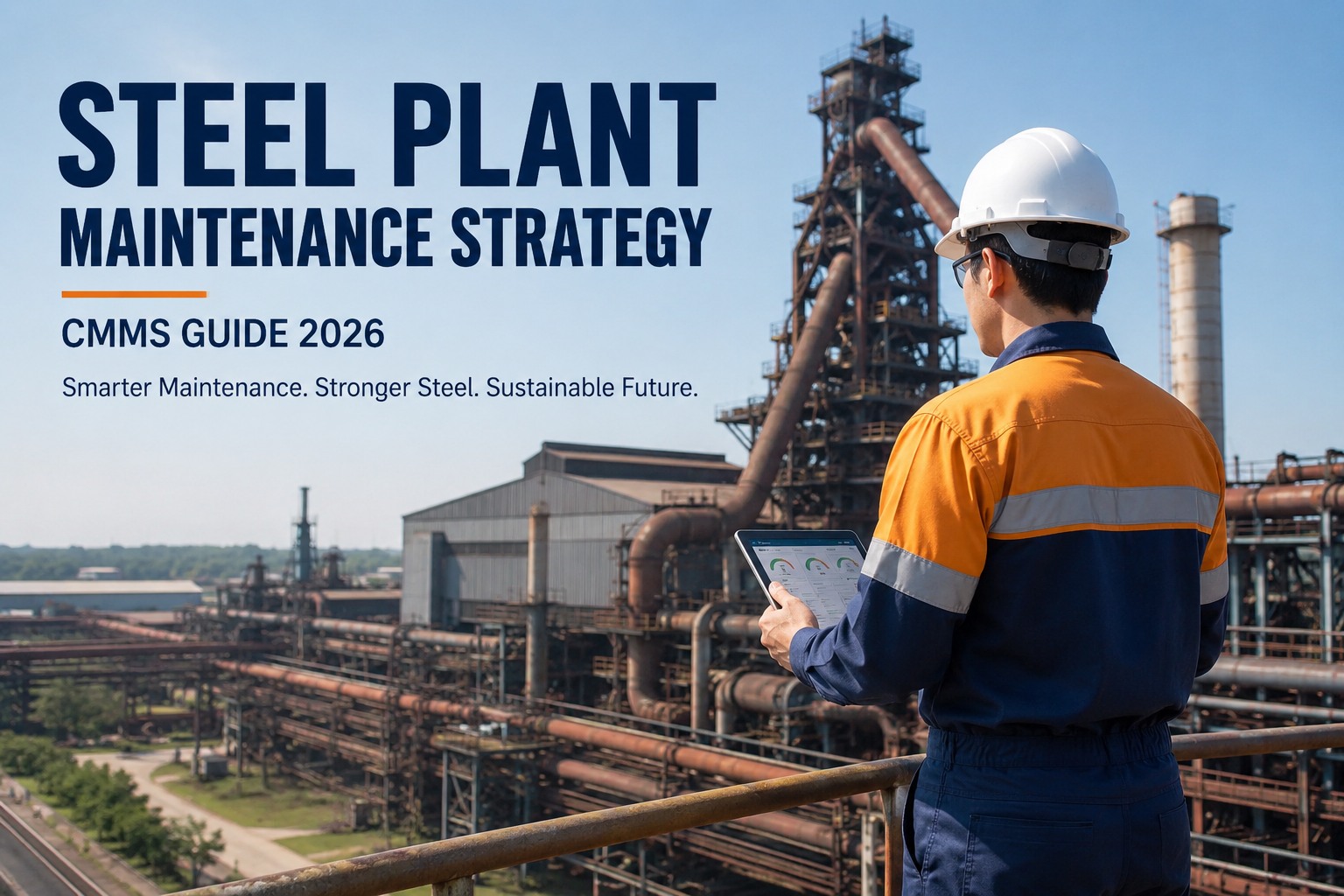
A steel plant is not a collection of machines — it is a single chain reaction. Iron ore enters the blast furnace and, hours later, finished steel leaves the rolling mill, having passed through the steelmaking vessel, the continuous caster, and the reheat furnace without ever stopping. That linear dependence is what makes steel maintenance uniquely brutal: an unplanned failure at any one zone shuts down every zone downstream of it, and the bill arrives by the hour. A single unplanned blast furnace or caster outage costs $500,000 to $1.2 million per day, and around 80% of those failures trace back to inconsistent preventive maintenance. The harder truth is that each zone runs on a completely different maintenance clock — heat counts, campaign tonnage, calendar time — so a strategy built for a finishing line will fail at the furnace. This guide lays out a maintenance strategy for the full production cascade and how a CMMS holds it together. Start a free Oxmaint trial pre-configured for steel plant zones from furnace to mill, or book a demo to see campaign and heat-count scheduling across the plant.
Steel · Integrated Plant · Maintenance Strategy
Steel Plant Maintenance Strategy & CMMS Guide
Blast furnace campaign management, rolling mill PM, continuous caster maintenance, and CMMS deployment — how integrated steel plants build a zone-by-zone maintenance strategy across the production cascade and move from reactive firefighting to planned, predictive reliability.
-
$500K–1.2M
per day cost of a single unplanned furnace or caster outage
-
80%
of failures linked to inconsistent preventive maintenance
-
5–15x
cost of an emergency repair versus a planned one
-
85%
planned-work ratio that best-in-class steel plants sustain
The Production Cascade
Five Zones, One Chain — Each on a Different Clock
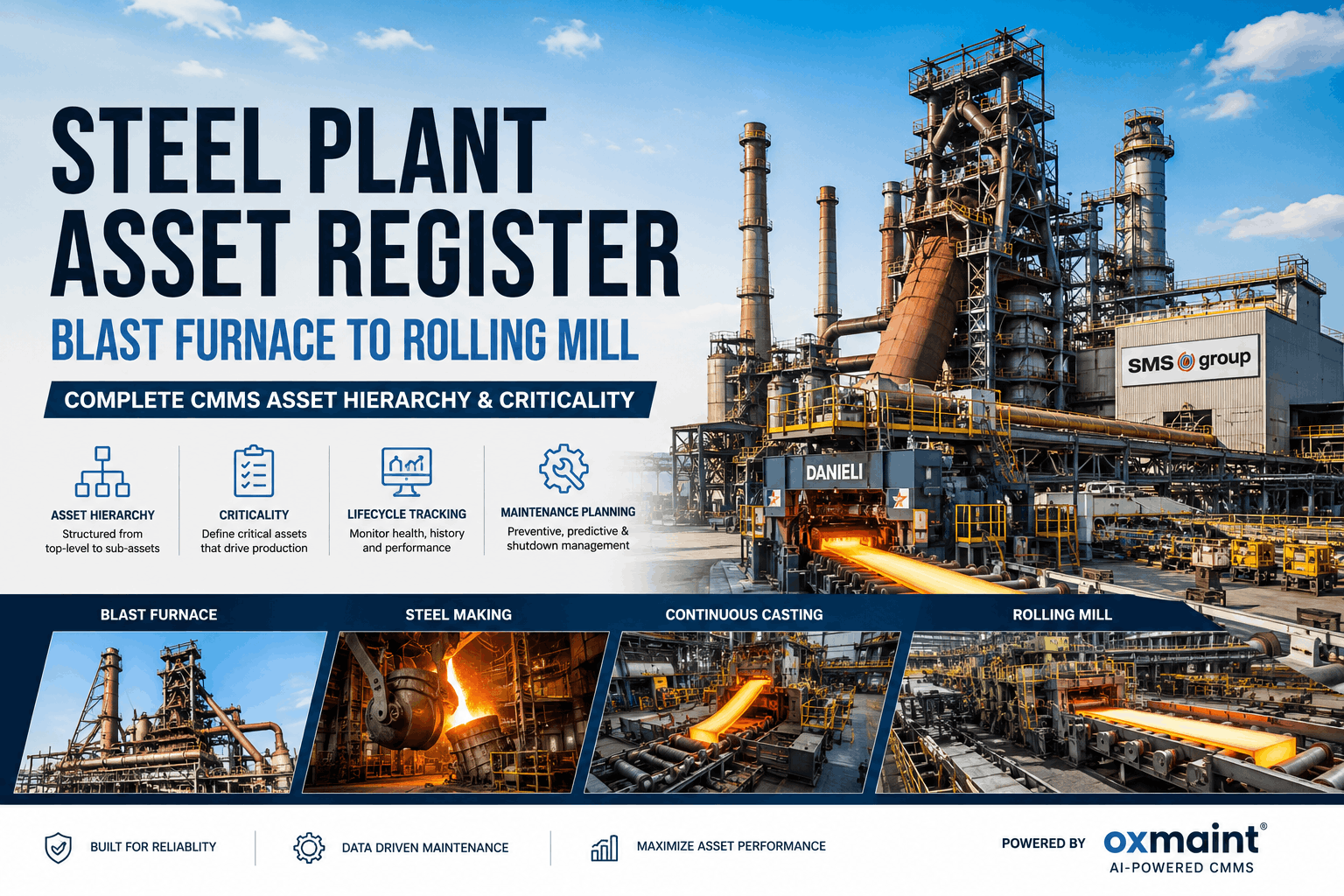
Steel flows in one direction, and a stop at any zone cascades downstream. The maintenance discipline at each stage is fundamentally different from the next — which is why each zone needs its own strategy, its own scheduling basis, and its own place in a single asset hierarchy.
-
1
Blast Furnace
Campaign life · heat counts A $500M+ asset on a 15–20 year reline campaign. Every tuyere, stave, and cooling circuit tracked per position on its degradation curve. Unplanned stops cost tens of millions. -
2
Steelmaking Vessel (BOF)
Heat-count cycles Converter lining, oxygen lance, ladle and tundish refractory tracked against heat counts. Lining-thickness projections drive planned relining — not emergency stoppages. -
3
Continuous Caster
Per-heat / sequence counts Mold copper wear, oscillation mechanism, and strand guide rolls on per-heat tracking. A single breakout costs $500K–$1M in equipment damage — the most consequence-dense zone. -
4
Reheat Furnace
Calendar + production hours Skid-pipe refractory, burner condition, door seals, and hearth on calendar and production-hour cycles. Furnace availability directly gates rolling-mill throughput. -
5
Rolling Mill
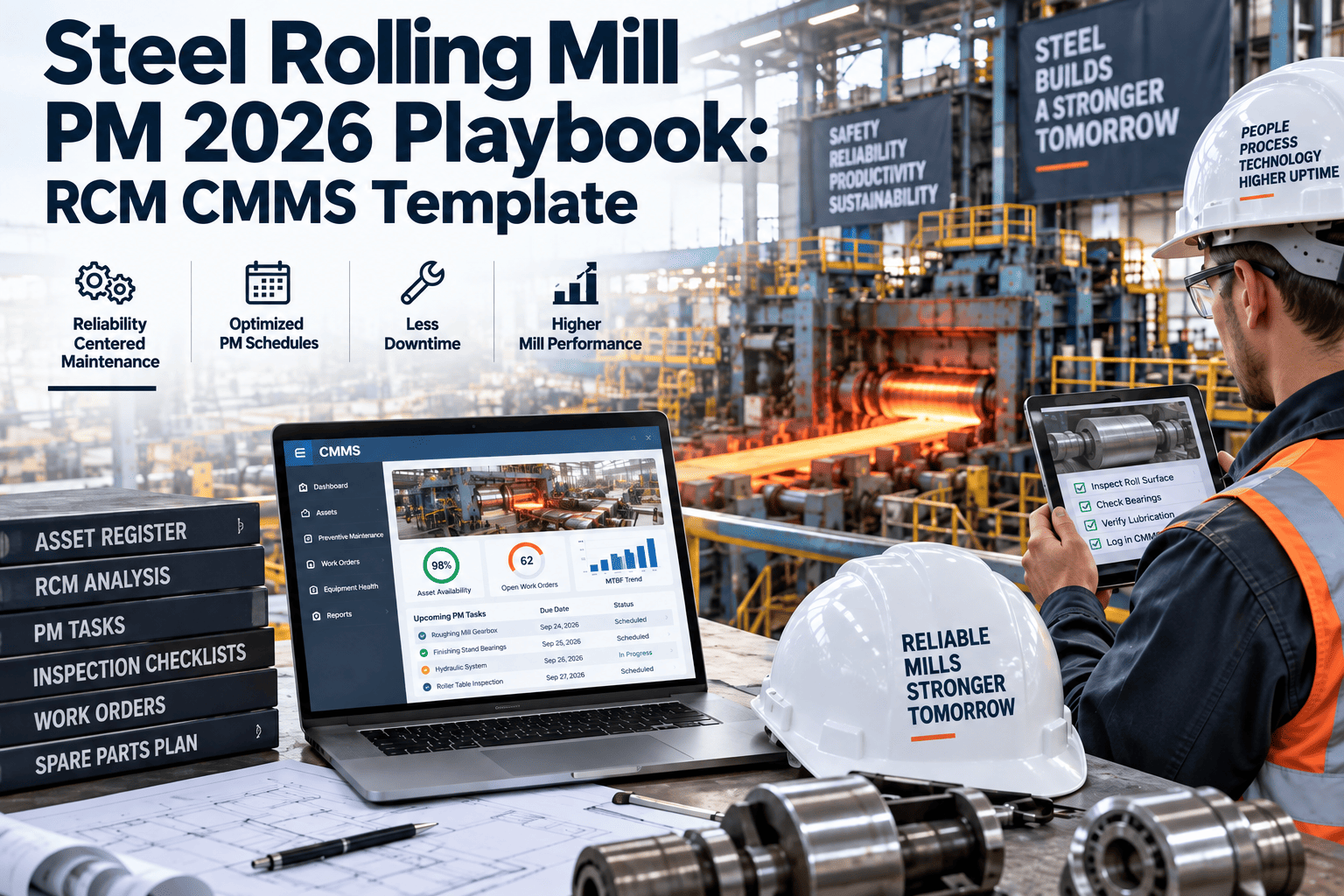
Vibration · campaign tonnage Bearing changes on vibration signature and tonnage target, not calendar. AGC servo valves checked every 4 weeks — an AGC fault deviates thickness across an entire coil.
Not Every Interval Is a Date
Steel Runs on Production Clocks, Not Calendars
The defining error in steel maintenance is scheduling everything by calendar. Critical assets wear by use, not time — so their intervals must be driven by the production counters that actually track degradation. A CMMS built for steel triggers on all of these.
-
Heat Counts
Furnace tuyeres, converter linings, and caster molds wear per heat processed — the true measure of refractory consumption.
-
Campaign Tonnage
Mill bearings and rolls scheduled against cumulative tonnage rolled — replacement planned ahead of the wear limit, not after a stand-down.
-
Operating Hours
Reheat furnaces, drives, and rotating equipment on runtime-based cycles — the middle ground between use and calendar age.
-
Calendar & Condition
Statutory inspections and oil analysis on the calendar; vibration and thermography triggering condition-based work when a signature deviates.
The One Number That Matters
Planned vs Reactive: The Maturity Meter
If a steel plant tracks one maintenance KPI, it is the planned-to-reactive ratio — it captures program maturity, production integration, and cost efficiency in a single figure. Here is where plants sit, and where the strategy has to move them.
- Below 65% Reactive Cycle Maintenance cost per tonne compounds quarter over quarter. The plant is firefighting — the average North American mill sits at 55–65% reactive.
- 65–80% Transitioning A CMMS is enforcing schedules and capturing completion data. Moving the planned ratio from 45% to 70% lifts throughput, energy efficiency, and quality.
- 85%+ Best-in-Class Planned work dominates. Unplanned downtime is rare and scheduled outages are optimized — the reliability position every strategy is aiming for.
Plants that lift the planned ratio over 18–24 months of CMMS adoption document 35–45% fewer unplanned failures and falling maintenance cost per tonne. Sign up for Oxmaint to track the planned-vs-reactive ratio live by zone.
The Warning Was in the Data
One Prevented Breakout Pays for a Decade of CMMS
A blast furnace once gave 23 days of warning — stave cooling-water temperature differential widened, hearth thermocouples trended up, blast pressure fluctuated. The DCS logged every point. Nobody connected the trend to a maintenance action, and the cooling system failed unplanned: over a million dollars a day while molten iron solidified in the hearth. The sensor data almost always exists in steel; the gap is the analytical connection between process data and a work order. Close that gap and a single prevented furnace or caster event exceeds years of platform cost.
Reactive to Predictive
The Deployment Roadmap
Moving a steel plant off reactive maintenance is a phased progression, not a switch. Each phase builds the foundation for the next — and the planned ratio climbs at every step.
- 1 Foundation · Months 1–3 Import the steel equipment hierarchy, apply criticality ratings, configure trade profiles, and deploy mobile work orders and PM schedules. Add wireless vibration and temperature sensors on 10–20 critical assets.
- 2 Integration · Months 4–9 Expand monitoring, connect SCADA and process-historian feeds, and route condition alerts into CMMS work orders — converting reactive alarms into scheduled preventive tasks.
- 3 Prediction · Months 10–18 Degradation detected by monitoring auto-generates work orders 30–60 days before the failure threshold. Planned ratio climbs past 80%; unplanned downtime drops 50–70%; cost per tonne falls.
The platform itself is live fast — a steel plant can be running digital work orders in 3–5 days, with the predictive layer built on top. Book a demo to see steel-zone work orders stood up in days, then prediction layered on top.
Oxmaint for Steel
How Oxmaint Runs Steel Plant Maintenance
-
Zone Asset Hierarchy
Furnace to Mill, Pre-Configured
Asset hierarchies, PM checklists, and compliance structures for every zone — blast furnace, steelmaking vessel, caster, reheat furnace, rolling mill, and utilities — not adapted from a generic template.
-
Production-Basis PM
Trigger on Heats, Tonnage, or Hours
Schedule maintenance by heat count, tonnage produced, operating hours, or condition reading — so refractory and bearings are serviced on real wear, not an arbitrary date.
-
Production-Aware Scheduling
Respects Zone Interdependencies
A planned caster outage blocks upstream work — the system surfaces production constraints when scheduling windows, so maintenance is coordinated across the cascade, not against it.
-
Permit-to-Work
Enforced in the Work Order
Hot work, confined space, electrical isolation, and LOTO enforced as part of the work-order lifecycle — isolation, gas tests, and competency verified before execution, logged to the asset's history.
-
Sensor & Historian Feeds
Process Data Becomes Work Orders
Vibration, thermal, and process-historian data (OSIsoft PI, OPC-UA) feed asset records, so a widening stave temperature differential or a deviating bearing signature auto-generates an inspection task.
-
Shift & Mobile
Built for 24/7 and the Heat
Structured handover notes across three shifts and offline-capable mobile work orders for a harsh, hot environment — with OEE, MTBF, and downtime tracked in real time.
Frequently Asked
Steel Plant Maintenance Questions
Why can't a generic CMMS run a steel plant?
Most CMMS platforms were built for facilities or light manufacturing, where the highest-consequence asset is a chiller or conveyor. A steel plant is a cascade of interdependent zones where refractory wears on heat counts, mill bearings on campaign tonnage, and a failure at any zone shuts down everything downstream. It needs campaign-based scheduling, production-constraint awareness, and enforced permit-to-work — features absent from general-purpose platforms. Sign up for Oxmaint pre-configured for steel plant zones.
How is blast furnace campaign maintenance scheduled?
A modern blast furnace is designed for a 15–20 year campaign between major relinings, and reaching that requires never missing a trending anomaly in stave cooling integrity or refractory wear. Tuyeres, staves, and cooling circuits are tracked per position on their degradation curves, with intermediate PM scheduled toward the reline — refractory-critical components run on heat counts, not calendar dates.
What is the single most important steel maintenance KPI?
The planned-to-reactive work ratio. It captures program maturity, production-maintenance integration, and cost efficiency in one number. Best-in-class steel plants sustain around 85% planned; plants below 65% are in a reactive cycle where cost per tonne compounds quarter over quarter. Moving the ratio up is the core objective of any steel maintenance strategy. Book a demo to see the planned-vs-reactive ratio tracked by zone.
How fast can a steel plant deploy a CMMS?
The platform can be live with digital work orders in about 3–5 days using pre-built steel-zone hierarchies — no IT project required. The predictive layer builds on top over a phased 12–18 month roadmap: foundation and sensors first, SCADA and historian integration next, then automated predictive work orders generated 30–60 days before failure. Sign up for Oxmaint to go live on steel-zone work orders in days.
Plan · Predict · Prevent
In a Cascade, the Cheapest Repair Is the One You Saw Coming
A stop at any zone stops the whole plant, and the data that would have warned you is usually already there — unread. Oxmaint gives steel plant maintenance teams one platform to manage every zone on its own production clock, enforce permit-to-work, turn sensor and historian data into work orders, and move the planned-work ratio steadily toward best-in-class.

.png)
