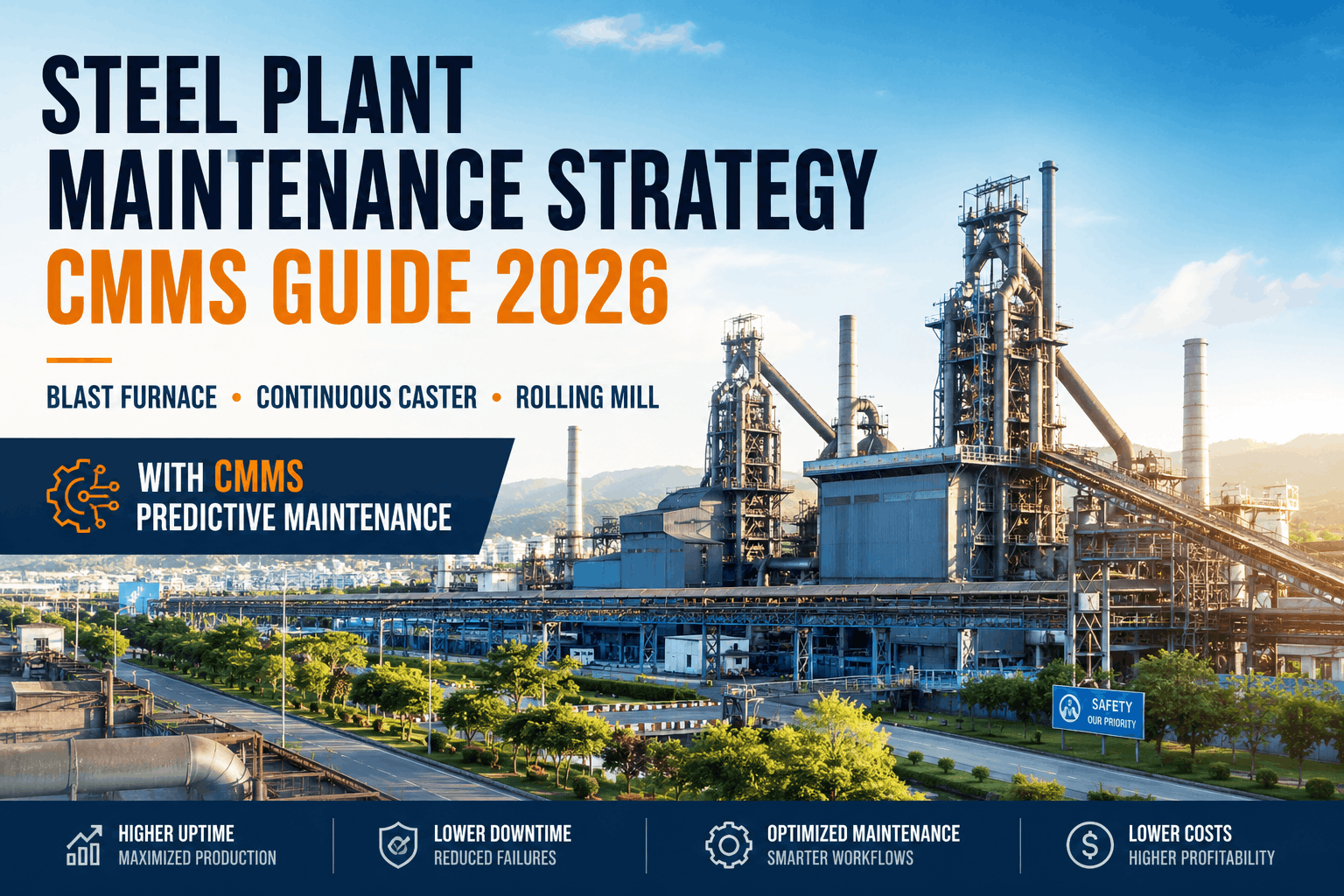
Steel plant maintenance strategy in 2026 requires moving beyond calendar-based PM schedules toward integrated, data-driven asset management across blast furnaces, steelmaking vessels, continuous casters, and rolling mills. A properly structured maintenance strategy connects production constraints, asset criticality, refractory lifecycle tracking, and labor capacity into a single operational discipline. Plants implementing comprehensive CMMS-backed maintenance strategies report 15–20% higher asset availability, 30–40% reduction in unplanned downtime costs, and measurably improved OEE across all production zones. The difference between reactive mills and strategic maintenance operations is not equipment age or geography — it is organizational discipline, data quality, and a CMMS platform built to handle the extreme complexity of continuous steelmaking. Sign Up Free to build your steel plant maintenance strategy in OxMaint and shift your operation from reactive firefighting to planned reliability.
Why Generic Maintenance Strategy Fails in Steel Plants
Most CMMS platforms were designed for facilities management, light manufacturing, or discrete production — asset classes where the highest consequence failure is a conveyor stoppage or a chiller outage. Steel plants operate at a fundamentally different complexity level. A blast furnace running at 2,000°C internally, a continuous caster producing molten metal at thousands of tonnes per hour, and a hot strip mill rolling steel at 100+ km/h are not the same operational problem. Maintenance strategy in steel requires understanding refractory campaign life, heat-count-based scheduling, thermal monitoring, multi-zone asset hierarchies, production cascade dependencies, and safety-critical permit workflows. Book a Demo to see how OxMaint structures maintenance strategy specifically for blast furnace, steelmaking, casting, and rolling operations.
Five Pillars of Steel Plant Maintenance Strategy
Best-in-class steel plants structure their maintenance strategy across five integrated pillars, each supporting the next. Blast furnace campaign management protects the $500M asset running continuously for 15–20 years. Steelmaking vessel tracking ensures BOF, EAF, and ladle refractory lifecycle is measured and planned, not reactive. Continuous casting maintenance prevents the frequent minor faults that cascade into downtime. Rolling mill reliability requires discipline around bearing, drive train, and cooling system PM. And across all zones, labor loading and spare parts logistics must align to support execution. A CMMS that doesn't address all five pillars simultaneously leaves your maintenance strategy incomplete. Sign Up Free to implement these five pillars in a single platform built for steel.
Blast Furnace Campaign Management
Track refractory lining health through shell temperature trends, stave circuit wear, tuyere lifecycle, and cooling system performance. Heat-count-based scheduling replaces calendar-based estimates, enabling furnaces to run full campaigns (15–20 years) without unexpected reline costs. Campaign planning begins 12+ months before end-of-life, coordinating millions of dollars in refractory procurement, engineering design, and production outage scheduling.
Steelmaking Vessel Refractory Lifecycle
BOF vessel, EAF, ladle, and tundish refractory are tracked on heat counts, not calendar days. Lining thickness projections and wear trend monitoring drive relining campaigns months ahead rather than emergency mid-production stops. Tramp element removal and thermal cycling stress are logged per vessel per campaign. This discipline prevents the unplanned downtime that costs hundreds of thousands when molten metal sits idle waiting for repair authorization.
Continuous Casting Maintenance Discipline
Caster maintenance combines high-frequency component replacement (mold oscillation parts, spray cooling nozzles, torch cut-off consumables) with critical structural reliability (strand guide alignment, segment drive performance, breakout prevention systems). OxMaint prioritizes caster maintenance around sequence counts and quality data, not guesswork, ensuring casting sequences stay at design length and yield targets are protected across product grades.
Rolling Mill Drive Train and Bearing Reliability
Hot and cold rolling mills generate the highest vibration signature density in a steel plant — 40+ bearing positions, multiple stand configurations, and extreme mechanical stress per stand. Vibration monitoring on roughing stands, intermediate stands, and finishing stands detects bearing degradation weeks before catastrophic failure. Hydraulic pack reliability, coiler performance, and AGC system stability are tracked separately, each with its own PM interval and criticality classification aligned to production impact.
Labor Loading and Spare Parts Logistics Strategy
Maintenance execution is only as good as the labor and parts available to execute it. OxMaint surfaces the gap between incoming work volume and available crew capacity by shift and production zone, enabling proactive rebalancing before backlog accumulates. Spare parts strategy integrates with work order forecasting — high-wear consumables (refractory bricks, bearing sets, hydraulic seals) are procured in advance of scheduled PM, not purchased on emergency overnight expedite when breakdowns occur.
Maintenance Strategy Deployment Roadmap
Moving from reactive to strategic maintenance typically follows a phased path. Most plants begin with asset registration and work order discipline — capturing what assets exist and what work is being done. Phase two connects asset data to maintenance history, enabling MTBF and MTTR analysis. Phase three adds condition monitoring — sensors on critical assets feeding automated work order triggers. Phase four integrates OEE and production data, creating the link between maintenance decisions and production outcomes. Book a Demo to map your facility's starting point and deployment sequence using OxMaint's pre-configured steel plant templates.
Asset Registration and Work Order Capture
Register all maintainable assets with criticality classification, equipment type, and sub-asset hierarchy. Implement digital work orders capturing labor hours, parts used, and actual downtime timestamps. Most steel plants complete this phase in 4–8 weeks with OxMaint's mobile-first interface, which works offline on taphouse floors and rolling mill platforms where connectivity is unreliable.
MTBF and MTTR Baseline Establishment
After 4–12 weeks of consistent work order closure, MTBF and MTTR metrics stabilize for each asset class. This baseline identifies your current reliability profile — which assets are degrading, which are stable, and where your maintenance investment is concentrated. Use this period to flag equipment operating below world-class benchmarks (BF cooling pump MTBF of 8,000–15,000 hrs; rolling mill bearing MTBF of 1,500–4,000 hrs) as candidates for condition monitoring or early replacement.
Condition Monitoring Deployment on Top 20–30 Assets
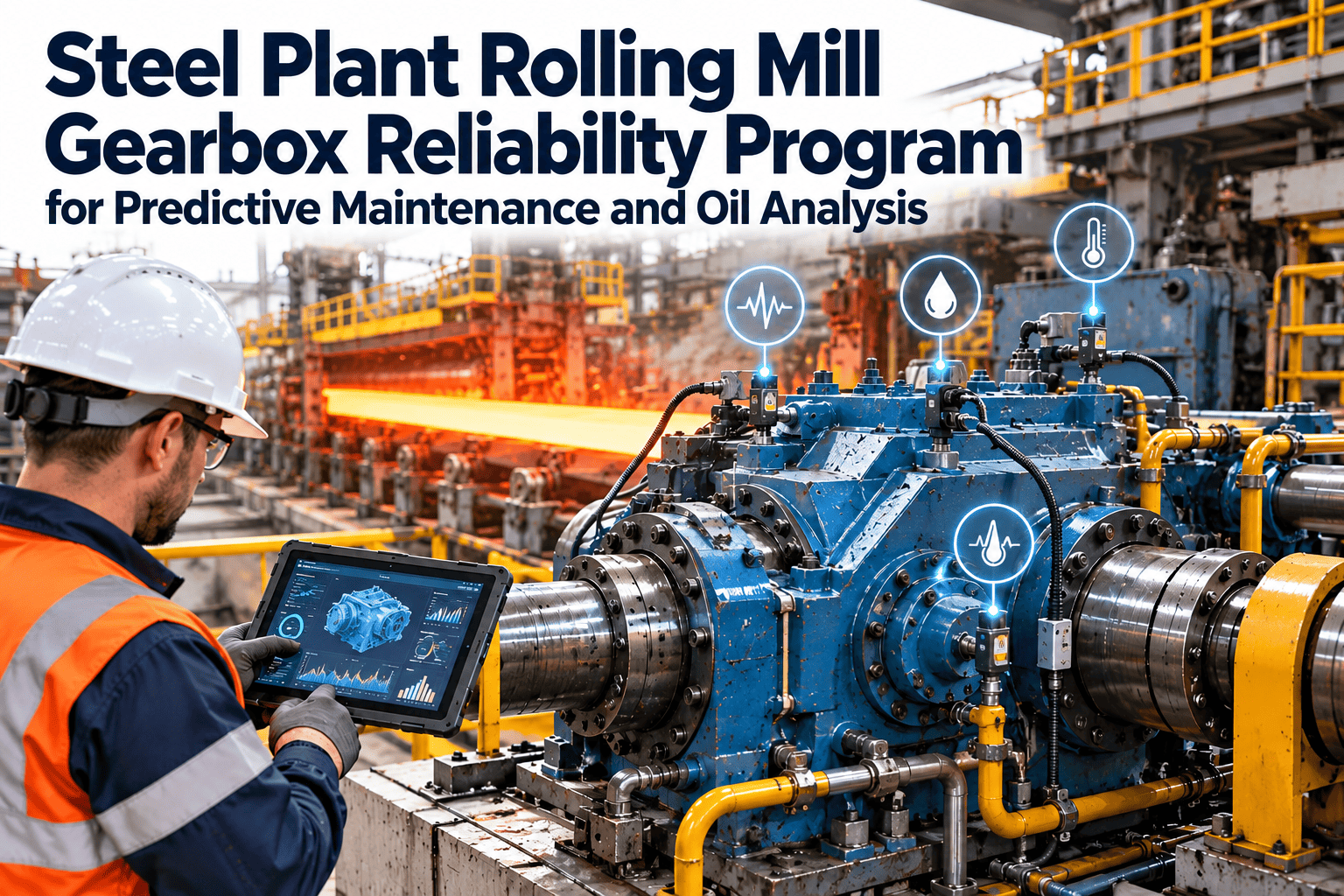
Install vibration sensors on rolling mill bearings, thermal sensors on blast furnace cooling circuits, and oil particle count monitoring on critical gearboxes. Connect these sensors to your CMMS — OxMaint integrates with standard IoT platforms and your existing process historian (OSIsoft PI, Honeywell PHD). Within 3–6 months, the AI models baseline normal equipment signature and begin detecting anomalies 2–8 weeks before failure occurs. This phase typically pays for itself on the first prevented critical failure.
PM Compliance Enforcement and Backlog Clearance
With work order discipline established, shift scheduling from reactive to preventive. Set PM compliance targets (85%+ on-time completion for critical assets) and use OxMaint's backlog management tools to attack deferred maintenance. Most facilities discover 150–300 hours of deferred maintenance on the books — work that's been postponed due to production pressure. Clear this backlog over 3–6 months while simultaneously protecting newly scheduled PM from compression.
OEE Integration and Strategic KPI Reporting
Connect production schedule and actual output data to your CMMS. OxMaint calculates OEE, TEEP, and MTBF-driven production loss attribution automatically. Strategic reporting shifts from "we did 87 work orders this week" to "we prevented 2.4 OEE points of loss through preventive maintenance execution, valued at $2.1M in protected production margin." This visibility drives board-level support for maintenance investment and justifies continued technology expansion.
How OxMaint Structures Steel Plant Maintenance Strategy
Frequently Asked Questions: Steel Plant Maintenance Strategy
What separates world-class steel plant maintenance strategy from reactive operations?
World-class plants operate at 70–85% planned maintenance ratio, track MTBF and MTTR by individual asset class, enforce PM compliance at 85%+ on-time rate, and integrate condition data into work order triggers. Reactive plants operate at 40–50% planned ratio, track maintenance only as total hours spent, and schedule work reactively after failures occur. OxMaint bridges this gap by automating the data capture that enables strategic decision-making.
How does OxMaint handle blast furnace campaign life prediction and reline planning?
OxMaint collects shell temperature trends, stave wear data from inspections, tuyere replacement history, and cooling system performance metrics. The platform analyzes these inputs against campaign wear models, predicts remaining campaign life with 85–90% accuracy 6–12 months before end-of-life, and generates the full reline work order package (refractory procurement, engineering design, production scheduling) well in advance. This replaces the estimate-based planning that often leads to surprises.
Can OxMaint integrate with existing process historians like OSIsoft PI or Honeywell PHD?
Yes — OxMaint connects to OSIsoft PI via Web API, Honeywell PHD via ODBC, and standard OPC-UA connections for direct PLC/DCS integration. This means your thousands of temperature, pressure, flow, and composition data points already being collected by process control systems flow directly into CMMS asset records without deploying new sensors. The AI layer correlates process parameter trends with maintenance history to detect degradation patterns.
How long does a typical OxMaint deployment at a steel plant take?
Most steel plants are running digital inspections and capturing work orders within 48–72 hours of account setup using OxMaint's pre-built templates for blast furnaces, BOF, continuous casters, and rolling mills. Full MTBF and MTTR baseline establishment takes 4–12 weeks. Condition monitoring integration can begin immediately and generates ROI within 14–18 months of phased implementation, with immediate payback on the first prevented critical failure.
What is the maintenance cost per tonne benchmark for a well-managed integrated steel plant?
World-class integrated mills (2–4 MTPA) operate at $20–45 per tonne in annual maintenance costs. The difference between a $20/tonne plant and a $40/tonne plant is program maturity and data discipline, not equipment age. Over a 3.5 MTPA mill, the $10/tonne difference represents $35M annually — often enough to fund a comprehensive CMMS platform and predictive maintenance layer within 11–14 months, then compound as downtime avoidance accumulates.
.png)
