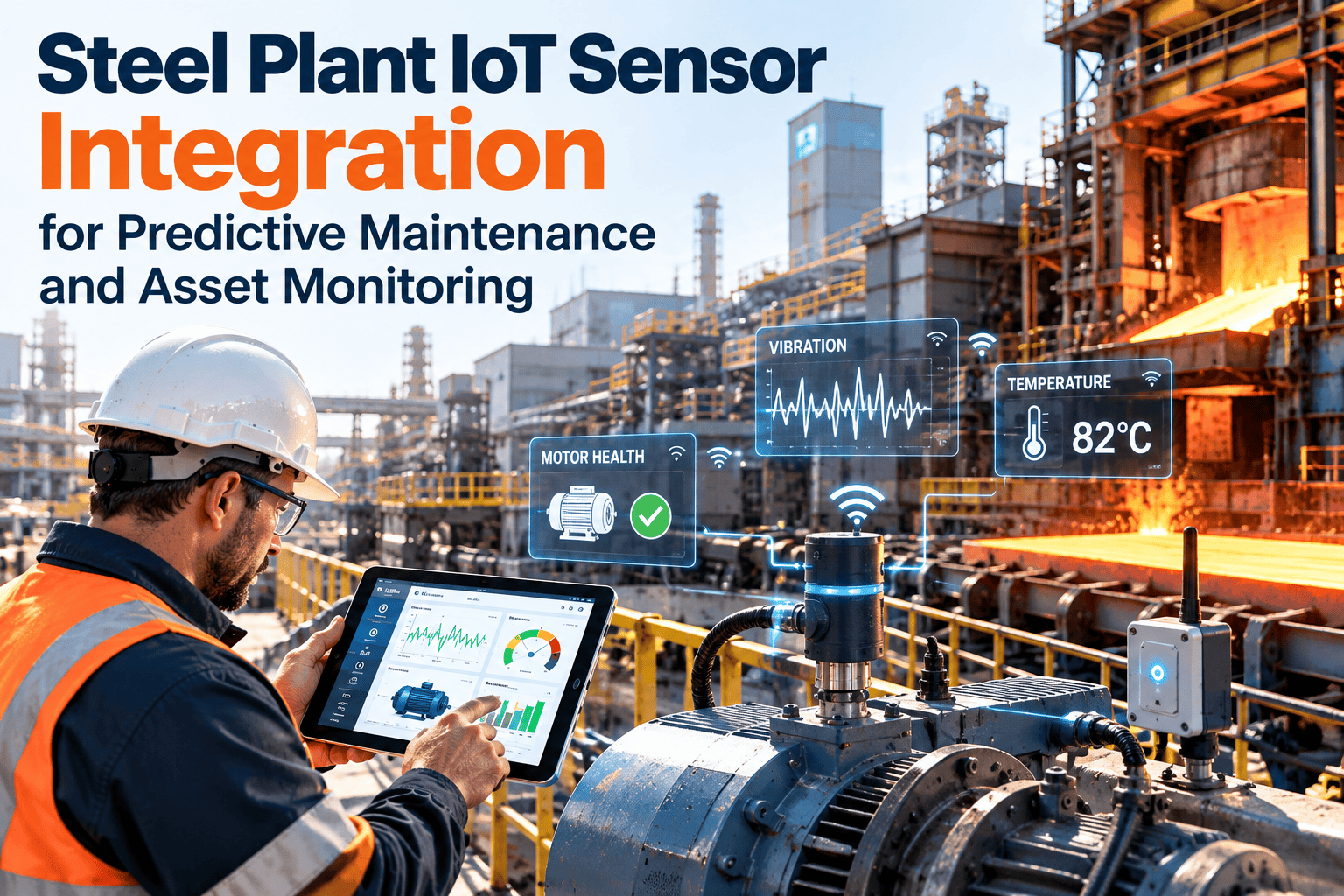
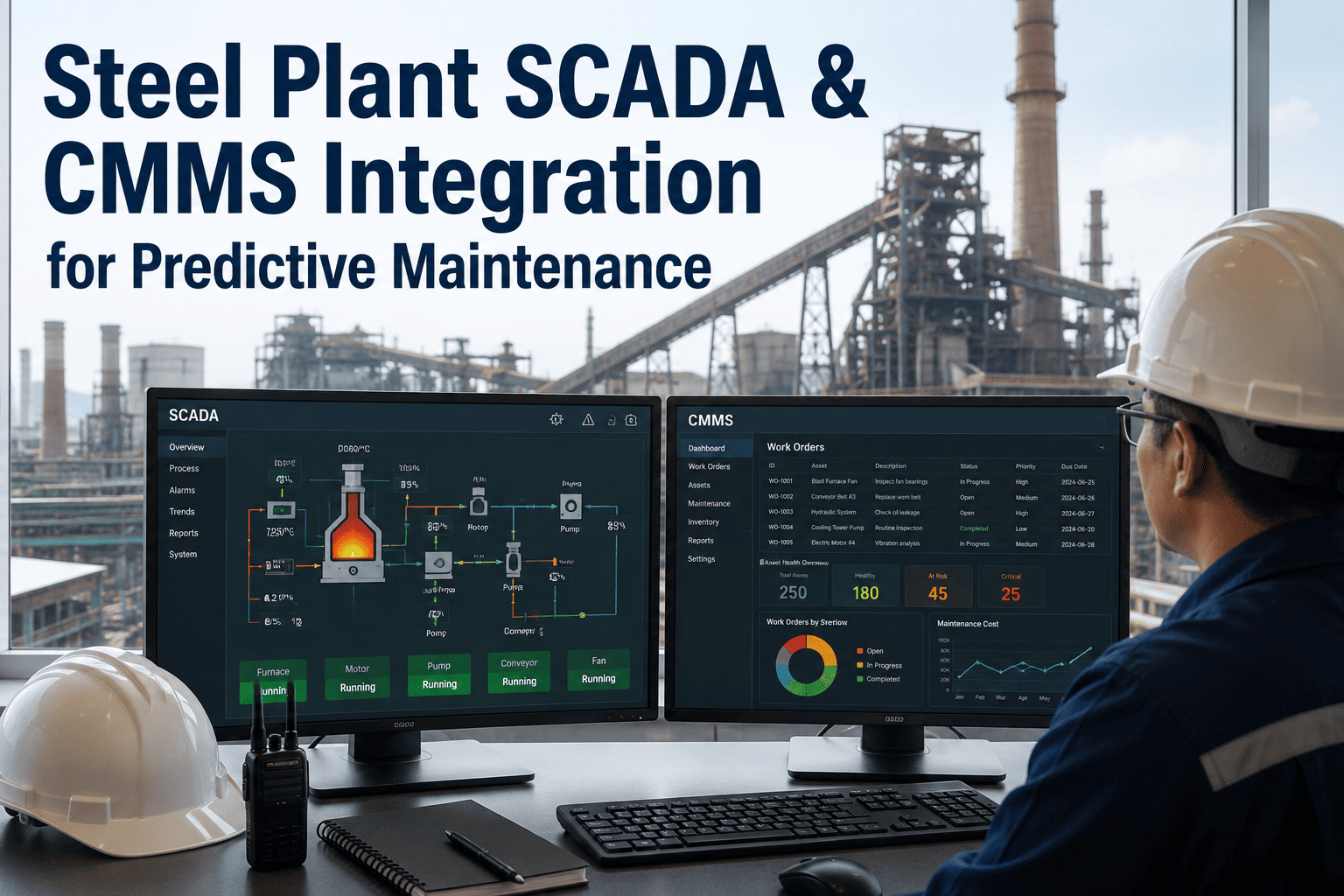
Connecting IoT sensors to a steel plant's CMMS transforms maintenance from schedule-based guessing into condition-based precision — but the implementation path is littered with failed pilot projects, orphaned sensor networks, and expensive hardware collecting data that nobody uses. The difference between a successful IoT integration and a $300,000 science project isn't the sensor technology — it's the implementation strategy. Plants that succeed start with the equipment that costs the most when it fails, connect sensor data directly to the CMMS work order workflow, and expand only after the first phase proves measurable ROI. This guide covers the complete implementation path: which equipment to instrument first, which sensor types to deploy where, how to connect sensor data to your CMMS, how to build the alert-to-work-order pipeline, and how to scale from pilot to plant-wide deployment without the common failures that kill 60% of industrial IoT projects.
60%
of industrial IoT pilot projects fail to scale beyond the initial deployment — usually because data isn't connected to maintenance action
3–6 mo
typical timeline from first sensor installation to measurable ROI when implementation follows equipment-criticality sequencing
$2.4M
average annual maintenance savings from IoT-integrated CMMS across an integrated steel plant after full deployment
Phase 1: Start Where the Money Is — Equipment Selection
The most common IoT implementation mistake in steel plants is instrumenting everything at once. A 500-sensor deployment across the entire plant takes 12–18 months, costs $400K+, and produces so much data that the maintenance team drowns before seeing a single prevented failure. Successful implementations start with the 15–25 assets where unplanned failures cost the most — and prove the system works before expanding.
1
Rolling Mill Main Drive Motors & Gearboxes
Failure cost: $180K–$420K per event
Sensors needed: 8–12 per stand
Vibration (bearing housings, gearbox), temperature (bearings, windings), current (motor signature analysis), oil quality (gearbox sump). Single bearing failure on F3 main drive causes 18–48 hour mill stop. Vibration monitoring provides 3–8 weeks warning.
2
Blast Furnace Cooling System — Stave & Tuyere Circuits
Failure cost: $500K–$2M per event
Sensors needed: 40–60 per furnace
Flow sensors (per cooling circuit), temperature differential (inlet/outlet per stave), pressure (header and individual circuits), leak detection. Cooling circuit failure can force unplanned BF shutdown — the most expensive single failure event in any steel plant.
3
Continuous Caster — Segments, Mold, & Hydraulics
Failure cost: $120K–$350K per event
Sensors needed: 30–50 per strand
Vibration (segment roll bearings), temperature (mold copper plates), pressure (hydraulic segment clamping), flow (secondary cooling nozzles), position (mold oscillation). Breakout event from mold or segment failure is both a safety and production catastrophe.
4
Sinter Plant — Main Exhaust Fan & Strand
Failure cost: $180K–$400K per day
Sensors needed: 15–25
Vibration and temperature (fan bearings), current (fan motor), UT thickness scheduling data (wind boxes), thermal monitoring (grate bar cycle tracking). Single strand with zero redundancy means every failure stops blast furnace feed.
5
BOF/EAF — Hydraulic Systems & Transformer
Failure cost: $100K–$280K per event
Sensors needed: 15–25
Pressure and flow (vessel tilting hydraulics, lance positioning), temperature (transformer windings, hydraulic oil), vibration (hydraulic pumps), current (EAF electrode regulation). Vessel tilting failure near molten metal is both a production and safety-critical event.
Plants selecting their Phase 1 equipment should sign up to see how CMMS ranks equipment by failure cost impact to guide IoT sensor deployment priority.
Phase 2: Sensor Selection & Placement — What Goes Where
Each sensor type detects specific failure modes. Deploying the wrong sensor on the right equipment wastes money. Deploying the right sensor in the wrong location misses the failure signature. This mapping ensures every sensor is matched to the failure mode it can actually detect, installed in the location where the signal is strongest.
Vibration (accelerometer)
Bearing defects, gear wear, misalignment, unbalance, looseness, shaft cracks
Mount directly on bearing housing — never on a bracket, guard, or adjacent structure. Axial and radial measurement points on each bearing. Magnetic mount acceptable for route-based; stud mount required for permanent online systems.
3–8 weeks
Temperature (RTD / thermocouple)
Lubrication failure, bearing deterioration, electrical hot spots, cooling blockage, insulation degradation
Bearing housings: embedded in housing or surface-mounted with thermal compound. Motor windings: factory-installed RTDs in stator slots. Oil systems: immersion probe in reservoir and return line. Rate-of-rise trending more valuable than absolute thresholds.
1–4 weeks
Pressure (transducer)
Hydraulic pump wear, servo valve degradation, accumulator pre-charge loss, filter clogging, seal leakage
Install at both pump discharge and cylinder/actuator inlet to capture pressure drop across the circuit. Accumulator nitrogen side requires separate pre-charge gauge. Use snubbers in high-pulsation circuits to protect transducer.
2–6 weeks
Oil quality (particle counter / moisture)
Gear tooth wear, bearing wear (metal particles), water contamination, oil oxidation, wrong lubricant
Install inline in the return line before the filter — captures debris generated during the full circulation cycle. Moisture sensor positioned in the reservoir at the lowest point where water collects. Bypass sampling port for lab analysis confirmation.
4–12 weeks
Current (CT / power analyzer)
Motor winding faults, rotor bar cracks, power factor decay, mechanical overload, VFD anomalies
Clamp-on CT on motor supply cable — all three phases for imbalance detection. Sampling rate must support Motor Current Signature Analysis (MCSA): minimum 2 kHz for rotor bar defect detection. Install in the MCC or at the VFD output.
2–8 weeks
Flow (ultrasonic / mag meter)
Cooling circuit blockage, lubrication delivery failure, hydraulic internal leakage, pump cavitation
Clamp-on ultrasonic preferred for retrofit (no pipe cutting). Install on straight pipe runs: minimum 10× pipe diameter upstream, 5× downstream of elbows or valves. Mag meters for conductive fluids where higher accuracy required.
1–4 weeks
Phase 3: Data Architecture — From Sensor to CMMS
The most critical and most frequently botched part of IoT integration isn't the sensors — it's the data path from sensor to maintenance decision. A sensor generating data that sits in a historian database without connecting to the CMMS work order system is an expensive thermometer. The architecture must deliver sensor data into the hands of people who can act on it — automatically.
Layer 1
Edge Collection
Sensors transmit to local edge gateways positioned throughout the plant. Each gateway aggregates data from 20–50 sensors within its zone via wired (4–20mA, Modbus, HART) or wireless (WirelessHART, ISA100.11a, LoRaWAN) connections. The gateway performs initial data validation, filters noise, and compresses high-frequency vibration data for efficient transmission. Steel plant environments require industrial-rated gateways — IP65+ enclosures, operating temperature rated for ambient conditions near furnaces and mills, and EMI shielding for electrically noisy environments near VFDs and arc furnaces.
Layer 2
Plant-Level Data Platform
Edge gateways forward data to a plant-level IoT platform (on-premise server or hybrid cloud) that stores time-series data, runs analytics models, and manages device health. This layer handles data normalization (converting all sensor outputs to engineering units), time synchronization across all devices, data historian storage, and baseline establishment for each monitored asset. Key decision: on-premise vs. cloud. Most steel plants use hybrid — real-time analytics on-premise for speed, historical trending and AI model training in cloud for compute power. Latency requirement: anomaly detection must run within 30 seconds of data collection for safety-critical equipment.
Layer 3
Analytics & AI Engine
The analytics layer applies fault detection algorithms to incoming data — comparing current readings against equipment-specific baselines, identifying frequency-domain signatures that indicate specific defect types, and trending degradation rates to estimate remaining useful life. This is where raw data becomes diagnosis: not "vibration is 4.2 mm/s" but "F3 backup roll bearing has outer race defect, currently Stage 2, estimated 5–7 weeks to functional failure at current load." Three analytical approaches working together: threshold monitoring (basic — immediate alerts for acute failures), trend analysis (intermediate — rate-of-change detection for gradual degradation), and pattern recognition (advanced — AI matching of frequency-domain signatures against known fault libraries).
Layer 4
CMMS Integration — The Action Layer
This is where most IoT projects fail — the data stays in the analytics platform and never reaches the maintenance team's daily workflow. Successful integration means the AI engine pushes findings directly into the CMMS as work order requests with pre-populated diagnosis, recommended action, required parts (with current stock check), estimated labor hours, and suggested scheduling window based on time-to-failure estimate. The maintenance planner reviews and approves — they don't troubleshoot. The CMMS becomes the single source of truth where AI-generated work orders sit alongside PM tasks and corrective requests in the same priority queue. Integration method: REST API connection between IoT platform and CMMS, or middleware integration layer for legacy CMMS systems. Data exchange must be bidirectional — CMMS sends maintenance history back to the AI engine to improve future predictions.
Sensor Data Connected Directly to Maintenance Action
OxMaint provides the CMMS integration layer that converts IoT sensor findings into scheduled work orders — automated work order generation from AI diagnostics, pre-populated parts and labor estimates, priority-ranked alongside existing PM schedules, and the bidirectional data flow that makes AI predictions more accurate over time.
Phase 4: The Alert-to-Work-Order Pipeline
A sensor alert that requires a human to manually interpret the data, decide on action, look up parts, check stock, and create a work order will be ignored within 3 months — guaranteed. The pipeline must be automated end-to-end, with human judgment applied only at the approval step. Teams building automated maintenance pipelines should book a free demo to see the complete alert-to-work-order automation.
01
AI Detects Anomaly
AI identifies a developing fault — bearing defect frequency trending, temperature rate-of-rise exceeding baseline, hydraulic response time degrading. Confidence score calculated (typically must exceed 80% before escalation).
Automated — no human intervention
02
Diagnosis & Time-to-Failure Estimate
AI correlates data across multiple sensor types on the same asset (vibration + temperature + oil quality) to confirm diagnosis and estimate remaining useful life. Multi-parameter correlation increases confidence from 80% to 90%+.
Automated — no human intervention
03
CMMS Work Order Generated
AI pushes a work order request into CMMS with: specific component, defect type, severity stage, recommended action, required parts (BOM auto-populated from equipment record), current parts stock status, estimated labor hours, and scheduling window based on time-to-failure.
Automated — CMMS receives and queues
04
Planner Reviews & Approves
The maintenance planner reviews the AI-generated work order — confirms parts availability, assigns crew, selects specific maintenance window. The planner is making a scheduling decision, not a diagnostic decision. The AI has already done the troubleshooting.
Human decision point — the only manual step
05
Execution & Feedback Loop
Crew executes the planned repair. Work order closure data feeds back to the AI engine — confirming or correcting the diagnosis. Over time, this feedback loop improves AI accuracy from initial 80–85% to 92–96% within 12–18 months of operation.
CMMS feeds data back to AI — continuous improvement
Phase 5: Scaling — From Pilot to Plant-Wide
Phase 1 covers 15–25 high-criticality assets with 80–150 sensors. Once the pilot proves ROI (typically within 3–6 months), expansion follows a structured sequence — always prioritizing equipment where prevented failures deliver the highest financial return.
Assets covered: 15–25 highest-criticality equipment items
Sensors deployed: 80–150
Investment: $80K–$160K (sensors, gateways, platform setup, CMMS integration)
Target ROI: 1–3 prevented major failures = $200K–$600K in avoided costs
Success criteria: At least 2 confirmed AI-predicted failures, CMMS integration operational, planner trust established
Assets covered: Expand to 60–100 assets including secondary critical equipment
Sensors deployed: 250–400 total
Investment: $120K–$220K incremental
New capabilities: Cross-equipment correlation (e.g., rolling mill motor current + gearbox vibration + oil quality combined), fleet-level pattern recognition for similar equipment types
Target ROI: $1.2M–$2.0M annual savings from combined predictive and condition-based maintenance
Assets covered: 150–300 assets across all production areas
Sensors deployed: 500–1,200 total
Investment: $150K–$300K incremental
New capabilities: Predictive spare parts ordering (AI triggers part procurement based on predicted failure timeline), maintenance scheduling optimization (AI suggests optimal maintenance windows across the full plant), digital twin integration for process-critical equipment
Target ROI: $2.4M–$4.2M annual savings — full predictive maintenance capability
The Pitfalls That Kill 60% of Industrial IoT Projects
Most failed IoT implementations didn't fail because of bad technology — they failed because of implementation mistakes that are entirely avoidable. Here are the five most common failure patterns in steel plant IoT projects and how to avoid each one.
500 sensors deployed across the plant in a single project. Data floods the analytics platform. The maintenance team has 200 alerts per day — most are noise. Within 6 months, everyone ignores the system.
Prevention: Start with 15–25 assets. Prove value with 80–150 sensors. Expand only when the pilot has demonstrated prevented failures and the team trusts the alerts. Quality of coverage beats quantity of sensors.
Sensors feed data to a standalone analytics dashboard that the reliability engineer checks once a week. Findings never become work orders. The maintenance planner uses CMMS for scheduling and never sees the sensor insights. Two systems, zero integration, no action.
Prevention: CMMS integration is Day 1 architecture — not a "Phase 2 nice-to-have." If sensor findings don't auto-generate CMMS work orders, the system will be abandoned. The maintenance planner must see AI findings in their normal CMMS workflow.
Vibration sensor mounted on a guard cover instead of the bearing housing. Temperature sensor in ambient air stream instead of on the bearing surface. Pressure transducer on the wrong side of the filter. The sensor works perfectly — it just isn't measuring what matters.
Prevention: Every sensor placement reviewed by a vibration analyst or condition monitoring specialist — not by the IT team or the sensor vendor. Placement determines whether the system detects failures or detects noise.
AI predicts a bearing defect. The crew replaces the bearing. Nobody tells the AI whether the prediction was correct, what they actually found, and what condition the component was in. The AI never learns from its mistakes or successes.
Prevention: Build a mandatory feedback field into the CMMS work order closure — "AI prediction confirmed / partially confirmed / not confirmed." This data feeds back to the AI engine and improves accuracy from 80% to 95%+ within 12–18 months.
Sensors rated for factory automation environments fail within months in a steel plant — vibration sensors shaken loose near rolling mills, temperature sensors destroyed by radiant heat near furnaces, wireless signals blocked by thick steel structures and electromagnetic interference from arc furnaces and VFDs.
Prevention: Specify industrial-rated sensors: IP67+ enclosures, operating temperature range covering actual ambient conditions (not just "industrial"), EMI-hardened electronics for areas near VFDs and arc furnaces, and wired connections (not wireless) in high-interference zones.
Plants avoiding these pitfalls should sign up to see how CMMS provides the integration layer that connects IoT sensor data directly to maintenance workflow — closing the gap where most projects fail.
Implementation Budget: What It Actually Costs
Sensors & hardware
$40K–$80K
$60K–$110K
$80K–$160K
Edge gateways & networking
$15K–$30K
$20K–$40K
$25K–$50K
IoT platform & analytics license
$15K–$30K/year
$25K–$45K/year
$35K–$60K/year
Installation & commissioning
$10K–$20K
$15K–$25K
$20K–$35K
Total investment
$80K–$160K
$120K–$220K
$160K–$305K
Expected annual savings
$200K–$600K
$1.2M–$2.0M
$2.4M–$4.2M
Expert Perspective: The Sensor Isn't the Product — The Work Order Is
I've led IoT implementations at four steel plants over 14 years and the single sentence I repeat to every project team is this: the sensor isn't the product. The work order is the product. Nobody's job gets better because there's a vibration sensor on a bearing housing. Jobs get better when the CMMS tells the planner "F3 backup roll bearing has an outer race defect, replace within 4 weeks, here's the part number, it's in stock, and here's the recommended maintenance window." That's the product. Everything between the sensor and that work order — the gateway, the platform, the analytics, the AI — is plumbing. Essential plumbing, but plumbing. The moment you lose sight of that and start treating IoT as a technology project instead of a maintenance improvement project, you're on the path to the 60% that fail. Every decision should be tested against one question: does this make it easier for the maintenance planner to prevent the next failure? If yes, proceed. If no, reconsider. The second lesson is about trust. Your maintenance team has been doing this for decades. They know their equipment. When the AI says "this bearing is failing" and the mechanic says "it sounds fine to me," you need both to be right — the AI detects what the mechanic can't hear yet, and the mechanic provides the physical verification that validates the AI. Build the system so they complement each other, not compete with each other.
Require CMMS Integration Before First Sensor Install
Don't install a single sensor until the data pipeline to CMMS work order generation is designed, built, and tested. A sensor without a work order path is a $400 data logger. The integration architecture must be confirmed working before hardware goes on equipment.
Celebrate the First Predicted Failure — Loudly
When the AI predicts its first real failure and the team prevents it during a planned stop, make sure everyone knows — the shift crew, the planners, plant management. This single event builds more trust than any PowerPoint presentation about IoT benefits ever could.
Budget for Sensor Replacement — They Don't Last Forever
In a steel plant environment, expect 5–10% sensor attrition per year from heat, vibration, dust, and physical damage. Budget for annual replacement. A monitoring system with 15% of its sensors dead is worse than no system — it creates false confidence in incomplete data.
From Sensor to Work Order. From Data to Prevention. From Pilot to Plant-Wide.
OxMaint delivers the CMMS integration layer that makes IoT sensor networks actually useful — automated work order generation from AI diagnostics, equipment-linked sensor mapping, bidirectional data flow for continuous AI improvement, and the phased implementation support that gets steel plants from first sensor to full predictive capability.
Frequently Asked Questions
How many sensors does a steel plant IoT deployment require?
A pilot phase covers 15–25 critical assets with 80–150 sensors. Full plant-wide deployment typically requires 500–1,200 sensors across 150–300 assets. Start small, prove ROI in 3–6 months, then expand. Trying to deploy 500+ sensors at once is the #1 reason IoT projects fail.
What does IoT integration for steel plant maintenance cost?
Phase 1 pilot: $80K–$160K covering sensors, gateways, platform, installation, and CMMS integration. Full plant-wide deployment over 24 months: $360K–$685K total. Expected ROI at full deployment: $2.4M–$4.2M annual savings — a 6–12× return on total investment.
Why do 60% of industrial IoT projects fail?
Five main reasons: deploying too many sensors at once (alert fatigue), failing to integrate sensor data with CMMS (findings never become work orders), wrong sensor placement (measuring noise instead of failures), no AI feedback loop (system never improves), and using consumer-grade hardware that can't survive steel plant conditions. All are avoidable with proper implementation planning.
Should IoT sensor data be processed on-premise or in the cloud?
Most steel plants use a hybrid approach: real-time anomaly detection runs on-premise for speed (under 30 seconds latency for safety-critical equipment), while historical trending and AI model training runs in the cloud for compute power. Pure cloud introduces latency risk; pure on-premise limits AI capability.
How long before IoT predictive maintenance shows measurable results?
First confirmed predicted failure typically occurs within 2–4 months of sensor deployment. Measurable ROI (cost of prevented failures exceeding sensor investment) typically achieved by month 4–6. Full AI accuracy maturity (92–96% prediction confidence) requires 12–18 months of operation with feedback loop data.