In the high-intensity world of US steel manufacturing, energy is more than a utility — it is the single largest variable cost after raw materials. Implementing an ISO 50001 Energy Management System (EnMS) is no longer just a sustainability goal; it is a strategic necessity for maintaining global competitiveness and meeting rigorous ESG (Environmental, Social, and Governance) reporting standards. By establishing clear Energy Performance Indicators (EnPIs) and tracking Specific Energy Consumption (SEC) at the asset level, US steel mills can transition from reactive energy spending to a systematic culture of conservation. A CMMS-backed energy program ensures that every efficiency project is converted into an actionable work order, providing the objective evidence required for successful ISO certification and surveillance audits. Sign Up Free to start building your ISO 50001 compliance roadmap today.
Master Your Steel Plant Energy Intensity
OxMaint gives energy managers the tools to track SEC, manage EnPIs, and execute energy action plans — all linked to the maintenance records that prove your efficiency gains are real.
What is ISO 50001 for Steel Plants? The PDCA Framework
ISO 50001 is a global standard for energy management based on the Plan-Do-Check-Act (PDCA) cycle. For a US steel mill, this means moving beyond simple utility bill tracking and into deep asset-level analytics. The "Plan" phase involves identifying Significant Energy Uses (SEUs) like EAFs and reheat furnaces. The "Do" phase is where action plans are executed — such as burner optimization or waste heat recovery. The "Check" and "Act" phases rely heavily on accurate data: comparing current EnPIs against a historical Energy Baseline (EnB) to verify savings. OxMaint serves as the digital engine for this entire cycle, ensuring that your energy policy is translated into shop-floor maintenance activities that drive measurable SEC reduction. Book a Demo to see how we manage ISO 50001 records.
Core Components of a CMMS-Driven EnMS
Significant Energy Use (SEU) Register
Identify and track the maintenance of your most energy-intensive assets. Seized bearings or clogged filters in an SEU can waste thousands in power in a single shift.
Energy Performance Indicators (EnPIs)
Configure custom metrics for each furnace or mill stand. Track power-per-heat or fuel-per-ton to identify operational drift before it impacts your bottom line.
Energy Action Plan Workflows
Convert audit findings into actionable projects. Assign energy-saving tasks to specific technicians and track their completion against your certification goals.
Automated Utility Meter Logging
Schedule regular sub-meter readings as PM work orders. Digital logging eliminates the errors of paper clipboards and provides a clean data set for baseline calculations.
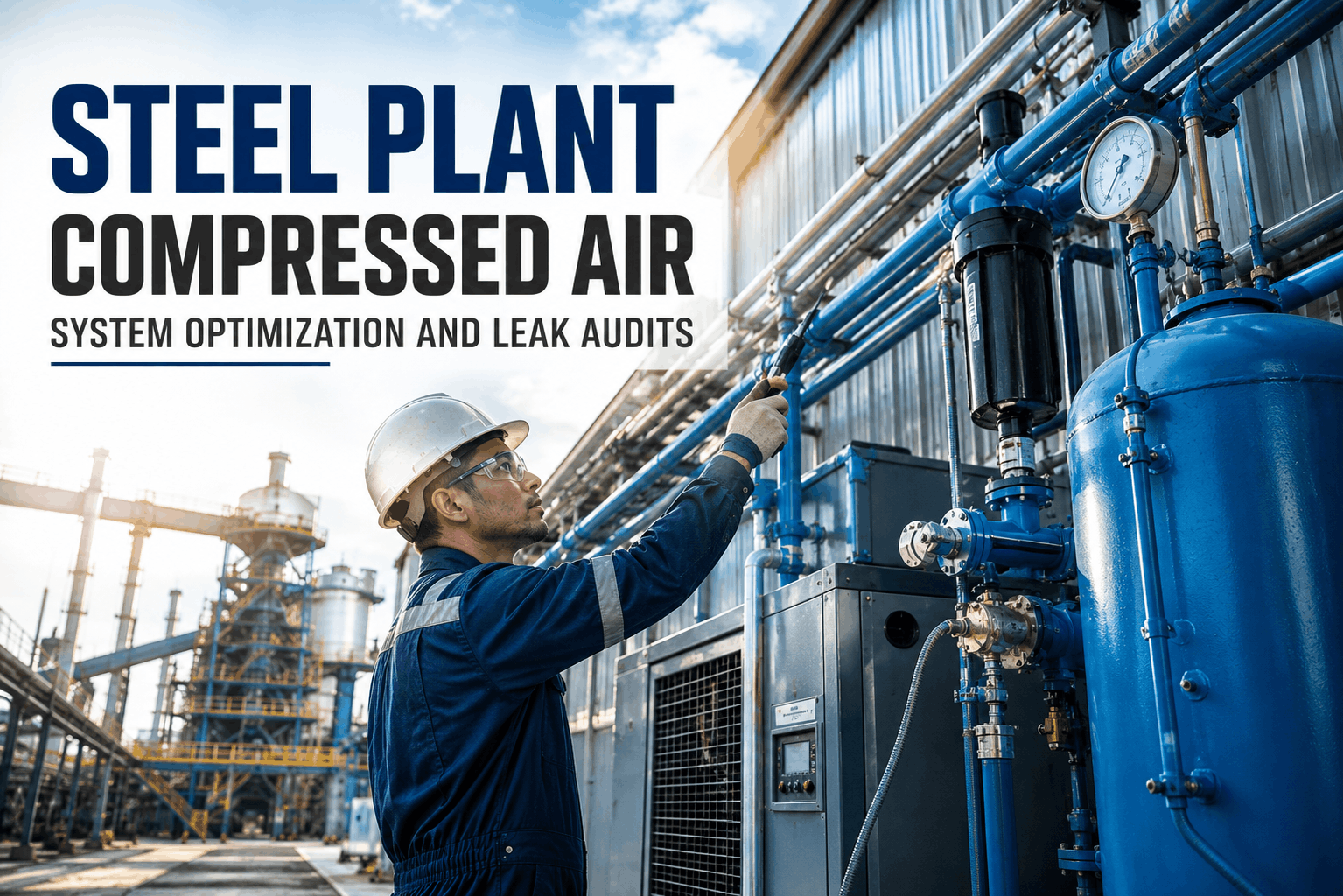
Compressed Air Leak Programs
Schedule quarterly ultrasonic leak audits. Air leaks are a "silent killer" of steel mill efficiency, often accounting for 30% of total plant power waste.
ISO Surveillance Audit Readiness
Maintain a permanent record of all energy-related maintenance. When the ISO auditor arrives, your "Do" and "Check" evidence is ready in a single filtered view.
Energy Intensity Benchmark: Potential Savings by Process Route
Note: Actual ROI depends on facility age, local utility rates, and current maintenance maturity. OxMaint tracks the specific ROI of your action plans.
How to Implement ISO 50001 with OxMaint
Establish Your Energy Baseline (EnB)
Archive two years of utility bills and production tonnages in OxMaint's document management module. This historical record is the foundation of your EnB, allowing you to prove that future energy performance improvements are real. Sign Up Free to start building your baseline.
Define Your EnPIs & SEUs
Identify your EAF, ladle furnace, and compressor plant as Significant Energy Uses. Set up EnPIs for each (e.g., kWh/ton). OxMaint's asset hierarchy allows you to link energy consumption directly to the mechanical health of these critical units.
Execute Energy Action Plans as Work Orders
Don't leave energy conservation to chance. Convert your energy audit recommendations into scheduled work orders. Whether it's replacing motor bearings or cleaning heat exchangers, OxMaint ensures the work gets done and the results are recorded. Book a Demo to see our action plan workflows.
Standardize "Check" Procedures
Schedule weekly sub-meter rounds using the OxMaint mobile app. Technicians log data at the source, providing real-time visibility into SEC deviations. If a furnace's energy intensity spikes, the system generates an immediate corrective work order to find the root cause.
Simplify Management Review & Audits
Generate one-click energy reports for your annual management review. OxMaint's audit-trail shows that your energy policy was followed, your EnPIs were monitored, and your action plans were completed — the exact "Check" evidence ISO auditors require.
Why Steel Plant EnMS Programs Fail — and How to Fix It
Energy policies often stay in the office while the shop floor continues old habits. Link energy targets to maintenance work orders in OxMaint to bridge this gap.
Using paper clipboards for utility data leads to missing or incorrect baseline data. Use OxMaint's mobile interface for error-free digital logging at the meter.
Many plants install energy-saving gear but never verify if it works. Use OxMaint to track asset performance before and after projects to prove ROI.
Action plans without owners or due dates never get finished. Assign energy projects as high-priority work orders in OxMaint to ensure total accountability.
ISO 50001 Best Practices for US Steel Producers
Prioritize Low-Cost/No-Cost Wins First
Start with compressed air leak repair and motor alignment. These projects require minimal capital but deliver immediate SEC reductions that build momentum for your EnMS.
Leverage Utility Rebate Documentation
Many US utilities offer rebates for proven energy savings. Use OxMaint's maintenance and meter records to provide the auditable proof needed to claim these incentives.
Integrate Energy with Asset Criticality
Assign higher energy-auditing frequency to your most critical SEUs. A 5% efficiency drop in an EAF is far more costly than a 50% drop in a small auxiliary motor.
Train Technicians on "Energy Maintenance"
Help your team understand how proper bearing lubrication and filter changes directly impact the plant's power bill. An energy-aware culture starts on the shop floor.
Use EnPI Drift as a Diagnostic Tool
If a mill stand's energy-per-ton increases, it often signals a mechanical problem before a failure occurs. Use EnPIs as an "early warning system" for your reliability team.
Annual Management Energy Review
Schedule a formal review of your energy performance. Use OxMaint dashboards to present clear data on savings, project completion, and areas for improvement.
Ready to Secure Your Energy Future?
Join the US steel mills using OxMaint to digitize their ISO 50001 EnMS, trend their SEC, and maximize the ROI of every energy action plan.
Frequently Asked Questions
An EnPI tracks specific system performance like furnace efficiency, while SEC measures total energy used per ton of steel produced.
OxMaint aggregates both metrics into a unified energy dashboard to ensure your plant meets federal and state efficiency targets.
By standardizing energy conservation, US mills can reduce operational costs by 10-15% through identified waste heat recovery.
OxMaint documents these savings as auditable records, allowing for easier access to utility rebates and federal energy tax credits.
The EAF, ladle furnaces, and the compressed air plant are typically the largest energy consumers in a US mini-mill.
OxMaint tracks the maintenance and runtime of these SEUs, ensuring they operate at peak efficiency to minimize peak-demand charges.
The system stores meter readings and motor efficiency logs that serve as objective evidence for internal and external audits.
Automated alerts for energy-intensive asset failures ensure that inefficient operations are corrected before they impact your monthly baseline.
The EnB provides the historical reference point needed to prove that your energy performance improvements are real and sustainable.
OxMaint archives years of utility and asset performance data, making it the perfect repository for building and maintaining your baseline.
OxMaint converts energy saving projects into actionable work orders with specific targets, assignees, and ROI tracking capabilities.
This turns a high-level policy into a daily shop-floor reality where every technician contributes to the plant's sustainability goals.
Yes, the rigorous documentation required for ISO certification provides the verified data needed for Scope 1 and Scope 2 emissions reporting.
OxMaint's energy reports map directly to ESG frameworks, simplifying transparency requirements for investors and US regulatory bodies.
US industry best practice suggests a comprehensive leak audit every quarter, as air leaks can account for 30% of a mill's power waste.
OxMaint schedules these audits as recurring PM work orders, ensuring that energy waste is identified and repaired on a systematic basis.
"Before implementing ISO 50001, our energy strategy was essentially 'pay the bill and hope for the best.' We had no idea that our compressed air system was costing us an extra $140,000 a year due to simple leaks and poor motor alignment. By centralizing our energy baseline and SEU maintenance in OxMaint, we were able to identify and fix these leaks within three months. We passed our ISO surveillance audit with zero findings, and our Specific Energy Consumption (SEC) has dropped by 8% in the first year alone. The ROI was clear within the first 90 days."
Ready to Secure Your Energy Future?
Start your free OxMaint trial and give your plant sustainability team the tools to document, manage, and enforce energy procedures — linked to every work order.


-programs.png)