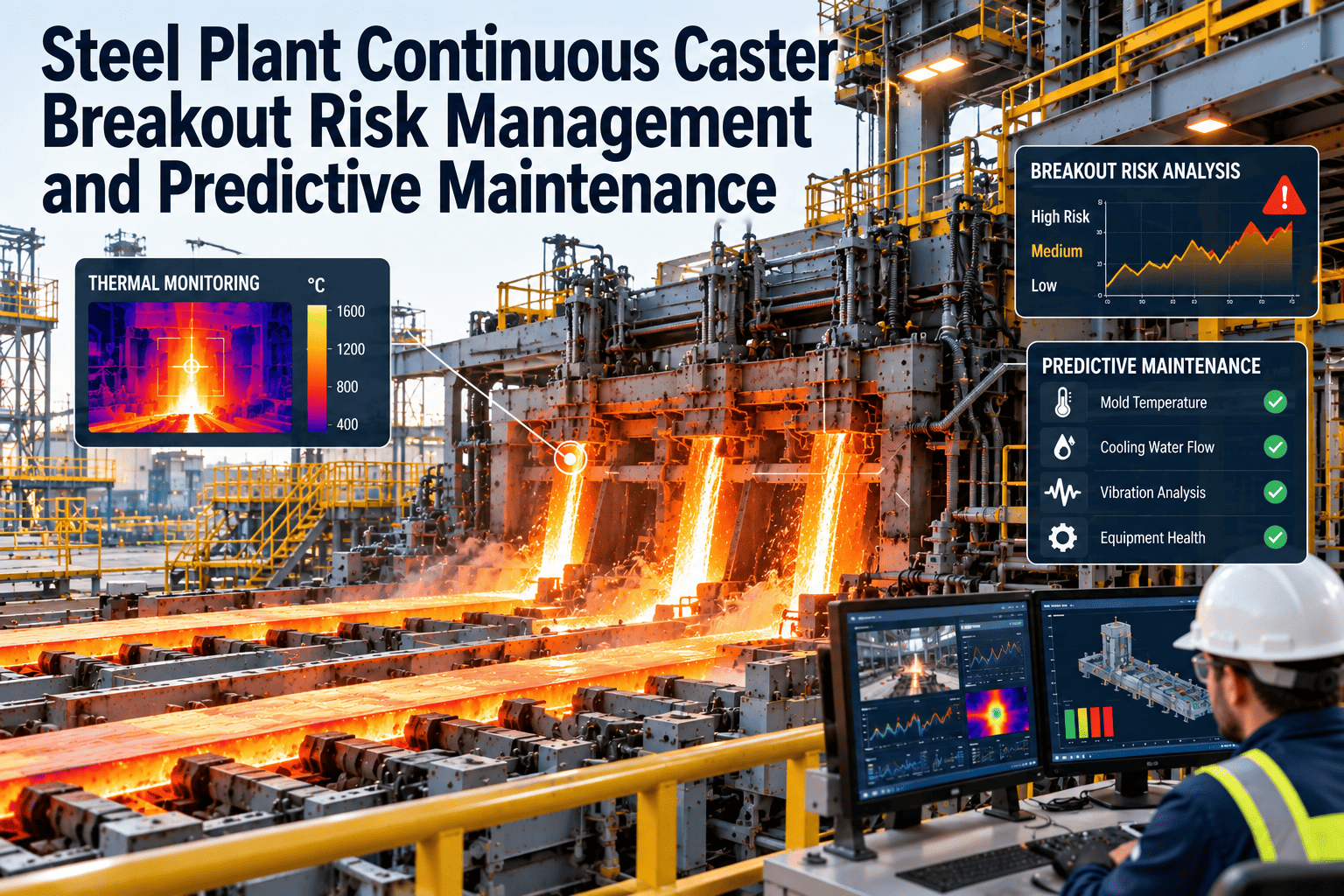
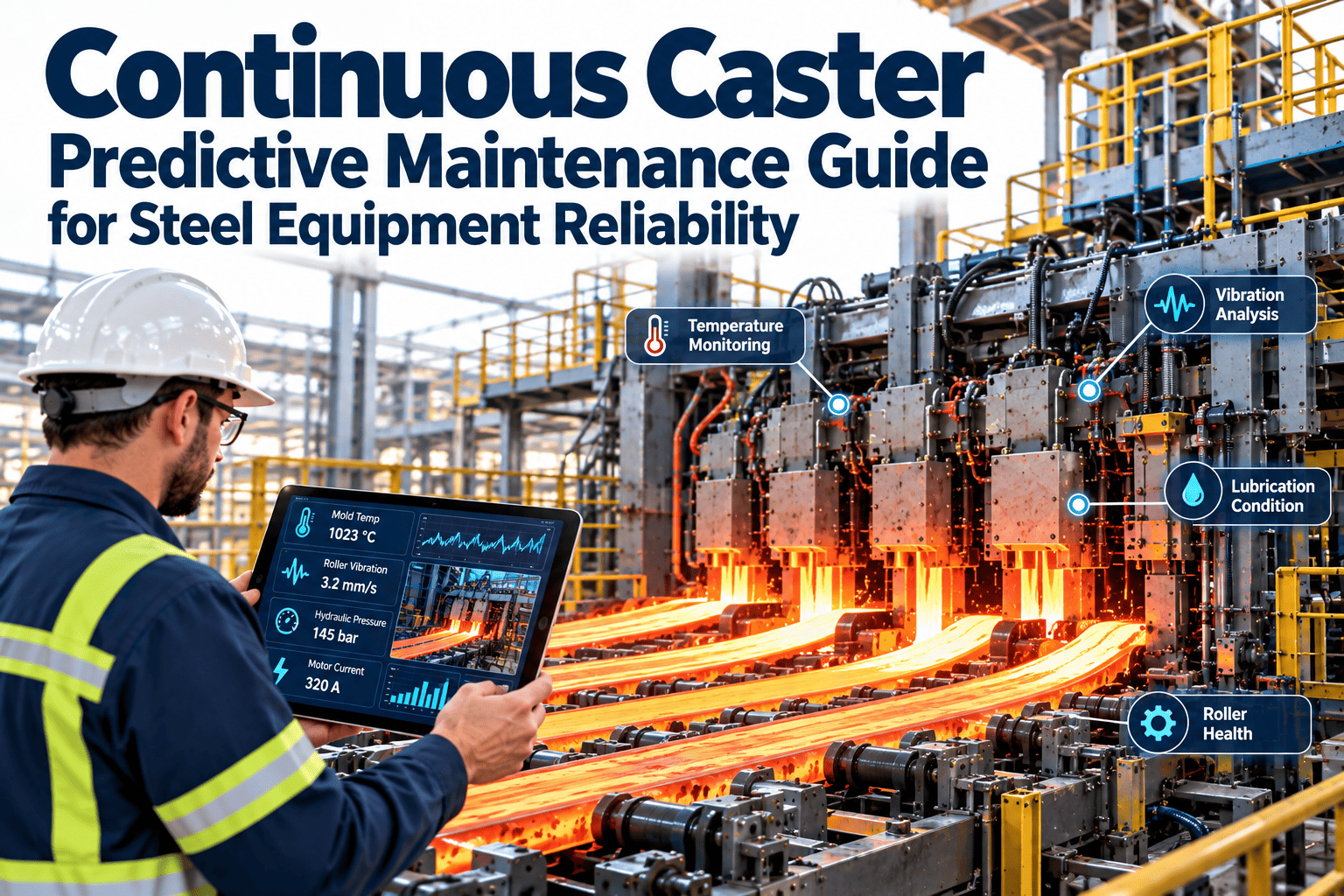
Ladle Turret and Tundish Maintenance Optimization for Maximum Steel Casting OEE
By Lebron on March 11, 2026
The ladle turret and tundish are the most overlooked bottleneck in continuous steel casting operations — yet they control the single most critical transition point in the entire steelmaking process. Every tonne of liquid steel must pass through the tundish, and every ladle exchange depends on a turret that rotates flawlessly under extreme thermal stress, hydraulic load, and mechanical fatigue. When either component fails during a casting sequence, the consequences are immediate and catastrophic: strand freezing, tundish skull formation, breakout risk, and a cascade of lost heats that can cost $200,000 to $500,000 per incident in scrapped steel, emergency repairs, and lost production time. A steel plant running two continuous casters in the upper Midwest tracked their unplanned caster downtime for 18 months and discovered that ladle turret hydraulic failures and tundish wear-related interruptions accounted for 31% of all casting downtime — more than mould issues, withdrawal roll failures, and secondary cooling problems combined. The turret slewing bearing had been replaced reactively three times in two years at $340,000 per replacement including downtime costs, yet nobody had investigated why it was failing prematurely. When a root cause analysis was finally completed, the team found that a lubrication line installed during the last bearing replacement had been routed 6 inches too close to a radiant heat source, degrading the grease within weeks and starving the bearing of protection. A $400 rerouting job would have prevented $1.02 million in bearing replacements.
Optimising ladle turret and tundish maintenance is not about performing more maintenance — it is about performing the right maintenance at the right time, guided by condition data, failure history, and a clear understanding of how these critical components degrade under the extreme operating conditions of continuous casting. The turret must rotate under loads exceeding 300 tonnes at temperatures that degrade seals, warp structures, and accelerate bearing wear. The tundish must contain liquid steel at 1,550°C while its refractory lining erodes millimetre by millimetre toward failure. Both require maintenance strategies that balance maximum campaign life against the catastrophic cost of in-sequence failure. Oxmaint delivers the CMMS platform that integrates turret condition monitoring, tundish refractory tracking, predictive maintenance scheduling, and campaign optimisation into a single system — maximising casting OEE by ensuring these critical components never become the reason your caster stops. Start your free trial to bring structured maintenance intelligence to your ladle turret and tundish operations today.
Casting Maintenance Guide 2026
Ladle Turret & Tundish Maintenance Optimisation for Maximum Steel Casting OEE
A comprehensive framework for optimising maintenance on the two most critical — and most neglected — components in continuous steel casting. Covers turret hydraulics, slewing bearings, structural integrity, tundish refractory management, nozzle systems, preheating optimisation, campaign life extension, and predictive maintenance integration. Purpose-built for caster maintenance engineers, melt shop managers, and reliability teams targeting world-class casting OEE.
31%Of Caster Downtime From Turret & Tundish
$340KAvg Cost Per Turret Bearing Failure
18–24Hrs Lost Per Tundish Skull Event
75%Failures Preventable With Optimised PM
Critical Failure Modes: Ladle Turret Systems
The ladle turret is a rotating heavy-lift platform operating in one of the harshest environments in any industrial setting — directly adjacent to 300+ tonne ladles of liquid steel at 1,550°C. Every mechanical, hydraulic, electrical, and structural component degrades faster here than anywhere else in the steel plant. Understanding the specific failure modes, their progression timelines, and their casting OEE impact is the foundation of effective turret maintenance optimisation.
01Critical
Slewing Bearing Degradation
The turret slewing bearing supports the full rotational load of two ladle arms and their payloads — typically 600+ tonnes combined. Radiant heat from open ladles degrades lubricant, thermal cycling causes raceway micro-pitting, and contamination from scale and dust accelerates wear. Failure progression spans 8–16 weeks from detectable vibration increase to catastrophic seizure.
Turret rotation, ladle clamping, and emergency lift functions depend on hydraulic systems operating at 200–300 bar under extreme thermal stress. Seal degradation from heat exposure, oil contamination from steel splash, hose fatigue from repeated flexing during rotation, and pump wear from continuous duty cycling are the primary failure drivers.
Repeated thermal cycling between ambient and 1,200°C+ surface temperatures combined with dynamic loading during ladle placement and rotation creates cumulative fatigue in turret arm structures, trunnion seats, and pin connections. Crack propagation is insidious — invisible without NDT inspection — and catastrophic if undetected.
Drive motor overheating from radiant heat exposure, gearbox lubrication breakdown, encoder drift causing positioning errors, and brake pad wear affecting hold position accuracy. Positioning errors of even 5mm can cause ladle shroud misalignment with the tundish, creating steel splash, refractory damage, and quality defects.
The tundish is the final vessel before liquid steel enters the mould — a refractory-lined buffer that controls flow rate, temperature, inclusion separation, and multi-strand distribution. Unlike most steel plant equipment, the tundish is a consumable component with a finite campaign life defined by refractory erosion rates. Optimising tundish maintenance means maximising campaign heats while eliminating the catastrophic in-sequence failures that destroy casting OEE.
05Critical
Refractory Lining Erosion
Working lining erosion at 0.3–1.2 mm per heat depending on steel grade, temperature, and slag chemistry. Uneven erosion patterns — especially at the impact zone below the ladle shroud and around the stopper rod/slide gate area — create hot spots that risk steel penetration to the permanent lining. Campaign life typically 20–80 heats depending on steel grade mix.
Flow control mechanisms must operate with precision at 1,550°C in contact with liquid steel and slag. Slide gate plate erosion, stopper rod tip degradation, nozzle clogging from alumina buildup, and actuator mechanical failure all cause uncontrolled flow — either flooding the mould (breakout risk) or starving it (strand freeze risk).
Inspection: Every SequenceReplacement: Per CampaignRisk: Breakout/Freeze
07High
Tundish Preheating Deficiency
Inadequate or uneven preheating causes thermal shock cracking in working lining, premature spalling, cold spots that freeze steel on first contact, and accelerated erosion that shortens campaign life by 15–30%. Preheater burner maintenance, thermocouple accuracy, and preheat schedule discipline directly control campaign length and first-heat quality.
Target Temp: 1,100–1,200°CPreheat Time: 3–5 hrsImpact: Campaign Life
08Medium
Tundish Car & Transfer System
The tundish car must position a 15–30 tonne preheated tundish with millimetre accuracy over the mould centreline. Rail wear, drive motor overheating, positioning sensor drift, and clamping mechanism failure delay tundish changes during sequence transitions — adding 5–20 minutes per changeover that compounds across hundreds of annual transitions.
Positioning: ±2mm requiredChange Time: 8–15 min targetDowntime: Per Change
Maintenance Optimisation Matrix: Turret & Tundish
Each turret and tundish component requires a specific maintenance strategy — from condition-based monitoring for bearings to campaign-based replacement for refractory linings. The matrix below maps every critical component to its optimal maintenance approach, the condition indicators that predict failure, the recommended inspection technology, and the OEE impact of getting it wrong. Discover how Oxmaint automates this entire maintenance matrix.
Turret and tundish maintenance must operate on two parallel timelines: the continuous condition-monitoring cadence for turret mechanical systems and the campaign-based cycle for tundish consumable components. The schedule below integrates both timelines into a unified maintenance calendar that ensures no inspection window is missed, no campaign is pushed beyond safe limits, and no condition trend goes unmonitored.
Per Sequence
Pre-sequence turret rotation test — verify full travel, positioning accuracy, and hydraulic pressureTundish refractory visual inspection before preheat — check for cracks, spalling, and lining damageSlide gate / stopper rod assembly inspection — verify plate condition and actuator responseLadle shroud alignment check — confirm centreline alignment with tundish pour point
Daily
Turret hydraulic oil level, pressure, and temperature check — log readings in CMMSSlewing bearing grease point verification — confirm all ports received grease at scheduled intervalTundish shell temperature monitoring — compare against campaign erosion model predictionsPreheat system burner performance check — flame pattern, fuel flow, thermocouple readings
Weekly
Turret vibration measurement — baseline comparison on slewing bearing and drive motorHydraulic oil sample collection for particle count, water content, and viscosity analysisTundish campaign review — current heat count vs campaign limit, erosion trend analysisTundish car rail inspection — wear measurement, positioning accuracy verification
Monthly
Turret structural inspection — visual + UT on critical welds, trunnion seats, and arm connectionsHydraulic hose and fitting inspection — check for heat damage, abrasion, and fitting torquePreheat system full service — burner nozzle cleaning, thermocouple calibration, gas train checkRefractory consumption analysis — actual vs predicted erosion rates, campaign optimisation review
Quarterly
Full turret NDT inspection — magnetic particle and ultrasonic testing on all structural membersSlewing bearing grease sample laboratory analysis — iron particle trending and contaminationManagement review: turret & tundish OEE impact, maintenance cost trending, MTBF analysis
Never Let the Turret or Tundish Stop Your Caster Again
Oxmaint integrates turret condition monitoring, tundish campaign tracking, refractory erosion modelling, and predictive maintenance scheduling into a single CMMS platform — ensuring every bearing vibration trend, every campaign heat count, and every hydraulic oil sample feeds directly into maintenance decisions that maximise casting availability.
Four Optimisation Strategies for Maximum Casting OEE
Maximising casting OEE through turret and tundish maintenance requires four distinct optimisation strategies applied simultaneously. Each strategy targets a different loss mechanism — from catastrophic turret failures through chronic tundish campaign inefficiency to the subtle speed and quality losses that erode OEE without ever triggering a formal downtime event.
Strategy 1
Turret Condition Intelligence
Deploy continuous vibration monitoring on the slewing bearing and drive motor. Implement automated grease analysis on every lubrication event. Track hydraulic pressure decay rates between service intervals. Build predictive degradation models that forecast failure windows 6–12 weeks in advance — enabling planned replacement during scheduled outages instead of emergency repair during casting sequences.
75% reduction in unplanned turret failures through condition-based prediction
Strategy 2
Tundish Campaign Maximisation
Track shell temperature profiles continuously during casting to build real-time erosion models. Correlate refractory wear rates against steel grade, superheat temperature, and slag chemistry to predict exact campaign end-point per tundish. Optimise grade sequencing to front-load aggressive grades and extend campaigns on clean steel — gaining 10–20 additional heats per campaign.
30% campaign life extension through data-driven refractory management and grade sequencing
Strategy 3
Changeover Time Optimisation
Apply SMED principles to tundish changeover: pre-stage heated tundish on standby car, standardise nozzle and shroud assembly procedures, eliminate waiting time for crane availability, and synchronise ladle turret rotation with tundish change sequence. Every minute saved per changeover across 200+ annual transitions recovers significant casting capacity.
40% changeover time reduction through SMED and standardised transition procedures
Strategy 4
Quality-Linked Maintenance
Connect turret and tundish equipment conditions directly to slab quality outcomes. Track the correlation between tundish campaign age and inclusion rates, between turret positioning accuracy and shroud seal quality, between preheat temperature uniformity and first-heat surface defects. Use quality data to trigger maintenance actions before defects reach customer-detectable levels.
50% quality loss reduction by linking equipment condition data to downstream product defects
Maximise Every Heat From Every Tundish Campaign
From turret bearing vibration trending to tundish refractory erosion modelling, from predictive hydraulic analysis to campaign optimisation algorithms — Oxmaint delivers the complete maintenance intelligence platform that ensures your ladle turret and tundish never limit your casting OEE again.
CMMS Integration: Connecting Condition Data to Casting Decisions
The six capabilities below describe how Oxmaint connects every turret sensor, tundish campaign counter, refractory erosion measurement, and hydraulic analysis result into a unified maintenance intelligence system that drives proactive casting decisions instead of reactive emergency responses.
01
Campaign Life Tracking
Every tundish campaign is tracked from first heat to end-of-life with heat count, grade mix, superheat log, and shell temperature history. The system predicts remaining campaign life based on actual erosion data and alerts production planning when the tundish approaches its safe limit — preventing both premature relines and dangerous over-extension.
02
Turret Condition Monitoring
Continuous vibration, temperature, and hydraulic pressure data from turret sensors feeds directly into CMMS. Automated trend analysis compares current readings against degradation models trained on historical failure data. Predictive alerts generate work orders 6–12 weeks before predicted failure — enabling planned replacement during scheduled outages.
03
Refractory Erosion Modelling
Machine learning models correlate tundish shell temperature profiles with actual post-campaign erosion measurements to build predictive erosion maps for each tundish. The model accounts for steel grade, casting speed, superheat, slag chemistry, and campaign position to predict remaining lining thickness in real time.
04
Changeover Work Order Automation
When campaign end approaches, the CMMS automatically generates the complete changeover work package: pre-heated tundish preparation, nozzle assembly, shroud setup, refractory inspection of outgoing tundish, and skull cleaning schedule. Every task is assigned, sequenced, and time-tracked to minimise changeover duration.
05
Quality Correlation Engine
Links turret and tundish maintenance data to downstream quality outcomes — tracking how tundish age affects inclusion rates, how turret positioning accuracy impacts shroud seal quality, and how preheat uniformity influences first-heat surface quality. Quality-triggered maintenance alerts ensure equipment conditions never degrade to defect-producing levels.
06
Casting OEE Impact Reporting
Every turret and tundish maintenance event is linked to its OEE impact — quantifying availability loss from failures, performance loss from changeover delays, and quality loss from equipment-related defects. Monthly reports show exactly how turret and tundish maintenance performance contributes to — or detracts from — total caster OEE.
Frequently Asked Questions
Q. Why are ladle turret and tundish maintenance so critical to casting OEE?
The ladle turret and tundish represent the single point of failure between steelmaking and solidification. Unlike other caster components that have redundancy or can be partially bypassed, the turret and tundish have zero redundancy — when either fails during a casting sequence, the entire caster stops immediately. Industry data shows that turret and tundish-related events account for 25–35% of total continuous caster downtime, making them the largest single equipment category affecting casting availability. Additionally, tundish condition directly impacts steel quality through inclusion removal efficiency, temperature control, and flow stability — meaning tundish-related losses affect both the Availability and Quality components of OEE simultaneously. A single in-sequence tundish skull event or turret hydraulic failure typically costs $200K–$500K in lost production, scrapped steel, and emergency repairs.
Q. How do you extend tundish campaign life without increasing breakout risk?
Extending tundish campaign life safely requires three capabilities that must work together. First, continuous shell temperature monitoring using thermocouple arrays or infrared cameras to track refractory erosion in real time — detecting localised hot spots that indicate thin lining areas before they become dangerous. Second, predictive erosion modelling that correlates actual temperature data with steel grade, superheat, casting speed, and slag chemistry to predict remaining lining thickness at every point in the tundish. Third, grade sequencing optimisation that schedules aggressive grades (high superheat, aggressive slag chemistry) early in the campaign when the lining is thickest, and transitions to cleaner grades as the campaign progresses. Steel plants using all three approaches typically extend campaign life by 25–40% while simultaneously reducing breakout risk because they have better real-time visibility into lining condition than plants that rely on fixed heat-count limits. Sign up for Oxmaint to deploy campaign life tracking and erosion modelling on your tundish operations.
Q. What condition monitoring should be deployed on ladle turret slewing bearings?
Ladle turret slewing bearings require a three-layer condition monitoring approach due to the extreme operating environment. First, vibration monitoring using permanently mounted accelerometers on the bearing housing — measuring overall vibration level, bearing defect frequencies (BPFO, BPFI, BSF), and trending changes over time. Vibration increases of 3–5 dB from baseline typically indicate the onset of raceway damage 8–16 weeks before functional failure. Second, grease analysis on every lubrication event — measuring iron particle content, consistency change, and contamination level. Iron content trending reveals bearing surface wear progression with 4–8 week lead time. Third, axial and radial play measurement during scheduled outages — tracking the growth in bearing clearances that indicates raceway and roller wear. The combination of all three provides 6–12 weeks of advance warning before failure, enabling planned replacement during scheduled maintenance windows instead of emergency replacement during casting.
Q. How does tundish preheat quality affect casting OEE?
Tundish preheat quality directly affects all three OEE components. Availability is impacted because inadequate preheating causes thermal shock cracking in the working lining during first contact with liquid steel — leading to premature campaign termination and unplanned tundish changes that cost 30–60 minutes each. Performance is impacted because cold spots in an under-preheated tundish cause local steel freezing during the first 1–3 heats, forcing operators to reduce casting speed by 15–25% until the tundish reaches thermal equilibrium. Quality is impacted because uneven preheat temperatures create inconsistent flow patterns and temperature gradients that increase inclusion entrapment and cause surface defects on early-campaign slabs — typically resulting in 2–5% higher defect rates on the first 3–5 heats compared to mid-campaign production. Optimising preheat involves maintaining burner systems, calibrating thermocouples quarterly, following standardised preheat schedules, and monitoring temperature uniformity across the tundish volume. Book a demo to see how Oxmaint tracks and optimises tundish preheat performance.
Q. What is a realistic implementation timeline for turret and tundish maintenance optimisation?
A realistic implementation follows a 6-month phased approach. Month 1: deploy CMMS with tundish campaign tracking (heat count, grade log, temperature monitoring) and turret maintenance history digitisation. Establish baselines for campaign life, turret MTBF, changeover time, and OEE contribution. Month 2–3: install turret condition monitoring (vibration sensors on slewing bearing, hydraulic pressure trending, oil sampling programme). Configure automated alerts and work order triggers in CMMS. Begin formal maintenance schedule per the campaign and condition-based calendar. Month 3–4: deploy tundish refractory erosion modelling using shell temperature data. Begin grade sequencing optimisation. Conduct SMED analysis on tundish changeover to reduce transition time. Month 5–6: integrate quality correlation data — link tundish campaign position and turret condition metrics to downstream slab quality. Launch management OEE impact reporting. Most steel plants see 15–25% reduction in turret and tundish-related caster downtime within the first 90 days and achieve full programme ROI within 6 months through prevented in-sequence failures and extended tundish campaigns.