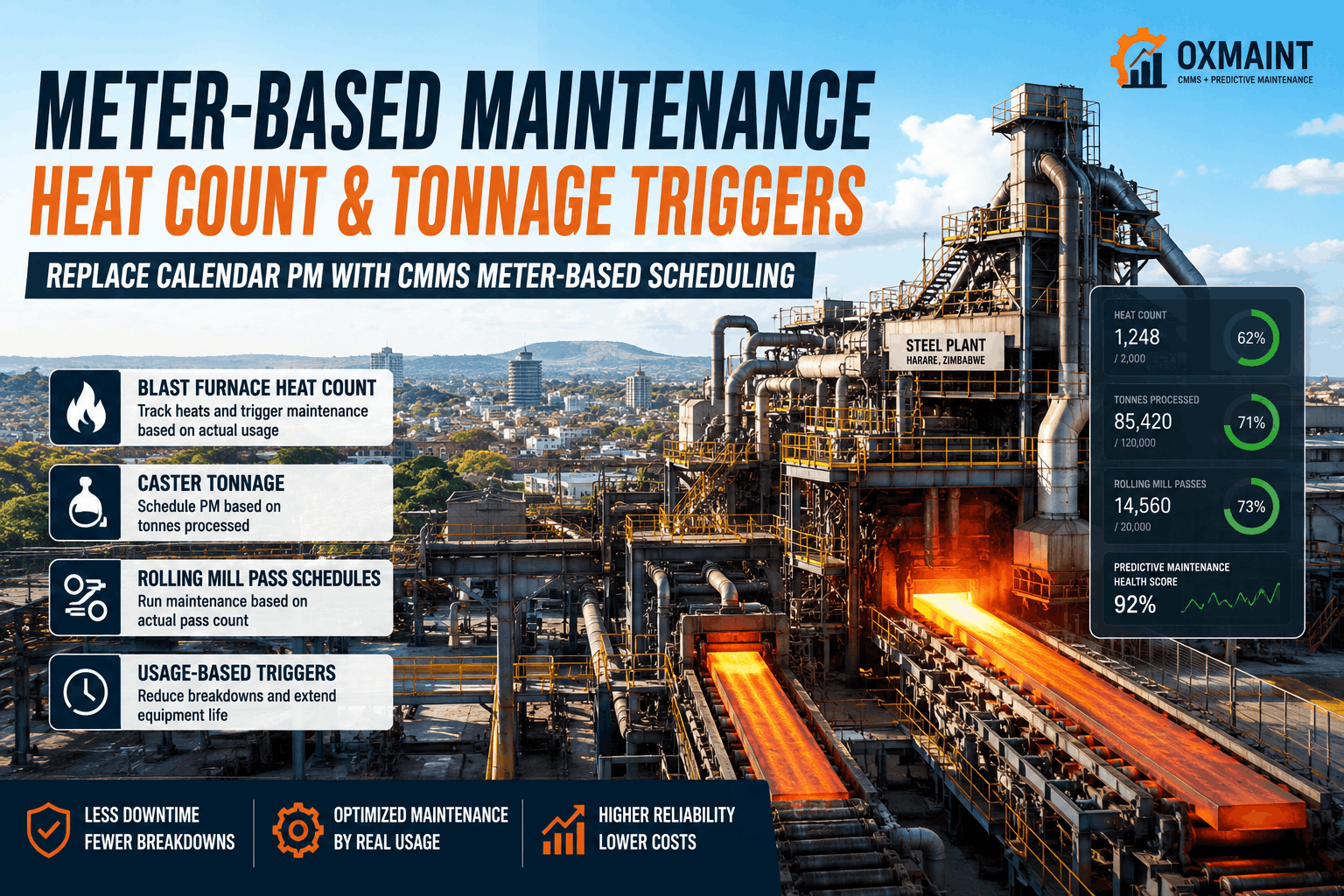
Calendar-based preventive maintenance was invented for equipment with predictable, consistent wear patterns. Steel plants operate in the opposite environment—blast furnace campaigns vary from 1,200 to 2,000 heats, caster speeds fluctuate from 4 to 6 meters per minute, rolling mill pass counts swing by 40% depending on product mix, and refractory degradation accelerates or decelerates based on slag chemistry and operating temperature. A tundish replaced on a fixed 90-day calendar might be removed after 26 campaigns (wasting $50,000) or left in service until campaign 35 (risking a $1.5M breakout). Start a free trial of Oxmaint's meter-based maintenance platform to replace calendar intervals with heat-count, tonnage, and usage triggers, or book a demo to see how usage-based PM adapts to your specific production intensity and asset degradation patterns.
Meter-Based Maintenance for Steel Plants: Heat Count & Tonnage Triggers
Replace calendar PM with heat-count and tonnage triggers. Blast furnace heats, caster tonnes, rolling mill pass schedules, and electrode consumption tracking eliminate calendar guessing and extend consumable life 30–50%.
Why Meter-Based Triggers Outperform Calendar Intervals in Steel Manufacturing
A blast furnace operating in February running low-phosphorus iron ore on a short campaign (1,200 heats) experiences fundamentally different refractory stress than the same furnace in June running high-manganese ore on a long campaign (2,000 heats). The variance is not minor—it is 40% different degradation rate. Yet calendar-based PM treats both scenarios identically: replace at exactly 90 days. This mismatch between wear reality and replacement logic creates two failure modes: premature replacement (costing $80,000–$120,000 per refractory replacement for no operational benefit), or late replacement (risking catastrophic failure costing $1.2M–$3M). Rolling mills exhibit similar variance—a hot strip mill processing soft grades moves at 5–6 meters per second, while heavy plate lines process at 1–2 meters per second. Roll wear over 8 weeks might represent 120,000 tonnes for soft grades versus 40,000 tonnes for heavy plate. Calendar PM on both lines wastes rolls on soft grades and risks failure on heavy plate. Meter-based maintenance eliminates this guessing. Every refractory campaign is measured at thickness checkpoints. Every roll is tracked by pass count and cumulative tonnage. Every electrode is logged by megavolt-hours consumed and chemical composition. Oxmaint's meter-based system integrates directly with your MES, blast furnace PLC, and rolling mill controllers—triggering maintenance only when measured condition requires it.
Blast Furnace Tuyere Management: From Calendar Replacement to Heat-Count Based Maintenance
Blast furnace tuyeres experience thermal cycling and chemical corrosion at some of the most extreme conditions in manufacturing—stoves cycle from ambient temperature to 1,100°C in minutes, and hot blast temperatures reach 1,200°C continuously. A tuyere that fails mid-campaign forces an emergency furnace shutdown, damaging the refractory lining and requiring a reline that costs $500,000–$1,000,000 in direct costs and $1.2M–$2.8M in lost production. Yet most integrated mills on calendar-based PM replace all tuyeres at fixed intervals—typically every 4 months. This wastes tuyeres that could last 200+ additional heats and exposes the furnace to failure risk if a tuyere fails between replacement cycles. Heat-count-based triggers eliminate this risk. When your blast furnace PLC logs every heat automatically, tuyere age becomes measurable and predictable. Oxmaint integrates with Siemens, ABB, and Rockwell automation systems to pull heat count in real-time. When a tuyere reaches 1,500–1,800 heats (the degradation threshold for your specific tuyere material and hot blast temperature), the system queues a replacement work order before failure occurs. The result: 8–12 additional months of tuyere service per campaign, plus elimination of unplanned furnace stops caused by tuyere failure.
Caster Segment Overhaul: From Fixed Schedule to Cast-Count Triggers
Continuous caster mold segments are replaced on fixed 6-month intervals at most mills, regardless of actual segment condition. Yet segment wear varies dramatically with casting speed (4 m/min vs 6 m/min = 50% different wear rate), slab thickness (50mm vs 250mm = 5x different wear distribution), and strand geometry. A mill casting heavy plate at 2 m/min might achieve 1,500+ casts per mold, while the same mill switching to thin slab at 5 m/min might see mold life drop to 600 casts. Calendar-based replacement means wasting 900 casts of segment life, or accepting breakout risk if segment wear reaches critical limits. Cast-count-based triggers adapt to your actual casting pattern. When your caster controller logs every cast sequence, MES records tonnage, and Oxmaint correlates both signals, mold segments are replaced at 900–1,300 casts—exactly when wear measurement shows replacement is required. The operational impact: 35–47% longer mold life, 18–24% reduction in mold-related casting interruptions, and zero surprise segment failures mid-shift.
MES & PLC Integration: Automating Usage Data Collection for Zero-Touch PM Triggers
Manual meter tracking—logsheets, shift notes, memory-based estimates—is the reason most steel plants never escape calendar-based PM. A supervisor's notebook saying "we ran 1,500 heats last month" is not the same as objective, time-stamped heat count pulled from the furnace controller every 15 minutes. Discrepancies accumulate: a furnace actually runs 1,620 heats in a month but the log shows 1,480. By month's end, the PM trigger moment has passed undetected. The asset continues running past optimal replacement time, degradation accelerates, and failure risk rises. Integration with MES and PLC systems eliminates this gap. Your blast furnace PLC logs every heat completion with timestamp. Your rolling mill controller logs every pass and cumulative tonnage. Your caster MES records every cast sequence and slab weight. When Oxmaint integrates with these systems (Siemens TIA Portal, Rockwell CompactLogix, ABB ACS series drives), usage data flows automatically into the CMMS. Work orders trigger the moment usage thresholds are reached—not based on supervisor memory, not based on approximate hand counts, but based on objective equipment data. The implementation takes 2–4 weeks for most mills. The payoff: PM compliance jumps from 58% to 82%, emergency repairs drop by 28%, and technicians stop being surprised by breakdowns because the system triggers maintenance weeks before failure occurs.
Rolling Mill Pass Count vs. Tonnage Triggers: Dual-Metric Roll Management
Rolling mill roll wear depends on two competing factors: mechanical stress from pass count (each rolling stand compresses steel, generating plastic deformation in the roll surface) and thermal-mechanical fatigue from tonnage (cumulative energy dissipation and microstructural degradation). A high-speed mill casting soft grades at 5–6 m/min completes 80–100 passes per day, each processing 20–30 tonnes. The same mill switching to heavy plate at 1–2 m/min processes 15–20 passes per day, each handling 100–250 tonnes. Using pass count alone, the soft-grade line retires rolls prematurely (wasting $30,000–$50,000 per roll). Using tonnage alone, the heavy-plate line risks roll breakage (catastrophic failure costing $400,000–$800,000 in emergency repair and lost production). Dual-metric roll management uses both triggers simultaneously: replace the roll when either pass count OR cumulative tonnage reaches its threshold, whichever comes first. For soft grades, this is typically 45,000–55,000 passes. For heavy plate, this is typically 45,000–65,000 tonnes. Oxmaint's roll tracking system monitors both metrics in parallel, automatically calculating which trigger will be reached first based on your product mix and operating speed. Technicians never guess. Rolls are replaced at exactly the right moment—maximizing asset life while maintaining zero-failure operations.
Ladle Refractory Thickness Measurement: The Foundation of Campaign-Based Maintenance
A ladle lining does not "wear out" at a predictable calendar interval. It degrades based on refractory material grade, slag chemistry, steel grade, ladle age (refractory creeps over repeated thermal cycles), and operator practice (heating rate, holding time, tapping speed). Two ladles with identical refractory installed on the same day, operating in the same steelmaking shop, can show 50% variance in lining thickness after identical campaign lengths due to these factors. Calendar-based replacement ignores this variance and replaces both ladles at the same time—wasting $50,000–$100,000 on one ladle that could have lasted 10 more campaigns, while potentially risking failure on the ladle that is already at critical wear. Campaign-based thickness measurement eliminates the guessing. After each campaign, thickness is measured at 3 standardized points (slag line, upper wall, lower wall) using calibrated dial gauges or ultrasonic measurement. When minimum thickness reaches 35mm (configurable per your refractory specification), replacement is triggered. The result: ladle campaign life extends by 35–40%, and every ladle is replaced based on actual condition, not calendar assumption. Oxmaint tracks these measurements digitally, maintains historical trends, and predicts remaining campaign life automatically—so your maintenance planner knows 4–6 weeks ahead when replacement will be required.
Frequently Asked Questions: Meter-Based PM for Steel Plants
Replace Calendar PM with Usage-Based Triggers
Deploy heat-count, tonnage, and MVh-based maintenance within 6–8 weeks. Extend asset life 30–50%, reduce emergency spending 28%, and gain predictive visibility into replacement scheduling.