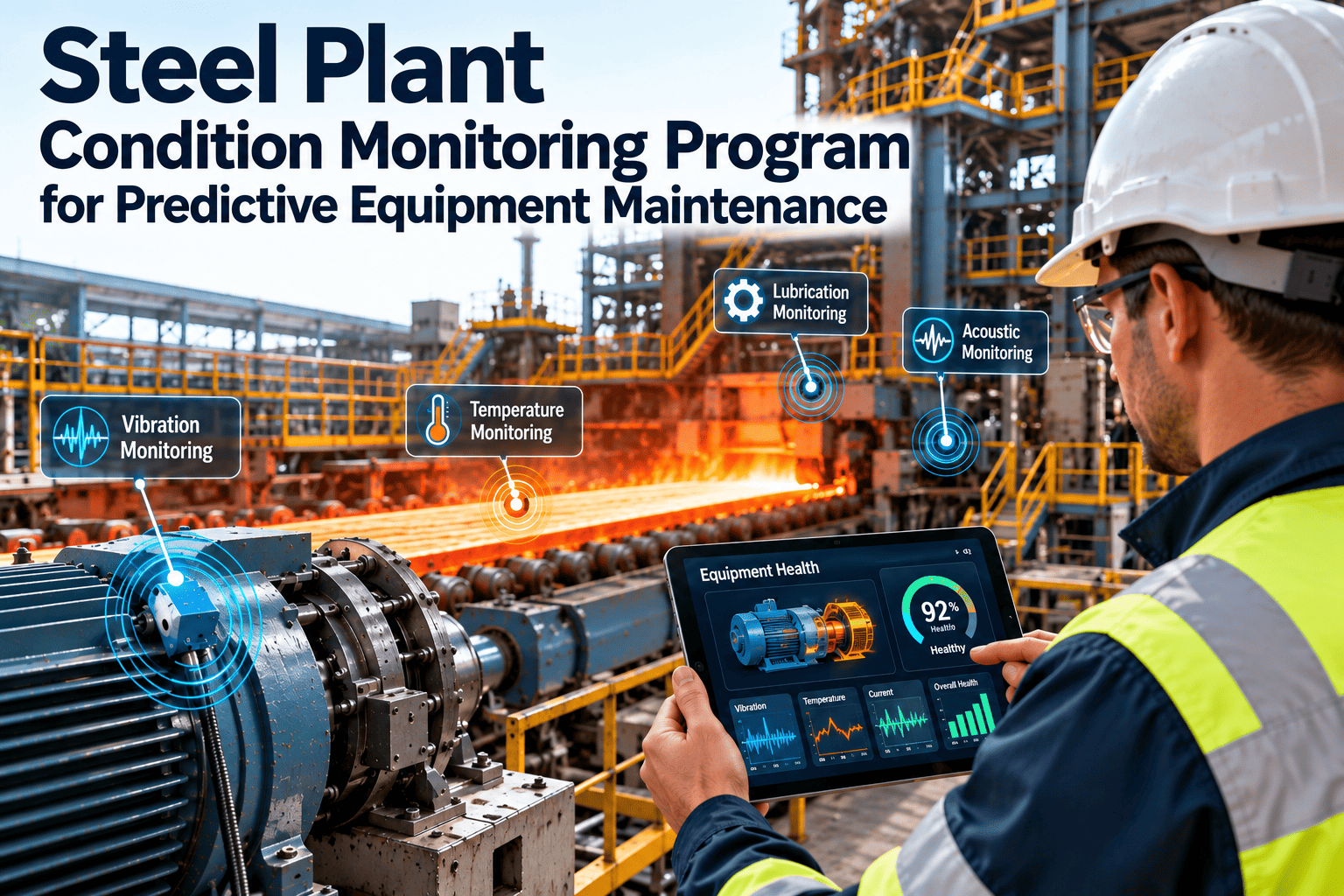
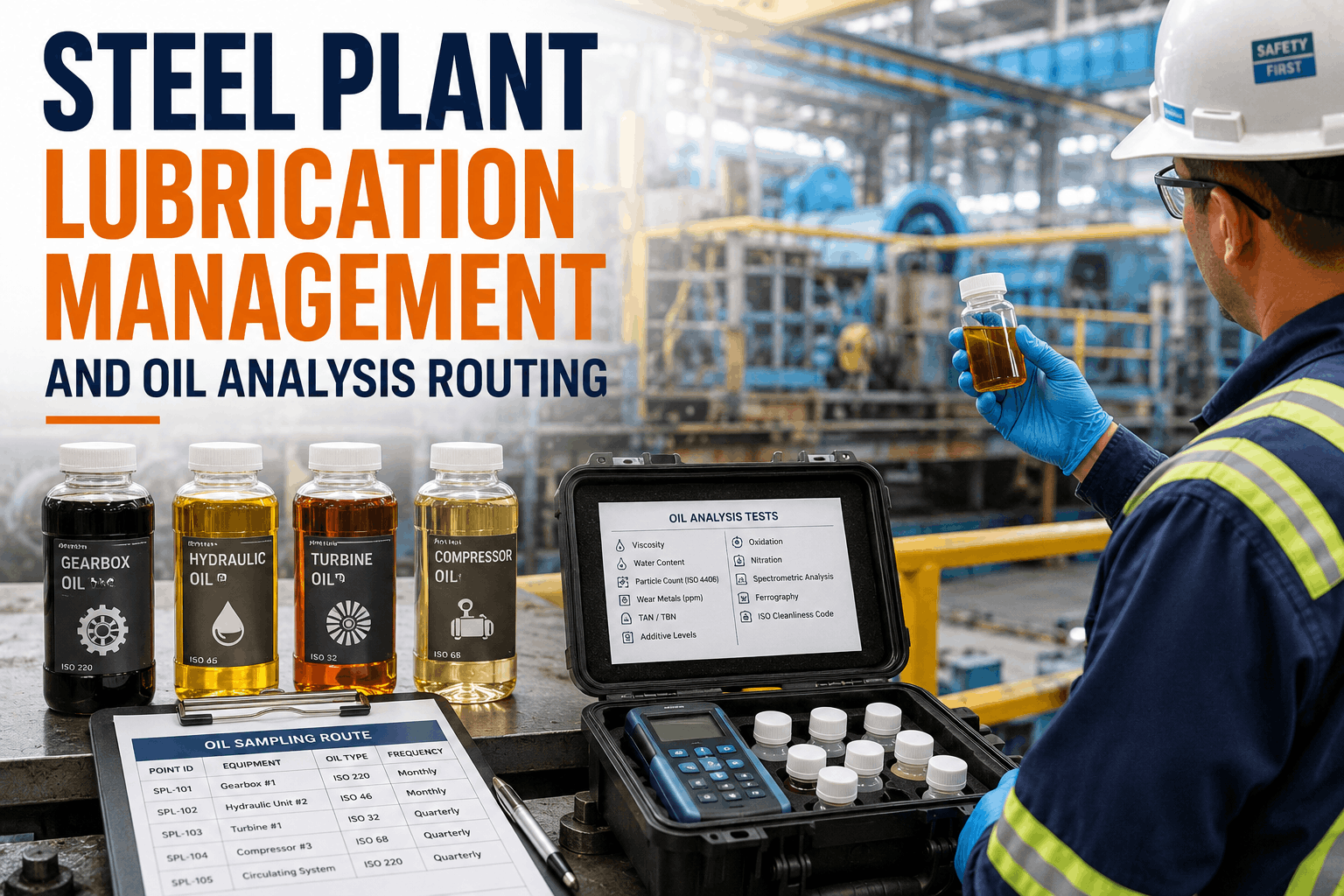
A maintenance engineer pulls a sample from a critical hydraulic system powering a 2,000-ton forging press — the oil is dark, smells burnt, and the filter differential pressure has been climbing for three weeks. Without laboratory analysis, the team is guessing whether to change the oil, replace the filter, or shut down the press for bearing inspection. Steel plants running structured oil analysis programs detect 85% of lubrication-related failures before they cause unplanned downtime, reduce lubricant consumption by 30–50%, and extend equipment life by 3–5× compared to time-based oil change schedules. A 4-blast-furnace integrated steel mill in the U.S. Midwest implemented a plant-wide oil analysis program across 1,800 lubricated assets over 18 months — linking every sample result directly to Oxmaint CMMS for trend tracking, automated alert generation, and condition-based maintenance scheduling. This guide explains exactly how oil analysis works for steel plant equipment, what each test reveals about lubricant and machine health, and how CMMS integration turns sample data into predictive maintenance intelligence.
60%
Bearing Failures from Lubrication
Percentage of rolling element bearing failures in steel plant rotating equipment directly attributable to contamination, wrong lubricant, or degraded oil
$1.2M
Average Annual Lube-Related Downtime
Estimated cost of unplanned downtime per year at a mid-size integrated steel mill caused by lubrication-related equipment failures
8–12 hr
Blast Furnace Restart Time
Production hours lost when a critical hydraulic or gearbox failure forces an unscheduled shutdown of a blast furnace auxiliary system
Maintenance teams ready to
Sign Up connect oil analysis sample results to structured maintenance workflows — linking every lubricated asset to its sample history, trend data, alarm thresholds, and condition-based PM schedule in a single platform.
What Oil Analysis for Steel Plants Actually Means
Oil analysis is not simply checking whether lubricant looks clean. It is the systematic laboratory testing of in-service lubricants to measure three distinct categories of information: the condition of the oil itself (has it degraded beyond useful life?), the condition of the machine (are wear metals or contaminants indicating component failure?), and the condition of the lubrication practice (is the right oil in the right place at the right cleanliness?). For steel plants — where extreme heat, heavy loads, water contamination, and metallic dust are constant threats — oil analysis is the earliest and most cost-effective indicator of equipment distress. The real value emerges when sample data connects to operational systems. Steel plants implementing Sign Up for Oxmaint establish the critical link — connecting every oil sample result to the asset's maintenance history, PM schedule, and condition score so that lubricant intelligence and maintenance workflows reinforce each other continuously.
5
Predictive Action Layer
Trend analysis across multiple sample intervals identifies degradation trajectories months before failure thresholds. CMMS generates condition-based work orders automatically when alarm limits are breached — scheduling oil changes, filter replacements, or component inspections based on actual lubricant condition rather than arbitrary time intervals.
Outputs: Condition-based PMs, predictive failure alerts, lubricant lifecycle reports, capital replacement justifications
4
CMMS Integration Layer
Each sample result is linked to an Oxmaint asset record via unique equipment ID. Alarm thresholds, trend charts, sample history, and recommended actions are unified with the asset's maintenance history, PM schedule, and condition score in a single record.
Technologies: Oxmaint CMMS, laboratory LIMS data exchange, REST APIs, asset hierarchy mapping, alarm threshold configuration
3
Diagnostic Interpretation Layer
Certified lubrication analysts interpret results against equipment-specific alarm limits, baseline values, and historical trends. Root cause analysis identifies whether abnormal results indicate oil degradation, contamination ingress, abnormal wear, or incorrect lubricant application.
Technologies: Tribology expertise, ASTM test standards, OEM wear metal limits, ISO cleanliness codes, statistical trend analysis
2
Laboratory Testing Layer
Samples undergo a slate of standardized tests — viscosity, wear metal spectrometry, particle count, moisture content, acid number, oxidation level, additive depletion — each revealing a different dimension of lubricant and machine health.
Technologies: ICP-OES spectrometry, Karl Fischer titration, FTIR spectroscopy, laser particle counting, kinematic viscometers
1
Sample Collection Layer
Consistent, contamination-free sampling from designated sample ports on hydraulic systems, gearboxes, compressors, turbines, and circulating oil systems. Proper technique — flushing sample lines, using clean bottles, sampling from live zones — determines whether results are valid or misleading.
Technologies: Minimess sample valves, vacuum pumps, clean sample bottles, sample identification labels, chain-of-custody documentation
Critical Integration Point: Oxmaint operates at Layer 4, connecting every oil analysis result to its asset maintenance record — so lubricant condition data and operational maintenance history reinforce each other across every sampling interval and maintenance cycle.
Oil Analysis Tests: What Each Test Reveals About Your Equipment
Every oil sample undergoes a battery of tests — but not every test matters equally for every application. Steel plant maintenance teams need to understand which tests detect which failure modes so they can specify the right test slate for each equipment class. Hydraulic systems, gearboxes, turbine oils, and rolling mill lubricants each require different test emphasis. Maintenance leaders evaluating oil analysis programs can Book a Demo to see how Oxmaint connects sample results to automated maintenance workflows regardless of laboratory provider.
Most steel plants specify a standard test slate of viscosity, wear metals, particle count, moisture, and TAN for all critical rotating and hydraulic equipment. Additional tests — ferrography, RPVOT, demulsibility — are added for specific high-value or problem assets. Regardless of test slate, all results flow into the same CMMS asset structure through
Sign Up for Oxmaint.
Connect Oil Analysis Data to Maintenance Intelligence
Oxmaint links oil sample results to structured work orders, condition-based PM schedules, trend alarms, and capital planning — so every lubricated asset becomes a monitored asset, not a run-to-failure risk.
Critical Steel Plant Equipment for Oil Analysis Programs
Not every lubricated asset requires the same sampling frequency or test slate. The key to a cost-effective program is prioritizing assets by criticality, failure consequence, and oil volume — then matching each equipment class to the right analysis approach. Understanding which equipment benefits most ensures oil analysis investments deliver maximum failure prevention per sample dollar spent.
Hydraulic Systems
The highest-value oil analysis target in any steel plant. Hydraulic systems power presses, shears, furnace doors, caster segments, and mill stands. Contamination from iron scale, water, and thermal breakdown causes servo valve failures, pump wear, and cylinder seal leaks.
Sampling Frequency: Monthly for critical systems; quarterly for support hydraulics. Focus tests: particle count, moisture, viscosity, wear metals.
Gearboxes & Gear Drives
Rolling mill main drives, continuous caster drives, conveyor gearboxes, and crane hoists. High torque loads create distinctive wear metal signatures — iron and chromium from gear teeth, copper and tin from bronze thrust washers and bearings.
Sampling Frequency: Monthly for mill drives; quarterly for auxiliary gearboxes. Focus tests: wear metals, viscosity, particle count, ferrography for large particles.
Turbine & Compressor Oils
Turbo-blowers for blast furnace air supply, steam turbine generators, and compressed air systems. These oils must maintain extreme cleanliness and oxidation resistance over long service intervals — often 3–5 years between changes if properly managed.
Sampling Frequency: Monthly. Focus tests: RPVOT (remaining oxidation life), particle count, moisture, viscosity, varnish potential (MPC).
Rolling Mill Circulating Systems
Large-volume oil circulation systems (5,000–50,000+ liters) serving rolling mill bearings and gearboxes. These systems accumulate metallic fines from the rolling process and are exposed to extreme heat from hot strip contact. Oil cooler leaks introduce water contamination.
Sampling Frequency: Weekly for hot strip mills; biweekly for cold mills. Focus tests: particle count, moisture, viscosity, wear metals, filtration efficiency.
Bearing Lubrication Systems
Roll neck bearings, caster roll bearings, and large fan/blower bearings. Grease analysis or circulating oil analysis detects early-stage bearing distress — elevated iron and chromium from raceway spalling, copper from cage wear, silicon from environmental contamination.
Sampling Frequency: Monthly for critical process bearings; quarterly for support equipment. Focus tests: wear metals, particle count, consistency (grease), moisture.
Transformer & Electrical Oils
EAF (Electric Arc Furnace) transformers, ladle furnace transformers, and switchgear — dielectric oil degradation causes arcing, insulation breakdown, and catastrophic transformer failures with replacement lead times of 12–18 months.
Sampling Frequency: Quarterly for EAF transformers; annually for distribution transformers. Focus tests: dissolved gas analysis (DGA), dielectric strength, moisture, acidity.
In-House Lab vs. Commercial Lab vs. Hybrid: Program Strategy
The program structure decision depends on sample volume, turnaround time requirements, and internal analytical capacity. Most steel plants start with commercial laboratory services and transition toward hybrid as program maturity increases. The critical factor is ensuring that regardless of who analyzes the sample, all results flow into the same CMMS asset structure for consistent trend tracking and maintenance integration.
Fully Commercial Lab
Best for: <200 samples/year
Cost: $25–$80 per sample
Advantages
- No capital equipment investment
- Certified analysts interpret results
- Full ASTM-standard test capabilities
- Scale up or down with program growth
Considerations
- 3–5 day turnaround for standard service
- Shipping delays add to response time
- No immediate on-site screening capability
- Rush service adds 2–3× cost per sample
Recommended
Hybrid Program
Best for: 200–1,500 samples/year
Cost: $8–$40 per sample blended
Advantages
- On-site screening for immediate triage
- Commercial lab for full diagnostic suites
- Same-day results for critical equipment
- Lowest blended cost at program scale
Considerations
- Requires trained on-site technician (1 FTE)
- $40K–$120K on-site test equipment investment
- On-site tests are screening — not full diagnostics
- Dual data sources require CMMS integration
Fully In-House Lab
Best for: 1,500+ samples/year
Cost: $200K–$500K equipment + staff
Advantages
- Same-day full diagnostic results
- Lowest per-sample cost at high volume
- Complete control over test standards
- Immediate support for breakdown analysis
Considerations
- Highest capital investment
- Requires dedicated analysts (2–3 staff)
- Instrument calibration and accreditation overhead
- Equipment obsolescence risk (5–7 yr cycles)
Most steel plants begin with a commercial laboratory, add on-site screening instruments (particle counter, moisture sensor, viscometer) within 12 months as sample volume grows, and reserve commercial full-suite testing for quarterly deep diagnostics and problem investigations. All data — regardless of source — feeds into the same Oxmaint asset structure.
The Maintenance Connection: Why CMMS Is the Backbone
An oil analysis report without maintenance context is a data point. A CMMS without lubricant condition data schedules oil changes by calendar instead of condition. The integration of oil analysis results with CMMS maintenance records transforms both — giving sample data operational context and giving maintenance workflows predictive intelligence. This is where oil analysis investment compounds in value across every future sampling interval and equipment lifecycle decision.
1
Sample Collection
Technician pulls sample from designated port — CMMS PM schedule triggers sampling at correct interval for each asset
→
2
Lab Analysis
Sample tested per equipment-specific slate — results returned electronically with alarm flags and trend comparisons
→
3
CMMS Alert Generation
Oxmaint auto-generates work orders when results exceed alarm thresholds — prioritized by severity and equipment criticality
→
4
Condition-Based Action
Oil change, filter replacement, contamination source repair, or component inspection scheduled based on actual oil condition
→
5
Trend & Capital Planning
Multi-interval trend data drives equipment replacement decisions with documented evidence of degradation trajectory
Example Scenario 1: Hydraulic System Contamination Detection
A hot strip mill's main hydraulic system serving 16 hydraulic actuators on the finishing stands showed a particle count jump from ISO 17/15/12 to ISO 21/19/16 over two consecutive monthly samples. Wear metal analysis showed iron rising from 12 ppm to 48 ppm with silicon increasing from 4 ppm to 22 ppm — indicating external contamination ingress rather than internal component wear. Oxmaint auto-generated a critical work order. Investigation found a cracked breather filter housing allowing mill scale dust into the 8,000-liter reservoir. The $180 breather replacement and targeted filtration prevented an estimated $340,000 servo valve replacement campaign that would have been needed within 60 days at the contamination ingress rate.
Example Scenario 2: Gearbox Failure Prediction
Oil analysis on a continuous caster segment drive gearbox showed copper trending upward over four quarterly samples: 8 → 14 → 23 → 41 ppm. Iron remained stable at 35 ppm. The copper trend signature indicated bronze thrust washer wear — a known precursor to gearbox seizure in this equipment class. Oxmaint flagged the trend alarm and linked it to the asset's maintenance history showing the gearbox had been in service for 6.5 years against a 7-year expected life. The maintenance team scheduled a planned gearbox rebuild during a scheduled caster outage — avoiding an unplanned caster stoppage estimated at $850,000 in lost production per day. The thrust washers were found worn to 40% of original thickness, confirming the oil analysis prediction.
Oil Samples Find the Problem. Oxmaint Drives the Action.
Connect oil analysis results to structured work orders, condition-based maintenance schedules, trend alarms, and capital planning — all in one platform designed for heavy industrial plants managing thousands of lubricated assets.
Expert Perspective: Oil Analysis for Steel Plant Reliability
We used to change hydraulic oil every six months across the entire plant — 48 systems, roughly 120,000 liters of oil per year. When we started oil analysis, we discovered that 70% of those systems had oil in perfectly serviceable condition at the six-month mark, while 15% actually needed changing at three months because of contamination we never knew about. The first year of condition-based oil changes saved us $280,000 in lubricant costs alone. But the real payoff was catching failures early. We identified a cooling water leak into a caster gearbox three months before it would have caused a catastrophic seizure — the moisture trend was unmistakable once we had consecutive data points. The CMMS integration made the program manageable. Before Oxmaint, sample results arrived as PDF reports that sat in someone's email. Now every result auto-populates the asset record, trends update in real time, and alarm-triggered work orders go directly to the right technician. That closed loop is what turned oil analysis from a reporting exercise into a reliability tool.
Sample Consistently or Don't Sample at All
Oil analysis value comes from trends — not single data points. Inconsistent sampling intervals, different sample points, or contaminated bottles produce noise that masks real failure signatures. Establish fixed sample ports, documented procedures, and CMMS-scheduled sampling PMs before starting the program.
Set Equipment-Specific Alarm Limits
Generic alarm limits miss equipment-specific failure modes. A gearbox and a hydraulic system have completely different normal wear metal ranges. Work with your lab and OEMs to establish asset-class-specific alarm and caution limits — then load them into the CMMS for automated alert generation.
Act on Results Within 48 Hours
An oil analysis alarm that generates a work order two weeks after the sample was pulled has lost most of its predictive value. Build a closed-loop response process: sample → lab → CMMS alert → technician action within 48 hours for critical and abnormal results. Speed of response determines program ROI.
Frequently Asked Questions
How much does an oil analysis program cost for a steel plant?
Costs depend on the number of assets sampled, sampling frequency, and test slate complexity. A typical commercial lab sample costs $25–$80 for a standard industrial test slate (viscosity, wear metals, particle count, moisture, TAN). For a mid-size steel plant sampling 300 critical assets monthly to quarterly, annual laboratory costs typically run $40,000–$120,000. On-site screening instruments (portable particle counter, moisture sensor, viscometer) add $40,000–$120,000 in capital. Program ROI is typically demonstrated within 6–12 months through a single avoided catastrophic failure or through documented lubricant consumption reduction. Most plants recover full program costs 3–5× annually.
Book a Demo to model costs for your plant's asset portfolio.
How often should steel plant equipment be sampled?
Sampling frequency depends on equipment criticality, operating severity, and oil volume. Critical hydraulic systems and hot rolling mill circulating oils should be sampled monthly — these face the most severe contamination and thermal stress. Gearboxes and large compressors are typically sampled monthly to quarterly. Turbine oils and large reservoir systems can be sampled quarterly with monthly on-site screening. EAF transformer oils are sampled quarterly for dissolved gas analysis. Non-critical support equipment may require only semi-annual sampling. The CMMS should generate sampling PMs at the appropriate interval for each asset class, ensuring no critical sample is missed.
What are the most common oil problems found in steel plants?
The top five problems detected through oil analysis in steel plants are: (1) particulate contamination from mill scale, iron dust, and process debris — the leading cause of hydraulic component wear; (2) water contamination from cooling system leaks, condensation, and process water ingress; (3) thermal degradation and oxidation from operating near furnaces, casters, and hot rolling processes; (4) wrong or mixed lubricants from improper top-ups or lubricant consolidation errors; and (5) additive depletion in long-service oils that have exceeded their useful chemical life. All five are detectable through routine oil analysis months before they cause equipment failure.
How does oil analysis data connect to Oxmaint CMMS?
Oil analysis results from commercial laboratories are delivered electronically (typically via LIMS data exchange, CSV upload, or API integration) and mapped to Oxmaint asset records using unique equipment identifiers. Each sample result populates the asset's condition record with test values, alarm status, trend data, and analyst recommendations. When results exceed configured alarm thresholds, Oxmaint auto-generates prioritized work orders routed to the appropriate maintenance team. Historical sample data builds trend charts visible on each asset record, giving technicians and planners immediate access to the complete lubricant condition history alongside maintenance work history and PM schedules.
Sign Up to start building the lubricant intelligence layer for your plant.
Should we start with a pilot program or implement plant-wide immediately?
Phased implementation is both practical and strongly recommended. Start with a criticality assessment — identify the 50–100 most critical lubricated assets ranked by failure consequence, repair cost, and production impact. Begin monthly sampling on these assets using a commercial laboratory. Link all results to Oxmaint CMMS records with equipment-specific alarm limits. Measure ROI after 6–12 months — typical results include 1–3 avoided catastrophic failures and 30–50% lubricant consumption reduction on sampled equipment. Present documented results to plant management to justify expanding the program to 300–500 assets. Mandate oil analysis integration into all new equipment commissioning procedures to prevent program gaps.