Preventive Maintenance Checklist for Steel Plant Overhead Cranes

By James smith on March 18, 2026

overhead-crane-preventive-maintenance-checklist-steel-plant

An overhead crane failure in a steel plant is not a maintenance inconvenience — it is a production stoppage with a safety dimension. A ladle crane carrying 300 tonnes of liquid steel at 1600°C is not an asset that tolerates deferred inspections. A charging crane bridging the furnace bay is not a machine where a missed brake inspection is recoverable after the event. The consequence asymmetry in crane maintenance is extreme: the cost of a structured PM programme is measured in engineer-hours per week; the cost of an unplanned crane failure or, in the worst case, a dropped load, is measured in production loss, equipment damage, regulatory investigation, and in the most serious events, human injury. A comprehensive crane preventive maintenance checklist structured by inspection frequency — daily operator checks through annual third-party certification inspections — is the operational discipline that keeps steel plant cranes certified, serviceable, and safe throughout their operating campaign.

Checklist · Equipment Maintenance Inspection Management Preventive Maintenance

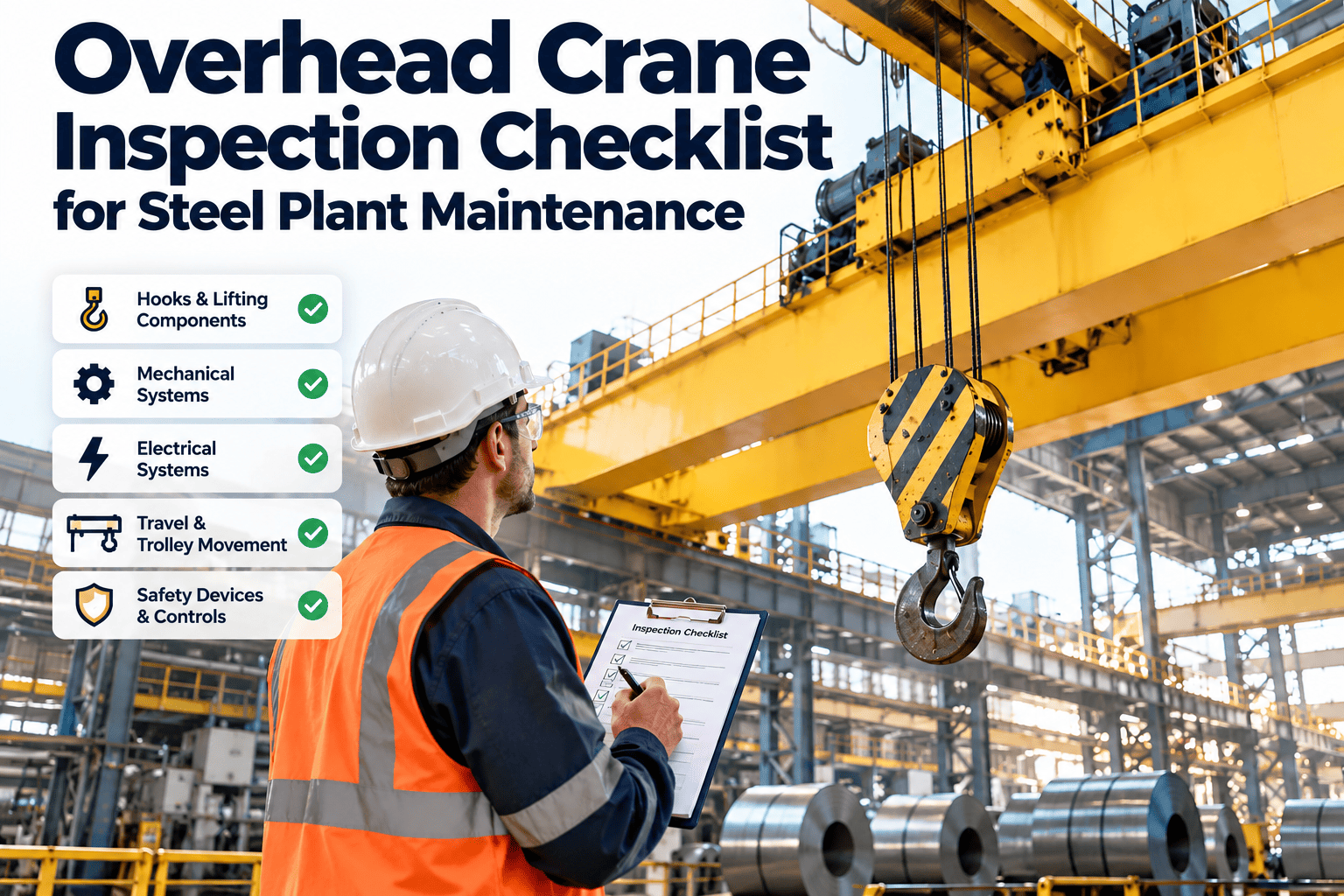
Preventive Maintenance Checklist for Steel Plant Overhead Cranes

A complete five-frequency PM checklist — daily operator checks through annual certification inspections — covering structural, mechanical, electrical, and safety systems for ladle cranes, charging cranes, scrap magnets, and general overhead cranes in steel plant environments.

Daily Operator pre-shift 8 items
Weekly Engineering technician 10 items
Monthly Engineering technician 10 items
Quarterly Senior engineer 8 items
Annual Certified inspector Statutory
Crane Types and Inspection Scope

Steel Plant Crane Types and Their Specific Inspection Requirements

The checklist below applies to all overhead crane types in steel plants, but three crane categories require additional attention beyond the standard inspection protocol — ladle cranes, charging cranes, and scrap/magnet cranes each operate under conditions that create specific failure modes not present in standard bay cranes. Book a demo to see how OxMaint configures crane-type-specific PM templates for each crane category.

LC

Ladle Cranes

Highest criticality. Carry liquid steel ladles — 150 to 350 tonnes at 1600°C. ASME B30.2 Class F or equivalent. Dual hoist mandatory. Anti-drop safety device inspection is a daily requirement. Load path inspection frequency doubled versus standard cranes. Any structural defect: out-of-service immediately.

CC

Charging Cranes

High-heat environment. Operate above furnace openings — extreme radiant heat exposure on bridge structure, hoist ropes, and electrical components. Steel structure thermal deformation inspection monthly minimum. Heat-rated lubricants required. Electrical cable and limit switch inspection accelerated — heat degrades insulation and thermoplastic components faster than standard environments.

SM

Scrap and Magnet Cranes

High-shock loading from scrap grab and drop operations. Structural connection fatigue inspection monthly. Magnet control and drop prevention circuit inspection weekly. Electromagnet cable wear accelerated by dynamic loading and contamination. Hoist rope fatigue from repetitive shock loading — inspect wire rope for broken wires weekly, not monthly.

BC

General Bay Cranes

Standard overhead cranes in production and maintenance bays. Follow ASME B30.2 / FEM standard inspection frequencies. Daily operator inspection mandatory before first lift. All cranes: hook, hoist rope, brakes, and limit switches checked at every pre-shift inspection — no exception by crane classification.

PM Checklists by Frequency

Steel Plant Overhead Crane PM Checklist

Five frequency tiers from daily operator pre-shift checks through annual statutory certification. All items are configurable as PM work order checklists in OxMaint — each frequency tier generates a recurring work order on schedule. Sign up to import crane PM templates into OxMaint — free.

Daily
Daily Operator Pre-Shift Inspection Performed by: Crane Operator · Before first lift each shift
No lift until all items pass. Any failure: tag out and notify supervisor.
Daily pre-shift inspection is the primary defence against immediate-consequence failures — hook failure, rope failure, and brake failure that manifest during operation
All pre-shift checks must be logged in OxMaint before first lift — operator signature, time, and any defects noted
Weekly
Weekly Engineering Inspection Performed by: Engineering Technician · During planned downtime or shift change
Crane available for inspection — brief production window or planned outage required
Weekly detailed rope inspection catches the wire breakage progression that daily visual inspection may miss — particularly at the drum and sheave interfaces where most rope fatigue originates
Brake lining wear measurement prevents the gradual lining degradation that causes extended stop distances — detectable by measurement before becoming detectable by operation
Monthly
Monthly Engineering Inspection Performed by: Engineering Technician · During planned maintenance outage
Planned outage required — crane de-energised and locked out for structural and mechanical inspection items
Thermal imaging on electrical panels under operational load is the monthly detection method with the highest ROI — catches terminal overheating and contactor erosion before they cause unplanned outages
Overload device test and ladle crane anti-drop test must both generate CMMS compliance records — required for insurance, regulatory, and brand audit documentation
Quarterly
Quarterly Senior Engineering Inspection Performed by: Senior Engineer or Specialist · Extended outage required
Full LOTO required — crane power isolated for structural NDT and mechanical disassembly items
NDT weld inspection at quarterly frequency matches the fatigue cycle accumulation rate for high-utilisation steel plant cranes — annual NDT is insufficient for ladle cranes and charging cranes
Quarterly dynamic load test record is the primary document required for crane insurance, regulatory compliance, and incident investigation — must be in OxMaint statutory record
Annual
Annual Statutory Certification Inspection Performed by: Certified Crane Inspector (Competent Person per local regulation) · Extended outage
Statutory requirement in all major jurisdictions — certificate must be issued and stored in CMMS compliance record

The annual inspection is a statutory requirement in all major industrial jurisdictions — ASME B30.2 (US), EN 13001 / FEM (EU), BS 7121 (UK), and equivalent national standards elsewhere. The inspection must be performed by a competent person as defined by the applicable regulation — typically a certified lifting equipment engineer or accredited inspection body. The inspection certificate must be retained and accessible for regulatory inspection at any time. All annual inspection records — test results, certificates, and corrective actions arising — must be stored in OxMaint's compliance history for the crane asset record. Book a demo to see OxMaint's statutory inspection compliance record management for cranes.

Annual certification inspection is a statutory requirement — operating without a valid certificate creates regulatory liability, invalidates insurance, and in most jurisdictions is a criminal offence
All certificates and test records must be stored in OxMaint — paper filing is not sufficient for regulatory compliance; inspectors require retrievable digital records
All five crane PM frequencies as recurring OxMaint work orders. Daily pre-shift logs, statutory compliance records, and inspection certificates — all stored in the crane's asset record and accessible in seconds for regulatory audit.
FAQs

Frequently Asked Questions

What are the statutory inspection requirements for steel plant overhead cranes?
Statutory inspection requirements vary by jurisdiction but share common elements: an annual examination by a competent person (certified lifting equipment inspector), a proof load test at 125% of SWL, and a crane register or log maintained accessible for inspection. In the US, ASME B30.2 governs overhead and gantry cranes. In the EU, EN 13001 and national implementations of the Machinery Directive apply. In the UK, LOLER 1998 (Lifting Operations and Lifting Equipment Regulations) requires thorough examination at 12-month intervals minimum for cranes used to lift people, and at 6-month intervals for ladle cranes that carry liquid metal loads. All inspection certificates must be retained — in OxMaint, these are stored as compliance record attachments in the crane's asset history, retrievable instantly during regulatory inspection. Sign up to manage crane statutory compliance records in OxMaint — free.
How often should wire rope be inspected and replaced on a ladle crane?
Ladle crane wire rope requires daily visual pre-shift inspection, weekly detailed inspection counting broken wires and measuring diameter, and a replacement schedule based on risk assessment rather than condition alone. Most regulatory frameworks and steel plant internal standards specify a maximum service life for ladle crane hoist rope regardless of apparent condition — typically 12 to 18 months from initial installation, or when any of the discard criteria are met, whichever comes first. The discard criteria per ASME B30.2 and EN 12385 include: 6 or more broken wires in one rope lay, 3 or more broken wires in one strand within one rope lay, greater than 10% reduction in nominal rope diameter, visible corrosion pitting on outer wires, evidence of heat damage, kinking, bird-caging, or any structural distortion. All rope inspection records — including broken wire counts — must be logged in OxMaint to create the service life and condition trend required for replacement scheduling. Book a demo to see OxMaint's wire rope inspection record management.
What additional inspection requirements apply to ladle cranes versus standard overhead cranes?
Ladle cranes carry a consequence of failure that is categorically different from standard overhead cranes — a dropped liquid steel load is a potential catastrophic event. Additional requirements on top of standard crane PM: anti-drop safety device (secondary holding brake) must be function-tested monthly and load-tested quarterly; NDT weld inspection of main structural members at quarterly frequency rather than annual; wire rope maximum service life regardless of condition; anti-collision system where multiple cranes share runways; duplicate hoist drive mandatory in most jurisdictions; all inspection records retained in retrievable format for the life of the crane; and in most jurisdictions, a formal risk assessment specifically for ladle crane operations that defines the inspection regime exceeding minimum regulatory requirements.
Crane Inspection Management · Compliance Records · OxMaint

Every Pre-Shift Log, Load Test Certificate, and NDT Record in One Asset History.

OxMaint stores the complete crane compliance record — daily operator logs, weekly engineer inspections, statutory test certificates, and corrective action work orders — in the crane's asset history, accessible instantly during regulatory audit and insurance review.

Share This Story, Choose Your Platform!