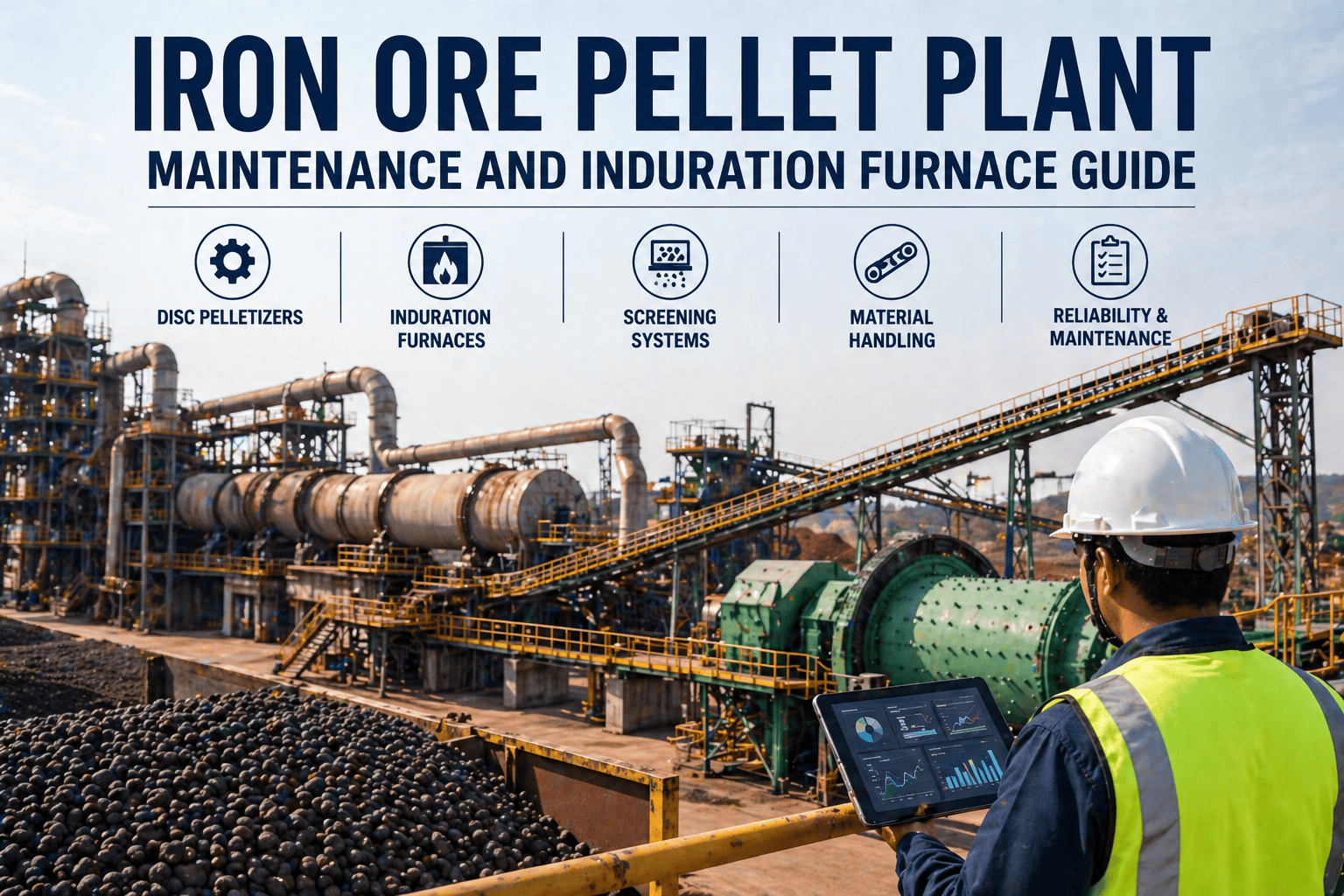
Iron ore pellet plants are the critical link between mining and steelmaking — converting fine iron ore concentrate into uniform, high-strength pellets that feed blast furnaces and direct reduction plants worldwide. A single pelletizing line produces 4-8 million tonnes of pellets per year, operating 330-350 days annually at throughput rates of 500-1,000 tonnes per hour. When the line is running, it generates $2-6 million in revenue per day. When it's not, that revenue stops instantly while fixed costs continue accumulating at $800K-$2M per day of unplanned downtime.
Pellet plant maintenance is uniquely challenging because the process combines every harsh environment simultaneously: extreme heat (1,200-1,350°C in the induration furnace), abrasive materials (iron ore wears everything it touches), corrosive gases (SO₂ from oxidation, HCl from bentonite), massive rotating equipment (kilns, drums, fans), and continuous operation with minimal buffer storage between process stages. A failure in any single stage — grinding, balling, induration, cooling, or screening — stops the entire line. Oxmaint's pellet plant maintenance platform manages the full equipment lifecycle across all process stages, linking condition monitoring data to maintenance scheduling to ensure maximum line availability and pellet quality.
4-8 Mt/Year Output. $2-6M/Day Revenue. Zero Tolerance for Unplanned Stops.
The Pelletizing Process: 5 Stages, 5 Failure Points
Every stage of the pelletizing process has unique equipment, unique failure modes, and unique maintenance requirements. A failure in any single stage stops the entire production line because there is minimal buffer capacity between stages:
Grinding & Preparation
Balling (Green Ball Formation)
Induration (Travelling Grate / Grate-Kiln)
Cooling
Product Handling & Screening
One Line. Five Stages. Zero Buffer. Every Minute of Uptime Counts.
Oxmaint manages every piece of equipment across all five process stages — linking condition data to maintenance scheduling so repairs happen during planned windows, not during production.
Induration System: The Heart of the Pellet Plant
The induration system accounts for 40-55% of all unplanned downtime and represents the highest-value maintenance focus area. Whether your plant uses a straight grate, grate-kiln, or grate-kiln-cooler system, the induration equipment demands the most sophisticated maintenance approach in the plant:
Grate Bar & Pallet Management
A travelling grate contains 500-2,000+ individual grate bars organized in pallets. Each bar endures thermal cycling from ambient to 1,300°C+ thousands of times per year. Oxmaint tracks bar condition by pallet position, predicts replacement timing based on historical thermal fatigue data, and schedules bar replacements during planned stoppages. Spare bar inventory is managed against predicted demand.
Refractory Lifecycle Management
Kiln refractory (MgO-Cr, high alumina castable), hood refractory, windbox refractory, and process ducting refractory all have different materials, wear mechanisms, and campaign lives. Oxmaint tracks remaining thickness by zone using thermocouple data and periodic measurements, projects reline dates 3-6 months ahead, and manages refractory material inventory and contractor scheduling.
Kiln Mechanical Monitoring
Rotary kiln alignment (shell ovality, tyre-to-shell gap, roller alignment) determines both refractory life and mechanical component life. Oxmaint integrates with shell scanner data, tyre temperature monitoring, thrust roller position tracking, and girth gear/pinion wear measurement. Trending this data prevents the catastrophic misalignment failures that require months of repair.
Process Fan Fleet Management
A pellet plant operates 8-15 major process fans (updraft, downdraft, cooling, exhaust) ranging from 2,000 to 15,000 kW. These fans handle hot, dusty gas and are the #1 source of forced production rate reductions. Oxmaint manages the entire fan fleet: bearing vibration trending, impeller wear tracking, motor condition monitoring, and spare rotor management to enable rapid fan swaps.
Maintenance Strategy by Equipment Criticality
Not all pellet plant equipment deserves the same maintenance approach. Oxmaint assigns strategies based on failure consequence and failure predictability:
Annual Shutdown Planning
Most pellet plants schedule one major shutdown per year (7-21 days) plus 2-4 mini-shutdowns (2-5 days each). These windows must accomplish massive scope in compressed timeframes with peak contractor and crane utilization:
Major Annual Shutdown
7-21 days | 200-500+ contractorsQuarterly Mini-Shutdowns
2-5 days | 50-150 contractorsFrom Grinding to Shipping. Every Asset. Every Shutdown. One Platform.
Oxmaint manages the full lifecycle of pellet plant maintenance — daily operations, condition monitoring, shutdown planning, and spare parts — maximizing line availability and pellet quality.
Frequently Asked Questions
How does Oxmaint handle the sheer number of grate bars?
Oxmaint tracks grate bars using a positional grid system rather than individual serial numbers. The grate is mapped into zones (e.g., drying zone rows 1-40, preheating zone rows 41-80, firing zone rows 81-140, cooling zone rows 141-200). Each zone has a defined replacement schedule based on historical thermal exposure and failure rates. During inspections, technicians record bar condition by zone using mobile devices — cracked, warped, missing, or intact. The system identifies replacement quantities needed per zone for the next shutdown and generates material requisitions with sufficient lead time. Over time, the data reveals which zones have the highest failure rates, enabling investigation into whether process conditions (temperature distribution, pellet bed depth) are contributing to accelerated wear in specific areas.
What is the most cost-effective maintenance investment in a pellet plant?
Process fan condition monitoring delivers the highest ROI. A comprehensive vibration monitoring program for 8-15 major fans costs $100K-$300K/year (sensors, analysis software, analyst time) but prevents 2-5 forced fan outages per year that would each cost $500K-$2M in production losses plus $100K-$500K in emergency repair costs. ROI: 5-20x. The second-highest ROI is refractory thickness monitoring in the kiln and hood: continuous thermocouple data analysis costs minimal incremental investment but prevents catastrophic refractory failures that can shut down the line for 2-6 weeks and cost $5-15M in combined repair and production losses.
How many maintenance work orders does a typical pellet plant generate?
A single pelletizing line typically generates 15,000-30,000 work orders per year: 8,000-15,000 scheduled PM/CBM work orders (daily inspections, weekly lubrication, monthly detailed inspections, quarterly overhauls, annual shutdowns), 3,000-8,000 corrective work orders from inspection findings and condition monitoring alerts, 2,000-5,000 minor reactive work orders (adjustments, minor replacements, housekeeping), and 500-2,000 shutdown-specific work orders during annual and mini-shutdowns. A 2-line pellet plant doubles these numbers. Without a CMMS, this volume is impossible to schedule, track, and analyse effectively.
How does maintenance affect pellet quality, not just availability?
Maintenance directly impacts all four key pellet quality parameters: Compressive strength (affected by induration temperature uniformity — burner condition, grate bar integrity, and fan performance determine heat distribution), Size distribution (affected by balling disc/drum liner condition and roller screen integrity), Reducibility (affected by consistent firing temperature — refractory hot spots and fan imbalances create uneven firing), and Fines generation (affected by conveyor transfer point design and screen media condition). Oxmaint correlates maintenance activities and equipment condition with pellet quality data from the plant laboratory, identifying which equipment deficiencies produce which quality impacts — enabling maintenance prioritization based on both availability and quality.
Can Oxmaint manage spare parts for pellet plant-specific components?
Yes. Pellet plant spare parts management is uniquely challenging because of long lead times and high unit costs: kiln tyres (12-18 months lead time, $500K-$1.5M each), process fan rotors (6-12 months, $200K-$800K), grate bars (8-16 weeks for specialty alloys, consumed in thousands per year), and gearbox assemblies (6-12 months, $300K-$1M). Oxmaint manages minimum stock levels based on failure probability, consumption rates, and lead times. For high-value spares like kiln tyres and fan rotors, the system tracks refurbishment cycles — a removed rotor goes to the workshop for rebalancing and impeller replacement, then returns to the spare pool. The platform generates procurement recommendations 2-3 lead times ahead of projected need.