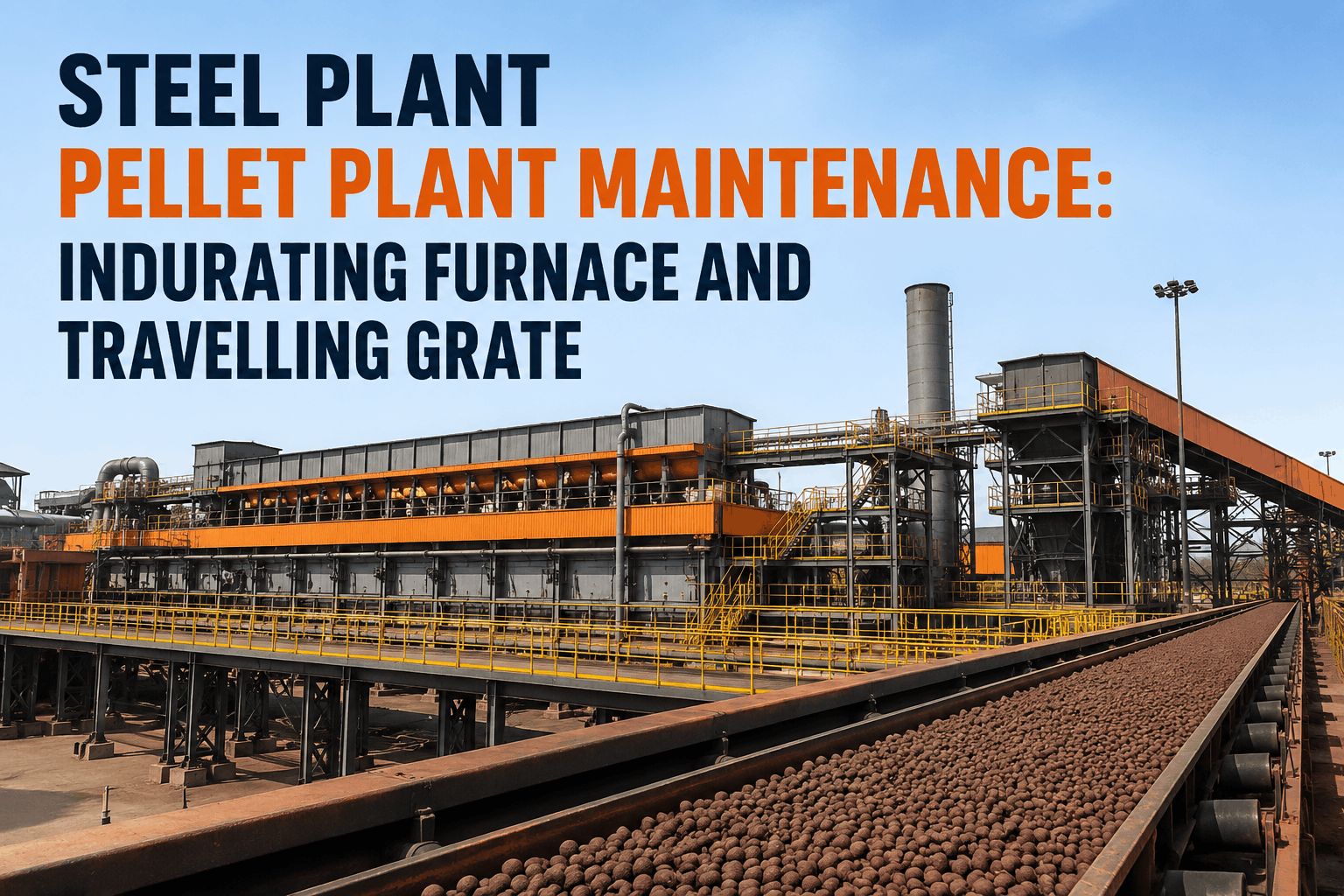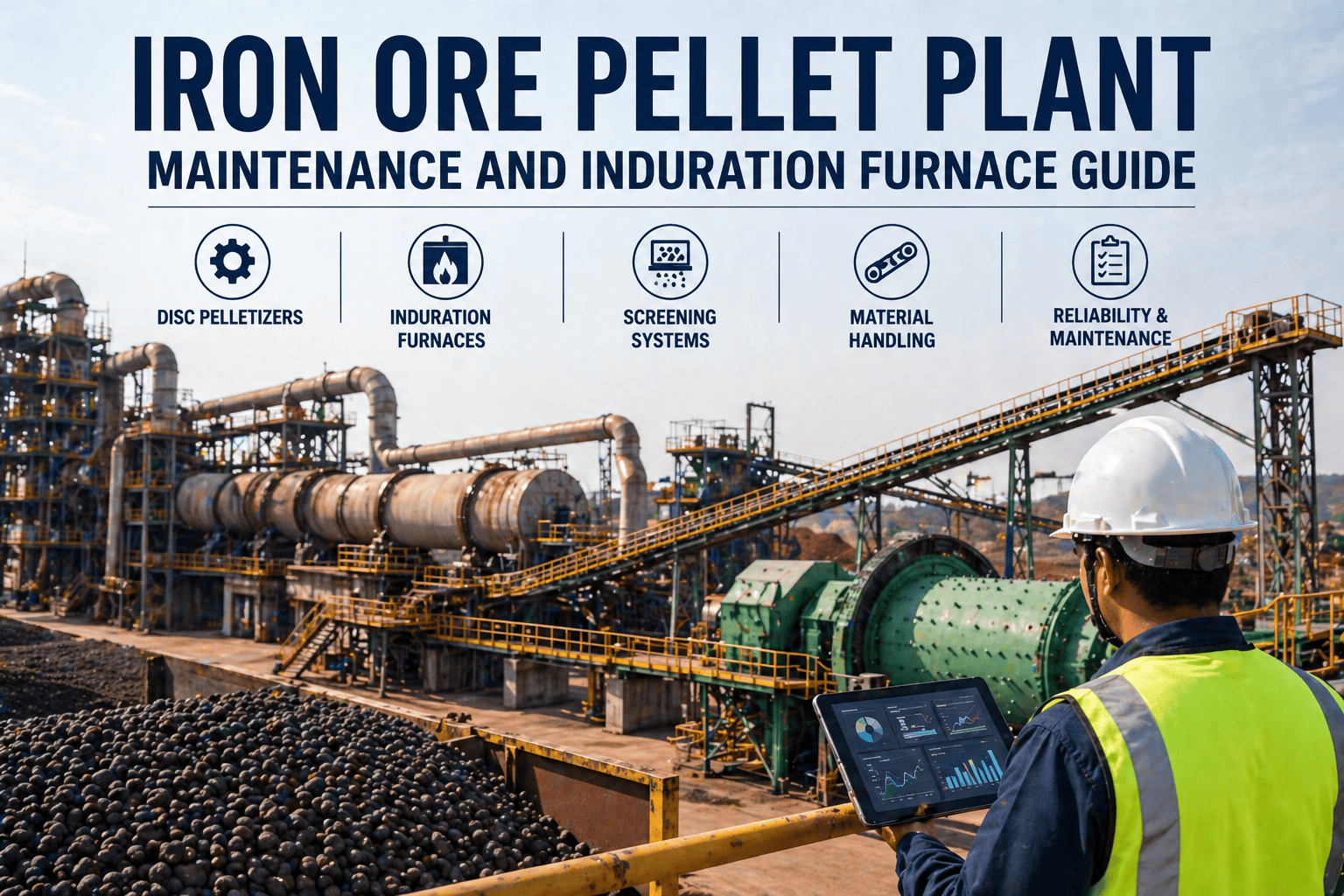
The global iron ore pellets market — valued at USD 70.6 billion in 2025 and forecast to reach USD 128.1 billion by 2035 — is being shaped by two simultaneous pressures: rising demand from direct reduction steelmaking and an industry-wide recognition that unplanned downtime is no longer an acceptable operating reality. A pelletizing plant that loses 25 days to an unplanned induration furnace refractory repair does not simply lose production — it loses the pellet contracts that moved to other suppliers during that window, the blast furnace productivity at the customer's end, and the trust that takes years to rebuild in a market where supply reliability is a primary procurement criterion. The maintenance disciplines that prevent these failures are not novel. Infrared thermography for refractory crack detection, travelling grate link fatigue monitoring, disc pelletizer scraper wear tracking, and roller screen gap management are all well-documented maintenance practices — documented in peer-reviewed literature, OEM service guidelines, and the operational experience of major producers including Vale, LKAB, ArcelorMittal, and Cleveland-Cliffs. What most plants lack is not knowledge of what to do. It is a system that ensures it gets done, measured, and acted upon before the failure window closes. Book a demo to see how OxMaint's Asset Lifecycle Management platform tracks wear rates, schedules condition-based PM, and manages pellet plant asset lifecycles from disc pelletizer to induration furnace.
Iron Ore Pellet Plant Maintenance & Induration Furnace Guide
Evidence-based maintenance strategies for disc pelletizers, roller screens, travelling grate and grate-kiln induration furnaces, and material handling systems — backed by peer-reviewed research and OEM service data from Metso, Primetals, and FEECO.
Why Pellet Plant Maintenance Is a Revenue Problem, Not Just a Cost Problem
Iron ore pellet producers operate in a market where their customers — blast furnaces and direct reduction plants — cannot easily substitute feedstock on short notice. A pellet plant that delivers consistent quality and availability commands premium pricing and long-term supply contracts. One that delivers unplanned outages loses both.
Pellet Plant Process Architecture — Maintenance Dependency at Each Stage
Every stage in the pelletizing circuit creates a maintenance dependency for the stage downstream. A disc pelletizer producing off-spec size distribution overloads the roller screen. A roller screen with worn roller gaps passes oversize pellets to the induration furnace. Oversize in the furnace bed disrupts gas permeability and creates temperature non-uniformity that degrades fired pellet quality. The failure chain begins at the balling disc and ends at the customer's blast furnace.
Disc Pelletizer Maintenance — The Green Pellet Quality Foundation
The disc pelletizer (pan granulator) is the green pellet formation stage. Its qualified on-size pelletizing rate of 93% — achievable when maintained — degrades progressively with scraper plow wear, spray system fouling, and pan angle drift. A well-documented finding from FEECO (the leading pelletizer OEM) confirms that worn or misaligned scrapers allow material to build unevenly on the pan face, causing the disc to run unbalanced and transmitting cyclic load to the reducer. In abrasive iron ore concentrate service, plow wear rates are significantly higher than fertiliser or limestone applications — making shorter inspection intervals a process-specific requirement, not an OEM generic recommendation.
Roller Screen PM — Green Pellet Size Control Before the Furnace
Research published in Metallurgical Research & Technology confirms that roller screens provide 25% better screening efficiency over vibrating screen technology with significantly lower pellet breakage — critical for green pellets that are structurally fragile before induration. The roller screen's performance is entirely dependent on the precision of the gap between rollers: a 0.5 mm deviation from the specified gap across a single roller pair produces measurable degradation in the on-size percentage delivered to the furnace bed. Metso's roller screen design guidance specifically identifies that properly sized green pellets ensure uniform gas flow through the pellet bed — which is the primary determinant of consistent heat distribution and fired pellet quality.
| Component | Inspection / PM Task | Frequency | Key Failure Indicator | OxMaint Trigger |
|---|---|---|---|---|
| Roller gaps | Gap measurement per roller pair against specified tolerance | Weekly | Increased undersize or oversize % in screen output; bimodal pellet size distribution | Weekly measurement WO; alert if deviation >0.5mm from spec |
| Roller bearings | Vibration and temperature check; lubrication per OEM schedule | Monthly vibration; lube per OEM | Elevated bearing temperature >10°C above baseline; vibration deviation | Monthly bearing inspection + runtime-triggered lube WO |
| Roller surface | Surface profile measurement — check for grooving or flattening | Monthly | Visible grooving; pellet size distribution shift toward bimodal | Monthly wear measurement WO; replacement at defined wear limit |
| Drive chain | Chain tension, sprocket wear, drive alignment check | Monthly | Chain elongation >2%; visible sprocket tooth rounding | Monthly PM WO; replacement triggered by elongation measurement |
| Frame structure | Structural integrity, fastener torque, vibration mounts condition | Quarterly | Loose fasteners; abnormal vibration signature during operation | Quarterly structural inspection WO per screen unit |
OxMaint tracks roller wear rates, gap measurements, and bearing condition per roller screen unit — projecting replacement timelines and triggering procurement before screen performance degrades furnace bed quality.
Induration Furnace Maintenance — Research-Based PM for the Highest-Consequence Asset
Published research in REM: International Engineering Journal (SciELO Brazil, 2018) on pelletizing furnace refractory lining lifecycle extension confirms: thermography analysis effectively identifies hot spots before structural failure, mass injection of refractory material at early-stage cracks mitigates propagation and enhances furnace longevity, and failures predominantly initiate at the corners of the refractory structure — making corner-specific scanning a mandatory element of any thermography protocol. The same study confirms that proper cleaning frequency significantly reduces refractory wear by preventing dust accumulation that hinders heat exchange and accelerates crack formation.
The induration furnace operates with burners positioned laterally in the firing zone using natural gas or oil, with preheated air at approximately 1,000°C for combustion, reaching pellet-bed temperatures of 1,280–1,320°C in straight-grate designs. At these temperatures, minor cracks in the refractory lining — invisible to visual inspection — produce detectable thermal signatures on the furnace shell exterior. Infrared thermography converts these thermal gradients into a spatial heat map that identifies crack location and severity.
The critical programme parameter is inspection frequency: minor cracks identified during a 90-day inspection cycle can be repaired with direct refractory injection in 2–4 hours during a planned maintenance window. The same crack, undetected for a further 4–6 weeks, undergoes thermal cycling expansion and contraction that propagates it to structural displacement — triggering the 20–30 day cold shutdown. The research conclusion is unambiguous: periodic cleaning and thermography inspection at appropriate frequency is the cost-effective approach compared to reactive shutdown repair.
ScienceDirect research on iron ore pelletizing plant TG link failures documents chronic failure after a service life of 2.5–3 years, attributed to sigma phase precipitation at grain boundaries (Cr23C6 carbides in the new link, sigma phase formation in service). Fractographic analysis reveals intergranular brittle fracture at the surface followed by transgranular fracture — a failure mode that begins at the microstructural level before any visible indication.
The maintenance implication: travelling grate links should be tracked by cumulative heat cycles, not calendar age. A grate link in a high-production plant that runs three shifts accumulates thermal cycles at 3× the rate of a single-shift plant. OxMaint registers each pallet car as an individual asset with heat cycle counter, enabling replacement based on actual thermal exposure rather than calendar assumption.
Grate-Kiln (GKC) Additional Maintenance — Rotary Kiln & Annular Cooler
GKC plants add the rotary kiln (30–50 m length, 5–7.5 m diameter, temperatures up to 1,400°C) between the travelling grate pre-heat section and the annular cooler. This enables pelletizing of haematite and magnetite-haematite blends — but introduces maintenance requirements not present in straight-grate designs. SAIMM research documents that difficulties with refractory lining occur at kiln diameters exceeding 7.2 m, making lining management a design-constrained maintenance challenge. The kiln refractory typically comprises Al₂O₃ and SiO₂ bricks with castable alternatives; fly ash deposition from coal-fired kilns accelerates lining degradation at contact zones.
Asset Lifecycle Management — OxMaint Framework for Pellet Plant Equipment
The difference between a 7-day planned induration furnace shutdown and a 25-day unplanned one is entirely a function of whether the maintenance programme identified the developing failure early enough to plan the outage. OxMaint's Asset Lifecycle Management module provides the data infrastructure to make that identification systematic.
The peer-reviewed literature on pelletizing furnace refractory lining has been clear since at least 2018: thermography identifies hot spots before structural failure, direct injection at early-stage cracks prevents escalation, and the corners of the refractory structure are where failures predominantly initiate. This is not obscure knowledge — it is published in REM International Engineering Journal and accessible to any maintenance engineer. The reason pellet plant operators still experience 25-day unplanned refractory shutdowns is not ignorance of the technique. It is the absence of a system that schedules the 90-day thermography inspection, ensures it is performed rather than deferred, and routes the findings to the shutdown scope before the inspection data expires. OxMaint provides exactly that system — and the difference between a 7-day planned repair and a 25-day unplanned one is worth more than any other maintenance investment a pellet plant can make.
Frequently Asked Questions
What is the scientifically supported maintenance method for extending induration furnace refractory life?
Published research in REM: International Engineering Journal (SciELO Brazil, 2018) documents that infrared thermography inspection combined with direct refractory mass injection at identified minor cracks is the most effective preventive approach. The study confirms that failures predominantly initiate at refractory corners, thermography effectively identifies these hot spots before structural failure occurs, and mass injection prevents crack propagation. The programme requires consistent inspection frequency — the research specifically concludes that "use of this technique in the proper frequency may result in furnace life cycle extension." OxMaint schedules 90-day thermography work orders per furnace zone with findings linked to the asset record and routed to the shutdown scope build. Book a demo to see OxMaint's furnace refractory monitoring workflow.
Why do travelling grate links fail early despite being within their calendar replacement schedule?
ScienceDirect research documents that TG link chronic failures occur after 2.5–3 years and are caused by sigma phase precipitation at grain boundaries (confirmed by XRD and SEM analysis). Pre-existing Cr23C6 carbides in new links facilitate crack initiation under thermal cycling. Calendar-based replacement that does not account for actual heat cycle accumulation rate misses the plants running multiple shifts — where the same calendar period corresponds to 2–3× the thermal exposure of a single-shift plant. OxMaint's per-pallet-car heat cycle tracking replaces calendar-based replacement with exposure-based replacement, directly addressing this documented failure mechanism. See OxMaint's pallet car heat cycle tracking module.
How does roller screen maintenance directly affect induration furnace performance and fired pellet quality?
Metso's roller screen design documentation explicitly states that the quality and size distribution of green pellets are crucial for gas permeability of the pellet bed in the induration machine, and that properly sized pellets ensure uniform gas flow essential for consistent heat distribution. When roller screen gaps deviate from specification — through roller wear or bearing failure allowing gap drift — off-spec pellets reach the furnace bed and create gas flow channels that produce temperature non-uniformity. The resulting quality exceedances (inconsistent CCS, reduction degradation index failures) appear as furnace management problems but are caused by unmaintained screening equipment. Weekly gap measurement in OxMaint closes this diagnostic gap by maintaining the evidence trail from screen condition to pellet quality.
From Disc Pelletizer Wear Rate to Induration Furnace Thermography — One Asset Lifecycle Record.
OxMaint's Asset Lifecycle Management platform connects disc pelletizer plow wear data, roller screen gap measurements, induration furnace thermography findings, and TG link heat cycle counts into a unified maintenance record — generating condition-based replacement forecasts, consolidated shutdown work packages, and critical spares procurement triggers for your entire pellet plant asset register.