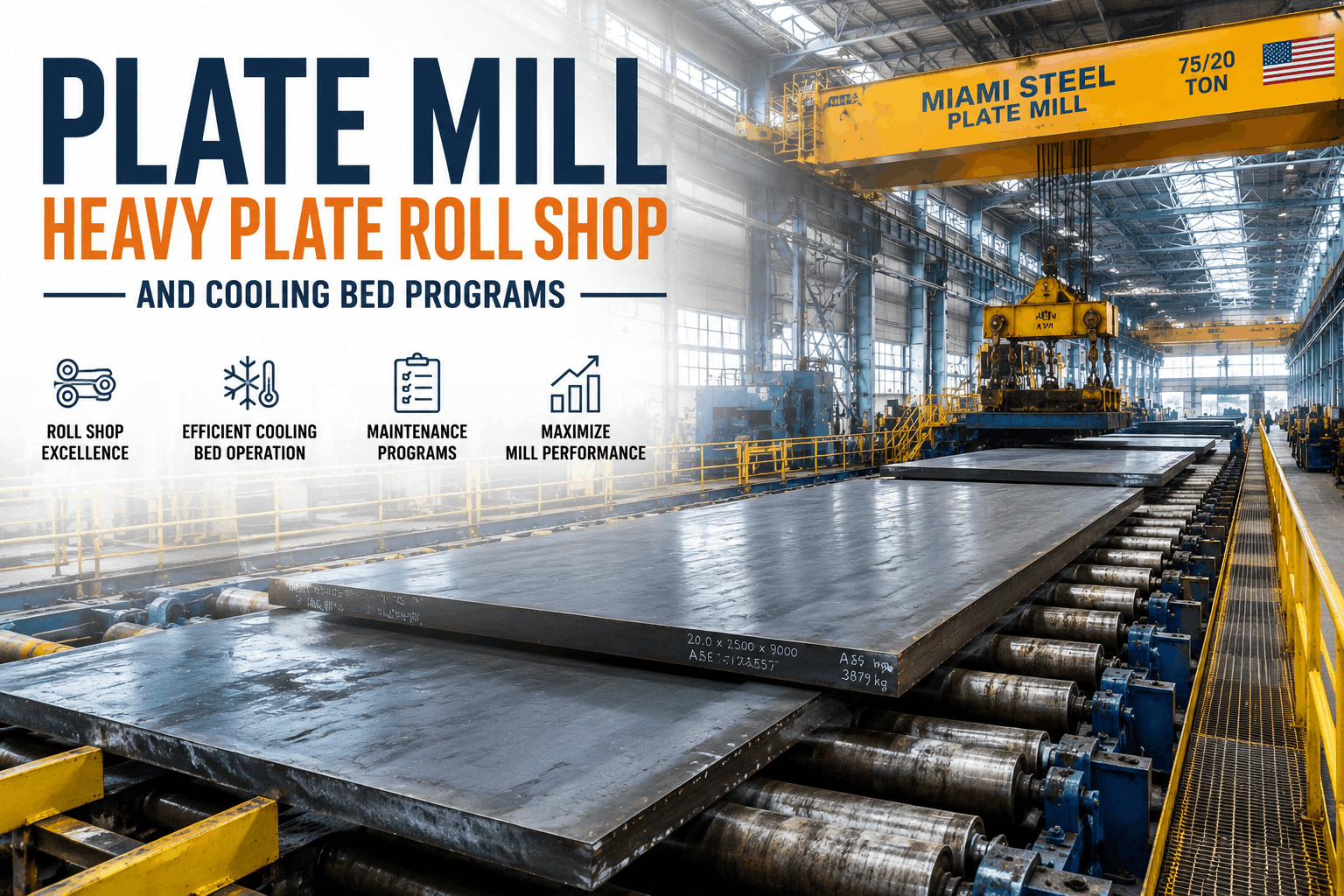
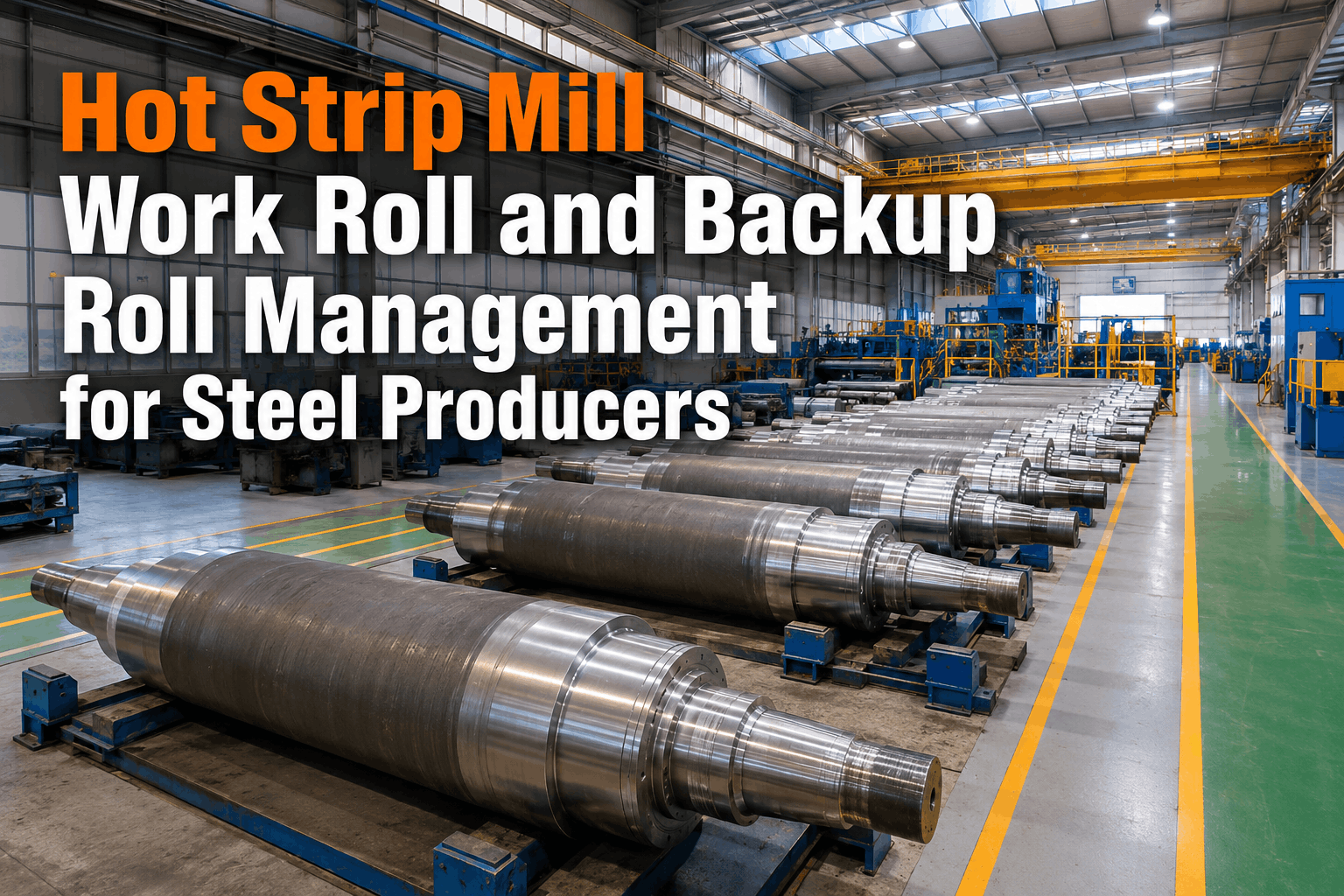
Plate mills represent one of the most critical assets in heavy steel production, operating continuously at extreme mechanical pressures and thermal stresses. The heavy plate roll shop is the engineering heart of production — where precision, downtime prevention, and predictive maintenance converge to maximize throughput while minimizing catastrophic failures. In integrated steel mills across North America, Europe, and Asia-Pacific, plate mill maintenance accounts for 18–22% of total plant operating expenditure. Yet most facilities continue to manage rolls, levelers, and backup equipment on fixed calendar intervals, missing the early warning signs that predict bearing degradation, roll eccentricity, and hydraulic system failures. This guide explores the complete lifecycle of plate mill equipment, the technology stack driving modern maintenance programs, and how Oxmaint delivers actionable intelligence that keeps production rolling.
Plate Mill Equipment Lifecycle — Five Critical Subsystems
A modern heavy plate mill stands comprises five integrated subsystems, each with distinct failure modes and maintenance triggers. Work rolls — the primary contact surface — face the harshest conditions: temperatures approaching 1,000°C, contact pressures exceeding 300 MPa, and continuous mechanical cycling that induces thermal fatigue cracking. Backup rolls support the work rolls under load but operate in a cooler zone, extending their service life to 8–12 months compared to work roll campaigns of 3–6 months. Pre-levelers and hot plate levelers remove residual stresses and flatness defects, requiring precise alignment and bearing maintenance every 500–1,500 operating hours. Hydraulic systems — mill stands, levelers, and descaling equipment — demand condition-based trigger monitoring because calendar-based fluid change intervals leave contaminated or thermally degraded fluid in circulation. The fifth system, the cooling bed and associated conveyor equipment, operates at lower thermal stress but at extremely high cycle counts, making bearing and belt degradation the primary failure driver. Oxmaint manages all five subsystems under a single predictive framework, eliminating the coordination gaps that typically result in missed early warnings.
Surface spalling and thermal cracking develop over 10–15 days of continuous rolling. Eccentricity increases 0.05–0.10 mm per week. AI detects acoustic signatures and vibration patterns 3–4 weeks before quality rejection thresholds are breached. Planned roll changes prevent unscheduled downtime.
Hydrodynamic bearing clearance degradation increases friction and heat. Temperature rise of 8–12°C above baseline indicates incipient spalling. Trending bearing temperature by shift enables replacement scheduling during planned roll changes, avoiding secondary damage to work rolls.
Hydraulic pressure differentials across leveler cylinders cause asymmetric plate deflection, producing flatness defects. Differential exceeding 5% triggers quality alerts. Sensor data identifies failed solenoid valves or seal degradation 2–3 weeks before statistical product failure.
Oil particle count, viscosity index, and acid number drift before pump or valve damage occurs. Condition-based fluid analysis replaces expensive full-tank replacements. AI correlates fluid test results with failure risk, optimizing fluid change timing to actual system condition.
Roll Shop Maintenance Programs — Four Evidence-Based Strategies
The transition from calendar-based to condition-based maintenance in plate mills requires restructuring how rolls are inspected, stored, and redeployed. Four distinct maintenance models coexist in modern mills: preventive interval-based (change every 4 months regardless of condition), condition-triggered (measure wear and change when threshold is reached), predictive analytics (model remaining useful life and schedule replacement based on degradation rate), and campaign planning (coordinate roll changes with other planned maintenance to minimize total downtime). Most mills operate a hybrid approach — preventing catastrophic failures with interval changes while using condition monitoring to optimize campaign windows and eliminate unnecessary downtime. Oxmaint enables this hybrid by tracking individual roll condition data (hardness, diameter, eccentricity, thermal cycling count) across campaigns, building a digital archive that informs future scheduling decisions. Rolls that complete only 60–70% of their nominal campaign life signal metallurgical or operational issues — material chemistry problems, mill stand misalignment, or incorrect rolling schedules — that root-cause analysis can address, preventing expensive repeat failures.
Track diameter loss per campaign, thermal stress cycles, and spall initiation. Schedule replacement 2–3 weeks before projection models reach diameter cutoff or spall growth accelerates. This eliminates the 15–20% of rolls replaced unnecessarily under fixed interval policies.
Record bearing temperature, vibration signature, and oil analysis results per bearing per shift. Temperature trend acceleration indicates accelerating wear. Vibration frequency content distinguishes spall growth from surface roughness, enabling early intervention during low-production periods.
Monitor pressure differential, response time, and fluid condition simultaneously. Combine signals to distinguish failing solenoids (slow response + normal pressure) from seal degradation (high differential + thermal drift). Schedule maintenance with 2–3 week lead time instead of emergency stops.
Track bearing temperature, belt tension, and drive motor current draw. Rising motor current at constant speed indicates increasing friction. Trending identifies bearing wear 3–4 weeks before mechanical failure, enabling planned replacement without production impact.
Plate Quality Anomalies — Root Cause Correlation with Equipment Condition
Surface flatness defects, edge wave, and centerline segregation in finished plates originate from mill equipment conditions that developed weeks or months before the defect appears in the final product. When statistical process control flags a 2–3% rise in flatness rejections, the response is typically reactive: adjust mill stand pressure, change rolling schedule, or quarantine affected plates. Predictive maintenance inverts this logic: Oxmaint correlates plate quality metrics against equipment health signals collected on the same date, identifying which component degradation produces which quality signature. A rising defect rate paired with increasing backup roll bearing temperature and leveler pressure differential suggests inadequate plate support and residual stress, causing flatness distortion. Rising edge wave pairs with work roll eccentricity growth. Centerline segregation spikes when roll surface degradation produces inconsistent heat transfer. By building this correlation model, maintenance engineers can distinguish between quality issues requiring mill schedule changes and those requiring equipment intervention — eliminating weeks of trial-and-error troubleshooting and enabling root-cause repair on the first diagnosis attempt.
Oxmaint Plate Mill Monitoring — Real-Time Subsystem Intelligence
Automatic diameter measurement from mill stand forces correlates with vibration signals to calculate roll ovality and eccentricity. Trending identifies which rolls are approaching 0.5–0.8 mm runout threshold — the point where surface spalling initiates. Planned replacement prevents quality defects and secondary damage.
Infrared sensors on all main bearing locations record temperature every 15 minutes. Abnormal gradients between left and right bearings, or trend acceleration above 2°C per day, trigger bearing inspection work orders. Planned maintenance replaces failing bearings before catastrophic seizure.
Pressure transducers on all mill stand and leveler circuits measure pressure differential in real time. Solenoid valve response time, thermal drift, and fluid particle count combine into a system health score. Identifies failing valves 2–3 weeks before production impact.
Edge and centerline flatness data from measurement stands feeds back to leveler pressure optimization. AI identifies asymmetric flatness patterns indicating uneven gap wear, pressure imbalance, or hydraulic seal degradation. Correlates equipment condition with quality anomalies.
Frequently Asked Questions — Plate Mill Maintenance & Roll Management
"Implementing Oxmaint's plate mill monitoring reduced our unplanned roll stand downtime from 8–10 occurrences per month to just 2–3. We're now scheduling roll changes 3–4 weeks in advance instead of reacting to quality rejections. The change coordination alone saves us $40K per planned shutdown in labor and missed production."
Monitor work rolls, backup rolls, levelers, and hydraulics in real time — schedule maintenance weeks in advance instead of responding to failure.