Steel quality management at most plants operates as an open loop — defects are detected after they happen, investigated hours or days later, and corrective actions are implemented manually by operators who may or may not be on the same shift that produced the defect. A surface crack is found at the finishing inspection line. The inspector logs the defect. A quality engineer reviews the log the next morning. The engineer traces the defect to a caster mold oscillation setting that drifted out of specification six hours ago. By the time the correction is made, 200 additional slabs have been cast with the same drifted parameter, half of which will show the same defect at inspection. The other half will ship to customers and become complaints, claims, and lost contracts. This is the fundamental problem with open-loop quality: the time between a process deviation and its correction is measured in hours or days, during which the deviation continues producing defective material. Closed-loop quality eliminates this gap by connecting defect detection directly to process control — when a defect is detected or a process parameter drifts beyond acceptable limits, the system automatically adjusts the upstream process that caused it, alerts the responsible operator, and verifies that the correction was effective, all within minutes rather than hours. The loop closes when the defect signal travels backward through the process chain to its root cause and triggers a correction that prevents recurrence — not in the next quality review meeting, not on the next shift, but in the next production cycle. This is not theoretical. Closed-loop quality systems operating in advanced steel plants have reduced defect rates by 40–65%, cut customer quality claims by 50–80%, and recovered 2–5% of production that was previously downgraded or scrapped due to quality deviations that persisted for hours before anyone noticed.
The Closed Loop: Defect to Correction in Minutes, Not Days
1
Detect
In-line sensors identify defect or process deviation in real time
→
2
Classify
AI/rules engine identifies defect type, severity, and probable root cause
→
3
Trace
System maps defect to originating process step, heat, and parameter set
→
4
Correct
Automatic parameter adjustment or operator alert with prescribed corrective action
→
5
Verify
Subsequent production monitored to confirm defect eliminated — loop closes
Continuous feedback — every cycle refines the model
Open Loop (Traditional)
Detect → Investigate → Report → Meeting → Decide → Implement → Verify
Response time: 8–72 hours
Closed Loop
Detect → Classify → Trace → Correct → Verify
Response time: 2–15 minutes
The Cost of Every Hour the Loop Stays Open
In open-loop quality, every hour between a process deviation and its correction produces defective material. The cost compounds linearly with time — and in a continuous process like steelmaking, the production rate never stops while humans investigate, meet, decide, and implement corrections. Facilities that sign up to centralize their quality and maintenance data on a single platform build the traceability foundation that makes closed-loop quality achievable.
15 min
8–12 tons (2–3 slabs)
Contained at caster — regrading or minor trimming, minimal customer exposure
1 hour
30–50 tons (8–12 slabs)
Material enters slab yard — rolling decisions needed for each affected slab
4 hours
120–200 tons (30–50 slabs)
Affected material in rolling and finishing — some already shipped or allocated to orders
8 hours (1 shift)
240–400 tons (60–100 slabs)
Full shift of production affected — customer claims, order delays, grade downgrades across dozens of orders
24+ hours
700–1,200 tons
Multi-customer exposure, potential recalls, contract penalties, and reputation damage — total cost $500K–$2M+ per event
The Six Closed Loops in Steel Production
A fully closed-loop quality system doesn't have one feedback loop — it has multiple loops operating simultaneously across the entire production chain, each connecting a specific detection capability to a specific process control action. Each loop operates independently while sharing data with the others to identify systemic patterns.
Loop 1
Mold Level & Oscillation Sensors
↓
Caster Mold Parameters
Caster Surface Quality Loop
Mold level fluctuations, oscillation mark depth, and breakout prediction systems detect surface formation defects in real time. When mold level variance exceeds ±3mm or oscillation marks deepen beyond threshold, the system automatically adjusts casting speed, mold oscillation frequency, and powder feed rate. Prevents longitudinal cracks, transverse cracks, and slag entrapment at the point of origin.
Defect reduction: 45–60% reduction in caster-origin surface defects within 3 months of activation
Loop 2
Slab Surface Inspection (Camera/Laser)
↓
Caster + Reheating Furnace Settings
Slab Quality → Upstream Process Loop
Automated slab surface inspection using high-resolution cameras and laser profilometry identifies cracks, inclusions, scabs, and depressions on every slab face. AI classification maps each defect type to its most probable caster origin — then feeds corrections back to caster parameters for subsequent heats while simultaneously adjusting reheating furnace profiles to minimize defect propagation through rolling for already-affected slabs.
Defect reduction: 35–50% fewer rolling-stage surface defects through pre-roll slab grading and furnace profile optimization
Loop 3
Rolling Force & Flatness Sensors
↓
Roll Gap, Speed & Cooling
Hot Strip Mill Dimensional Loop
Real-time measurement of strip thickness, width, flatness, and crown at every stand exit. Automatic gauge control (AGC) adjusts roll gap, rolling speed, inter-stand cooling, and bending forces within milliseconds to maintain dimensional tolerances. Flatness deviations trigger work roll bending and shifting adjustments. This is the most mature closed loop in steel production — operating at speeds of 10–20 meters per second with sub-millisecond response times.
Defect reduction: 90%+ of dimensional non-conformances corrected within the same coil — the standard for closed-loop performance
Loop 4
Online Surface Inspection System
↓
Rolling & Finishing Parameters
Strip Surface Quality Loop
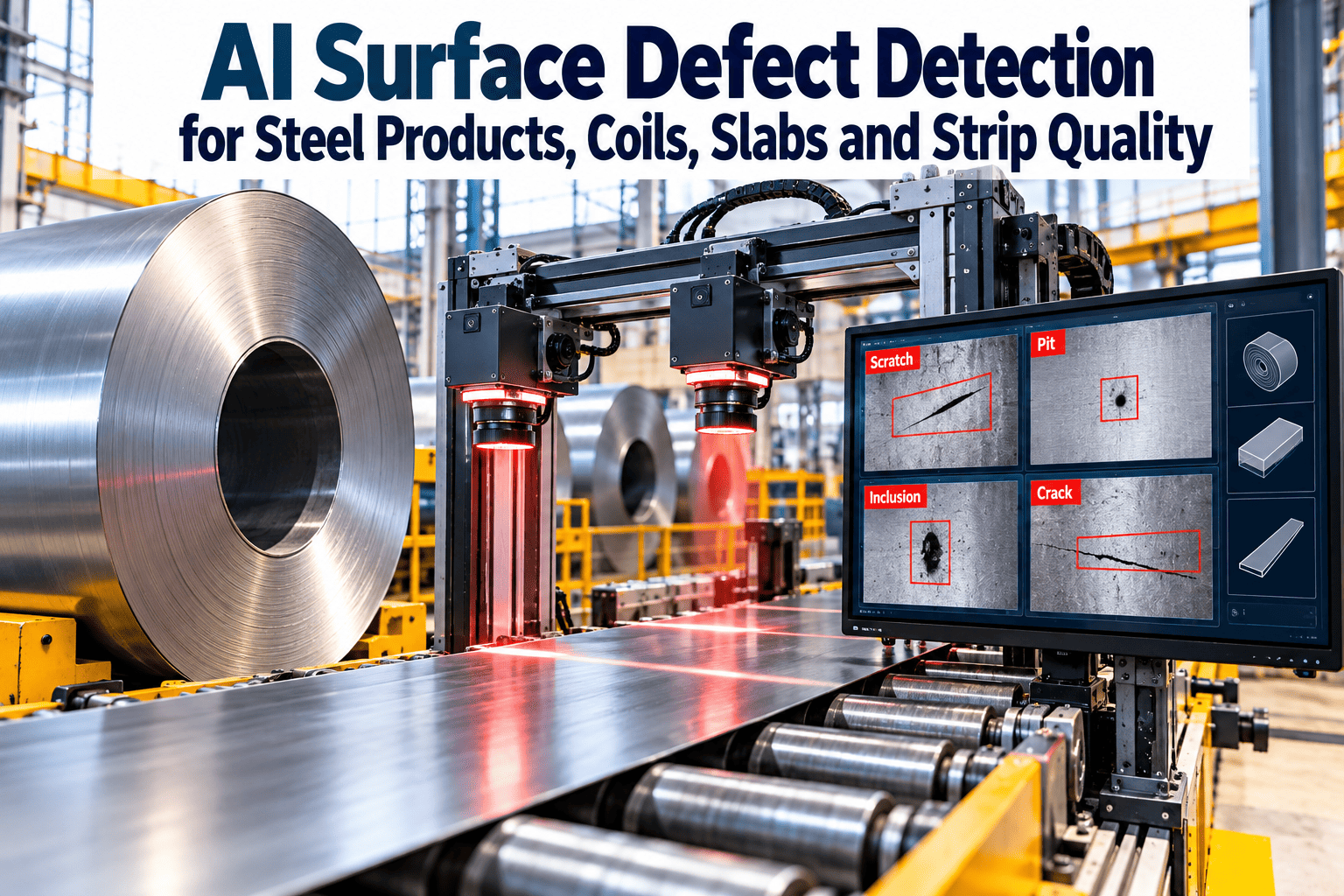
High-speed cameras (4,000+ frames/second) inspect both surfaces of the hot strip at full production speed. AI-based defect classification identifies roll marks, scale patterns, edge cracks, and inclusion-related defects in real time. Roll marks trigger immediate roll change scheduling. Scale defects feed back to descaling spray pressure and temperature adjustments. Edge cracks trigger width reduction or edger setting modifications on subsequent strips.
Defect reduction: 40–55% reduction in surface-related customer claims within 6 months
Loop 5
Mechanical Testing & Microstructure Analysis
↓
Chemistry, Rolling & Cooling Strategy
Metallurgical Property Loop
Tensile strength, yield strength, elongation, and hardness results from the testing lab are correlated to the specific heat chemistry, rolling temperatures, and cooling rates that produced them. Statistical models identify when mechanical properties are trending toward specification limits and adjust alloy trim additions, finishing temperatures, and run-out table cooling patterns to pull properties back to target center. The loop extends to include online electromagnetic property sensors that estimate mechanical properties before destructive testing confirms them.
Defect reduction: 50–70% reduction in mechanical property non-conformances and 80% faster response to property drift
Loop 6
Customer Complaint & Return Data
↓
Process Standards & Quality Rules
Customer Feedback → Process Standards Loop
Customer quality claims and forming/processing feedback are traced back through the production genealogy to the specific heat, caster, and rolling parameters that produced the material. Pattern analysis across multiple claims identifies systematic quality gaps — not individual defects but recurring conditions that the internal quality system isn't catching. These patterns drive updates to internal quality rules, tightened process windows, and new inspection criteria. The slowest loop (weeks to months) but the most strategically important for eliminating latent quality gaps.
Defect reduction: 30–50% reduction in repeat customer complaints year-over-year through systematic process standard refinement
Quality Data Without Action Is Just Expensive Record-Keeping
OxMaint connects quality events to maintenance actions — when a defect traces to equipment condition (worn rolls, misaligned guides, degraded sensors), the system generates a maintenance work order linked to the quality event, ensuring the equipment root cause is corrected alongside the process parameter correction.
The Data Architecture That Makes Closed-Loop Quality Possible
Closed-loop quality requires connecting three data domains that traditionally live in separate systems: real-time process data, quality inspection data, and production genealogy. Without this integration, defect detection and root cause identification remain manual, slow, and incomplete.
Caster parameters (speed, mold level, oscillation, temperatures)
Rolling parameters (force, gap, speed, temperature per stand)
Cooling parameters (water flow, spray patterns, temperatures)
Chemistry data (ladle, tundish, and final analysis)
Equipment condition (roll wear, guide alignment, sensor calibration)
Production Genealogy
Links every meter of finished product to the specific heat, caster strand, slab position, rolling sequence, and process parameters that produced it
Surface inspection results (defect type, location, severity)
Dimensional measurements (thickness, width, flatness, crown)
Mechanical test results (tensile, yield, elongation, hardness)
Customer complaints (defect type, forming behavior, application failure)
Internal hold/release decisions and disposition records
Equipment Condition: The Missing Link in Quality Root Cause
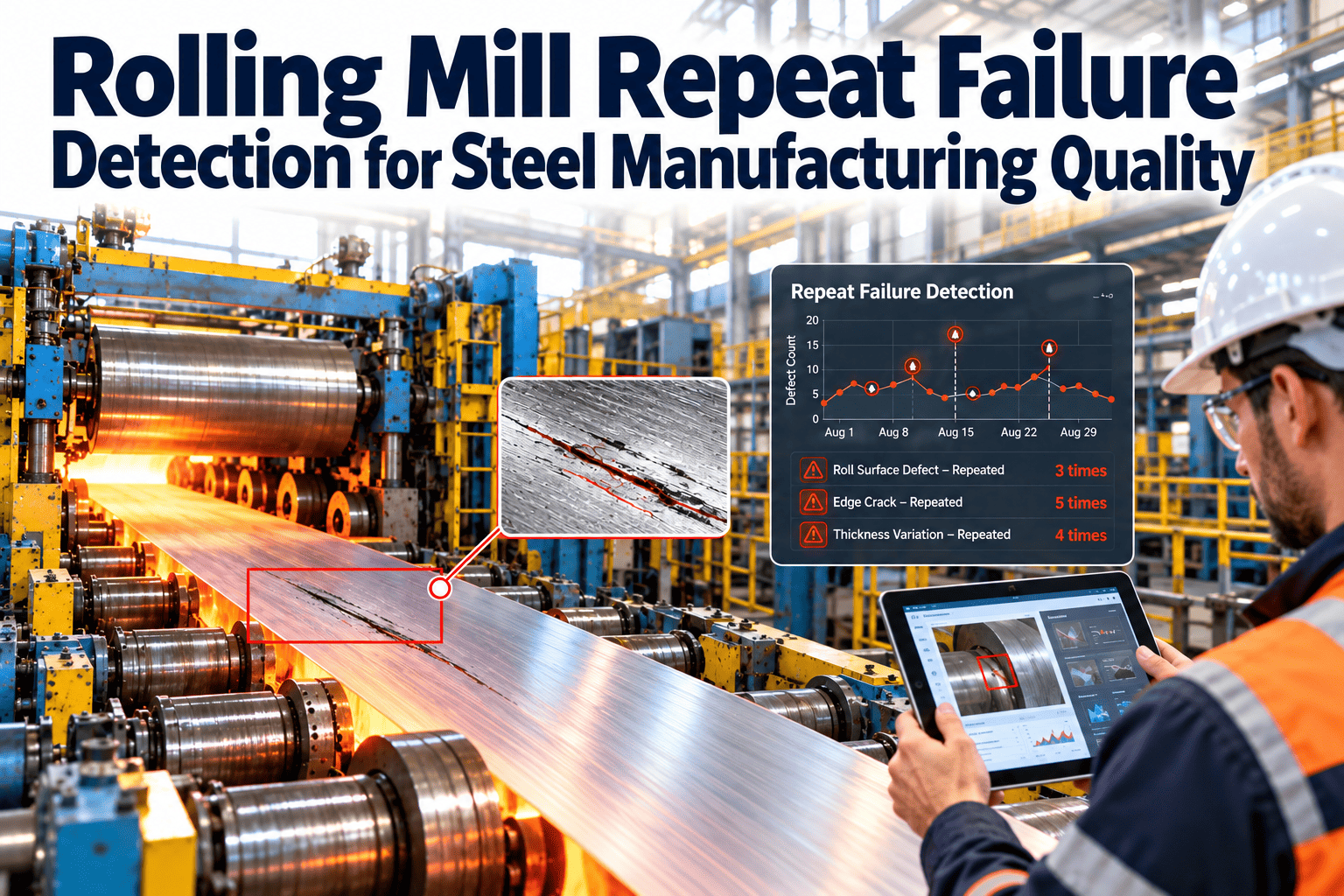
Process parameters can be perfect, and the product can still be defective — when the equipment executing the process is degraded. Worn work rolls produce surface marks that no rolling parameter adjustment can eliminate. A misaligned guide creates edge cracks regardless of the casting speed setting. A degraded descaling nozzle leaves scale patches that contaminate the strip surface. Connecting equipment condition data to quality outcomes closes a loop that most steel plants leave completely open.
←→
Work Roll Surface Condition
Roll surface deterioration from thermal fatigue, mechanical damage, or inadequate grinding. Monitoring: roll surface profilometry after each campaign, vibration signature analysis during rolling, and defect pattern recognition linking periodic marks to roll circumference.
Maintenance trigger: Automatic roll change scheduling when defect density exceeds threshold or roll surface roughness degrades beyond specification
←→
Guide & Edger Alignment
Guide rail wear, edger roll misalignment, or side guide positioning errors create asymmetric forces on strip edges. Monitoring: guide position sensors, edge force measurement, and correlation between edge defect frequency and guide maintenance interval.
Maintenance trigger: Work order for guide inspection and realignment when edge defect rate exceeds 2x baseline for the current product width range
←→
Descaling System Performance
Nozzle wear, blockage, or pressure drop in the high-pressure descaling system leaves residual scale on the slab surface that gets rolled into the strip. Monitoring: descaling spray pressure per header, nozzle flow rate comparison, and surface inspection defect mapping to descaling coverage gaps.
Maintenance trigger: Nozzle inspection/replacement when descaling-related defect patterns appear or spray pressure drops below 90% of nominal
←→
Roll Cooling & Thermal Crown
Roll cooling system degradation — blocked cooling channels, worn spray nozzles, or coolant contamination — creates uneven thermal crown across the roll face. Monitoring: roll coolant flow rate per zone, roll surface temperature profile, and flatness deviation correlation to cooling system performance metrics.
Maintenance trigger: Cooling system inspection when flatness correction demand exceeds AGC capacity or thermal crown drift exceeds 50µm from target
ROI: Closed-Loop Quality for Steel Production
$12M
Reduced Scrap & Downgrade Losses
1.5–3% scrap/downgrade rate reduced to 0.5–1.2% through real-time defect correction × $500–$600/ton margin differential
$8M
Customer Claim Reduction
50–80% reduction in quality claims through defect prevention vs detection, including claim processing costs and penalty avoidance
$4.5M
Yield Improvement
0.3–0.8% prime yield improvement from tighter process control and reduced quality holds — material ships as ordered grade rather than downgraded
$2.5M
Reduced Quality Investigation Labor
Automated root cause traceability replaces manual defect investigation — 60–80% reduction in quality engineering investigation time
$1.8M
Premium Product Qualification
Tighter process control enables qualification for automotive, API, and other premium grades with stricter quality requirements
Expert Perspective: Building Closed-Loop Quality in Steel
"
I spent 12 years as a quality manager at two integrated mills before leading the closed-loop quality transformation at our current plant. The biggest misconception about closed-loop quality is that it requires replacing your entire quality infrastructure with AI. It doesn't. Most plants already have 70–80% of the detection technology they need — surface inspection cameras, gauge measurement systems, and process data historians are standard equipment. What they're missing is the connection between detection and correction. The surface inspection system detects a roll mark at the finishing inspection line. A human reviews it four hours later. Another human traces it to a specific rolling stand. A third human schedules a roll change. By then, 400 coils have been rolled on the degraded roll. The closed-loop version: the surface inspection system detects the roll mark pattern, AI classifies it as stand F4-related based on the periodic spacing matching F4 roll circumference, the system immediately alerts the rolling operator, and the roll change is scheduled into the next available coil gap — typically within 15–30 minutes. Same detection technology, same roll change process, dramatically different outcome because the response time collapsed from hours to minutes. Start with the loop that has the highest defect cost — at most hot strip mills, that's the connection between the surface inspection system and roll change scheduling. Close that one loop and you'll fund the next five.
You already have 70–80% of the detection technology — the gap is the connection to process correction
Start with the highest-cost defect loop — typically surface inspection to roll change scheduling at the hot strip mill
Response time is everything — the same corrective action that costs $5K at 15 minutes costs $500K at 24 hours
Connect quality to maintenance — equipment condition is the root cause behind 30–40% of quality defects
Closed-loop quality transforms steel production from a detect-and-react operation into a predict-and-prevent operation. Every defect that's corrected in minutes instead of hours saves hundreds of tons of production from downgrade, scrap, or customer claims. If you're ready to connect your quality detection systems to maintenance execution and process control, book a free demo to see how quality-driven maintenance work orders close the equipment condition loop.
Detect. Trace. Correct. Verify. Every Cycle. Automatically.
OxMaint connects quality events to their equipment root causes — generating maintenance work orders when defect patterns trace to roll condition, guide alignment, sensor calibration, or any equipment-related quality driver. Close the loop between quality detection and maintenance action.
Frequently Asked Questions
How does closed-loop quality differ from traditional statistical process control (SPC)?
Traditional SPC monitors process parameters against control limits and alerts operators when parameters drift outside acceptable ranges — but the response is manual. An operator sees a control chart alarm, investigates the cause, decides on a correction, and implements it. This human-in-the-loop response typically takes 15–60 minutes for simple adjustments and hours for complex root cause investigations. Closed-loop quality extends SPC in three critical ways. First, it connects the detection signal directly to the corrective action — when a parameter drifts, the system either adjusts it automatically (for well-understood, deterministic relationships) or prescribes the specific corrective action for the operator (for complex, judgment-dependent situations). Second, it integrates multiple data sources simultaneously — SPC typically monitors individual parameters in isolation, while closed-loop systems correlate process data, quality data, and equipment condition data to identify root causes that single-parameter monitoring misses. Third, it learns — closed-loop systems use historical defect-to-cause correlations to improve their classification accuracy and correction prescriptions over time. SPC rules are static; closed-loop models are continuously refined by every quality event they process.
What role does AI play in closed-loop quality for steel production?
AI serves three primary roles in closed-loop steel quality. First, defect classification: AI models (typically convolutional neural networks for image-based surface inspection) classify detected defects into specific categories with 92–98% accuracy — far exceeding human visual inspection consistency. The classification determines which correction loop is activated. A crack classified as "longitudinal mold crack" triggers caster parameter adjustment; the same crack classified as "rolling-induced edge crack" triggers mill corrections. Accurate classification is essential because the wrong classification triggers the wrong correction. Second, root cause inference: when multiple process parameters could explain a defect, AI models trained on historical production data identify the most probable root cause based on the current process state. This is particularly valuable for defects with multiple potential origins — for example, a surface inclusion could originate from ladle slag entrainment, tundish flux pickup, or mold powder behavior, and the correct corrective action is entirely different for each cause. Third, predictive quality: AI models predict mechanical properties, surface quality, and dimensional accuracy from process data before the product reaches the inspection point — enabling preemptive adjustments rather than reactive corrections. These predictive models achieve 85–95% accuracy for most quality parameters and continuously improve as they accumulate more production data.
How do you handle the tension between automatic correction and operator expertise?
The relationship between automatic correction and operator expertise is managed through a tiered authority model. Tier 1 corrections are fully automatic — well-understood, deterministic adjustments where the relationship between the defect signal and the correct response is unambiguous and the risk of an incorrect correction is low. Examples include automatic gauge control (AGC) adjustments in the rolling mill, mold level control in the caster, and cooling water flow adjustments on the run-out table. These corrections operate in milliseconds to seconds without operator intervention. Tier 2 corrections are operator-guided — the system identifies the defect, classifies the probable root cause, and prescribes a specific corrective action, but the operator must approve and initiate the change. Examples include casting speed reductions, roll change scheduling, and furnace temperature profile adjustments. The operator retains judgment authority but receives a specific, data-backed recommendation rather than a general alarm. Tier 3 corrections are operator-investigated — the system detects an anomaly that doesn't match established patterns and alerts the operator with all relevant data for investigation. These typically involve complex, multi-factor quality issues where human expertise and contextual knowledge are essential. Over time, as Tier 3 investigations yield successful resolutions, those resolution patterns migrate into Tier 2 prescriptions and eventually Tier 1 automatic corrections.
What is production genealogy and why is it essential for closed-loop quality?
Production genealogy is the data system that links every piece of finished steel to the complete history of its production — which heat produced it, which caster strand and slab position it came from, which specific rolling pass schedule was applied, what cooling rate it received, and what every measured process parameter was at the exact time that specific material was being processed at each step. Without genealogy, a surface defect found on finished coil #47523 is just a defect with no traceable origin. With genealogy, the same defect is linked to slab 2847 from heat H-91042, cast on strand 2, position 3 of 5, at casting speed 1.25 m/min with mold level variance of ±4.2mm at 14:32:17 — which immediately identifies both the probable cause and the scope of affected production. Genealogy is essential for closed-loop quality because it provides the backward traceability that makes correction targeting possible. When the quality system detects a defect, genealogy answers: what process step produced this, what were the conditions, and which other material was produced under the same conditions and may have the same defect? This last question is critical — it enables proactive holds and re-inspection of potentially affected material before it ships, rather than waiting for customer complaints to reveal the scope of the quality event.
How long does it take to implement closed-loop quality across a steel plant?
Full closed-loop quality across all six loops typically takes 24–36 months, but the implementation is progressive with each loop delivering independent value. The recommended sequencing starts with the highest-impact, most technically mature loop and progresses to the more complex loops. Phase 1 (months 1–8): Close the hot strip mill dimensional loop (Loop 3) and the strip surface quality to roll change loop (Loop 4). These loops use mature detection technology (AGC, surface inspection systems) that most modern mills already have installed, and the corrective actions are well-understood and deterministic. Phase 2 (months 6–14, overlapping): Close the caster surface quality loop (Loop 1) and the slab inspection to upstream correction loop (Loop 2). These require integration of caster process data with downstream quality results and more sophisticated root cause inference models. Phase 3 (months 12–24): Close the metallurgical property loop (Loop 5), which requires the most complex multi-parameter modeling and the longest feedback delays (lab testing turnaround). Phase 4 (months 18–36): Close the customer feedback loop (Loop 6), which is an ongoing, continuously improving system rather than a one-time implementation. Each phase delivers standalone ROI — plants typically recover $4M–$8M annually from the Phase 1 loops alone, funding subsequent phases from quality improvement savings.