Refractory Maintenance Management in Steelmaking: Extending Lining Life with Data-Driven Decisions
By John Mark on March 12, 2026
Refractory maintenance management in steelmaking represents the critical barrier between molten metal and catastrophic failure. Every heat tapped, every ladle transferred, and every continuous cast relies on the integrity of refractory linings that withstand temperatures exceeding 1600°C. Poor refractory management leads to unplanned outages, safety incidents, energy inefficiency, and millions in lost production. Conversely, data-driven refractory strategies extend lining life, optimize gunning and patching schedules, and ensure predictable campaign lengths. This comprehensive guide explores how modern steel producers are leveraging digital tools, thermal monitoring, and predictive analytics to transform refractory maintenance from a reactive cost center into a strategic reliability function. Schedule a consultation to explore how intelligent refractory management can protect your critical vessels.
The High Stakes of Refractory Integrity
In steelmaking, refractory failure is not an option. A breakout in a ladle, tundish, or furnace can halt production for days, damage surrounding equipment, and endanger lives. The cost of a single unplanned reline often exceeds $500,000 when factoring in materials, labor, and lost production. Yet many plants still rely on visual inspections and fixed campaign counts rather than actual lining condition. Transitioning to data-driven decision-making enables precise intervention timing—maximizing lining life without compromising safety.
40%
Cost Reduction
Through optimized gunning and patching vs. premature relines
25%
Life Extension
Average increase in campaign length with condition monitoring
99%
Safety Compliance
Elimination of unexpected breakouts through predictive alerts
15%
Energy Savings
Reduced heat loss from optimized lining thickness management
Stop guessing lining condition. Join steel producers using AI-powered refractory tracking to extend campaign life and prevent breakouts.
Different steelmaking vessels face unique refractory challenges. Effective management requires tailored strategies for ladles, tundishes, furnaces, and torpedo cars, each with distinct wear patterns and failure modes.
Ladle Linings
Challenge: Thermal cycling, slag corrosion, and mechanical stress during tapping and transport.
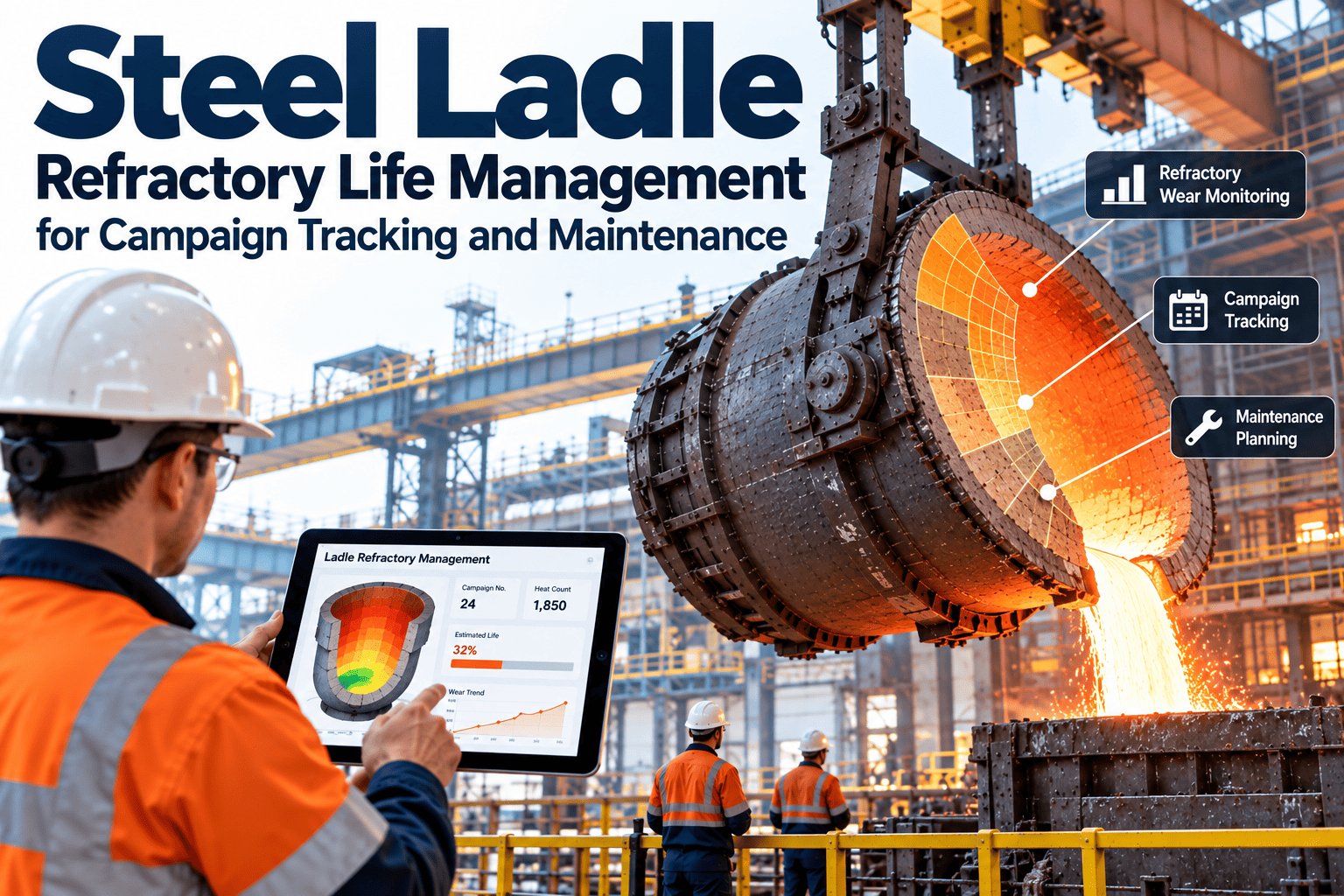
Strategy: Track heat count, monitor shell temperature, and schedule gunning based on wear rates rather than fixed intervals.
Key Metric: Heats per campaign, shell temperature delta.
Tundish Systems
Challenge: Continuous exposure to molten steel, nozzle erosion, and inclusion buildup.
Strategy: Monitor flow control components, track lining wear at impact zones, and optimize drying schedules.
Challenge: Extreme temperatures, chemical attack from slag, and mechanical charging impact.
Strategy: Use laser profiling for wear mapping, track tap-to-tap times, and plan patching during short stops.
Key Metric: Furnace campaign life, patching volume per heat.
Torpedo Cars
Challenge: Abrasion during transport, thermal shock during filling/emptying.
Strategy: Inspect trunnion areas, monitor lining thickness at discharge zones, and coordinate with transport schedules.
Key Metric: Miles per reline, hot metal temperature retention.
The Data-Driven Advantage
Traditional refractory management relies on fixed campaign counts (e.g., "reline after 500 heats"). This approach is inherently inefficient—some linings fail early while others could run longer. Data-driven management uses actual condition data to optimize intervention timing, balancing risk against cost.
Refractory Lifecycle Management Stages
01
Installation & Drying
Track installation quality, drying curves, and initial bake-out. Capture baseline data for future comparison.
02
Operation Monitoring
Continuously log heat counts, temperatures, and slag conditions. Use thermal imaging to detect hot spots.
03
Condition Assessment
Perform regular inspections (visual, laser, ultrasonic). Update digital twin with actual wear measurements.
04
Intervention Planning
Decide between gunning, patching, or relining based on remaining life models and production schedules.
05
Execution & Learning
Complete maintenance, record actual work done, and feed data back into predictive models for future accuracy.
See refractory tracking in action. Book a demo and we'll show you how Oxmaint structures lining history and predicts remaining life for your vessels.
Modern refractory management leverages multiple sensing technologies to create a comprehensive view of lining health. Integrating these data streams enables early warning of potential failures.
?️
Thermal Imaging
Detect shell hot spots indicating lining thinning. Continuous monitoring enables real-time alerts before critical thresholds are reached.
?
Laser Profiling
Map internal vessel geometry to measure wear patterns. Compare against original dimensions to calculate remaining thickness.
?
Acoustic Monitoring
Listen for changes in sound patterns during operation that may indicate brick movement or lining degradation.
?
Digital Twins
Create virtual models of vessels that update with real-time data. Simulate wear scenarios and plan interventions virtually.
Cost of Failure Analysis
Understanding the true cost of refractory failure justifies investment in proactive management. The direct costs are visible, but the indirect costs often dwarf them.
⚠️ Refractory Failure Cost Breakdown
Direct Costs
Materials, Labor, Equipment Repair
Typically 20-30% of total impact
Production Loss
Downtime, Delayed Orders, Penalty Fees
Typically 50-60% of total impact
Safety & Compliance
Incident Investigation, Regulatory Fines
Variable but potentially catastrophic
Implementation Roadmap
Transitioning to data-driven refractory management requires a structured approach. Start with critical vessels, establish baselines, and expand as confidence grows.
Phase 1
Data Foundation
Inventory all refractory assets
Digitize historical lining records
Define criticality ratings
Establish inspection standards
Phase 2
Monitoring Deployment
Install thermal sensors on critical ladles
Implement laser profiling schedule
Train inspectors on digital tools
Configure alert thresholds
Phase 3
Predictive Analytics
Deploy wear prediction models
Integrate with production scheduling
Optimize gunning vs. relining decisions
Track KPIs and continuous improvement
Documented Benefits for Steel ProducersBased on deployment data across integrated and EAF facilities
35%
Reduction in refractory costs
28%
Increase in campaign length
90%
Reduction in unplanned relines
$1.5M
Average annual savings per plant
Calculate your refractory ROI. Create a free Oxmaint account and our team will model the potential savings for your specific vessel fleet and campaign profiles.
Refractory management programs face unique challenges from harsh environments, data fragmentation, and operational pressures. Understanding these challenges and proven solutions accelerates successful implementation.
Harsh Environment Data Collection
Challenge: Heat, dust, and vibration damage sensors and hinder inspections. Solution: Use ruggedized sensors, remote monitoring tools, and protected inspection ports. Schedule data collection during cool-down periods.
Inconsistent Inspection Quality
Challenge: Different inspectors record data differently, reducing trend accuracy. Solution: Standardize inspection checklists, use digital tools with mandatory fields, and provide regular training and calibration.
Production vs. Maintenance Conflict
Challenge: Production pressures delay necessary refractory work. Solution: Use predictive data to show risk quantitatively. Integrate refractory needs into production scheduling systems for visibility.
Vendor Management
Challenge: Coordinating multiple refractory suppliers and contractors. Solution: Centralize vendor performance tracking. Use data to compare supplier materials and installation quality objectively.
Extend Lining Life with Data-Driven Decisions
Your refractory assets are too critical to manage reactively. Oxmaint helps you deploy intelligent maintenance programs that predict lining wear, optimize intervention timing, and provide real-time visibility into vessel health—transforming refractory management from a cost center into a strategic advantage for your steelmaking operations.
How often should refractory inspections be performed?
Inspection frequency depends on vessel criticality and campaign stage. Ladles typically require thermal scans every heat and detailed inspections every 50-100 heats. Tundishes need inspection between every sequence. Furnaces require daily visual checks and weekly profiling. AI-powered systems can optimize these frequencies based on actual wear rates. Schedule a consultation to develop an inspection strategy for your vessels.
What are the most common causes of premature refractory failure?
Leading causes include thermal shock from rapid temperature changes, chemical corrosion from slag composition, mechanical abuse during charging or tapping, and poor installation quality (incorrect drying, weak joints). Proactive monitoring targets these specific failure modes to prevent early removal.
How do we balance production demands with necessary refractory maintenance?
Predictive analytics enable scheduling interventions during natural production breaks rather than fixed calendar intervals. By knowing remaining life accurately, you can plan relines during scheduled outages. Executive alignment on maintenance windows and clear communication of risk trade-offs are essential. Sign up for a free account to access scheduling optimization tools.
Can refractory management systems integrate with our existing CMMS?
Yes. Oxmaint integrates with all major CMMS platforms (SAP PM, IBM Maximo, Infor EAM) and operational systems through APIs and standard data formats. Bi-directional integration enables seamless data exchange without replacing existing infrastructure. Our implementation team works with your IT group to ensure secure, reliable connectivity. Schedule a consultation to discuss integration options.
How do we measure the effectiveness of our refractory management program?
Key performance indicators include campaign length (heats or tons), refractory cost per ton of steel, unplanned reline frequency, and safety incidents related to vessel integrity. Establish baselines before program changes and track trends monthly. AI analytics can correlate maintenance activities with performance outcomes to identify the highest-impact improvements.
What role does AI play in modern refractory management?
AI analyzes historical wear patterns, thermal data, and operational parameters to predict remaining lining life. It recommends optimal intervention timing (gunning vs. patching vs. relining) and identifies anomalies that human inspectors might miss. Machine learning models improve over time as more data is collected. Book a demo to see AI capabilities in action.