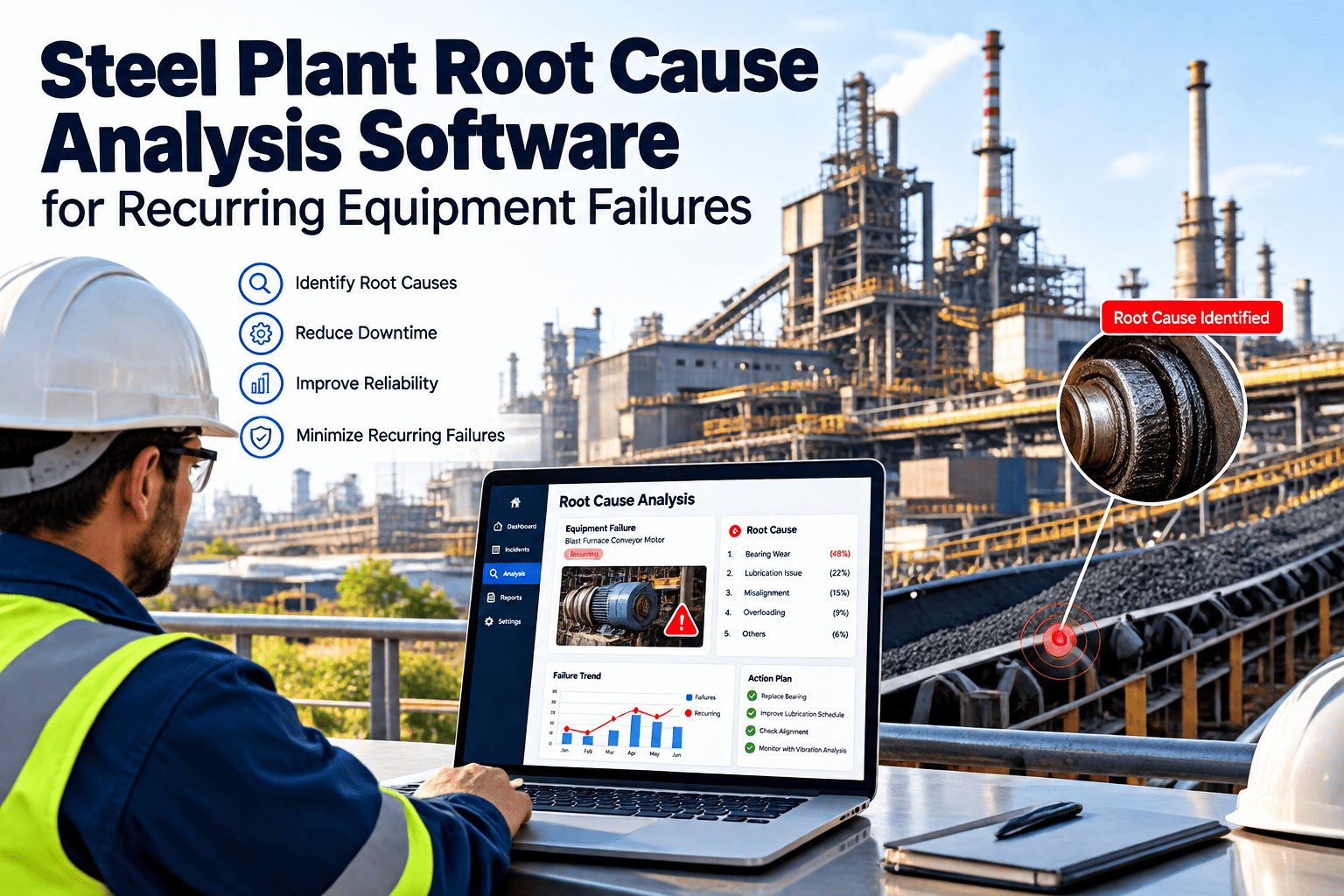
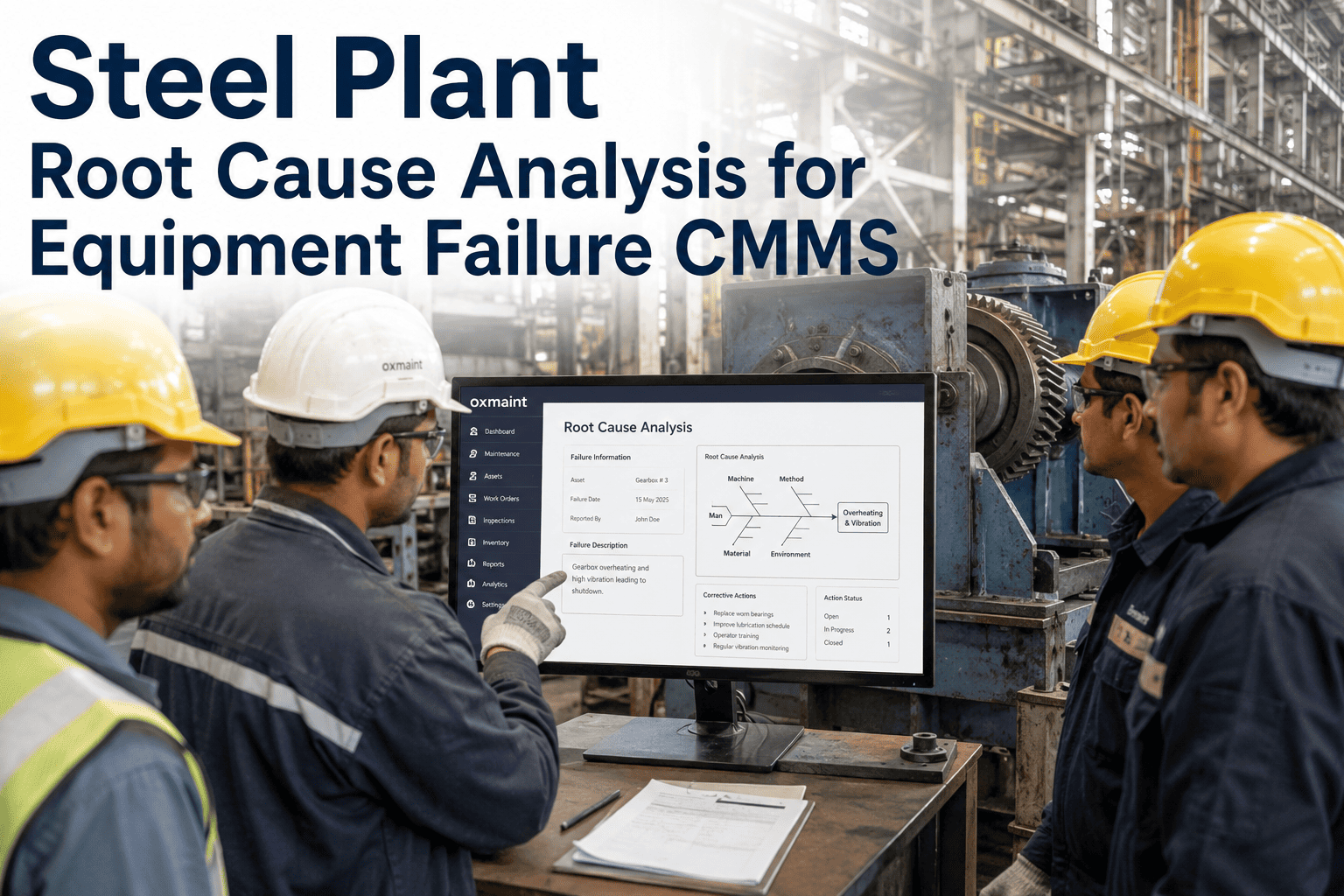
Calendar-based maintenance schedules applied uniformly across a steel plant treat a blast furnace tuyere cooling system, a rolling mill oil film bearing, and a plant lighting circuit with identical analytical rigour — which is to say, none. The tuyere cooling failure that causes a thermal blowout costs millions in emergency repairs and weeks of lost production. The lighting circuit failure costs a fuse and five minutes. Reliability-Centered Maintenance is the methodology that distinguishes these two assets analytically — matching maintenance investment to failure consequence, not to equipment age or scheduling convention. Plants applying RCM to critical steel assets report 40–70% reductions in unplanned downtime and 10–25% reductions in overall maintenance spend. Sign in to OxMaint to begin your steel plant RCM programme with FMEA analysis, criticality scoring, and CMMS-linked task deployment — or book a demo to see RCM configuration for blast furnace, caster, and mill asset hierarchies.
Reliability-Centered Maintenance (RCM) for Steel Plant Critical Equipment
FMEA-driven maintenance task selection, criticality assessment, and CMMS implementation for blast furnaces, continuous casters, and rolling mills — the methodology that eliminates unnecessary PM and stops the failures that matter.
Steel Plant Asset Criticality — Where to Start RCM Analysis
RCM analysis is resource-intensive. The correct starting point is the 20% of assets responsible for 80% of unplanned downtime and production loss — not a uniform analysis of every piece of equipment. The criticality matrix below maps steel plant assets by production consequence and failure frequency. Start full FMEA analysis in the top-right quadrant. Sign in to OxMaint to score your asset population and identify the top-20% critical assets for RCM prioritisation.
ConsequenceLow
Steel Plant FMEA — Sample Analysis for Continuous Caster Withdrawal Unit
The FMEA worksheet is the analytical engine of every RCM programme. The table below shows how each failure mode in a continuous caster withdrawal unit maps to a consequence category and a CMMS-deployed maintenance task. Every task in the CMMS must trace back to a row in this table — if it cannot, it may be unnecessary PM. Book a demo to see OxMaint's FMEA module and failure mode library for steel plant critical equipment.
| Failure Mode | Functional Failure | Effect | Consequence Category |
Maintenance Task Selected | Interval / Trigger |
|---|---|---|---|---|---|
| Roll bearing seizure | Loss of strand withdrawal | Emergency cast stop. Strand breakout risk. Refractory damage. Major repair. | Safety / Operational | Vibration monitoring + thermography on all withdrawal roll bearings | Continuous / Monthly survey |
| Hydraulic coupling slip | Reduced withdrawal speed | Strand speed deviation. Surface cracks. Slab quality rejection. | Operational | Speed deviation alarm monitoring + coupling torque check | Continuous alarm / Quarterly check |
| Roll guide misalignment | Strand steering deviation | Internal cracks. Bulging. Off-spec slab dimensions. | Operational | Laser alignment check at every roll change + segment inspection | Per roll change / Semi-annual |
| Hydraulic hose failure | Loss of segment clamping force | Uncontrolled strand bulging. Breakout hazard. Immediate stop. | Safety / Operational | Hose condition inspection + pressure testing + scheduled replacement | Visual monthly / Replace 3-yearly |
| Motor insulation failure | Drive motor trips offline | Unplanned cast stop. 4–8 hr repair window. Strand scrapping. | Operational | Motor insulation resistance test + thermal imaging | Annual test / Quarterly IR survey |
| Encoder signal loss | Withdrawal speed feedback lost | Speed control degraded. Alarm triggers manual speed control fallback. | Hidden | Failure-finding test — verify encoder signal and fallback mode quarterly | Quarterly functional test |
Consequence categories: Safety/Environmental — highest priority, no economic justification required. Operational — task justified if cost is less than production loss. Hidden — failure-finding task required at interval shorter than P-F interval. Sign in to build FMEA worksheets linked to CMMS asset records in OxMaint.
RCM Maintenance Strategy by Failure Consequence — Decision Chart
| Consequence Category | Failure Pattern | P-F Interval Available? | Strategy Selected | Steel Plant Example |
|---|---|---|---|---|
| Safety / Environmental | Any | Yes — detectable degradation | Condition-based monitoring | Tuyere cooling water temperature monitoring; bearing vibration on caster rolls |
| Safety / Environmental | Any | No — failure is sudden | Redesign / Redundancy | Dual water supply to critical cooling circuits; redundant encoder on withdrawal drive |
| Operational | Age-related wear | Yes | Scheduled restoration / replacement | Rolling mill work roll bearing replacement at defined operating hours; refractory relining schedule |
| Operational | Random — no age correlation | Yes | Condition monitoring | Oil analysis on blast furnace blower gearboxes; thermography on electrical switchgear |
| Operational | Random — no age correlation | No | Redesign if cost-justified; else run-to-failure | Minor seal failures on non-critical hydraulic lines with fast repair stock held |
| Hidden Failure | Any | Any | Failure-finding inspection | Monthly test of standby blowers and backup cooling water pumps; encoder fallback test |
| Non-operational (economic only) | Any | Any | Cost comparison: PM vs. repair cost | Lighting, minor ancillary systems — PM only if repair cost × probability > PM cost |
Steel Plant RCM Implementation — Phased Roadmap
| Phase | Timeline | Activity | Output | OxMaint Role |
|---|---|---|---|---|
| 1 — Criticality Ranking | Weeks 1–3 | Score all assets: production consequence × failure frequency × repair cost × safety impact. Identify top 20% (Tier 1 and 2 assets) for full RCM analysis | Prioritised asset register with criticality scores | Asset registry with criticality scoring fields; heat map dashboard |
| 2 — Function and Failure Definition | Weeks 4–8 | For each Tier 1 asset: define primary and secondary functions, functional failure states, and boundary conditions. Use cross-functional team: reliability engineers, operators, maintenance technicians | Function statements and functional failure list per asset | FMEA module — asset function and failure mode documentation |
| 3 — FMEA Workshops | Weeks 6–16 | Complete FMEA for each Tier 1 asset: failure modes, effects, causes, P-F intervals, current controls. 4–8 days per complex asset system with specialist facilitation. Build steel plant failure mode library in CMMS | FMEA worksheet per asset with RPN scores and consequence classification | Failure mode library linked to asset records; RPN calculation and ranking |
| 4 — Task Selection | Weeks 14–20 | Route each failure mode through RCM decision logic: consequence category → failure pattern → P-F interval → task selection. Document reasoning for every decision. Remove PM tasks with no traceable failure mode justification | RCM task register with strategy and interval per failure mode | PM task builder — create work order templates from FMEA task decisions |
| 5 — CMMS Deployment | Weeks 18–24 | Translate RCM task decisions into CMMS PM schedules, condition monitoring triggers, and failure-finding inspection work orders. Execute programme and track compliance against RCM-defined intervals | Active CMMS maintenance programme with RCM-justified tasks live | PM scheduling engine + condition monitoring triggers + compliance dashboard |
| 6 — Review and Optimise | Months 6, 12, 24 | Compare actual failure patterns to FMEA predictions using CMMS failure history data. Update failure mode occurrence rates. Adjust intervals where data supports change. Expand RCM to Tier 2 assets | Updated failure mode library; revised PM intervals; Tier 2 RCM begun | MTBF trend data; failure mode comparison reports; PM interval adjustment tools |
The most persistent misconception I encounter when introducing RCM to steel plant maintenance teams is that the output of RCM is more maintenance. It is not. In virtually every steel plant RCM programme I have led, the immediate output is a list of time-based PM tasks that can be removed or reduced — because the FMEA analysis reveals that the failure modes they address are either not age-related, already covered by a condition monitoring programme, or have non-operational consequences that do not justify the PM cost. The counterintuitive truth is that RCM produces fewer PM tasks on most assets and more intensive condition monitoring on the specific failure modes where it is genuinely justified. A blast furnace tuyere cooling circuit that was on a quarterly PM based on historical convention will typically move to continuous temperature monitoring and quarterly pressure testing — doing less intrusive work but watching more carefully. That shift alone extends tuyere life, reduces planned maintenance windows, and catches the actual failure mode before it becomes a safety event. The CMMS is what makes this sustainable — because every task that survives the RCM decision logic must be traceable to a failure mode in the FMEA, and the CMMS enforces that traceability through the work order system.