Predictive models are only as useful as the failure data behind them. In many steel plants that data is a stream of work orders with free-text descriptions such as "motor noisy" or "replaced bearing", which no model can learn from reliably. A failure mode library fixes this by defining, for each critical asset class, how it fails, what early signals appear and what action follows. This page is a working checklist: seven groups of items you can tick off to prioritize critical equipment, write library entries, prepare records and validate alerts before anyone trusts an AI model. If you want one place to hold assets, failure codes and work history, you can start with Oxmaint.
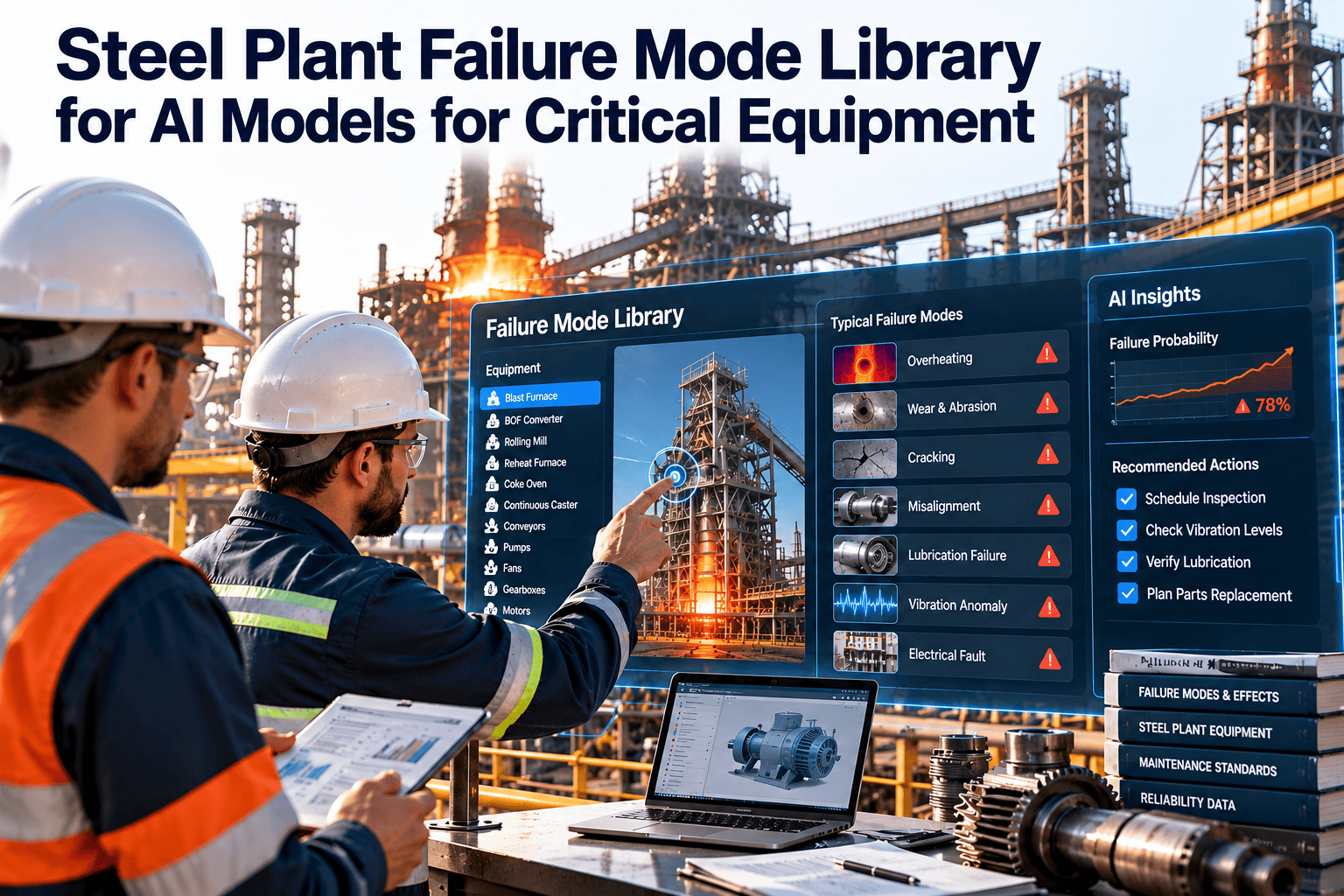
Steel Plant Failure Mode Library for AI Models for Critical Equipment
Checklist for mills, casters, furnaces, cranes and drives
Work through each group, tick what is done and find the gaps that keep predictive models from learning from your maintenance history.
A. Choose critical assets
B. Write each failure mode entry
C. Make records data-ready
D. Label events consistently
E. Map signals by equipment family
F. Validate alerts before trusting them
G. Keep the library alive
How to use this checklist
Why it exists
- The same failure is described in a dozen ways, so it cannot be counted.
- Records show a part was replaced but not why it failed.
- Sensor history cannot be matched to events when IDs and timestamps differ.
- Models trained on noisy labels raise alerts that crews learn to ignore.
How to work through it
- Run it per asset class, starting with the most critical.
- Tick an item only when you can show evidence for it.
- Count ticks at the end to see your readiness band.
- Repeat after major failures or equipment changes.
Checklist A
Choose the equipment that gets a library entry
A library for ten well-chosen asset classes is worth more than a thin list for a thousand. Rank by consequence, history and whether the equipment can be monitored.
- Failure stops the lineNo bypass or spare exists, such as main mill drives, caster drive rolls or furnace transformers.
- Safety or environmental consequenceInjury, fire or release is possible, such as ladle cranes or hydraulics near hot metal.
- Long repair or lead timeLarge gearboxes, work roll chocks and transformers need specialist crews or long deliveries.
- History of repeat failuresPumps, fans and conveyors with recurring faults are good early candidates.
- Signals can be measuredMeasurable signals exist or can be added, as with rotating equipment, drives and hydraulics.
- Ranking is written downThe final list of asset classes, with the reason for each, is stored where the team can see it.
Checklist B
Write each failure mode entry
Every entry should answer the same questions in the same words, so technicians, engineers and models read it the same way.
- Asset class and functionDescribe what the equipment does and where it sits in the process.
- Failure mode in a standard phraseUse a short phrase such as bearing wear or winding insulation breakdown.
- Failure causeRecord the mechanism: lubrication loss, misalignment, contamination or overload.
- Early signals with data sourceList each measurable change, where it is recorded and the usual lead time range.
- ConsequenceState the effect on safety, production, quality and cost.
- Response and ownerLink an inspection, PM task or corrective job with a priority and a named owner.
- As-found data to captureSay what must be recorded at repair, such as measured wear, test values and removed part condition.
Start with the worked example below
The table that follows shows illustrative entries to adapt. Signals and limits depend on your equipment, loads and instrumentation.
Starter failure modes for steel plant equipment
One entry written out in full
Hold assets, failure codes and history in one record
Oxmaint helps maintenance teams manage assets, work orders, inspections, preventive maintenance and reports, giving reliability work a consistent data foundation.
Checklist C
Make records data-ready for AI models
Most model projects stall on data, not algorithms. Confirm these basics for every critical asset before any training starts.
- One unique asset ID everywhereThe same ID appears on work orders, sensor tags and drawings.
- Short controlled failure code listCodes cover mode, cause and effect and are tested with technicians.
- Coded at close-outTechnicians pick the code at the job, not weeks later from memory.
- Failure start and end timesTimes are recorded for the failure itself, not only for the repair.
- Planned, corrective and emergency separatedEach work order is typed correctly when it is created.
- As-found condition recorded firstCondition and photos are captured before parts are removed or discarded.
- Sensor tags mapped to componentsEach tag is tied to the asset and component it describes.
- Changes are logged with datesEquipment modifications, setting changes and duty changes are recorded.
Failures are rare, so every record counts
Serious failures on well-maintained equipment may be too infrequent for a model to learn from alone. Combine your history with engineering knowledge, rules and condition thresholds instead of relying only on statistical learning.
Checklist D
Label events so models can learn
Labeling is a process with owners and checks, not a one-off clean-up.
- Event recordedA failure, near failure or repair is logged on a work order with date and asset.
- Code selectedThe technician chooses mode, cause and effect from the controlled list.
- Engineer reviewA reliability engineer checks unclear or high-consequence records.
- Signals alignedThe event is matched to sensor data for the period before it occurred.
- Near misses includedDefects caught early are recorded as evidence of failure development.
- Monthly spot checkA sample of coded records is checked with the technicians who closed them.
Quality over quantity in labels
A few hundred accurate, well-reviewed event records for critical assets are more useful than thousands of vague ones. Correct patterns that lead to wrong selections.
Checklist E
Map signals for each equipment family
Record the signals you already collect and the ones you would need to add. Always note load and operating state so changes are read in context.
- Rotating equipmentVibration, bearing temperature, lubricant condition, motor current and speed are mapped to each mode.
- Electrical systemsThermography, insulation tests, harmonics, protection relay events and trip logs are linked to assets.
- Hydraulics and coolingPressure, flow, oil cleanliness, filter condition, leak rate, water quality and temperature are tracked.
- Cranes and liftingBrake tests, wear measurements, rope and structural inspection findings are recorded as values.
- Operating contextLoad, product, speed and ambient conditions are stored alongside each reading.
Checklist F
Validate alerts before you trust them
Rules and limits
Fixed thresholds on temperature, vibration or pressure for well-understood modes. Easy to explain and a good first step.
Trend and baseline
Alerts when a measure drifts from its own normal range under similar load. Needs reliable operating context.
Machine learning
Models that combine many signals to estimate risk. Suited to assets with enough labeled failures and stable data.
- Start with rulesSimple limits are tested before any statistical model is added.
- Compare alerts with findingsEach alert is checked against what technicians find at inspection.
- Track confirmed and false alertsThe confirmation rate is reported by asset class.
- Measure warning timeYou know how long before failure a signal was raised.
- Retire models that do not earn trustModels with poor confirmation are tuned or switched off.
Checklist G
Keep the library alive
A library that is not reviewed drifts away from the plant. Tie reviews to events, not only to the calendar.
- Review after major failures and near missesAdd new modes or causes found by root cause analysis.
- Review after equipment changesModifications, replacements and new duties trigger an update.
- Review when alerts cannot be confirmedMisleading alerts point to wrong limits or missing context.
- Yearly review for critical classesA fixed interval catches slow drift.
- Update PM tasks and intervalsFindings that show a task misses a mode change the task.
- Adjust spare part levelsRecurring failures change what must be held in stock.
- Remove tasks for modes that never occurEffort moves to modes that do.
Use FMEA and RCM for depth
FMEA workshops and RCM decisions give structure for the most critical equipment, and taxonomies such as ISO 14224 are a useful reference for naming failure data. Keep the daily library technicians use short and link to the detailed analysis from the asset record.
Working the checklist in practice
Print it or keep it live
Many teams print one copy per asset class for the review workshop, then keep the ticked version with the asset record. Dating each review makes it easy to show how readiness improved and which items stayed open.
Score yourself: readiness bands
Treat the score as a guide
The bands are a rough guide, not a standard. A single missing item, such as unreliable sensor tag mapping, can block a pilot even when most boxes are ticked.
Common pitfalls
- 1
Overlong code lists
Hundreds of codes lead to random selection. Keep lists short and tested with technicians.
- 2
Coding by planners later
Records coded from memory days later are less accurate than those coded at the job.
- 3
Ignoring near misses
Early defects show how failure develops. Record them too.
- 4
Treating AI as a shortcut
Models depend on instrumentation, clean data and engineering review. They do not replace them.
How Oxmaint supports the checklist
- Asset hierarchies so failures can be traced to the right component.
- Work orders with structured close-out fields for cause and findings.
- Preventive and inspection tasks linked to known failure modes.
- Inventory records that show which spares each mode requires.
- Reports on repeat failures, backlog and planned versus reactive work.
- Condition-based and predictive workflows where connected signals are available.
Frequently asked questions
What is a failure mode library?
It is a structured list of how each asset class fails, with causes, early signals, consequences and responses. It gives teams and models a common language for failure.
Which steel equipment should come first?
Begin with assets that stop production or create safety risk, such as main drives, gearboxes, cranes and casting equipment.
Do we need machine learning to benefit?
No. Coded history alone improves PM tasks and spare parts. Models add value once data is clean. You can
book a demo to discuss your data.
How are failure codes captured?
Technicians choose them from a short list when closing a work order. You can
sign up for Oxmaint to set this up for your assets.
How often should the library be reviewed?
After major failures, equipment changes and misleading alerts, and at least yearly for critical asset classes.
Build the data foundation your reliability program needs
Standardize how critical steel plant equipment failures are described, so predictions and maintenance decisions rest on records you can trust.