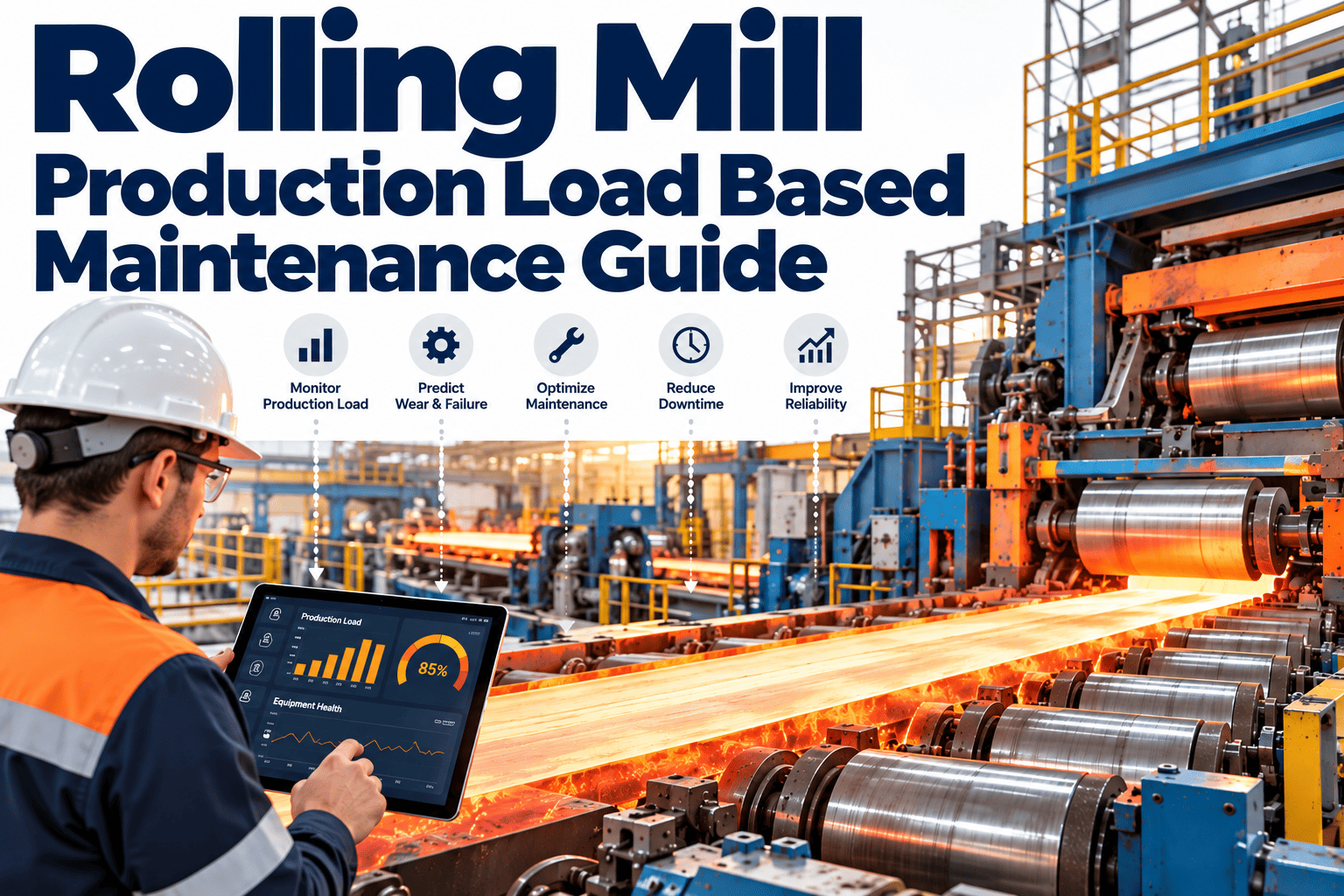
Most rolling mills still schedule bearing changes, gearbox oil drains and roll changes on a fixed calendar, even though the same interval sees wildly different wear depending on whether the mill spent that month rolling high-carbon grades at full speed or running light gauge orders at reduced throughput. Production load based maintenance replaces the fixed date with the actual work the mill has done — tonnes rolled, pass reductions, speed-hours and grade mix — so that intervals stretch or shrink with reality instead of the clock. For steel producers running tandem, reversing or Steckel mills, that shift usually starts with a simple question a CMMS platform such as Oxmaint is built to answer: how much load has this asset actually absorbed since it was last serviced.
Two mills, same calendar, completely different wear
A rolling mill that ran 40,000 tonnes of hard grades last month is not the same asset as one that ran 18,000 tonnes of soft coil, yet a calendar PM plan treats them identically. Production load based maintenance ties service intervals to tonnage, speed, grade hardness and pass load instead of the date on the wall.
Why the calendar and the mill floor disagree
A fixed six-month bearing change or an annual gearbox inspection assumes every interval sees roughly the same duty cycle. Rolling mills rarely work that way — order books shift grade mix week to week, campaign scheduling bunches hard grades together, and speed setpoints change with coil width and gauge target.
The practical result shows up on the shop floor in two directions at once. Reliability teams that pull bearings, drain gearbox oil or change rolls purely on a fixed date routinely find components in good condition during teardown — time and parts spent on an asset that had real life left. In the same plant, a stand that ran an unusually hard campaign between scheduled dates can quietly approach a failure limit weeks before its next calendar-triggered inspection, with nothing in the maintenance plan set up to notice.
- Bearing change fixed at 6 months regardless of tonnage rolled
- Gearbox oil drained on a fixed date, whether the gearbox ran light or hard
- Roll change intervals set by shift count, not surface load absorbed
- Hard-grade campaigns and soft-grade campaigns treated identically
- Healthy components pulled early; stressed components sometimes run past their real limit
- Bearing change triggered by cumulative tonnes rolled plus a vibration confirmation
- Gearbox oil sampled and changed against operating hours weighted by load, not the calendar
- Roll change interval driven by surface revolutions and pass reduction totals
- Hard-grade heats count toward the wear budget faster than soft-grade heats
- Interval length adapts automatically as the order book and grade mix change
The load variables that actually drive wear
A tonnage counter alone is a blunt instrument. The mills that get load based maintenance right combine several production variables into a single wear-weighted picture for each critical asset, rather than watching tonnage in isolation.
Most of this data already exists somewhere in the plant. Level 2 automation systems log tonnage, speed and grade code per coil as a matter of course for quality and yield tracking; the gap is almost never data availability, it is connecting that same feed to the maintenance plan for the specific asset it affects. That connection step is where a CMMS platform earns its place in the workflow, rather than leaving production data and maintenance data as two systems that never talk to each other.
Tonnes rolled since last service
The baseline variable for work roll bearings, backup roll bearings and gearbox internals — every tonne that passes through the stand adds a proportional load contribution.
Grade mix and material hardness
A tonne of high-carbon or alloy steel loads a stand differently than a tonne of low-carbon coil. Weighting tonnage by grade hardness keeps the wear budget honest across a changing order book.
Rolling speed and speed-hours
Higher line speeds raise bearing rotational cycles and gear mesh frequency for the same tonnage, so speed-hours belong in the index alongside raw throughput.
Pass reduction and roll force
Heavier reductions per pass raise separating force on backup rolls, chocks and housing components, which is why AGC cylinder and roll bearing intervals should track cumulative force, not just tonnes.
Reversals and thermal cycling
Reversing mills and Steckel mills subject spindles, couplings and gearboxes to repeated torque reversals — a stand doing 400 reversals a shift wears differently than one running continuous tandem passes.
Matching each asset to its driving variable
Not every component wears against the same variable, which is why a single tonnage counter for the whole mill under-serves some assets and over-services others. The table below maps common rolling mill assets to the production variable that should trigger their maintenance.
| Asset | Primary Load Variable | Typical Load-Based Trigger | Calendar Equivalent It Replaces |
|---|---|---|---|
| Work roll bearings | Tonnes rolled, weighted by grade hardness | Cumulative wear-weighted tonnage plus vibration confirmation | Fixed interval bearing change |
| Backup roll bearings & chocks | Cumulative roll separating force | Force-hours threshold plus oil analysis | Annual teardown inspection |
| Main drive gearbox | Speed-hours under load | Load-weighted operating hours plus oil particle count | Six-month oil change |
| AGC hydraulic cylinders | Pass reduction cycles | Cumulative stroke cycles at force threshold | Fixed-date seal replacement |
| Spindles & couplings | Torque reversals | Reversal count plus torque signature check | Shift-count based inspection |
| Work rolls (grinding) | Surface revolutions and pass reduction | Cumulative barrel wear estimate from revolutions and force | Fixed number of turns between grinds |
From production data to a work order
Building a load-linked PM program is a data pipeline problem before it is a maintenance problem. Production data already exists in the Level 2 automation system — the work is connecting it to the asset record so a threshold crossing turns into a work order without a planner manually checking a spreadsheet.
Tonnage, speed, grade code and pass schedule pulled from Level 2 per coil or heat
Variables weighted and summed against each asset's wear budget
Running total checked against the asset's calibrated trigger point
CMMS auto-generates the job, reserves inventory and notifies the crew
A simple composite load index
Most mills that move off the calendar do not need a complex model to start — a weighted composite index that reliability engineers can calibrate against their own failure history is enough to replace a fixed date with a load-driven trigger.
A stand that rolls 25,000 tonnes of soft coil at moderate speed might sit well under its bearing threshold, while a stand that rolls 15,000 tonnes of high-carbon grade at full speed with heavy reductions can cross the same threshold weeks earlier. Only a load index, not a date, catches that difference, and only a system that recalculates the index automatically as each coil finishes can keep the comparison current without adding manual work for a planner.
KPIs that tell you the program is actually working
Switching from a calendar to a load index is not a one-time configuration exercise — the thresholds need to be watched and adjusted as real outcomes accumulate. A handful of metrics tell reliability teams whether the index is calibrated correctly or needs tightening.
| Metric | What It Tells You | Signal to Recalibrate |
|---|---|---|
| Unplanned bearing failures per quarter | Whether the load threshold is set too loose | Any failure before the index reaches trigger level |
| Components pulled with significant remaining life | Whether the threshold is set too tight | Consistent teardown findings of healthy condition well ahead of the threshold |
| Mean time between load-triggered work orders | How the interval is actually behaving against the real order book | Wide swings that suggest the weighting factors need adjustment per grade |
| Condition-monitoring confirmation rate | How often a load trigger is backed up by a real vibration or oil signal | A falling confirmation rate suggests the index is drifting from actual wear |
| Emergency work orders avoided | The direct value case for the program | Tracked against the previous calendar-based baseline each quarter |
Common pitfalls when moving off the calendar
Plants that stall midway through this transition tend to run into the same handful of issues, most of which are process gaps rather than technology gaps.
Treating the whole mill as one tonnage counter
A single mill-wide tonnage figure hides which stand actually absorbed the load. Each stand, and ideally each bearing position, needs its own running index rather than sharing one number across the line.
Skipping the condition-monitoring cross-check
A load index tells you when to look, not that a failure is guaranteed. Removing the vibration or oil-analysis confirmation step turns a smart trigger into a slightly smarter calendar.
Leaving grade weighting factors static forever
A weighting factor calibrated during one order-book mix will drift as the product mix shifts. Reliability engineers should revisit factors at least once a campaign against actual teardown findings.
Running parallel systems indefinitely
Some plants keep the old calendar plan active "just in case" alongside the new load triggers, which doubles the paperwork and confuses the crew about which work order is authoritative. Retire the calendar plan once the load index has proven itself over a full campaign.
Stop replacing healthy parts on the same date as worn ones
Connect production data to your asset register and let tonnage, speed and grade mix set the maintenance schedule instead of the calendar.
What a CMMS needs to support load-based PM
Before a mill can retire its calendar-based PM plan, the CMMS layer underneath it has to support a few specific capabilities. This is the checklist reliability teams should work through before flipping the switch.
Skipping any one of these items tends to show up quickly as either a flood of premature work orders or, worse, a threshold that never trips because the underlying data feed silently stopped updating. Building the checklist into the initial rollout, rather than discovering the gaps after go-live, is what separates a load-based program that sticks from one that quietly reverts back to the calendar within a year.
Oxmaint's CMMS is built to carry this kind of hybrid program without a custom data-science build. Production variables feed into the asset record, thresholds are configured per component family, and a crossing writes a draft work order with the right parts and priority attached — the same inspection, oil-sample and condition data that already exists on the mill floor becomes the trigger instead of a date on a wheel chart.
Frequently Asked Questions
Do we need to replace our condition monitoring program to run load-based PM?
No — production load based maintenance works alongside vibration analysis, oil analysis and thermography. The load index sets when to look; condition data confirms whether a job should actually happen.
Which rolling mill components benefit most from a load-linked trigger?
Work roll and backup roll bearings, main drive gearboxes, AGC hydraulic cylinders and spindle couplings see the biggest gap between calendar and actual wear, since their duty cycle swings hardest with grade mix and speed.
How is a load index different from just tracking total tonnage?
Raw tonnage ignores hardness, speed and force. A composite index weights tonnes by grade and pass severity so two batches of equal tonnage can register very different wear contributions.
Can Oxmaint pull production data automatically instead of manual entry?
Yes — production variables can be integrated from Level 2 automation into the asset record, and thresholds can be configured per component so triggers fire without a planner tracking spreadsheets. Book a Demo to see it mapped to your mill.
How do we set the first threshold if we have no failure history to calibrate against?
Start with the OEM's calendar interval converted into an equivalent tonnage and speed-hour figure, then tighten or loosen the threshold as inspection and condition data accumulate over the first few campaigns.
Let production data set the next PM date, not the wall calendar
Move your critical stands onto tonnage, speed and grade-weighted maintenance triggers with Oxmaint.
Free trial available · No credit card required