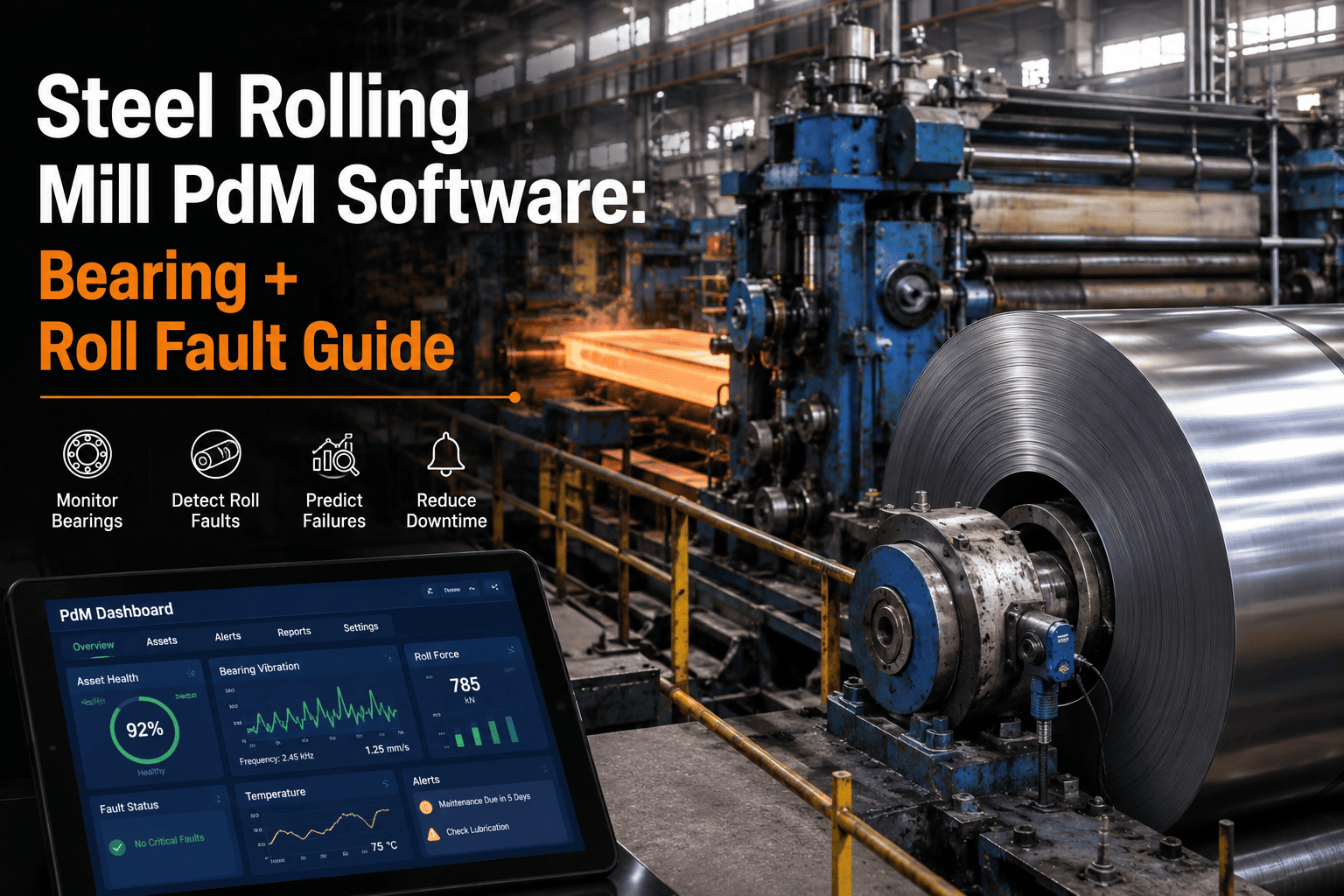
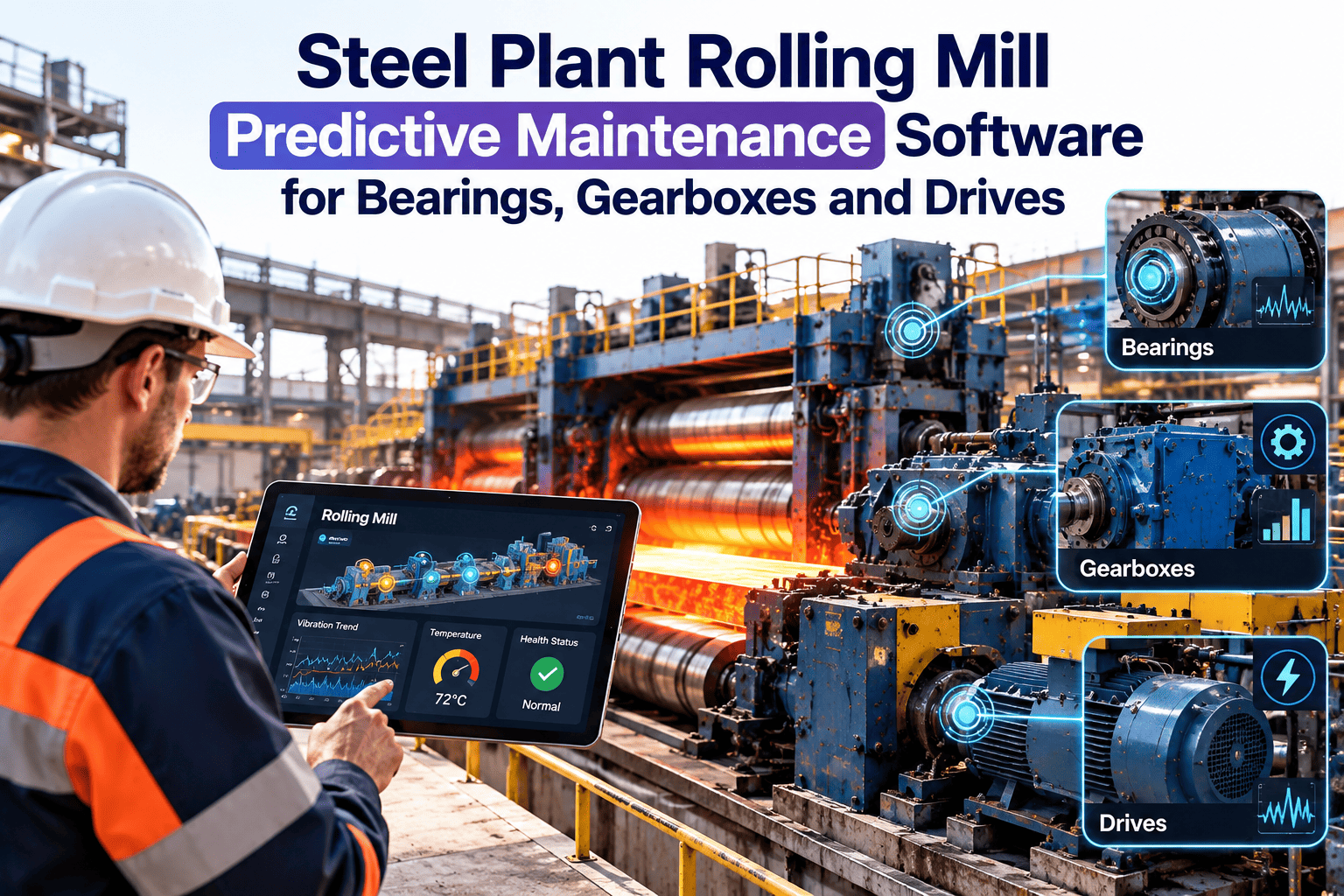
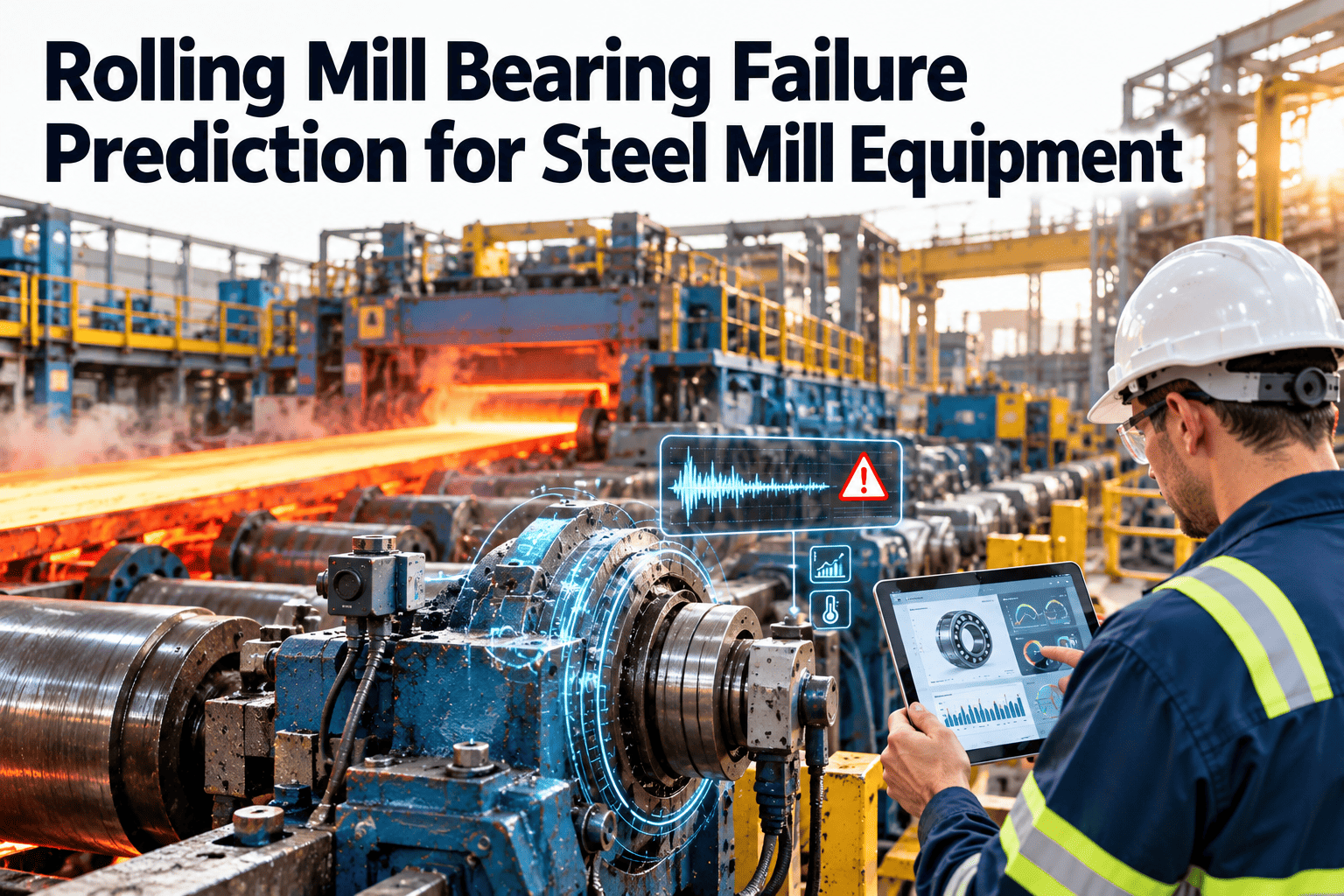
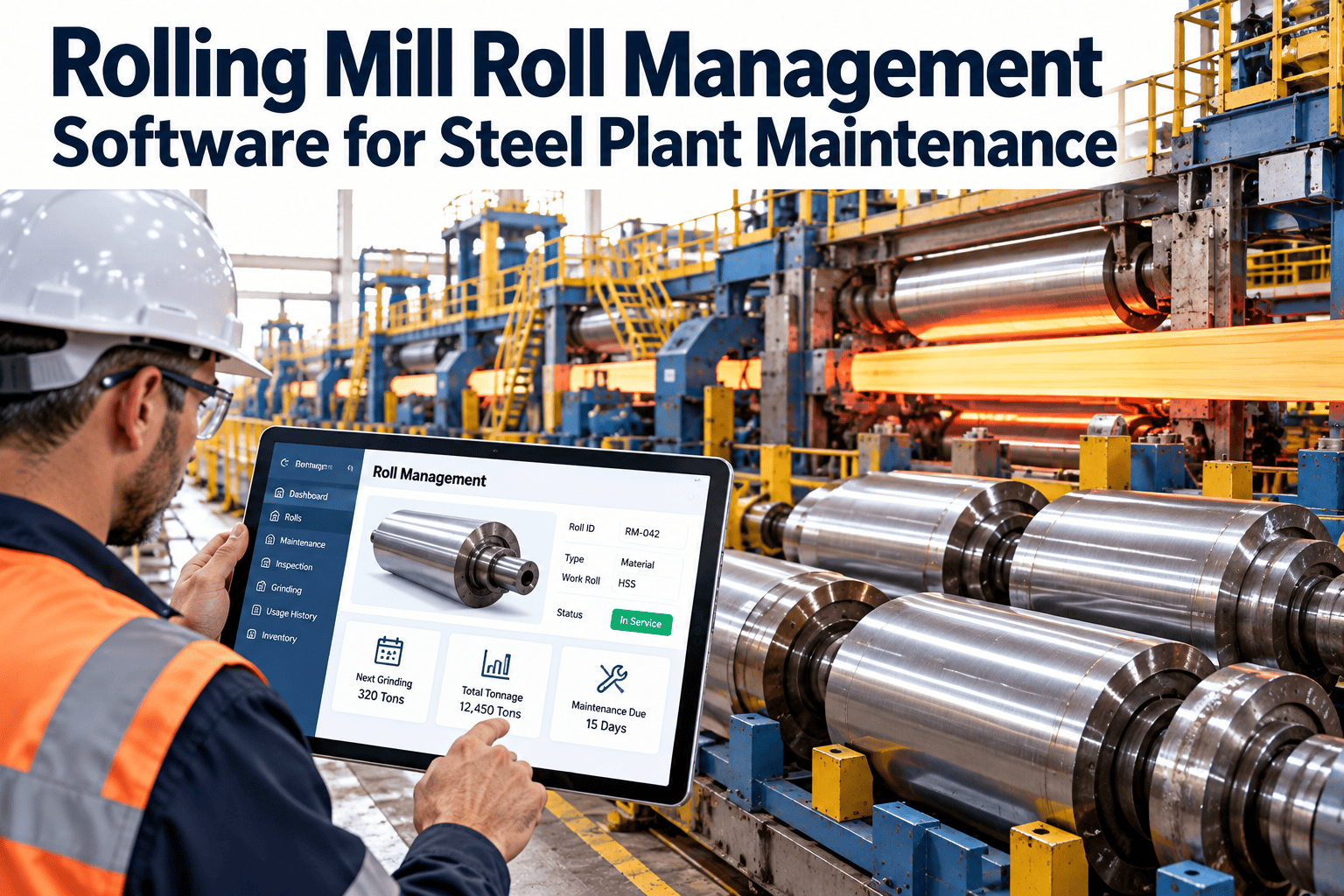
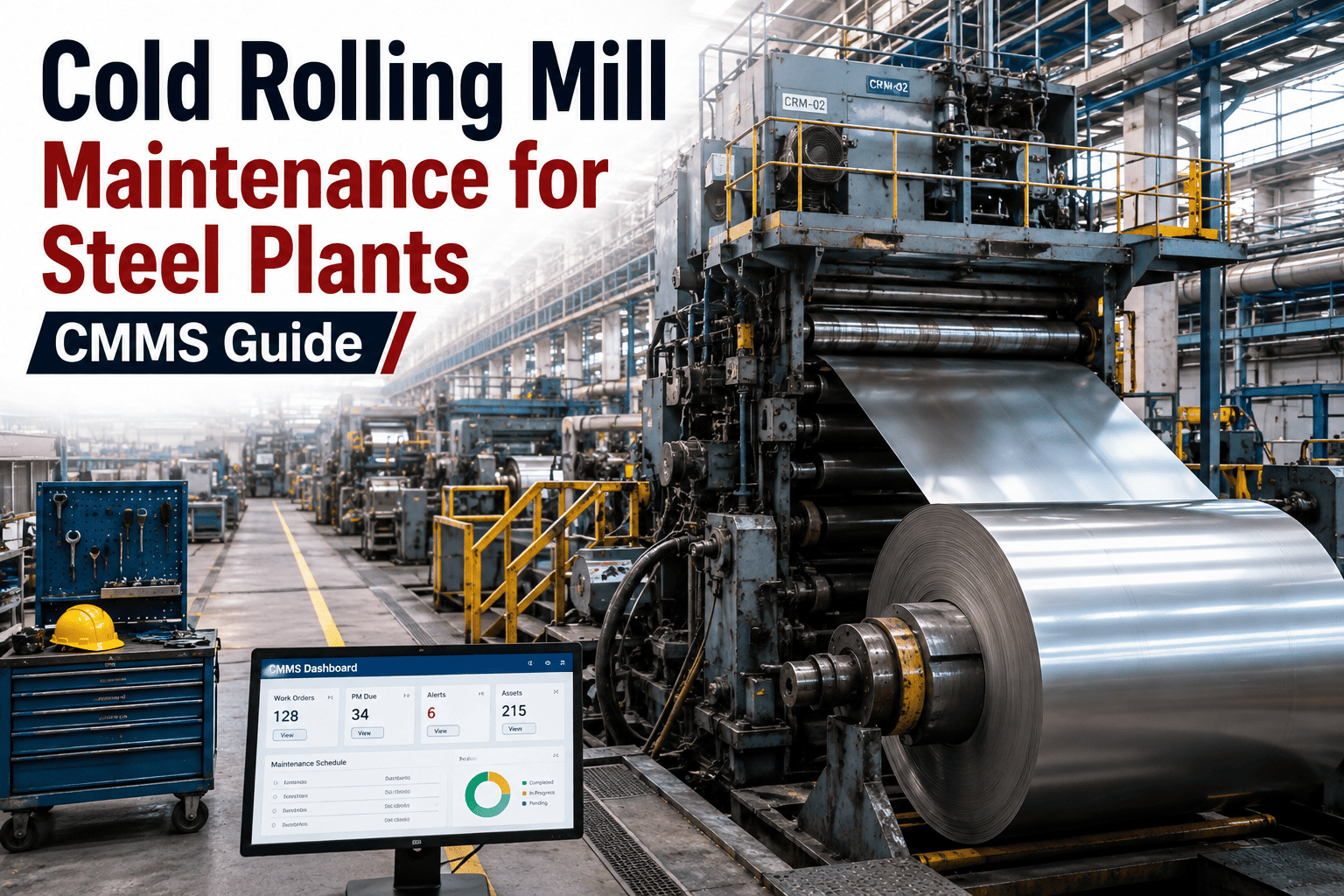
A work roll bearing rarely fails without warning — it fails without anyone reading the warning. Steel rolling mills run some of the highest-load, highest-speed rotating equipment in any industrial plant, and the bearing defect frequencies that predict a failure show up in vibration data weeks before a roll change turns into an unplanned mill stoppage. The gap is not sensor coverage; most mills already have accelerometers on the housings. The gap is a system that turns raw vibration and thermal readings into a scheduled roll or bearing change before the defect propagates into a spall, a roll bite disruption, or a burned-out mill housing bearing. Predictive maintenance done right on a rolling mill is the difference between a planned bearing swap during a scheduled roll change and a mill down for six hours mid-campaign. See how that discipline gets built with a free trial of OxMaint.
68%
Of rolling mill bearing failures show a detectable vibration signature 3+ weeks before failure
₹52L+
Average cost of an unplanned mill stand stoppage including lost rolling time and rework
5.3x
Higher repair cost when a bearing is allowed to fail versus a scheduled planned replacement
30%+
Reduction in unplanned mill downtime reported by plants running structured PdM programs
Fault Signatures
The Four Bearing Fault Frequencies Every Rolling Mill PdM Program Should Be Tracking
Every rolling element bearing has four characteristic defect frequencies, each pointing at a different failing component inside the bearing. Reading which frequency is rising in the vibration spectrum tells the maintenance team exactly what is wearing out — and how much running time is left before it needs attention.
BPFO
Ball Pass Frequency Outer Race
Rising amplitude at this frequency signals outer race spalling — the most common failure mode on work roll bearings carrying heavy radial load.
BPFI
Ball Pass Frequency Inner Race
Points to inner race pitting, typically progressing faster than an outer race fault because the inner race sees load on every rotation.
BSF
Ball Spin Frequency
Indicates rolling element damage — chipped or flattened balls or rollers, often linked to contamination entering the bearing housing.
FTF
Fundamental Train Frequency
Flags cage wear or slippage, which if ignored accelerates every other defect frequency by allowing rolling elements to move erratically.
OxMaint · Bearing Fault Tracking
Turn a Rising Fault Frequency Into a Scheduled Work Order, Not a Guess
OxMaint links vibration readings from work roll, back-up roll, and mill housing bearings directly to the asset record, tracks the trend against baseline, and raises a work order automatically when a defect frequency crosses your alert threshold.
Bearing Coverage
Three Bearing Zones on Every Mill Stand — And What Each One Is Trying to Tell You
01
Work Roll Bearings
Carry the direct rolling load and see the fastest wear cycle of any bearing on the stand. Vibration readings should be taken every shift on high-speed finishing stands, since a work roll bearing fault can propagate into a roll bite disruption within hours once it starts.
02
Back-Up Roll Bearings
Support the work roll under total rolling force and run at lower speed but far higher radial load. Thermal drift on a back-up roll bearing housing is often the first sign of an oil film breakdown, ahead of any vibration change.
03
Mill Housing Bearings
Anchor the entire stand structure and fail less often, but a housing bearing failure takes the whole stand down for a structural repair rather than a roll change, making early detection here disproportionately valuable.
Roll Fault Classification
Reading Roll Surface Faults — From Light Spalling to Campaign-Ending Damage
Roll surface condition and bearing condition are read together, because a worsening bearing fault frequently shows up first as a surface defect on the roll itself. The table below is the classification most mill technicians use to decide whether a roll change waits for the scheduled campaign end or happens now.
OxMaint · Roll Change Scheduling
Match Every Roll Change to the Fault Data, Not the Calendar Alone
OxMaint logs surface condition ratings alongside vibration trend data per roll, so scheduling a roll change becomes a data decision — plan it into the next campaign end when the fault is early, or pull it forward the moment the signal says otherwise.
The OxMaint Advantage
How OxMaint Runs Rolling Mill PdM Without Adding Work to the Technician's Day
Baseline-Referenced Trending
Every bearing gets a baseline vibration signature at commissioning or after a rebuild. All future readings are compared against that specific bearing's baseline rather than a generic threshold.
Automatic Work Order Generation
A defect frequency crossing its alert threshold raises a work order tied to the exact stand, bearing position, and fault type — no manual review step required to catch it.
Roll Change History Per Position
Every roll change is logged against the stand position with the surface condition and vibration data that triggered it, building a failure pattern library specific to your mill's operating conditions.
Downtime Cost Avoidance Log
Every planned bearing or roll change completed ahead of a failure is logged against the unplanned stoppage cost it avoided, giving reliability engineers a running record to justify the PdM program.
Impact
What Rolling Mills Report After a Structured PdM Rollout
30%+
Reduction in unplanned mill stand downtime within two quarters
2.4x
Longer average bearing service life with baseline-referenced trending
₹2Cr+
Typical annual saving from avoided unplanned stoppages on a hot strip mill
3+ wks
Average early warning window between first fault signal and prior failure point
Reliability Team Questions
Rolling Mill PdM — What Reliability Engineers Ask Before Rollout
How much vibration history is needed before a bearing baseline is reliable?+
Most mills establish a usable baseline after four to six weeks of readings taken on a consistent schedule following commissioning or a bearing rebuild.
OxMaint stores this baseline per bearing position so it carries forward automatically after every replacement.
Which bearing position fails most often on a hot strip mill?+
Work roll bearings on the finishing stands typically show the highest failure frequency due to combined high speed and cyclic load. Back-up roll bearings fail less often but each failure carries a longer repair time because of the larger bearing size involved.
Does thermal monitoring add anything vibration analysis does not already catch?+
Yes. Oil film breakdown and lubrication starvation often show up as rising housing temperature before the vibration spectrum changes meaningfully. Tracking both together closes the detection gap for lubrication-related failures specifically.
Can PdM data actually change when a roll change is scheduled?+
That is the core value of tracking fault data against a classification table rather than a fixed calendar interval. An early-stage fault can safely wait for the next campaign end, while an advancing spall with a sudden amplitude spike should move the change forward immediately.
How do we get started with rolling mill PdM without a full sensor overhaul?+
Start with the finishing stand work roll bearings, since they show the fastest fault progression and the highest downtime cost if missed. Most existing vibration sensors can feed directly into a tracking system.
Book a demo to map your current sensor coverage against this rollout order.
OxMaint · Rolling Mill Reliability
The Bearing Fault Is Already in Your Data — Make Sure It Reaches a Work Order
Vibration and thermal readings on your mill stands already carry the warning. OxMaint turns that warning into a baseline-referenced trend, an automatic work order, and a roll change scheduled on data instead of a guess — before the next unplanned mill stoppage happens.