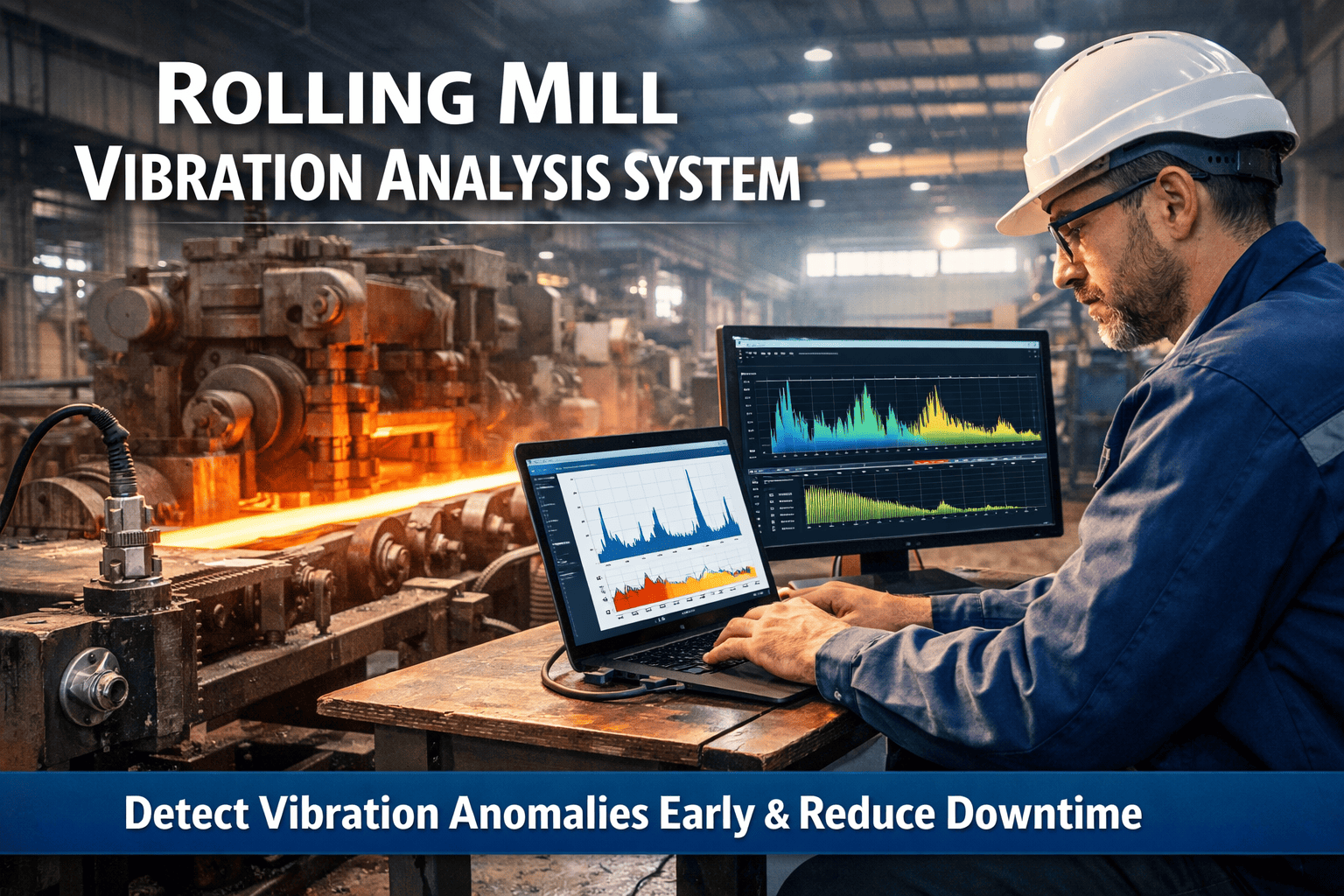
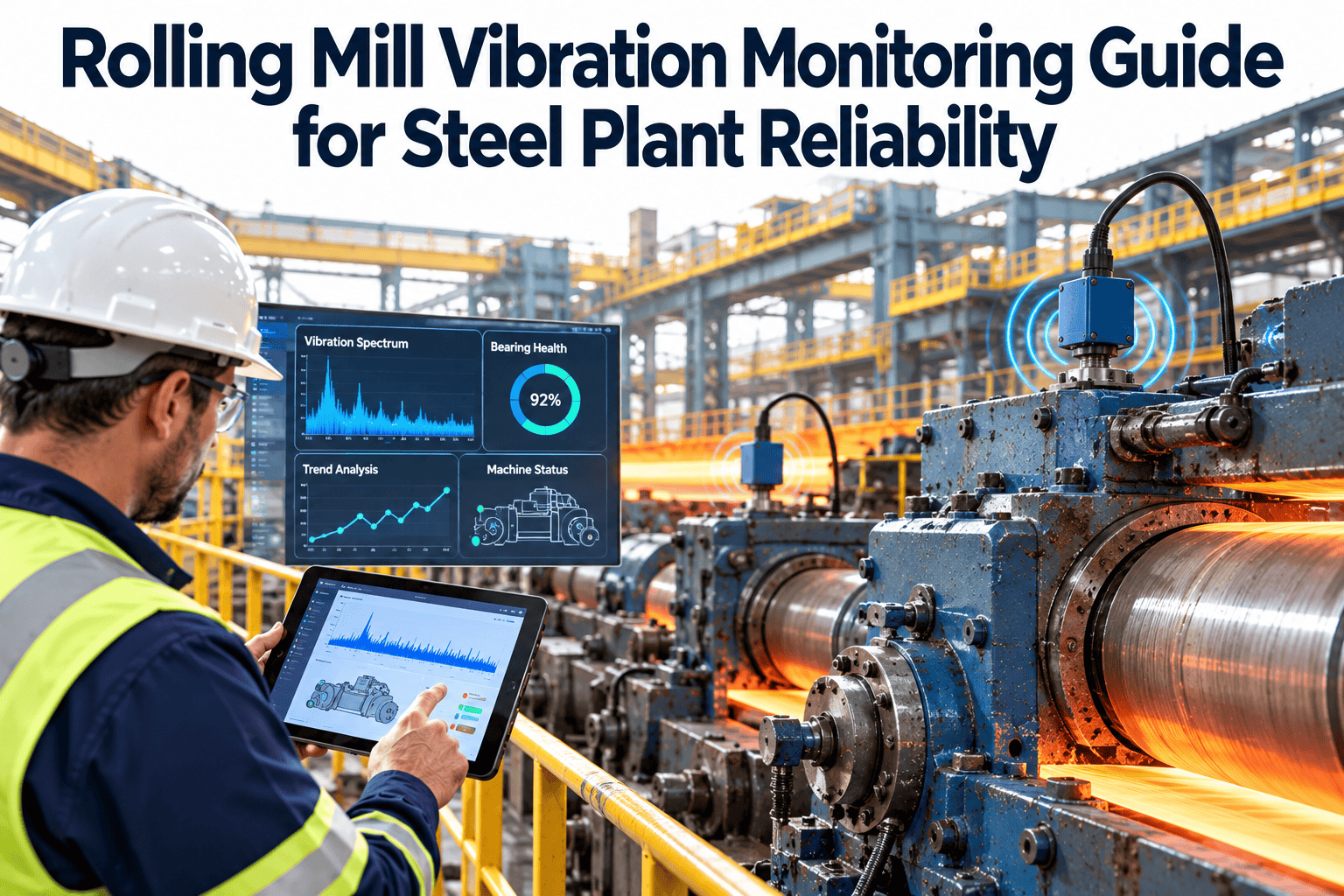
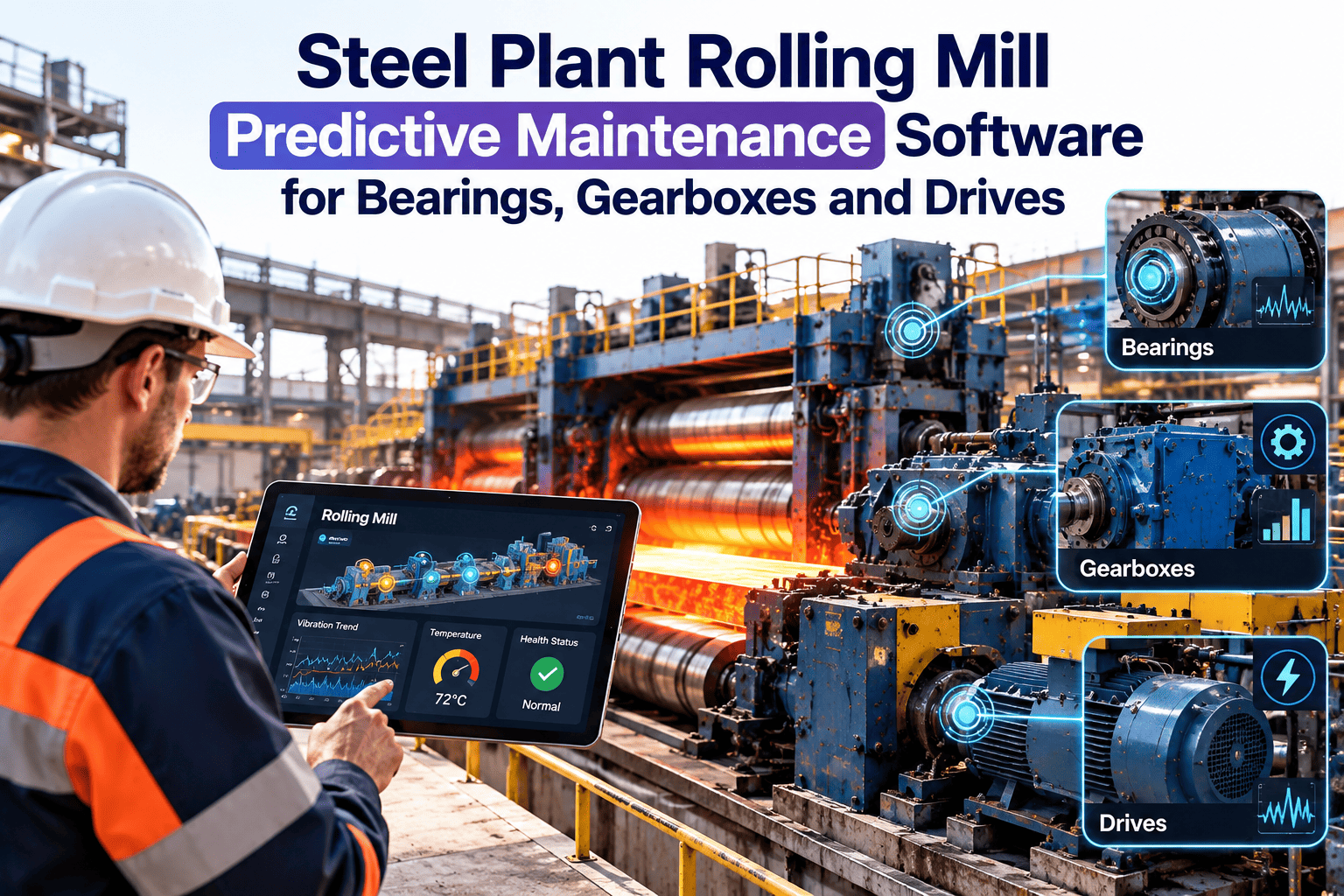
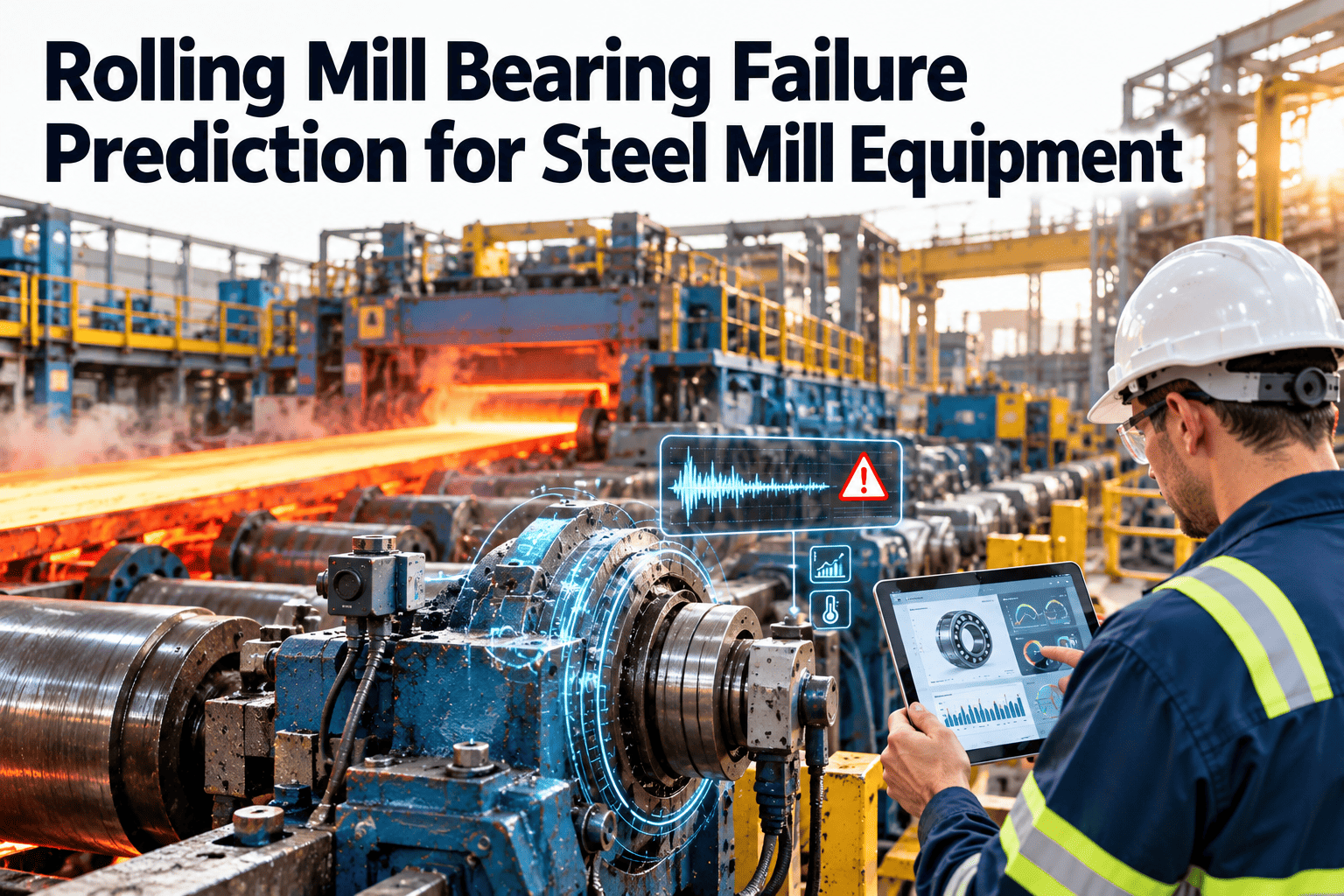
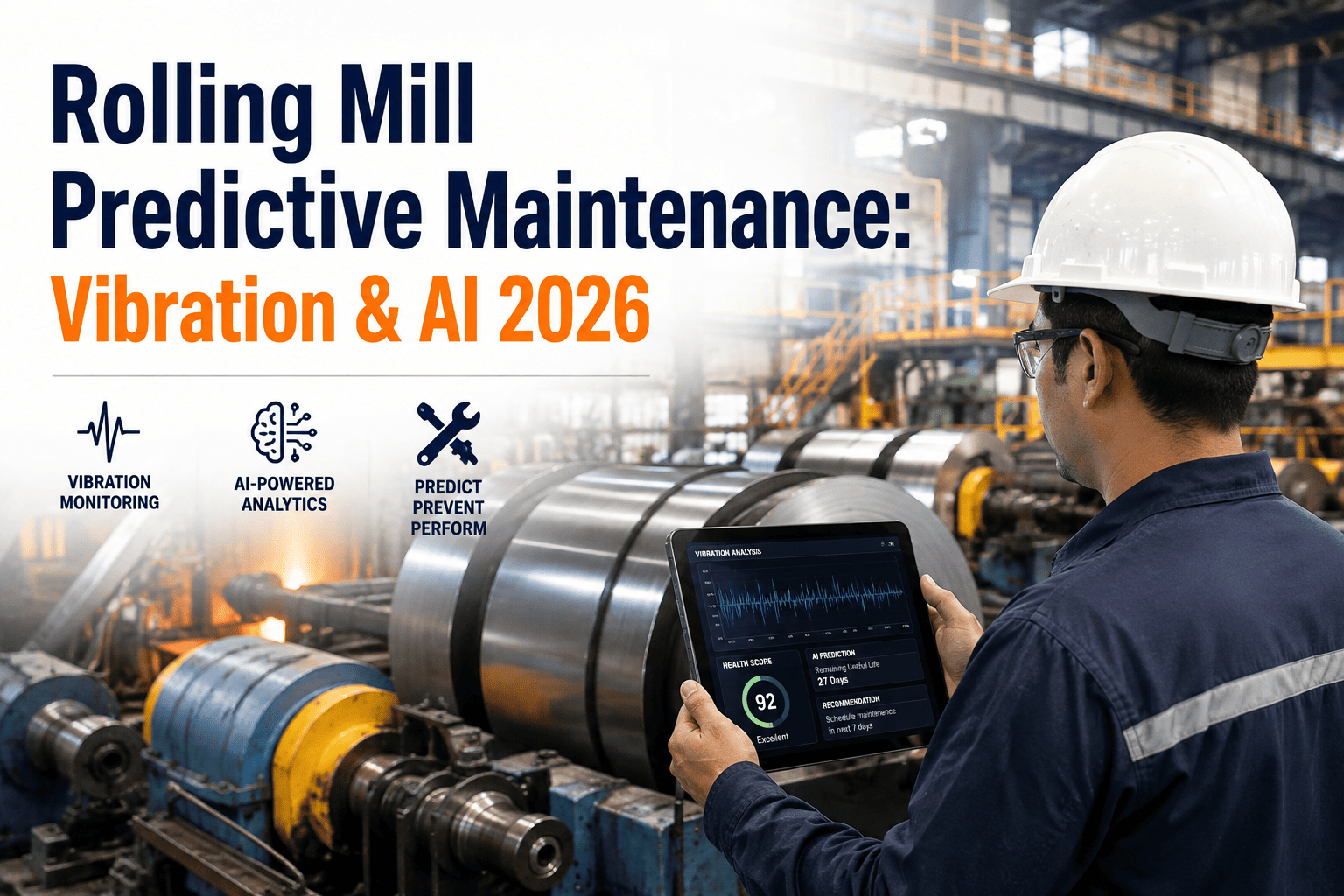
A hot rolling mill finishing stand processes steel at speeds exceeding 1,000 metres per minute through seven stands operating within ±0.02mm dimensional tolerance — while every backup roll bearing, pinion gearbox, motor drive, and hydraulic AGC system is subjected to extreme mechanical load, thermal stress, and vibration. A single unplanned stand failure stops the entire mill for 8–72 hours at $6,000–$12,000 per hour in lost production. A skilled mill mechanic can hear a bad bearing and feel excessive vibration. AI vibration analysis detects the same bearing defect 6 weeks before the mechanic can hear it — because the earliest failure signatures exist in frequency domains that human senses cannot perceive. OxMaint's vibration analytics engine monitors continuous FFT spectra, bearing defect frequencies, gear mesh harmonics, and motor current signatures across every critical rolling mill asset — auto-generating work orders the moment AI confidence crosses the threshold, with the diagnosis, recommended parts, and optimal maintenance window already attached.
Predictive Maintenance · Steel Industry
Rolling Mill Vibration Analysis System
Detect Faults 3–8 Weeks Early. Prevent $6,000–$12,000/hr Mill Stops.
Continuous FFT spectral analysis, AI bearing defect frequency tracking, gear mesh monitoring, and motor current signature analysis — connected to your existing sensor infrastructure and producing CMMS work orders automatically when fault thresholds are crossed.
6 weeks
advance warning before a bearing failure reaches the stage a mechanic can hear it
90–95%
AI fault detection accuracy for bearing defects and imbalance
$420K
saved vs $85K planned — catastrophic gearbox failure cost comparison
40%
reduction in unplanned downtime with continuous vibration monitoring
3–6 wks
P–F interval for industrial bearings — minimum detection window for scheduling
What AI Vibration Analysis Finds That Manual Inspection Misses
Manual Inspection — Week 0
Bearing sounds normal. No perceptible vibration increase. Temperature reading 62°C — within normal range. Passed routine inspection.
OxMaint AI — Same Week
BPFO frequency amplitude increased 42% over 45 days. Overall vibration still within "normal" band, but bearing-specific defect frequency shows exponential growth characteristic of outer race spalling. Temperature rate-of-rise: +0.3°C/week. At current progression rate, functional failure estimated in 5–7 weeks.
Work order generated: Replace F3 backup roll bearing within 4 weeks. Repair during planned stop: 6 hours, $85K. Emergency failure cost: $420K + 5-day mill stop.
Manual Inspection — 8 Weeks Earlier
Gearbox operating normally. Oil sample taken — iron content 18 ppm, within acceptable range. No unusual noise. Vibration levels acceptable.
OxMaint AI — Same Period
Gear mesh frequency sidebands appeared 8 weeks ago and are increasing at consistent rate. Online oil particle counter shows iron content rising from 18 to 34 ppm over same period. Vibration pattern matches Stage 2 gear tooth pitting. Estimated 8–14 weeks to gear tooth fracture if load maintained.
Work order generated: Schedule gearbox inspection at next planned shutdown (6 weeks). Order replacement gear set now — 8-week lead time. Reduce F1 load 10% until inspection confirms severity.
Fault Types — Detection Method and Warning Window
| Fault Type |
Detection Method |
Frequency Signature |
ISO Severity Metric |
Typical Warning |
| Outer race bearing defect (BPFO) |
Envelope analysis, high-frequency demodulation |
BPFO harmonics with sidebands at shaft frequency |
ISO 10816-3 velocity (mm/s) |
3–8 weeks |
| Inner race bearing defect (BPFI) |
Envelope analysis, cepstrum |
BPFI with ±shaft speed sidebands |
Kurtosis, overall RMS |
2–6 weeks |
| Shaft imbalance |
1× running speed amplitude trending |
Dominant 1× component, radial direction |
ISO 10816-3 displacement (µm) |
Weeks–months |
| Shaft misalignment |
2× and 3× harmonic pattern, axial component |
Elevated 2× radial + high axial at 1× and 2× |
ISO 10816-3, axial:radial ratio |
Weeks |
| Gear tooth pitting / wear |
Gear mesh frequency (GMF) sideband analysis |
GMF + sidebands at ±shaft speed; rising amplitude |
GMF/sideband ratio trending |
4–12 weeks |
| Mechanical looseness |
Sub-harmonic and super-harmonic pattern |
0.5× to 3× running speed harmonics |
Broad frequency energy increase |
Days–weeks |
| Roll eccentricity / surface defect |
1× roll rotation frequency amplitude |
1× per roll revolution — dominant in product gauge data |
Gauge variation correlation |
Detectable each pass |
AI Detects What Manual Inspection Cannot. Work Orders Created Before Anyone Notices a Problem.
OxMaint converts FFT spectral anomalies into P1–P4 priority work orders automatically — with bearing ID, fault type, recommended parts, and optimal window relative to the production schedule.
Asset Coverage — Rolling Mill Monitoring by Equipment Class
Backup & Work Roll Bearings
Fault modesBPFO/BPFI/BSF/FTF defects, race spalling, cage fracture, lubrication starvation
SensorsAccelerometers at bearing housing (H/V/A), temperature sensors per bearing
DetectionEnvelope analysis, BPFO/BPFI/BSF/FTF frequency tracking, kurtosis trending
FrequencyContinuous online — 25.6 kHz sampling, FFT every 60 seconds
Main Drive Gearboxes
Fault modesGear tooth pitting, root crack, micropitting, bearing defects within gearbox, lubrication degradation
SensorsTriaxial accelerometers on gearbox housing, oil particle counters, temperature
DetectionGMF sideband analysis, cepstrum, oil iron ppm trend correlation with vibration signature
Warning window4–12 weeks for gear tooth pitting; oil analysis adds independent confirmation
Main Drive Motors
Fault modesRotor imbalance, winding faults, rotor bar cracking, bearing defects, shaft misalignment
SensorsVibration sensors at drive end and non-drive end, motor current signature analysis (MCSA)
Detection1× imbalance at running speed, electrical frequency sidebands in MCSA, demodulated current spectrum
Special capabilityMCSA detects rotor bar faults and winding asymmetry without mechanical sensor — from existing drive instrumentation
AGC Hydraulic Systems
Fault modesServo valve response degradation, cylinder seal wear, pump cavitation, accumulator pressure loss
SensorsServo valve position response time, hydraulic pressure sensors, flow meters
DetectionResponse time trending from valve position command to completion — degradation visible in ms before gauge variance appears
ExampleAGC servo valve response degraded 58% — detected 9 days before scheduled roll change with parts in stock
Bearing Failure Stages — When AI Detects vs. When Humans Notice
Stage 1
Subsurface micro-cracks
AI: Detects via high-frequency envelope analysis (250kHz+)
Human: Undetectable
Lead time: 1–3 months
›
Stage 2
Surface pitting, BPFO visible
AI: BPFO/BPFI frequencies visible in envelope spectrum
Human: Undetectable without FFT
Lead time: 1–4 weeks
›
Stage 3
Harmonics + sidebands, audible
AI: Full defect frequency set with harmonics — urgency classification
Human: Experienced mechanic hears defect
Lead time: Days–2 weeks
›
Stage 4
Catastrophic failure
AI: Shutdown recommendation issued 4–8 weeks earlier
Human: Emergency response
Cost: $420K+ + mill stop
"
The fundamental problem with threshold-based vibration alarms on rolling mills is not false negatives — it is false positives. A mill going from rolling to idle generates a vibration change that looks alarming in a simple threshold system but is completely normal. When your alarm system cries wolf three times a shift, operators stop trusting it. What AI load-normalisation does is compare the vibration signature against what is expected at the current rolling force, roll speed, and temperature — not against a static threshold. When the signature deviates from what the model predicts for those conditions, that is a genuine signal. The result is dramatically fewer false positives, which means the alarms that do fire get acted on immediately instead of being dismissed as another threshold crossing. That change in operator trust is where the measurable downtime reduction actually comes from.
Marcus Eidenschink, B.Eng (Mechanical), CRL
Maintenance Manager — voestalpine Stahl GmbH (Linz) · 21 Years Steel Plant Maintenance Management · Certified Reliability Leader (SMRP) · Specialist in rolling mill predictive maintenance, vibration analysis programme deployment, and condition-based maintenance for tandem cold mills and hot strip mills
Frequently Asked Questions
How does OxMaint handle vibration data from rolling mills where load varies constantly between rolling and idling?
Load variation is the primary cause of false alarms in simple threshold-based vibration monitoring on rolling mills — the vibration signature at full rolling load looks completely different from the same bearing at idle. OxMaint's AI correlates every vibration reading with the concurrent rolling force, roll speed, and temperature from the Level 2 process system, comparing each measurement against what the model predicts for those exact conditions. The alarm is triggered by deviation from the predicted signature at current conditions — not by crossing a static threshold. This load-normalisation model requires 4–8 weeks of historical data to train, after which false positive rates drop to levels that maintain operator trust and ensure alarms are acted on.
Book a demo to see load-normalised vibration analysis for your mill configuration.
What sensor hardware does OxMaint require on a rolling mill, and does it integrate with existing accelerometers?
OxMaint integrates with existing accelerometers, vibration transmitters, and condition monitoring hardware via OPC-UA, Modbus TCP, and direct database connections. For mills with existing continuous monitoring hardware from vendors such as SKF, Emerson, Schaeffler, or Brüel and Kjær, OxMaint adds the AI analytics and CMMS work order layer over the existing data streams without replacing sensor hardware. For mills starting from a lower sensor coverage baseline, OxMaint supports deployment of wireless MEMS accelerometers with 25.6 kHz sampling — mountable at bearing housings without instrumentation shutdown. The minimum viable coverage for predictive bearing protection is two sensors per stand (drive end and non-drive end of the most critical bearing locations) with continuous sampling.
Start your free trial to assess your current sensor coverage against OxMaint's rolling mill monitoring requirements.
What is the difference between overall RMS vibration monitoring and spectral FFT analysis for rolling mill maintenance?
Overall RMS monitoring tells you something is wrong — the broadband vibration level exceeds baseline. FFT spectral analysis tells you exactly what and where: outer race bearing defect at Stand 3 drive end, gear mesh frequency sidebands in the F1 gearbox, or rotor imbalance on the main motor. Broadband RMS trending is the correct tool for real-time alarm triggering; FFT spectrum analysis is the correct tool for diagnosis and fault-type classification. OxMaint uses both simultaneously — broadband RMS for immediate threshold triggering and automated fault classification from the FFT spectrum for work order generation with specific diagnosis. ISO Category II analysis, which OxMaint's AI replicates for common fault types, typically requires 40+ hours of analyst training — the AI makes this level of diagnosis available on every monitored asset without requiring a certified vibration analyst on every shift.
How quickly does OxMaint generate a work order from a vibration alert, and what does the work order contain?
When AI confidence in a fault classification crosses the configured threshold (default: 85%), OxMaint generates a CMMS work order automatically within 30 seconds of the detection event. The work order contains: asset identifier and bearing/component location, fault type classification (BPFO, BPFI, GMF sideband, imbalance, etc.), severity and trend data showing the rate of degradation over the preceding weeks, recommended maintenance action and required parts with part numbers from the asset's spare parts record, priority based on asset criticality and estimated time to functional failure, and the vibration spectral data file attached for the technician's reference. A technician receiving this work order arrives at the asset with a specific diagnosis, the right parts staged, and a scheduled window — not a vague "bearing noise — investigate" entry on a paper job card.
Rolling Mill Vibration Analytics — OxMaint
Detect Every Bearing Defect. Prevent Every Mill Stop That a Work Order Could Have Prevented.
OxMaint's vibration analytics engine monitors continuous FFT spectra across every rolling mill bearing, gearbox, motor, and hydraulic system — generating auto-diagnosed, parts-ready work orders the moment AI confidence confirms a developing fault, weeks before it becomes a production emergency.