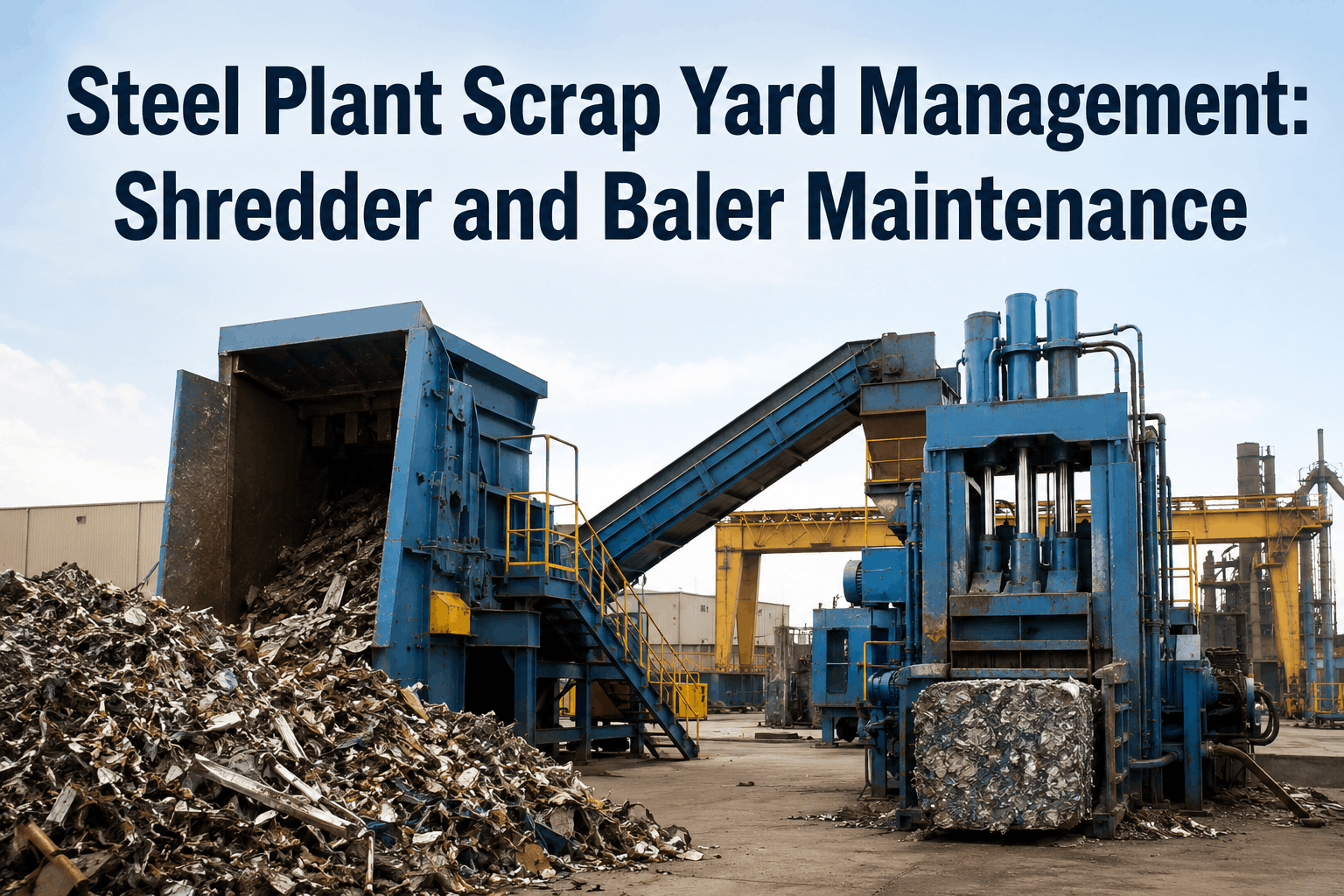
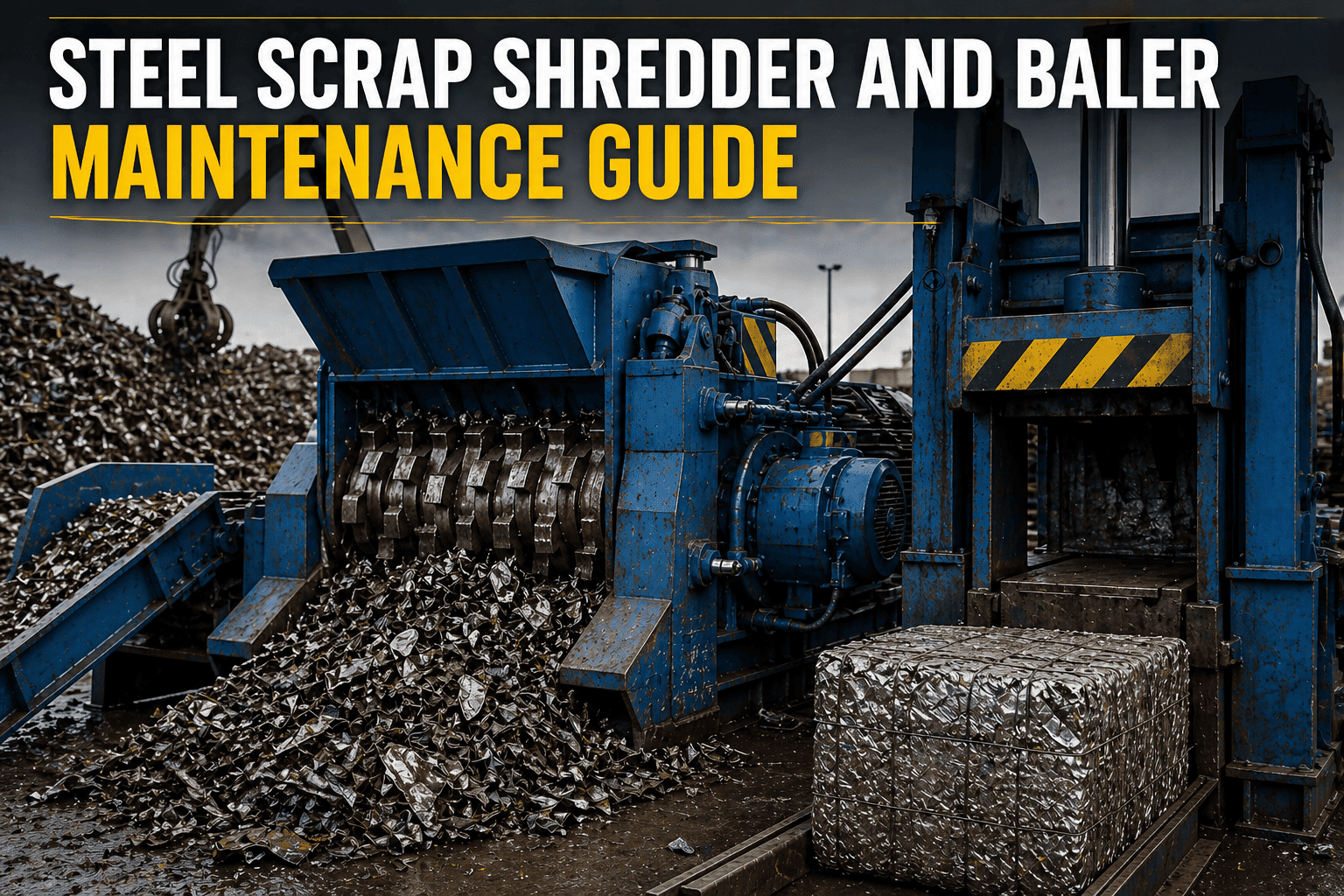
Steel Plant Scrap Yard Management: Shredder and Baler Maintenance
By Alex Jordan on June 18, 2026
A steel plant scrap yard is the starting point of the electric arc furnace (EAF) steelmaking process — and the reliability of scrap processing equipment directly impacts furnace productivity. A shredder breakdown can halt scrap processing, starving the EAF of feedstock and forcing production curtailment at $500,000–1,000,000 per day in lost output. Yet shredders, balers, magnets, and scrap cranes are often maintained reactively — technicians wait for a hammer to break or a cylinder to leak before acting. Start a free trial with Oxmaint to schedule and track scrap yard maintenance, or book a demo to see how steel mills use Oxmaint's scrap yard module to keep shredders running and EAF feed uninterrupted.
SCRAP YARD · SHREDDER · BALER · STEEL MILL · 2026
Steel Plant Scrap Yard Management: Shredder and Baler Maintenance for Uninterrupted EAF Feed
Shredder hammer replacement, baler cylinder maintenance, scrap crane reliability, magnet inspection, conveyor maintenance, and scrap processing efficiency — the complete guide to maintaining scrap yard equipment for steel mills.
$500K–1M
Daily lost production cost when scrap processing stops
60%
Of shredder downtime caused by hammer and grate wear
30–50%
Longer shredder component life with preventive maintenance
4:1
ROI on scrap yard maintenance program in year one
Scrap Yard Maintenance
Every Hour of Shredder Downtime Is $20,000–40,000 in Lost Scrap Processing
Oxmaint's scrap yard maintenance module tracks shredder hammer wear, baler cylinder condition, magnet performance, and conveyor reliability — generating work orders that keep scrap processing running and EAF furnaces fed.
Why Scrap Yard Reliability Matters — The Cost of Downtime
The scrap yard is the gateway to EAF steelmaking. Scrap must be processed, sorted, and delivered to the furnace on schedule. When scrap processing equipment fails, the EAF either runs out of feedstock (forcing downtime) or operates with poor quality scrap (reducing yield and increasing energy consumption). Start a free trial or book a demo to see how Oxmaint's scrap yard module prevents the failures that starve your furnaces.
The 5 Critical Scrap Yard Equipment Types That Need Scheduled Maintenance
Shredders
Heavy-duty shredders process scrap into furnace-ready size. Hammer wear, grate wear, and bearing failure cause unplanned downtime. Preventive maintenance extends life and reduces catastrophic failures.
Balers
Hydraulic balers compress scrap for efficient handling and furnace charging. Cylinder seals, hydraulic pumps, and control valves require regular inspection and maintenance.
Scrap Cranes & Magnets
Overhead and mobile cranes with electromagnets handle scrap movement. Magnet electrical system, crane hoist, and trolley require scheduled maintenance. Magnet failure stops scrap handling.
Scrap Conveyors
Apron, belt, and vibratory conveyors move scrap through processing. Chain wear, belt tracking, and drive system maintenance prevent material handling stoppages.
Scrap Sorting Systems
Sorting equipment separates scrap types. Sensor systems, air knives, and conveyors require regular calibration and maintenance to maintain sorting accuracy.
8 Essential Scrap Yard Maintenance Tasks
The eight maintenance tasks below represent the highest-ROI interventions for scrap yard reliability. Each task prevents the failures that starve EAF furnaces and drive emergency repair costs. Oxmaint's scrap yard module schedules and tracks all eight tasks automatically.
Maintenance Task
Frequency
Equipment Affected
Downtime Prevention
1. Shredder Hammer Inspection
Weekly
Shredder
Prevents hammer breakage and catastrophic rotor damage
2. Baler Cylinder Seal Inspection
Monthly
Balers
Prevents hydraulic fluid leaks and cylinder failure
3. Magnet Electrical System Check
Weekly
Scrap Cranes
Prevents magnet failure during scrap handling
4. Conveyor Chain & Belt Inspection
Weekly
Scrap Conveyors
Prevents material handling stoppages
5. Shredder Grate Inspection
Monthly
Shredder
Prevents unplanned grate replacement and downtime
6. Hydraulic System Oil Analysis
Quarterly
Balers, Shredders
Detects contamination and wear before failure
7. Crane Hoist & Wire Rope
Monthly
Scrap Cranes
Prevents hoist failure and safety incidents
8. Scrap Yard Housekeeping
Daily
All Equipment
Prevents fires, tripping hazards, and equipment damage
Without vs. With Scrap Yard Maintenance Program
The gap between a steel mill with a structured scrap yard maintenance program and one without is visible across every reliability metric — from shredder uptime to EAF feed availability. The comparison below shows the reactive baseline versus the structured result. Oxmaint delivers the structured result with automated tracking of all eight maintenance tasks.
Without Maintenance Program
Shredder Uptime
Typical: 75–85%. Unplanned hammer and grate failures cause 5–15% downtime. Scrap processing stops unexpectedly.
Scrap processing failures cause 3–8% EAF downtime annually. Lost production: $5–15M per year.
$5–15M lost production
With Maintenance Program
EAF Feed Availability
Scrap processing reliability >95%. EAF downtime from scrap shortage <1%. Production protected.
$1–3M lost production
Scrap Yard Maintenance Maturity Scoring
Scrap yard maintenance maturity follows a clear spectrum — from reactive operations that accept frequent shredder downtime to fully optimized programs that maintain >95% uptime. The scoring framework below lets steel plant managers assess their current capability — identifying the gaps that are starving EAF furnaces and costing millions.
5
Fully Optimized · Predictive Maintenance
All 8 maintenance tasks scheduled and tracked. Shredder hammer wear monitored. Baler cylinder condition tracked. EAF feed availability >95%.
$5–15M production protected. Scrap processing reliable.
4
Proactive · Scheduled Maintenance
Most maintenance tasks scheduled. Shredder inspected monthly. Some tracking gaps. EAF feed availability 85–95%.
Shredder maintained when issues arise. Baler serviced only after failure. Conveyor maintenance occasional. EAF feed availability 70–85%.
Gap: Preventive program needed. Prioritize shredder and baler PM.
2
Minimal Maintenance
Shredder runs until failure. Baler repaired only when broken. Conveyor maintenance ignored. Frequent EAF feed interruptions.
Risk: Production interruptions. Immediate program required.
1
No Maintenance Program
No scheduled maintenance. Shredder failures frequent. EAF feed interruptions cost millions annually. No tracking.
Risk: Maximum production exposure. Immediate maintenance program required.
Scrap Yard Maintenance Technology — What You Need
Effective scrap yard maintenance requires the right technology stack. The components below work together to prevent failures and keep EAF furnaces fed. Oxmaint integrates with all major scrap yard monitoring systems — giving you a single platform for all scrap processing reliability data.
Shredder Condition Monitoring
Track hammer wear, grate condition, bearing temperature, and vibration. Schedule replacement based on condition, not guesswork.
Baler Hydraulic Monitoring
Track hydraulic pressure, cylinder seal condition, fluid contamination, and pump performance. Detect developing failures.
Magnet Electrical Monitoring
Track magnet coil resistance, cable condition, and lifting capacity. Prevent magnet failure during scrap handling.
Conveyor Condition Monitoring
Track chain wear, belt condition, drive motor performance, and alignment. Schedule maintenance before failure.
Crane & Hoist Monitoring
Track wire rope condition, hoist brake function, trolley operation, and load capacity. Ensure safe, reliable scrap handling.
Scrap Inventory Tracking
Track scrap inventory by type and location. Ensure EAF has adequate feedstock. Prevent production interruptions.
Maintenance Scheduling
Schedule all 8 maintenance tasks. Generate work orders automatically. Track completion and effectiveness.
CMMS Integration
All scrap yard reliability data flows into CMMS. Automated work orders for all maintenance. Centralized records for EAF feed reliability.
"
Our scrap yard shredder was failing every 3–4 months — hammer breakage, grate wear, bearing failures. We were losing 5–8 days of scrap processing annually, starving our EAF and costing millions in lost production. We implemented Oxmaint's scrap yard maintenance program with weekly hammer inspections, monthly bearing monitoring, and scheduled grate replacements. Shredder availability improved from 82% to 95%. EAF feed interruptions dropped 70%. The maintenance program paid for itself in the first 6 months.
Scrap Yard Manager — Integrated Steel Mill, US Midwest
Shredder hammer replacement frequency depends on scrap type and throughput. Typical interval: 500–2,000 hours of operation. Weekly hammer inspection identifies wear patterns and predicts replacement timing. Oxmaint tracks hammer wear and recommends replacement based on actual condition, not fixed intervals. Book a demo to see hammer wear tracking.
What is the most common cause of baler failure?+
Hydraulic cylinder seal failure is the most common baler failure mode. Cylinder seals wear from contamination and high-pressure cycling. Regular seal inspection and hydraulic oil analysis detect seal degradation before failure. Oxmaint tracks cylinder seal condition and schedules replacement based on hours of operation. Start a free trial to configure baler maintenance schedules.
How do you prevent scrap magnet failure?+
Magnet failure is typically caused by coil burnout, cable damage, or control system failure. Weekly electrical system checks (resistance, insulation, current draw) and monthly visual cable inspections prevent failure. Oxmaint tracks magnet condition and schedules preventive maintenance. Keep spare magnets on hand for critical operations.
What is the cost of scrap yard downtime?+
Scrap yard downtime directly impacts EAF production. A 24-hour shredder outage can cost $500,000–1,000,000 in lost production if scrap inventory cannot feed the EAF. Even partial downtime (reduced throughput) can force EAF curtailment. Preventive maintenance programs prevent these losses at 5–10% of the cost of a single failure. Start free to calculate your scrap yard downtime cost.
How does a CMMS help with scrap yard maintenance?+
A CMMS like Oxmaint provides five scrap yard advantages: (1) Maintenance scheduling — all 8 tasks scheduled and tracked, (2) Condition monitoring — hammer wear, cylinder condition, magnet health tracked, (3) Work order integration — maintenance actions generate work orders, (4) Inventory management — critical spare parts tracked, (5) Reliability improvement — data-driven maintenance optimization. Start free to see how Oxmaint manages scrap yard maintenance.
Scrap Yard Intelligence from Oxmaint
Every Hour of Shredder Downtime Is $20,000–40,000 in Lost Scrap Processing
Shredder hammer wear tracking, baler cylinder monitoring, magnet electrical checks, and conveyor maintenance — unified in one CMMS that keeps scrap processing running and EAF furnaces fed. Stop fixing shredders. Start preventing failures.