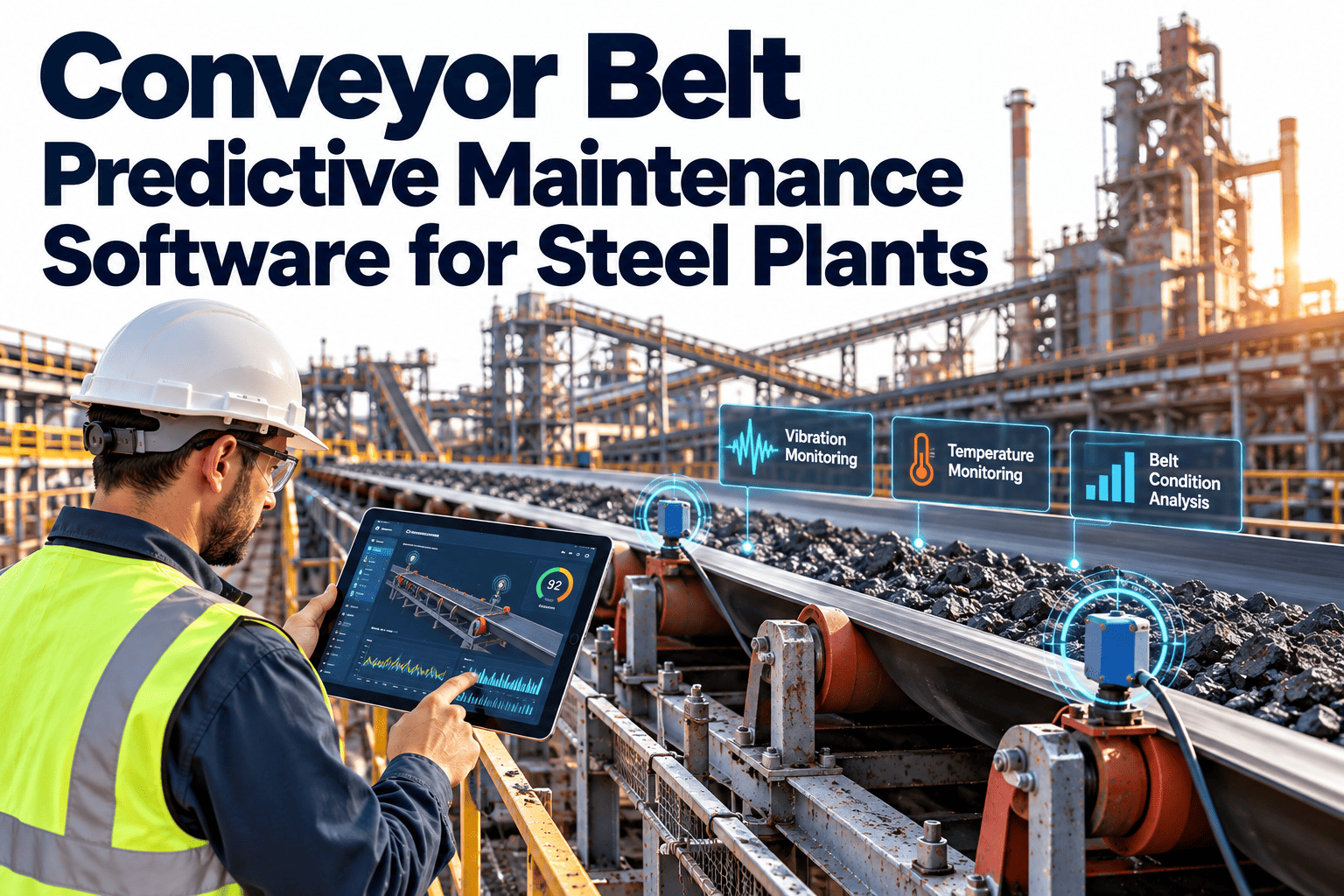
A sinter plant moves raw materials, fluxes, fuel and finished sinter on long belt conveyor chains, and one stopped belt can starve the sinter strand and the blast furnace behind it. Belt tracking, pulley lagging, idlers, drives and transfer chutes all wear under abrasive, dusty duty. Reliability here depends on catching small defects early and tying each one to a planned job. This guide shows how maintenance management software supports that routine.
Sinter Plant Conveyor Reliability for Steel Plant Raw Material Handling
Inspect belts, pulleys, idlers, motors, gearboxes and chutes on a schedule, and turn every finding into a tracked work order.
Stacker ReclaimertoCrushertoBelt ChaintoSinter Strand
Why Sinter Conveyors Fail
- Abrasive ore fines and coke breeze wear belt covers and chute liners quickly.
- Dust and spillage bury idlers and cause seized rolls and belt damage.
- Wet or sticky material builds up on pulleys and causes mistracking.
- Impact at transfer points damages belts, skirts and impact beds.
- Shared reclaim and crushing duty leaves little downtime for planned work.
Component Inspection Map
| Component | What to Check | Typical Warning Sign | Action |
|---|---|---|---|
| Belt | Cover wear, edge damage, splice condition, tracking | Edge fraying, repeated mistracking | Repair or schedule splice |
| Pulleys | Lagging wear, buildup, bearing temperature | Slip, polished lagging, hot bearings | Re-lag or replace bearing |
| Idlers | Rotation, noise, roll shell wear | Seized or noisy rolls | Replace in route order |
| Motor | Temperature, current, vibration | Rising current or heat | Condition-based work order |
| Gearbox | Oil level, leaks, vibration, noise | Metal in oil, rising vibration | Oil sample, planned overhaul |
| Chutes | Liner wear, blockages, skirt seal | Spillage, plugging | Liner replacement job |
From Finding to Fix
1
Inspect
Operators and technicians walk a mobile checklist by conveyor.
Operators and technicians walk a mobile checklist by conveyor.
2
Record
Findings attach to the exact asset with notes and photos.
Findings attach to the exact asset with notes and photos.
3
Prioritize
Rank by criticality to sinter production and failure risk.
Rank by criticality to sinter production and failure risk.
4
Schedule
Group jobs into planned shutdown windows.
Group jobs into planned shutdown windows.
5
Review
Check repeat failures and adjust intervals.
Check repeat failures and adjust intervals.
Criticality Matrix for Conveyors
Single-path feed belt
No standby route. Inspect most often, keep spares on hand.
No standby route. Inspect most often, keep spares on hand.
Crusher discharge belt
Blockage risk. Focus on chutes, skirts and overload protection.
Blockage risk. Focus on chutes, skirts and overload protection.
Return and trimming belts
Moderate impact. Use routine route-based checks.
Moderate impact. Use routine route-based checks.
Standby or parallel belts
Lower impact. Time-based preventive tasks are enough.
Lower impact. Time-based preventive tasks are enough.
See Your Conveyor Routes in One Place
Set up conveyor assets, inspection routes and preventive tasks in a short working session.
Predictive and Condition-Based Practices
- Trend motor current and temperature to spot belt or drive overload.
- Use vibration readings on gearboxes and pulley bearings.
- Use thermal checks on idler lines and bearing housings.
- Log oil analysis results against each gearbox.
- Trigger work orders when a reading crosses a set limit.
KPIs to Track
Unplanned stops
Count by conveyor and cause
Count by conveyor and cause
MTBF and MTTR
Reliability and repair speed
Reliability and repair speed
PM compliance
Planned tasks completed on time
Planned tasks completed on time
Idler failure rate
Replacements per route
Replacements per route
Frequently Asked Questions
How often should sinter conveyors be inspected?
Set frequency by criticality and wear rate. Critical single-path belts need the shortest intervals.
Set frequency by criticality and wear rate. Critical single-path belts need the shortest intervals.
What causes most belt mistracking?
Buildup on pulleys, worn idlers and uneven loading are common causes. Log each event to find repeats.
Buildup on pulleys, worn idlers and uneven loading are common causes. Log each event to find repeats.
Can a CMMS help with shutdown planning?
Yes. Book a demo to see backlog grouped by shutdown window.
Yes. Book a demo to see backlog grouped by shutdown window.
Does it support condition-based triggers?
Readings you record can trigger work orders when limits are crossed.
Readings you record can trigger work orders when limits are crossed.
Can crews use it on mobile?
Yes. Inspections and work orders can be completed from the field.
Yes. Inspections and work orders can be completed from the field.
Keep Raw Material Flowing
Move from reactive belt repairs to planned conveyor reliability with Oxmaint.