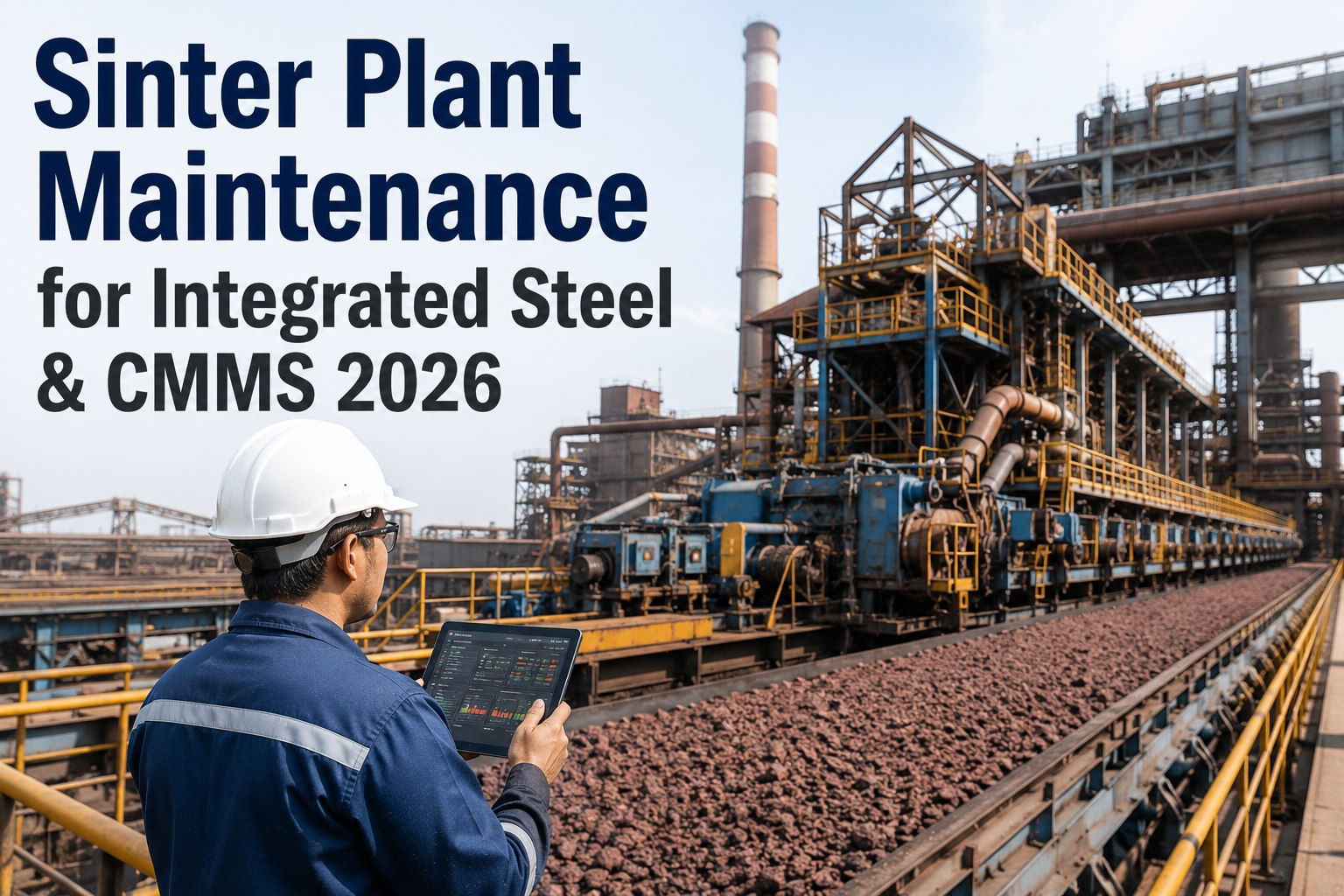
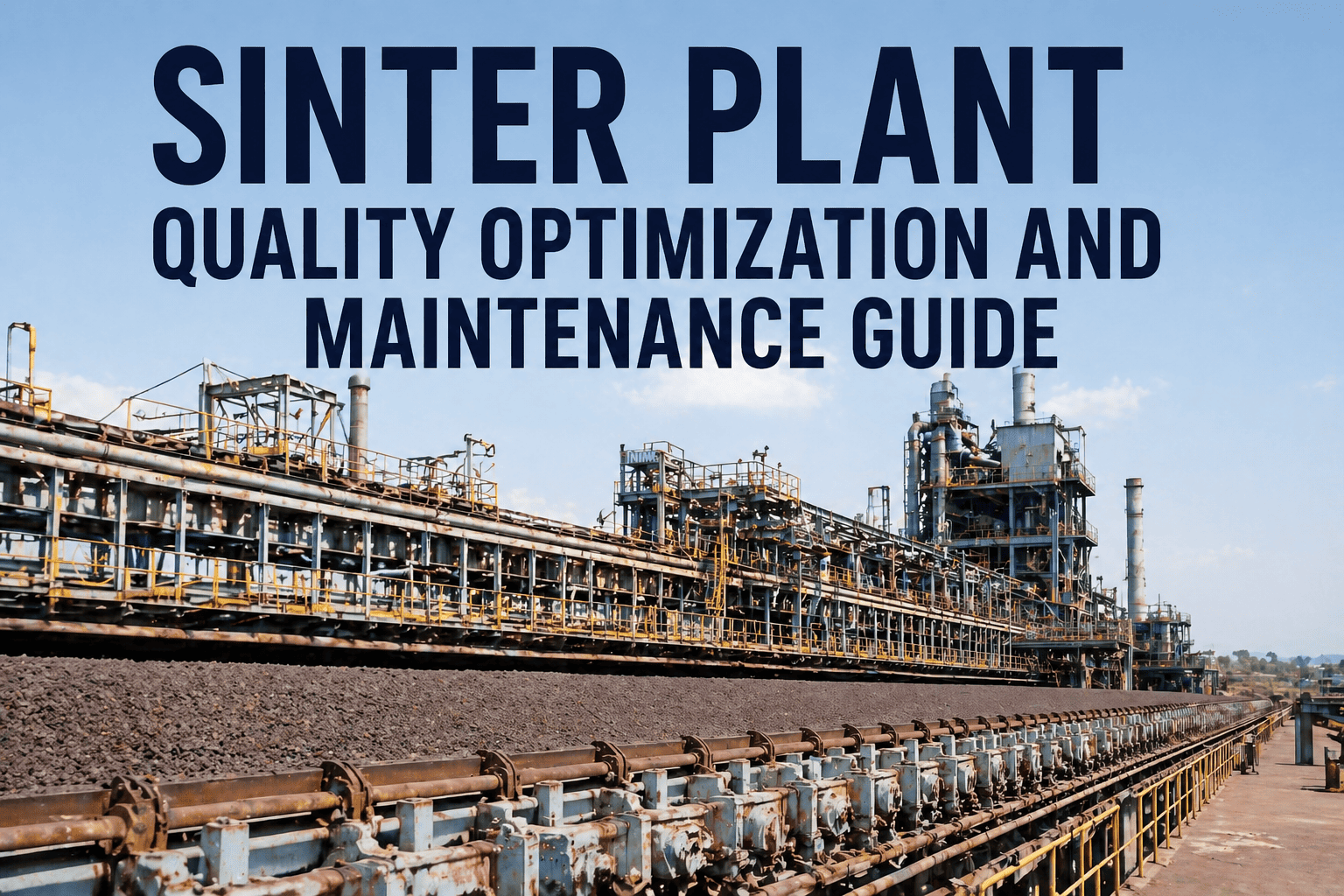
The sinter plant is the most maintenance-intensive operation per square meter in any integrated steelworks — running 24/7 at 300–500°C surface temperatures, processing 15,000–25,000 tonnes of raw mix daily through a single strand that has zero redundancy. When the sinter strand stops, the blast furnace feed stops. When blast furnace feed stops, hot metal production stops. A single sinter plant failure cascades into $180,000–$400,000 per day in lost production across the entire ironmaking chain. Yet sinter plant maintenance is consistently under-managed compared to the blast furnace and steelmaking shop because the equipment looks simple — a moving grate, some fans, a crusher, an ignition hood. It isn't simple. It's a thermal-mechanical system where every component is simultaneously abraded, corroded, thermally cycled, and dust-loaded, creating failure modes that don't exist anywhere else in the plant.
$47
That's the maintenance cost per hour of sinter strand operation. Over a year, that's $412,000 in routine maintenance alone — before a single unplanned failure. The question isn't whether to spend on sinter plant maintenance. It's whether you're spending on prevention or on emergencies.
Why the Sinter Plant Breaks Differently Than Everything Else
Maintenance teams trained on rotating equipment, electrical systems, and hydraulics encounter a completely different failure environment in the sinter plant. The combination of extreme abrasion, thermal cycling, and corrosive dust creates failure modes unique to sintering — and CMMS programs built for general steel plant equipment miss them entirely unless specifically configured for sinter plant conditions.
Grate bars cycle from 100°C to 450°C and back every 25–40 minutes. This isn't steady-state heat — it's repeated thermal shock. After 8,000–12,000 cycles, even heat-resistant alloy castings develop fatigue cracks that propagate until the bar fractures and drops through the grate, damaging wind boxes below.
Every cubic meter of process gas carries 5–15 grams of abrasive iron ore fite, limestone, and cite fines at velocities of 15–25 m/s. This sandblasts fan impellers, erodes ductwork elbows, wears conveyor idlers, and clogs instrumentation. Equipment that lasts 10 years elsewhere in the plant lasts 2–3 years in the sinter plant.
When hot sinter gas meets cooler surfaces in the windlegs and ESP, sulfurous compounds condense into acidic solutions that attack carbon steel at 1–3 mm/year — ten times the corrosion rate in ambient conditions. Fan housings, ductwork, and wind box structures thin invisibly until they perforate or collapse.
Most sinter plants have a single strand. There's no backup machine, no standby system, no way to reroute production. Every component is a single point of failure for blast furnace feed. When the main exhaust fan trips, sinter production stops in under 60 seconds. When sinter stops, the BF burden ratio changes within hours.
"
The sinter strand doesn't give you warning the way a motor does. A motor vibrates for weeks before it fails. A grate bar looks fine at 7,999 cycles and snaps at 8,000. If you're not tracking cycles and replacing proactively, you're gambling.
The Equipment That Keeps the Strand Moving
A sinter plant has seven critical equipment zones — and maintenance on each one has a direct, measurable impact on sinter quality, availability, and blast furnace feed stability. CMMS manages each zone with specific inspection frequencies, failure mode libraries, and PM task sets designed for the unique conditions in that zone.
Sinter Strand (Pallet Cars & Grate Bars)
If this fails → entire production stops immediately
Components
120–200 pallet cars, 15,000–25,000 grate bars, side plates, cross bars, pallet wheels, track rails
Primary failure modes
Grate bar thermal fatigue cracking, pallet car wheel bearing seizure, side plate warping, rail wear causing car derailment
CMMS approach
Track thermal cycles per grate bar set. Replace proactively at 80% of design life. Inspect pallet car wheels every rotation cycle (8–12 hours). Monitor rail wear with scheduled measurements — replace at 15% wear limit, not at derailment.
Ignition Hood & Fuel System
If this fails → sinter quality collapses, returns increase 30–60%
Components
Ignition burners, refractory lining, hood structure, fuel valves, flame detection, combustion air fans, temperature control
Primary failure modes
Refractory spalling exposing hood structure, burner nozzle plugging reducing ignition uniformity, flame detector fouling causing false trips, fuel valve sticking
CMMS approach
Weekly burner pattern inspection with thermal imaging. Monthly refractory condition assessment. Flame detector cleaning on every shift. Fuel valve stroke testing biweekly — valve response time trending predicts sticking 2–3 weeks before trip.
Wind Box & Windleg System
If this fails → suction distribution lost, sinter quality uneven across strand width
Components
18–24 wind boxes, windlegs, damper valves, expansion joints, structural supports, drainage system
Primary failure modes
Corrosion perforation (acidic condensate attacks at 1–3 mm/year), damper valve seizure from dust accumulation, expansion joint failure, drain blockage causing liquid pooling and accelerated corrosion
CMMS approach
Ultrasonic thickness measurements on a rotating schedule — every wind box measured quarterly. Corrosion rate tracked per box. Damper valve exercised weekly (full stroke) with position feedback verification. Drainage system flush monthly.
Main Exhaust Fan
If this fails → sinter production stops in 60 seconds, BF feed affected within hours
Components
Centrifugal fan (2,000–5,000 kW), impeller, main bearings, inlet damper, coupling, drive motor, lubrication system
Primary failure modes
Impeller erosion from abrasive dust (loses 8–15% efficiency per year without liner replacement), bearing failure from dust contamination of lube oil, coupling wear, inlet damper sticking
CMMS approach
Continuous vibration monitoring with bearing-defect-frequency analysis. Monthly oil analysis with particle count trending. Impeller thickness measurement during every planned stop. Drive motor amp draw tracking — increasing amps at same process load indicates impeller buildup or wear. This single fan justifies full predictive monitoring investment on its own.
Electrostatic Precipitator (ESP)
If this fails → environmental violation, potential plant shutdown by regulators
Components
Collecting plates, discharge electrodes, rapper system, transformer-rectifier sets, hoppers, insulator housings, gas distribution screens
Primary failure modes
Electrode wire breakage (snags on collecting plates, shorts out entire field), rapper malfunction allowing dust buildup, TR set failure reducing collection efficiency, insulator tracking from moisture/dust
CMMS approach
Daily opacity monitoring correlated with rapper performance. TR set secondary current/voltage trending — declining performance predicts field problems 2–4 weeks ahead. Rapper acceleration monitoring (accelerometer data confirms mechanical function). Insulator heating system PM — failure leads to tracking and field trip.
Sinter Crusher & Cooler
If this fails → sinter size distribution wrong, BF permeability problems within 12 hours
Components
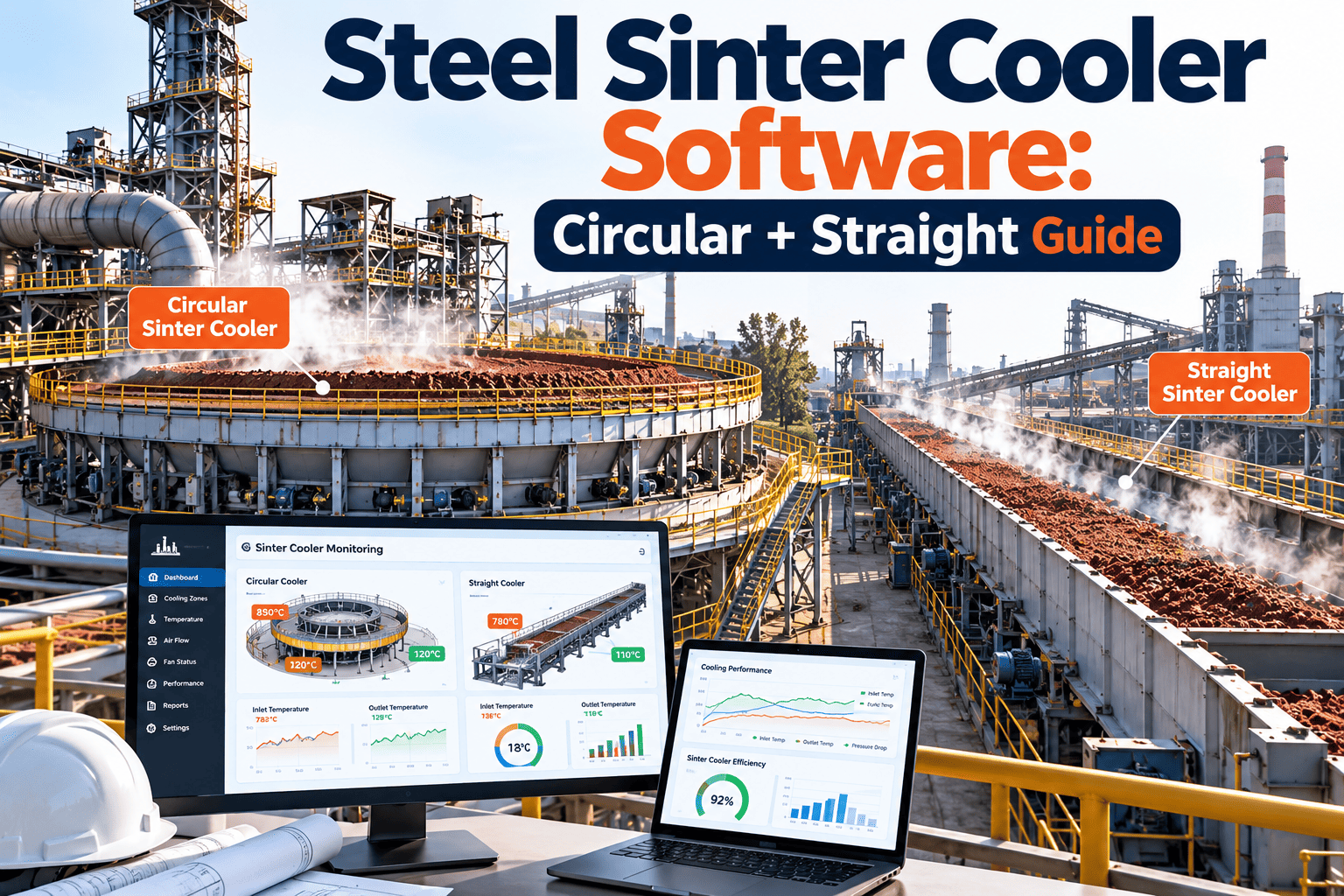
Hot sinter crusher (teeth, shaft, bearings), circular or linear cooler (grate, fans, drive, seals), hot screening, return fines system
Primary failure modes
Crusher tooth wear (operating at 300–400°C on abrasive sinter), cooler grate warping, cooler drive chain elongation, fan bearing failure from heat radiation, hot screen wire breakage
CMMS approach
Crusher tooth profile measurement on every planned stop. Cooler grate section inspection on rotating schedule. Drive chain elongation measurement monthly — replace at 3% elongation, not at breakage. Cooler fan bearing temperature trending with alarm at rate-of-change, not just absolute threshold.
Raw Material Handling & Mixing
If this fails → mix composition varies, sinter chemistry out of spec for BF
Components
Proportioning bins, weigh feeders, mixing drum, water addition, conveyor system, transfer chutes, dust suppression
Primary failure modes
Weigh feeder calibration drift affecting mix accuracy, mixing drum liner wear, conveyor belt damage, chute blockage from wet fines, bin level sensor malfunction
CMMS approach
Weigh feeder calibration check weekly — drift beyond 2% triggers immediate recalibration. Mixing drum liner thickness quarterly. Conveyor belt condition assessment monthly with splice integrity check. Chute inspection and cleaning frequency tied to moisture content of raw materials (wetter = more frequent).
Sinter plant teams mapping their equipment zones should sign up to see how CMMS organizes zone-specific PM schedules, failure mode libraries, and inspection protocols for each critical sinter plant system.
87%
of sinter plant unplanned stops trace back to just three equipment zones: the strand itself (pallet cars and grate bars), the main exhaust fan, and the ESP. Master these three, and you've eliminated the vast majority of your downtime risk.
What Changes When CMMS Runs the Sinter Plant
The difference between a reactive sinter plant and a CMMS-managed sinter plant isn't subtle — it shows up in availability, quality, and cost within the first 6 months. Here's what actually changes.
Every Zone Monitored. Every Failure Predicted. Every Stop Planned.
OxMaint delivers sinter-plant-specific maintenance management — thermal cycle tracking for grate bars, corrosion rate monitoring for wind boxes, predictive vibration analysis for the main fan, rapper performance verification for the ESP, and the zone-by-zone PM schedules that keep the strand running 24/7.
Planned Stop Optimization: Getting More Done in Less Time
A sinter plant typically gets one planned maintenance window per week — 8 to 16 hours, rarely more. Every task that doesn't get done during that window either waits another week (risk accumulates) or gets done during production (reduced effectiveness, safety compromises). CMMS maximizes the value of every planned stop by pre-staging materials, sequencing tasks by criticality, and eliminating the time wasted on "what should we work on" decisions. Teams optimizing their shutdown windows should book a free demo to see how CMMS packages planned stop work orders by priority and resource availability.
Must Complete
Replace grate bar set Section 3 (cycle count at 82% of limit) — 3.5 hrs
Main fan bearing inspection + oil sample — 1.5 hrs
Wind box 9 UT thickness measurement (last reading: 1.2mm above minimum) — 1 hr
Ignition hood refractory patch — hot spot identified on last thermal scan — 2 hrs
Subtotal: 8 hours — fits within window with 4 hours remaining
Should Complete
Cooler drive chain tension adjustment + elongation measurement — 1.5 hrs
ESP Field 2 rapper mechanical inspection (3 rappers showing declining impact) — 2 hrs
Subtotal: 3.5 hours — fits within remaining window
If Time Permits
Mixing drum liner thickness spot check — 0.5 hrs
Conveyor B3 splice inspection — 0.5 hrs
Subtotal: 1 hour — overflow buffer tasks. Deferred to next week if not completed.
"
We used to spend the first 2 hours of every planned stop figuring out what to work on. That's 2 hours of a 12-hour window — 17% of our maintenance time — consumed by poor planning. Now the CMMS prints the task package Wednesday afternoon and the crew walks in Thursday morning knowing exactly what they're doing, in what order, with what parts.
The Numbers: What CMMS-Managed Sinter Maintenance Delivers
Strand Availability
+7.2 percentage points = 631 additional production hours per year = 42,000+ additional tonnes of sinter
Unplanned Stops Per Month
–71% reduction. Remaining stops are minor duration (<2 hrs avg) vs. previous 6–18 hr events
Annual Corrective Maintenance Cost
–43% reduction as preventive and predictive maintenance catches failures before they become expensive emergencies
ESP Environmental Compliance
Zero opacity exceedances in 12 months vs. 8 regulatory notices in the previous year
$3.4M
Annual value created by CMMS-managed sinter plant maintenance — from increased production ($2.1M from higher availability), reduced emergency repairs ($1.2M), and avoided regulatory fines ($100K+). Against a CMMS implementation cost of $40K–$80K, this is a 42–85× return in year one.
Expert Perspective: The Sinter Plant Rewards Discipline More Than Any Other Area
I've managed sinter plant maintenance for 18 years across three plants, and here's what I tell every new reliability engineer who gets assigned to the sinter area: this is the most rewarding equipment in the plant to manage well, and the most punishing to manage poorly. The reward cycle is fast — implement a proper grate bar replacement program based on thermal cycles instead of breakage, and within 3 months your unplanned strand stops from grate bar failure go to zero. Put continuous vibration monitoring on the main fan, and within 6 months you'll prevent a bearing failure that would have cost $400,000 in emergency repair and lost production. Start measuring wind box corrosion rates, and within 12 months you'll know exactly which windlegs need replacement at the next annual shutdown instead of discovering perforations during production. The punishment cycle is equally fast. Skip one round of grate bar inspections and you'll find fractured bars jamming the discharge, damaging wind boxes, and causing a 12-hour emergency stop. Defer the main fan oil change by 4 weeks and contaminated oil will destroy a $65,000 bearing. Ignore declining ESP rapper performance and you'll get a regulatory notice that triggers a forced shutdown. The sinter plant doesn't store up problems quietly — it presents them immediately and expensively. That's actually what makes it ideal for CMMS implementation. The feedback loop between good maintenance and good results is so short and so clear that the value of the system is undeniable within months, not years.
Start With the Main Fan — It's the Highest-Value Single Asset
If you do nothing else, put continuous vibration monitoring and monthly oil analysis on the main exhaust fan. One prevented bearing failure pays for the entire monitoring program for 5 years. It's the single asset where predictive maintenance delivers the most dramatic and immediate ROI.
Track Grate Bar Cycles, Not Calendar Time
A grate bar doesn't care what month it is — it cares how many thermal cycles it's survived. CMMS calculates cycles from strand speed and operating hours. Replace at 80% of design cycle life. This single practice eliminates the most common cause of unplanned strand stops.
Make Every Planned Stop Count — Package Tasks by Priority
You get 8–16 hours per week. Don't waste any of it deciding what to do. CMMS should have the prioritized task package ready 24 hours before the stop, with parts staged and crews assigned. The best sinter plants complete 95% of "must complete" tasks every single week.
Every Cycle Tracked. Every Zone Monitored. Every Stop Maximized. Every Tonne Delivered.
OxMaint delivers sinter-plant-specific CMMS — grate bar thermal cycle tracking, wind box corrosion rate management, main fan predictive monitoring, ESP performance verification, planned stop task packaging, and the zone-by-zone PM programs that keep the single most critical link in the ironmaking chain running at 95%+ availability.
Frequently Asked Questions
What makes sinter plant maintenance different from other steel plant areas?
Sinter plants combine extreme abrasion, thermal cycling (100–450°C every 25–40 minutes), corrosive condensation, and zero redundancy (single strand = single point of failure for BF feed). Equipment that lasts 10 years elsewhere lasts 2–3 years here. CMMS must be configured with sinter-specific failure modes, cycle-based replacement logic, and corrosion rate tracking rather than standard calendar-based PM schedules.
What are the most critical equipment zones in a sinter plant?
The strand (pallet cars and grate bars), main exhaust fan, and ESP account for 87% of unplanned stops. The strand fails through thermal fatigue of grate bars; the fan fails through bearing damage from abrasive dust in lubricating oil; the ESP fails through rapper malfunction and electrode breakage. Mastering these three zones eliminates most downtime risk.
How does CMMS track grate bar replacement timing?
CMMS calculates thermal cycles per grate bar set using strand speed and operating hours rather than calendar time. When a set reaches 80% of its design cycle life, the system generates a replacement work order for the next planned stop. This proactive approach eliminates unplanned stops from grate bar fracture — the most common cause of strand downtime.
What ROI does CMMS deliver for sinter plant maintenance?
Typical first-year value is $3–4M: $2M+ from increased production (raising availability from ~88% to ~95%), $1.2M from reduced emergency repairs (–43% corrective maintenance cost), and $100K+ in avoided regulatory fines from continuous ESP compliance. Against $40K–$80K implementation cost, this represents 42–85× return in year one.
How should sinter plant planned maintenance stops be organized?
CMMS packages the weekly 8–16 hour window into three priority tiers: "must complete" (safety-critical and highest-risk items filling ~65% of the window), "should complete" (important but deferrable, ~25%), and "if time permits" (buffer tasks, ~10%). All parts are pre-staged, LOTO procedures pre-loaded, and crew assignments confirmed 24 hours before the stop begins — zero planning time consumed during the window itself.