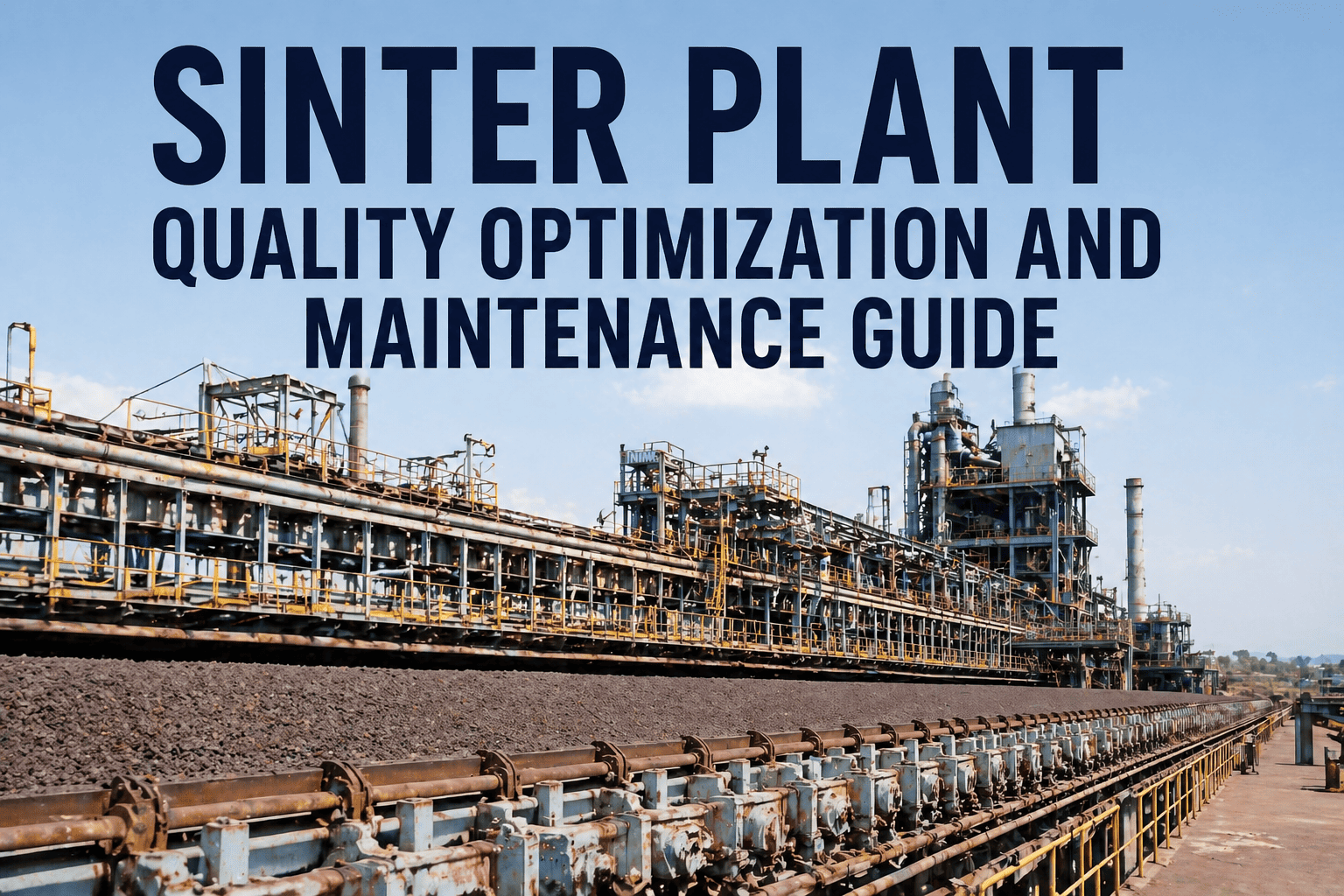
The sinter plant is the silent constraint of every integrated steel mill. When sinter quality degrades — because the windbox suction is uneven, because ignition hood burners are fouled, because the ESP pressure drop has been climbing unchecked for three weeks — the blast furnace feels it within hours. Increased coke rate. Unstable burden distribution. Throttled productivity. A 50-tonne/hour sinter shortfall costs an integrated mill $8,000–$15,000 per hour in lost blast furnace output — but the root cause sits in a deferred maintenance item in the raw material conditioning section. Six equipment zones, each with distinct failure modes, distinct wear rates, and distinct consequences for sinter quality and air quality compliance. This guide covers all six — with PM frequencies, critical inspection items, and the role of CMMS in closing every gap. Book a demo to see how Oxmaint manages sinter plant PM across all six equipment zones.
Specific Equipment
Equipment PM + Air Quality
Iron & Steel
$8–15K/hr
BF production loss from sinter shortfall
1,300–1,400°C
Strand operating temperature — defines maintenance criticality
6
Equipment zones — each with distinct PM requirements
10–20 mg/m³
Best-available emission target with ESP + bag filter
Plant Overview
Six Equipment Zones — One Integrated Maintenance Program
01Sinter Machine & Strand
02Ignition Hood
03Sinter Cooler
04Exhaust Fan & Windboxes
05ESP System
06Bag Filter
Zone 01
Sinter Machine & Strand — The Core Production Asset
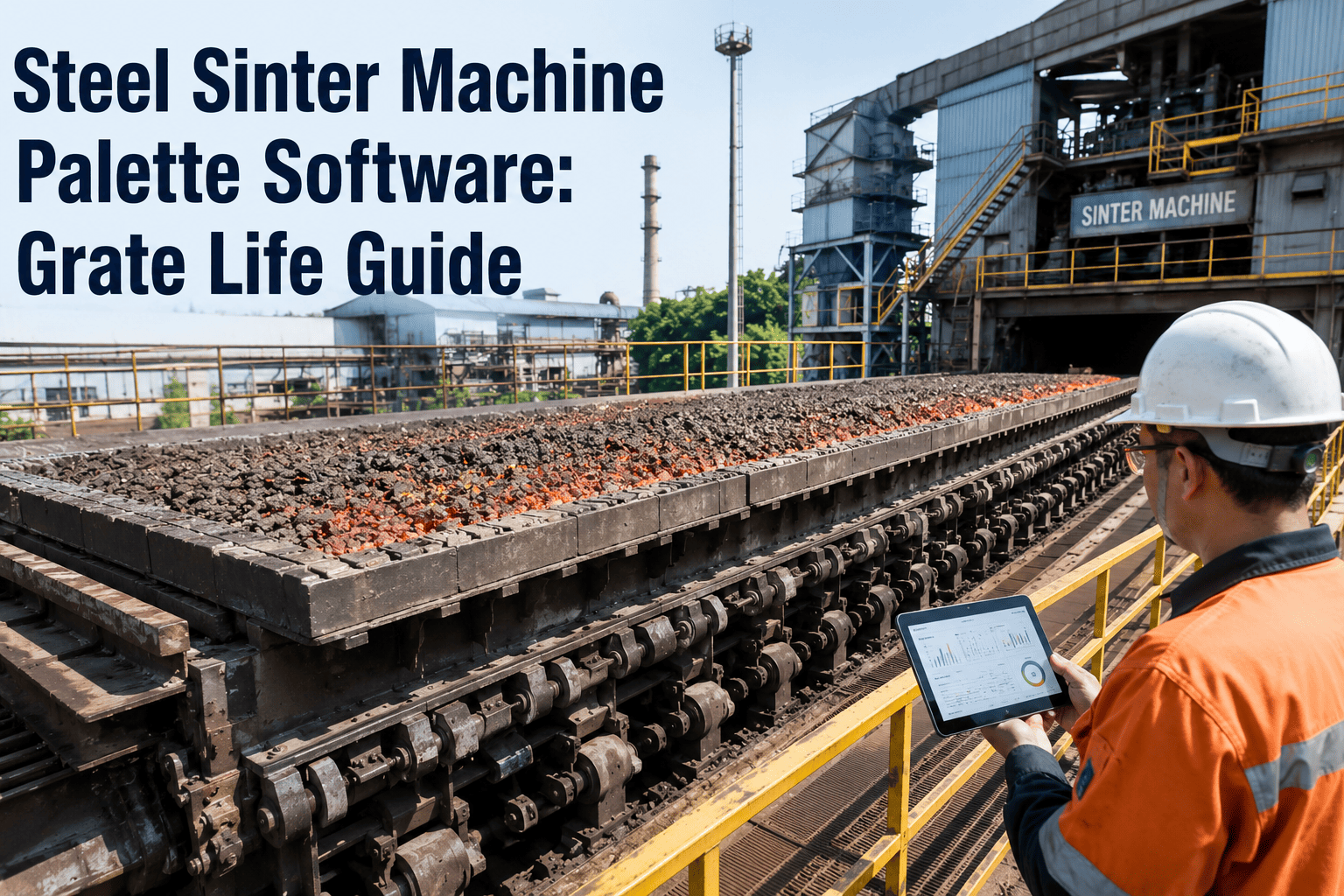
The sintering strand is a traveling grate of pallet cars carrying the raw mix at 1,300–1,400°C. Grate bars, pallet car wheels, drive chains, and windbox seals are all wear-intensive components that degrade continuously under thermal and mechanical stress. Strand alignment drift and grate bar condition directly affect burn-through point consistency — the single most important sinter quality parameter.
Zone 02
Ignition Hood — Where Sinter Quality Begins
The ignition hood fires the top surface of the raw mix with a blend of coke oven gas and blast furnace gas at 4,000–6,000 kJ/m³ calorific value. Multi-slit burner nozzle fouling creates uneven ignition across the pallet width — the primary cause of increasing return fines ratio. Refractory thermal erosion accumulates with every campaign and must be mapped against production data to predict replacement timing before structural failure.
Burner Nozzles
Monthly cleaning
Nozzle orifice inspection and cleaning; flame pattern check through inspection ports; carbon deposit removal
Refractory Lining
Quarterly inspection
Thermal crack mapping; spalling measurement; erosion depth survey; schedule replacement before 40% thickness loss
Monthly
Gas line leak testing; control valve response time check; calorific value analyzer calibration
Flame Detection Sensors
Monthly calibration
UV/IR detector response test; flame failure relay test; interlock verification for strand-stop condition
Hood Pressure Control
Weekly verification
Windbox damper actuator service; hood pressure setpoint verification; damper position feedback calibration
Temperature Sensors
Monthly calibration
BTP thermocouple calibration; hood temperature sensor verification against reference; response time test
Zone 03
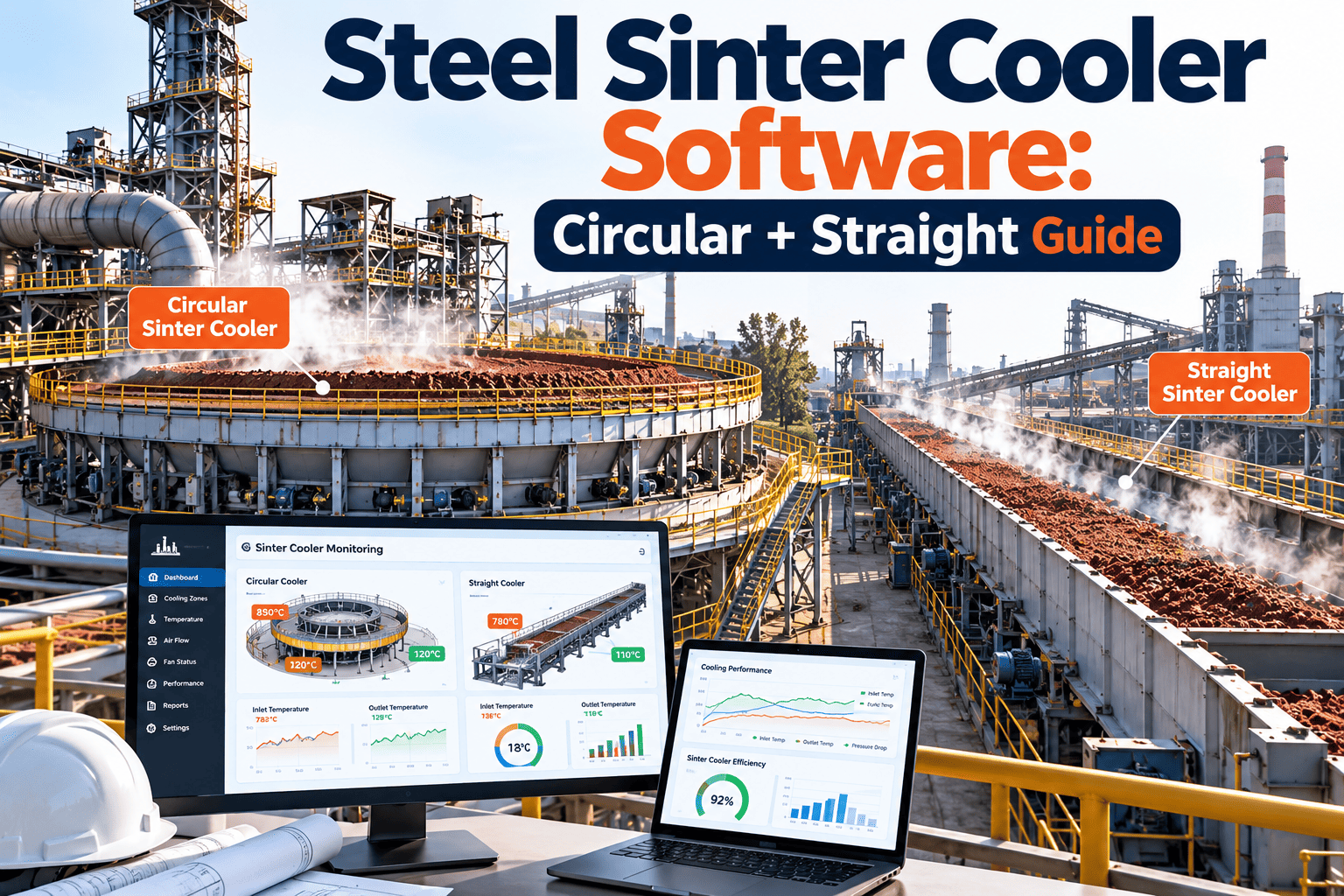
Sinter Cooler — Reducing 800°C to <150°C for Safe Handling
The circular or linear cooler reduces hot sinter from ~800°C to below 150°C using radial fans. Grate plate wear from abrasive hot sinter is the primary maintenance driver. Sealing system failure allows dust emission and reduces cooling efficiency simultaneously — a double penalty on both environment and output quality. Heat recovery systems, where installed, require additional attention on heat exchanger fouling and ductwork sealing.
Cooler fans & motorsMonthly bearing temp + quarterly vibration analysis
Grate plates / barsMonthly thickness measurement; replace at 50% wear limit
Sealing systemWeekly visual; monthly seal strip replacement where worn
Dedusting hood & ductworkMonthly inspection for buildup and leaks
Drive system (circular cooler)Monthly gear tooth wear + lubrication check
Temperature sensors (outlet)Monthly calibration — target <150°C at discharge
Cooler Health Indicators
Discharge temperature
Target <150°C
Grate plate wear limit
Replace at 50%
Fan bearing temperature rise
<40°C above ambient
Sealing gap (max allowable)
3mm threshold
Zone 04
Exhaust Fan & Windbox System — The Largest Single Failure Risk
The exhaust fan (main strand fan) is the single largest electricity consumer in the sinter plant and the single equipment item whose failure halts the entire strand immediately. Handling high-volume, dust-laden, corrosive gas at temperatures up to 350°C, impeller blade erosion and bearing failure are the dominant failure modes. Continuous vibration monitoring is non-negotiable on this asset — not periodic.
Critical — Strand Stop Risk
Exhauster Fan Impeller
Blade erosion measurement quarterly; dynamic balancing when vibration exceeds 4.5 mm/s RMS; continuous online vibration monitoring between overhauls
Continuous monitoring + quarterly measurement
Exhauster Bearings
Continuous temperature monitoring; monthly oil analysis; bearing replacement at first indication of elevated vibration floor
Continuous temp + monthly oil analysis
Windbox Damper Actuators
Actuator response time test; damper position feedback calibration; seal inspection for air leakage between windbox chambers
Monthly service
Windbox Sealing
Air leakage check across all windbox positions; draft uniformity verification; uniform suction across strand width is the key sinter quality indicator
Monthly inspection
Exhauster Motor
Insulation resistance testing annually; winding temperature monitoring; vibration trend comparison at motor and fan ends
Annual Megger + continuous temp
Ductwork & Expansion Joints
Visual inspection for cracking, corrosion, and refractory spalling in hot ductwork; expansion joint integrity check for gas leakage
Quarterly inspection
Auto-Schedule PM Across All 6 Equipment Zones in Oxmaint
Oxmaint links every inspection item to the right asset, the right technician, and the right frequency — with condition-based triggers for critical equipment like exhauster fans and windbox seals. No missed PM. No unacknowledged vibration alerts.
Zone 05 & 06
Exhaust Gas Treatment — ESP vs Bag Filter Maintenance
Emission target
30–50 mg/Nm³
10–20 mg/Nm³ (combined with ESP)
Primary maintenance item
Rapping mechanism inspection; electrode alignment check; high-voltage power supply calibration
Filter bag differential pressure monitoring; bag integrity leak test; pulse-jet cleaning system inspection
Critical failure mode
Electrode corona wire breakage; collecting plate deformation; rapping failure leading to ash bridging
Bag blinding (high pressure drop); bag rupture (emission exceedance); pulse valve failure
Key PM frequency
Rapping check: weekly; HV calibration: quarterly; full internal: annually
Pressure drop: continuous; bag inspection: monthly; bag replacement: condition-based
Temperature limit
No upper limit — handles high-temp gas streams directly
Max 200–250°C (standard bags); above this threshold requires ESP pre-treatment
CMMS monitoring priority
Rapping cycle runtime; secondary current/voltage trending; hopper level monitoring
Differential pressure trending per chamber; cleaning cycle frequency; bag life tracking
Key Performance Indicators
Sinter Plant Maintenance KPIs to Track in Your CMMS
Return Fines Ratio
Target <20%
Rising return fines signals ignition hood, windbox distribution, or granulation degradation — all maintenance-driven indicators
Sinter Yield
Target >72%
Yield trend is the composite indicator of process stability — maintenance quality shows directly in this number week over week
BTP Uniformity Deviation
Target <±5%
Deviation across windbox positions indicates leakage or blockage with direct impact on sinter bed combustion and quality
Planned Maintenance %
Target >70%
Below 70% planned indicates a structurally reactive program — accumulating failure risk across all six equipment zones continuously
ESP Emission mg/Nm³
Target <50 mg/Nm³
Trending above limit triggers immediate electrode and rapping inspection before regulatory exceedance event occurs
Exhauster Vibration
Alert >4.5 mm/s RMS
First deviation above baseline triggers balancing inspection — not shutdown. Continuous monitoring enables proactive response
Expert Review
What Sinter Plant Maintenance Engineers Say
"The exhaust fan is the one asset that maintenance managers lose sleep over — and rightly so. A strand stop from exhauster failure costs more in the first two hours than the entire annual maintenance budget of the fan system. Continuous vibration monitoring with automatic work order generation is not an upgrade; it is the minimum acceptable standard for this machine. Calendar-based inspection of an exhauster fan is indefensible in a modern sinter plant."
Senior Sinter Plant Engineer
Integrated Steel Mill — 3 MTPA, South Asia
"Ignition hood maintenance is consistently undervalued until the return fines ratio starts climbing and the blast furnace team starts asking questions. By the time quality data reveals the problem, the hood refractory has been eroding for weeks. The solution is to track BTP uniformity in your CMMS as a leading indicator — not sinter quality as a lagging one. A 3-point deviation in BTP across the strand width tells you the hood needs attention before the blast furnace does."
Process & Maintenance Integration Manager
Iron & Steelmaking Complex — Eastern Europe
Frequently Asked Questions
Sinter Plant Maintenance — Common Questions
How does sinter machine maintenance directly affect blast furnace performance?
Sinter quality — driven by ignition hood condition, windbox draft uniformity, and granulation drum performance — determines BF burden distribution and coke rate. A 50 t/hr sinter shortfall from deferred maintenance can force BF throttling at $8,000–$15,000 per hour in lost production. Tracking sinter KPIs (return fines ratio, yield, BTP uniformity) in your CMMS creates a direct link between maintenance actions and BF output.
Book a demo to see how Oxmaint correlates maintenance records with sinter quality KPIs.
What is the recommended maintenance approach for the exhaust fan (main strand fan)?
Continuous online vibration monitoring is the minimum standard for the main exhauster fan — not periodic inspection. Impeller blade erosion from dust-laden gas is progressive and can accelerate suddenly. Vibration baseline must be established at commissioning and trending monitored in CMMS, with automatic work order generation when velocity exceeds 4.5 mm/s RMS. Dynamic balancing should be scheduled at the first vibration deviation — not deferred to the next planned outage.
Start a free trial to configure vibration alert thresholds for your exhauster fleet.
When should a sinter plant use ESP vs bag filter for exhaust gas treatment?
ESPs are preferred for high-temperature, high-volume gas streams where temperatures exceed 250°C — they handle hot, sticky, and variable dust loads without filter media degradation. Bag filters achieve lower emission concentrations (10–20 mg/Nm³) but require gas temperature below 200–250°C and are sensitive to moisture and temperature surges. Many modern plants use ESP as primary treatment followed by a bag filter polishing stage to meet stringent sub-20 mg/Nm³ targets. Maintenance programs differ significantly between the two —
book a demo to see how Oxmaint manages both systems in a single maintenance program.
How does CMMS support sinter plant annual shutdown planning?
Sinter plant shutdowns are typically 5–10 days with simultaneous work fronts across all six equipment zones. CMMS links every work order to the shutdown schedule, pre-stages material and permit requirements, tracks real-time progress against the critical path, and flags work that will overrun the window. Work not pre-planned and pre-staged before the outage begins cannot be completed within the shutdown window — and blast furnace downtime awaits the overrun.
Start a free trial to walk through Oxmaint's shutdown planning module for your next sinter plant outage.
Manage All Six Sinter Plant Equipment Zones in One CMMS
Oxmaint tracks PM schedules, condition monitoring alerts, shutdown work orders, and sinter quality KPIs across every equipment zone — from the mixing drum to the ESP collector. Built for integrated steel plant maintenance teams.