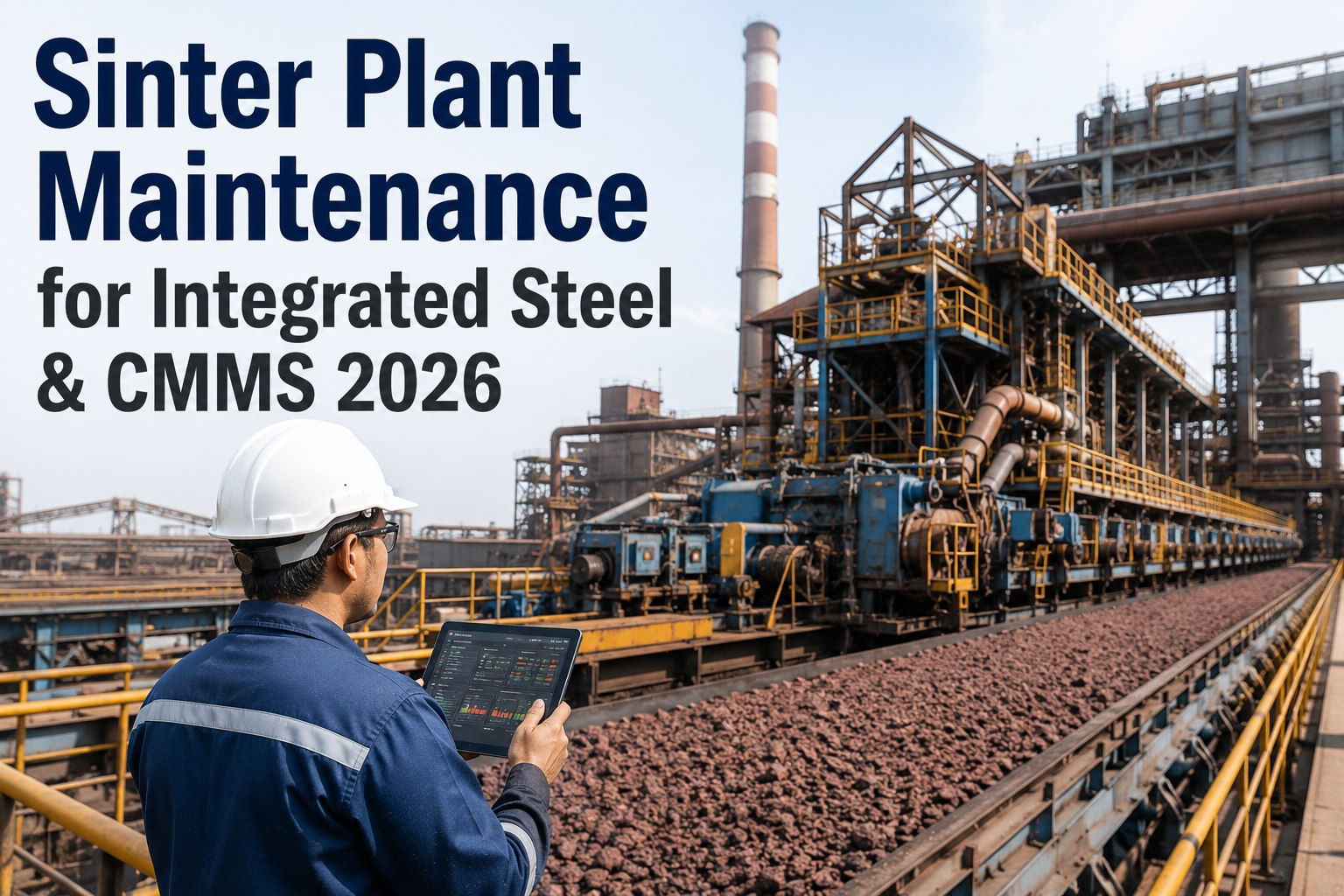
Sinter Plant Maintenance for Integrated Steel & CMMS 2026

By William Jerry on July 24, 2026

sinter-plant-maintenance-steel-cmms-guide-2026

Sinter plant availability is the single largest lever an integrated steelmaker has over blast furnace feed quality — every percentage point of strand uptime translates directly into hot metal cost, coke rate, and furnace stability. A well-executed preventive maintenance program on the sinter strand, windboxes, ignition furnace, and exhaust fan typically lifts plant availability from 88% to 94%, cutting unscheduled downtime by 35–45% within twelve months. This guide walks through the maintenance priorities, inspection cadences, and CMMS workflows that define a 2026-grade sinter plant operation. Ready to digitize your sinter maintenance? Start Free Trial and configure your asset hierarchy in under an hour.

Sinter Plant Maintenance · 2026 Guide

Is your sinter strand leaking 6% availability a quarter to unplanned stops?

Most integrated steel plants lose 4–8% of annual sinter output to windbox leaks, ignition hood refractory failures, and exhaust fan vibration events that a structured PM program catches weeks early. Below is the framework top-performing plants use to push strand availability past 94%.

94%
Top-quartile sinter strand availability target for 2026
Why Sinter Maintenance Matters

Availability drives blast furnace feed quality — and your bottom line

A 1% drop in sinter plant availability forces the blast furnace to substitute 3–5% more lump ore and pellets, raising hot metal cost by roughly $2.40 per tonne and destabilizing the burden distribution profile within 48 hours.

$2.40
Added hot metal cost per tonne for every 1% sinter availability loss
35%
Reduction in unplanned downtime with a CMMS-driven PM schedule
14 days
Typical early-warning window a vibration trend provides before exhaust fan failure
88→94%
Availability lift achievable in 12 months for a mid-tier integrated plant

Worked example: A 2.4 MTPA sinter plant running at 88% availability loses roughly 192,000 tonnes of sinter annually. At a substitution penalty of $2.40/tonne hot metal, that is $1.15M per year in avoidable cost — before counting coke-rate drift and furnace permeability losses.

Critical Asset Checklist

The four asset groups that decide sinter plant uptime

Over 80% of unplanned sinter stoppages trace back to just four systems. Tier your PM effort by failure frequency and detection difficulty.

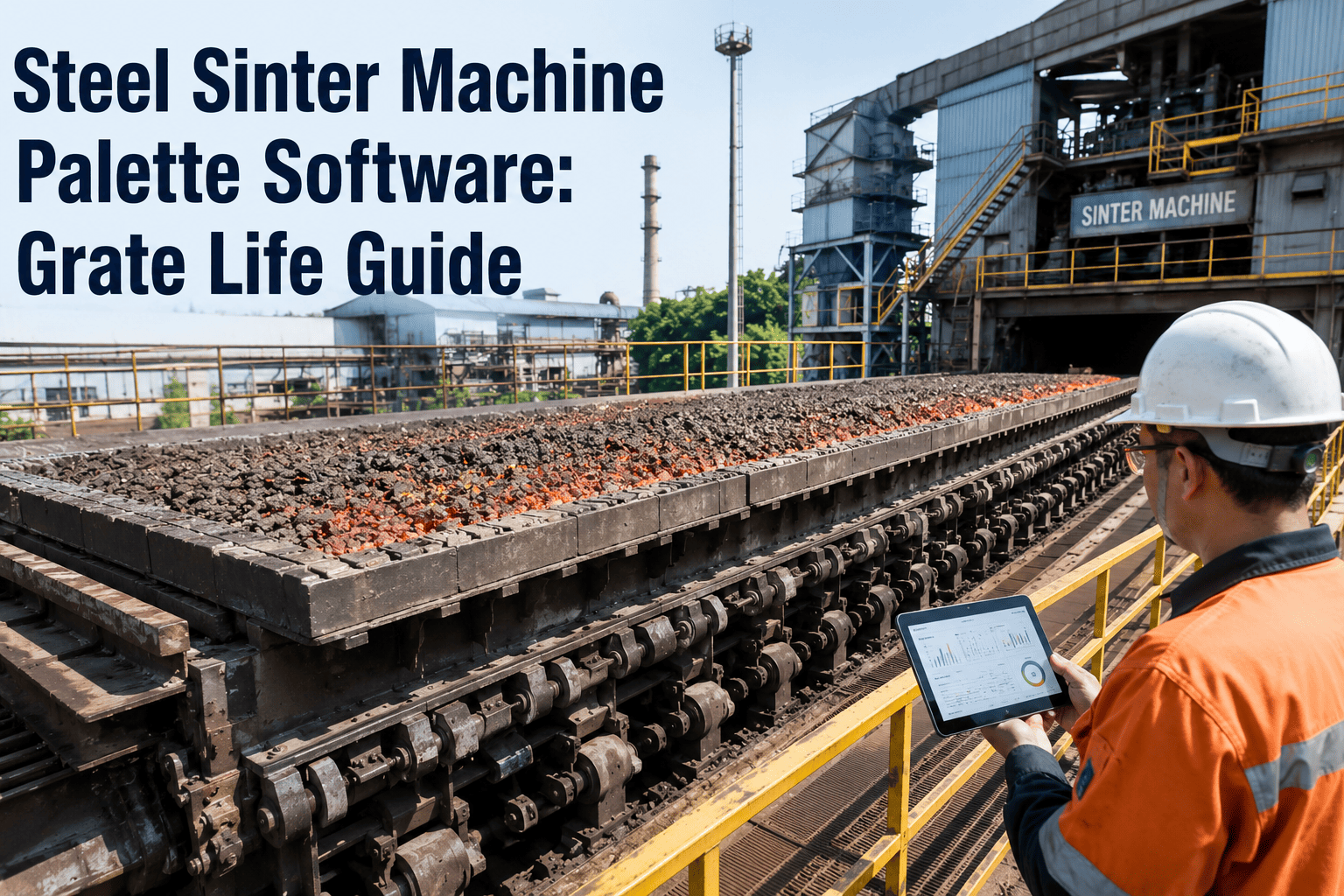
01 Sinter Strand & Pallet Cars
  • Pallet car wheel bearing temperature scan (weekly IR)
  • Grate bar wear measurement & replacement at 6mm min thickness
  • Strand seal plate gap — target under 2mm
  • Drive chain elongation check monthly, replace at 1.5% stretch
02 Windbox & Under-Strand
  • Windbox 1–5 dust buildup ultrasonic thickness (monthly)
  • Bellows & expansion joint visual + dye penetrant each outage
  • Suction box differential pressure log review weekly
  • Seal air fan vibration & flow verification
03 Ignition Furnace & Hood
  • Refractory hot-face inspection via borescope each 30 days
  • Burner tip alignment & flame pattern photo log
  • Hood skin temperature IR mapping — flag above 120°C
  • Ceramic fiber module replacement at 40% linear shrinkage
04 Exhaust Fan & ESP
  • Vibration spectrum analysis ISO 10816 monthly
  • Impeller erosion & dust buildup balance check quarterly
  • Bearing oil analysis — ISO 4406 cleanliness target 18/16/13
  • ESP hopper level & rapping cycle audit
12-Month PM Timeline

A maintenance calendar that keeps the strand running all year

Sinter plant PM is not a single annual event — it is a layered cadence of daily rounds, weekly checks, monthly inspections, and quarterly outages. Here is a proven schedule from a 2.4 MTPA plant.

Daily
Operator rounds & lube top-up
Strand speed, windbox suction, ignition temperature, and fan vibration reviewed every shift. 15-minute checklist in CMMS mobile app.
Weekly
IR thermography & DP logging
Pallet wheel bearing temps, hood skin scan, windbox differential pressure trend review. Auto-triggered work orders on threshold breach.
Monthly
Vibration spectrum & oil analysis
Full ISO 10816 analysis on exhaust fan, main drive, and seal air fan. Oil samples to lab for particle count and wear metals.
Quarterly
Impeller inspection & 24h outage
Borescope ignition hood, clean windbox 1–3, balance exhaust fan impeller, replace bellows showing cracks. Typical duration 18–26 hours.
Annual
Major outage & refractory
Full grate bar replacement, ignition hood refractory rebuild, windbox 1–5 ultrasonic thickness survey, drive chain replacement. 7–10 day window.
CMMS ROI Calculation

What a sinter plant CMMS pays back — and how fast

A CMMS deployed across a sinter plant's four critical asset groups typically pays for itself in under 5 months. The formula below shows the inputs that drive the payback.

Annual Savings Formula
Savings = (Downtime Hours Avoided × Sinter t/hr × Substitution Penalty $/t) + (Emergency Repair Cost Avoided) − (CMMS Annual Cost)
Plant Size Pre-CMMS Availability Post-CMMS Availability Annual Downtime Avoided Estimated Annual Savings Payback Period
1.2 MTPA 86% 92% 630 hrs $580K 4.2 months
2.4 MTPA 88% 94% 1,050 hrs $1.15M 3.8 months
4.0 MTPA 89% 95% 1,680 hrs $2.05M 2.9 months
6.0 MTPA 90% 95.5% 2,100 hrs $2.90M 2.1 months
Operational Impact

What changes when sinter PM goes digital

Plants that moved from spreadsheet and clipboard PM to a CMMS saw measurable shifts within the first quarter. These are the three benefit areas that moved the most.

Downtime Predictability
Vibration and temperature trends auto-generate work orders 8–14 days before failure, converting 70% of unplanned stops into planned interventions.
Faster Outage Execution
Pre-built outage checklists and parts pre-staging cut annual major outage duration by 18–24 hours, returning 4,000+ tonnes of sinter output.
Spare Parts Control
Critical spares — grate bars, impeller, refractory modules — linked to asset BOM with min-max triggers, reducing emergency procurement by 45%.
Take the next step

Build your sinter plant PM calendar in one afternoon

Import your asset list, map your four critical groups, and auto-generate a 12-month PM schedule aligned to ISO 55000 and TPM standards.

Frequently Asked Questions

Sinter plant maintenance & CMMS — what plant managers ask

How often should sinter strand pallet cars be inspected?
Pallet car wheel bearings should get an infrared temperature scan every week, with a full visual and dimensional inspection during the quarterly 24-hour outage. Replace wheels showing temperature rise above 15°C over baseline, and measure grate bar thickness — replace below 6mm to prevent sinter leakage and windbox contamination.
What vibration standard applies to sinter plant exhaust fans?
ISO 10816-3 is the governing standard for machines with power input above 15 kW and operating speeds between 120 and 15,000 rpm. For a typical sinter exhaust fan running at 1,500 rpm on a rigid foundation, the alarm threshold is 7.1 mm/s RMS and trip at 11.8 mm/s. Monthly spectrum analysis via Start Free Trial to set auto-triggers in your CMMS.
How long does a sinter plant ignition hood refractory last?
Ceramic fiber modules in an ignition hood typically last 18–30 months depending on flame impingement and thermal cycling. Hot-face borescope inspection every 30 days catches linear shrinkage — once modules show 40% shrinkage or surface glazing, schedule replacement at the next quarterly outage to avoid unplanned gas leaks and hood skin temperature excursions.
Can a CMMS integrate with our existing DCS and vibration analyzers?
Yes. A modern sinter plant CMMS pulls vibration data from ISO 10816 analyzers, bearing temperatures from your DCS historian, and oil lab results via API or scheduled file import. Threshold breaches auto-generate work orders against the specific asset, eliminating manual data entry and closing the loop between condition monitoring and maintenance execution.
What is the typical payback period for a sinter plant CMMS deployment?
For a 2.4 MTPA sinter plant, payback averages 3.8 months. The savings come from avoided emergency repairs ($180–260K/yr), reduced substitution penalty from higher availability ($650–900K/yr), and lower spare parts emergency procurement ($90–140K/yr). Larger plants above 4 MTPA see payback in under 3 months due to the scale of avoided downtime hours.
Get started today

Stop losing sinter output to preventable failures

Join the integrated steel plants pushing strand availability past 94% with a CMMS built for heavy industry maintenance workflows.

Free 14-day trial · No credit card

Share This Story, Choose Your Platform!