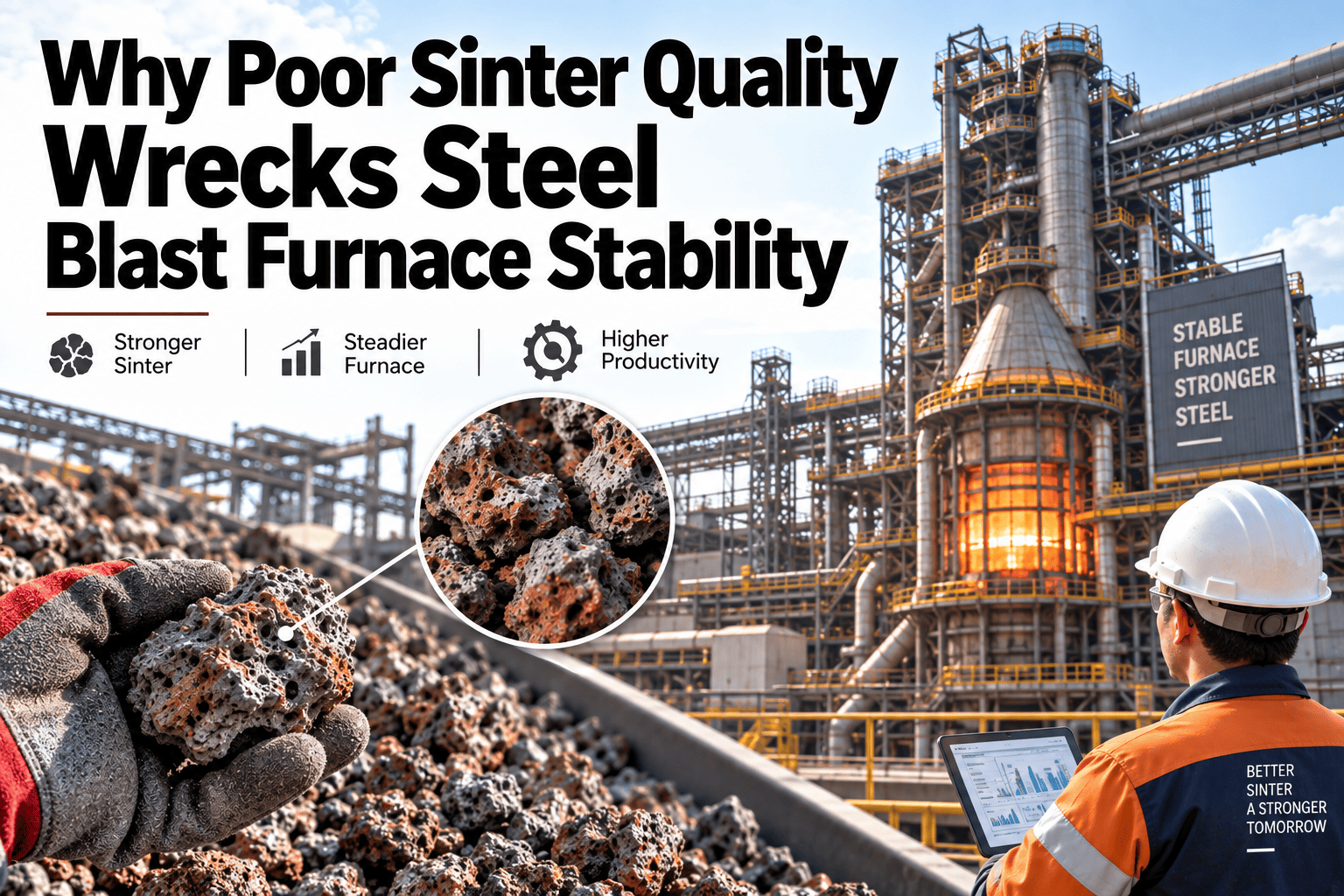
Sinter quality is the upstream lever that controls blast furnace productivity more than any other single input variable. A 1% improvement in sinter tumble index (TI) translates directly to a 0.8–1.2% increase in blast furnace output — and a corresponding reduction in coke rate. Yet most sinter plants still manage windbox pressure, raw mix proportioning, and machine maintenance reactively, leaving substantial productivity on the table. OxMaint's Predictive Maintenance AI brings data-driven control to sinter plant operations — from windbox profiling to strand speed optimization. Book a demo
Article · Steel Production Processes
Sinter Plant Quality Optimization and Maintenance Guide
1%
TI improvement = 0.8–1.2% BF output gain
40–60%
Of BF instability originates in sinter quality variation
$2.4M
Annual value of 5% sinter plant OEE improvement (1.5 MT/yr BF)
Sinter Quality Parameters
The Four Quality Metrics That Drive Blast Furnace Performance
TI
Tumble Index
Target: >75% (> 6.3 mm fraction)
Primary measure of sinter mechanical strength. Low TI generates fines in the burden — the leading cause of permeability loss and BF hanging. Controlled by coke breeze rate, basicity, and burn-through point position.
RDI
Reduction Degradation Index
Target: <30% (< 3.15 mm fraction)
Measures sinter disintegration under reducing conditions inside the BF stack. High RDI increases fines generation in the cohesive zone, restricts gas flow, and reduces driving rate. Controlled by FeO content and MgO addition.
RI
Reducibility Index
Target: >65% (ISO 4695 method)
Rate at which iron oxide in the sinter is reduced to metallic iron. High RI lowers coke rate and improves BF productivity. Maximized by optimizing basicity (CaO/SiO₂ ratio 1.7–2.1) and hematite content.
FeO
FeO Content
Target: 6–10% (grade dependent)
Indicator of sinter oxidation state. Low FeO improves reducibility but reduces strength. High FeO reduces RDI but penalizes RI. Balancing FeO against TI and RDI is a core sinter plant optimization challenge.
Windbox Control
Windbox Pressure Profiling: The Key to Uniform Burn-Through
The windbox pressure profile across the sintering strand determines how heat propagates through the raw mix bed. An ideal profile produces burn-through point (BTP) at 85–92% of strand length — ensuring complete sintering without overburning at the discharge end. Deviations from this profile are the most common cause of inconsistent sinter quality across a shift.
Zone 1–3
0–20% (Feed end)
80–120
Ignition and early combustion
Low pressure → poor ignition, raw sinter layer
Zone 4–8
20–60% (Mid strand)
120–160
Main combustion and heat front propagation
Pressure drop → cold spot, TI reduction
Zone 9–12
60–90% (BTP zone)
140–180
Burn-through completion and cooling initiation
High pressure → early BTP, over-reduction of FeO
Zone 13–16
90–100% (Discharge)
60–100
Sinter cooling before discharge
Rapid cooling → thermal shock, RDI increase
Raw Mix Optimization
Raw Mix Balance: Control Parameters and Targets
| Raw Mix Parameter |
Typical Control Range |
Quality Impact |
OxMaint Monitoring |
| Coke Breeze Rate |
4.5 – 6.0% (on mix weight) |
Controls peak temperature and TI. Excess coke → high FeO, low RI |
Real-time weighing, ±0.1% alert |
| Basicity (CaO/SiO₂) |
1.7 – 2.1 |
Governs slag bonding phase — critical for TI and RI balance |
Per-batch calculation, drift alert |
| MgO Addition (dolomite) |
1.5 – 2.5% |
Reduces RDI by forming MgO-bearing silicates. Excess slows reduction |
Dosing rate check, ±0.2% alert |
| Moisture Content |
6.5 – 7.5% |
Controls mix permeability. Low moisture → poor layering, flame back |
Continuous near-infrared sensor |
| Mean Particle Size |
3 – 5 mm (granulated) |
Bed permeability and combustion uniformity. Fines <1mm are detrimental |
Online laser sizer, ±0.5 mm alert |
| Return Fines Ratio |
25 – 35% (of total mix) |
Excess return fines reduce bed permeability and cause flame channelling |
Weigh belt integration, ratio alert |
Predict Sinter Quality Before the Strand Reaches Discharge
OxMaint's Predictive Maintenance AI monitors windbox profiles, raw mix parameters, and strand speed in real time — alerting your team to quality deviations before they reach the blast furnace.
Critical Equipment Maintenance
Preventive Maintenance Priorities for Sinter Plant Reliability
Sintering Machine Strand
DailyPallet car wheel and rail inspection, lubrication check
WeeklyGrate bar gap measurement, worn bar replacement
MonthlyStrand speed drive calibration, tension roller alignment
Failure impact: Full strand stoppage — 8–24 hr production loss
Windbox and Ductwork
WeeklyWindbox flap damper position and seal inspection
MonthlyDuctwork erosion measurement (ultrasonic thickness)
QuarterlyMain duct internal inspection and buildup removal
Failure impact: Pressure profile distortion — quality and yield loss
Ignition Furnace
DailyBurner flame pattern check, gas pressure verification
WeeklyRefractory inspection, thermocouple calibration check
MonthlyCombustion air damper calibration, full burner service
Failure impact: Ignition failure — raw sinter, TI collapse
Mixing Drum and Granulator
DailyMoisture addition nozzle check, drum rotation speed
WeeklyDrum liner wear inspection, discharge seal check
MonthlyDrive motor vibration analysis, pinion gear lubrication
Failure impact: Mix granulation failure — bed permeability loss
Expert Review
Research and Industry Expert Perspectives
"Sinter plant predictive maintenance represents the highest-leverage maintenance investment available to an integrated steel plant. Our benchmarking across 28 blast furnace complexes shows that plants with AI-assisted sinter quality monitoring achieve tumble index standard deviations 35–45% lower than manually controlled operations. The reduction in BF burden variability alone translates to coke rate savings of 8–15 kg/tHM — a figure that dwarfs the platform investment cost within months."
— ISIJ International, Ironmaking Technology Research, Vol. 64, 2024
"The burn-through point is the single most informative real-time indicator of sinter quality in a running strand. Plants that monitor BTP continuously and use it as the primary feedback variable for strand speed adjustment consistently outperform those that rely on offline TI measurements alone. Real-time BTP control, combined with predictive raw mix adjustment, has reduced per-campaign quality excursions by 50–65% in documented implementations at major integrated producers."
— Steel Research International, Sintering Process Optimization Studies, 2024
FAQs
Frequently Asked Questions
How does OxMaint use windbox data to predict sinter quality issues?
OxMaint ingests windbox pressure readings from each zone in real time and builds a pressure profile for every strand campaign. The AI model compares the live profile against historical data correlated with final TI and RDI results. When the developing profile indicates a BTP position outside the 85–92% strand length target, the system alerts operators to adjust strand speed or coke breeze rate before the affected material reaches the blast furnace.
Start free to connect your windbox instrumentation.
What is the recommended PM schedule for sinter machine pallet cars?
Daily lubrication and wheel condition checks are the minimum standard. Grate bar gap measurement should be performed weekly — gaps exceeding 8 mm allow raw mix to fall through, reducing yield and increasing return fines generation. A full pallet car overhaul — replacing worn grate bars, checking axle condition, and measuring wheel flange thickness — should be scheduled every 2,000–3,000 operating hours or when vibration analysis detects anomalies. OxMaint schedules and tracks all pallet car PM tasks automatically.
Book a demo to see the PM schedule builder.
How does return fines ratio affect sinter quality and how should it be controlled?
Return fines (screen undersize below 5–6 mm) are recirculated to the raw mix as a granulation aid and to recover zinc and alkali-bearing materials. The optimal return fines ratio is 25–35% of total mix weight. Above 35%, bed permeability decreases due to excess fines content, causing flame channelling, variable BTP position, and increased TI spread. OxMaint monitors return fines weigh belt data in real time and alerts when the ratio drifts outside the control band, allowing operators to adjust screen settings or strand speed to rebalance.
Can OxMaint integrate with existing sinter plant SCADA and process historian systems?
Yes. OxMaint connects to sinter plant SCADA via OPC-UA and Modbus protocols, and integrates with process historians including OSIsoft PI (AVEVA PI), Honeywell PHD, and AspenTech IP.21. All windbox pressure, strand speed, raw mix proportioning, and BTP pyrometer data can be ingested, trended, and used as inputs to OxMaint's predictive maintenance models. Implementation typically requires 2–4 weeks for initial data connection and model baseline training before live quality alerts are operational.
Predictive Maintenance AI
Put AI in Control of Your Sinter Quality — Before It Reaches the Blast Furnace
OxMaint monitors every windbox, tracks every raw mix parameter, and predicts quality deviations in time for your operators to act — protecting blast furnace productivity and reducing coke rate continuously.