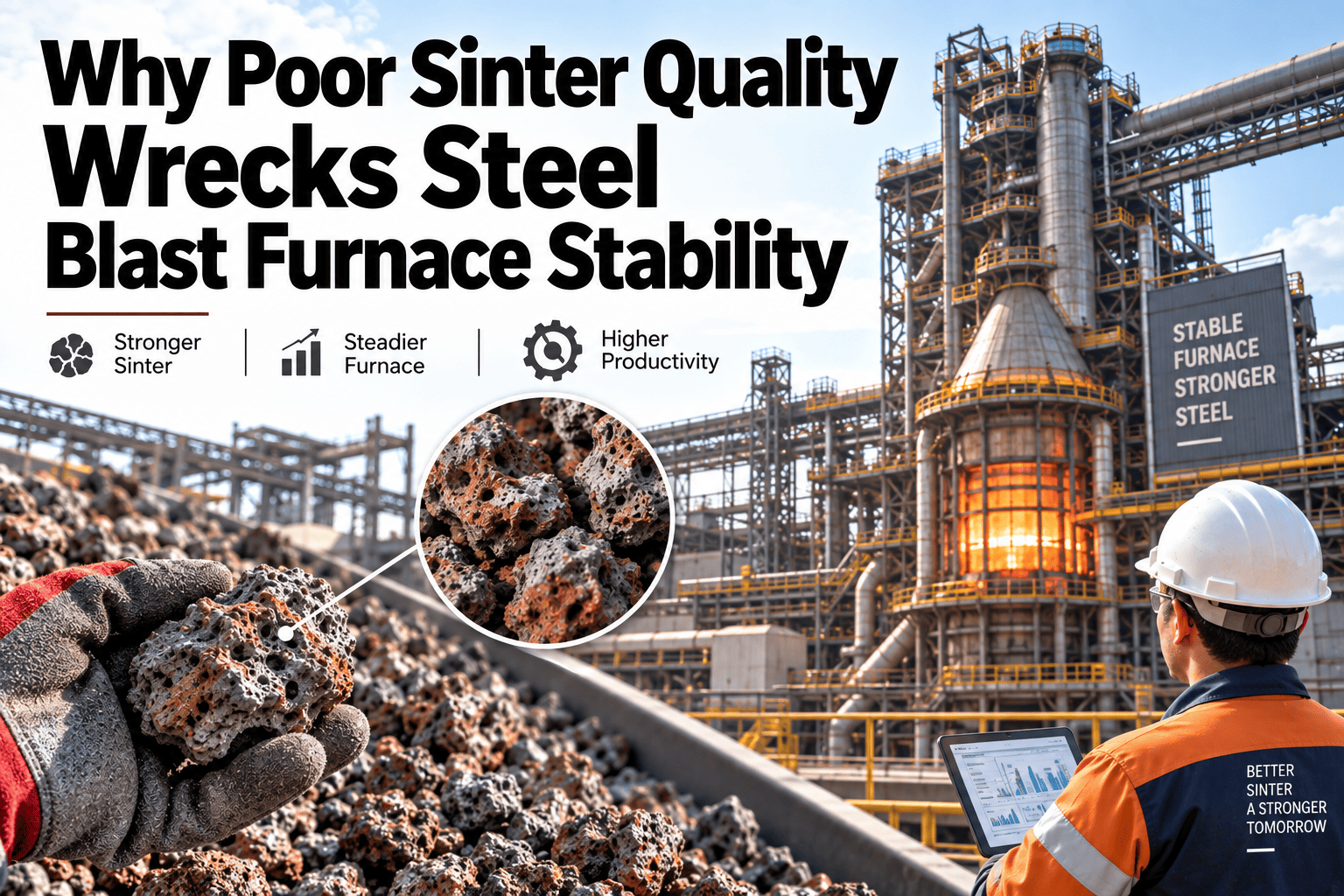
A blast furnace doesn't fail because of one bad shift. It fails because of hundreds of small inconsistencies in the burden feeding it, and sinter is usually the biggest single contributor. When basicity swings, FeO content drifts, or size distribution goes off-spec, the furnace has to absorb that variability internally — and it does so through erratic gas flow, cooling stave stress, and fuel rate creep that operators often trace back to the wrong cause, Start a free trial with Oxmaint
Sinter Quality & Blast Furnace Stability
Sinter quality problems don't stay in the sinter plant — they move straight into your furnace
Reduction degradation index, tumbler strength, basicity, and size distribution all determine how the burden behaves once it's inside the stack. Manual lab sampling catches these variations hours after they've already disrupted permeability and gas flow.
Cause and Effect
How sinter quality variation becomes furnace instability
Sinter defects rarely announce themselves at the furnace top. They surface gradually, as a chain reaction that starts on the sinter strand and ends in erratic burden descent, hanging, or slips.
Chemistry & basicity drift
Inconsistent limestone or coke breeze proportioning shifts basicity outside target range, changing the melting behavior of the sinter cake.
Weak reduction properties
Poor RDI (reduction degradation index) means sinter fragments and generates fines as it's reduced inside the stack, rather than staying intact.
Fines choke the bed
Generated fines accumulate in the cohesive zone, reducing voidage and restricting the upward flow of reducing gas through the burden.
Permeability drops
Restricted gas flow forces uneven burden descent, raising the risk of channeling, hanging, and sudden slips that jolt the entire furnace.
Fuel rate and output pay the price
Operators compensate with higher fuel rates and reduced blast volume, protecting stability at the direct cost of hot metal output and coke consumption.
The Metrics That Matter
Sinter quality indicators every burden manager should be watching
These are the parameters that determine whether sinter will behave predictably inside the blast furnace stack, not just whether it looks acceptable on the strand.
RDI (Reduction Degradation Index)
Target <25%
Measures fines generated during low-temperature reduction; high RDI degrades permeability deep in the stack.
Tumbler / Shatter Index
Target >65%
Physical strength indicator; low values mean sinter breaks apart in transport and charging, adding fines to the burden.
Basicity (CaO/SiO2)
Target 1.8–2.2
Controls melting and softening behavior; wide swings between charges create inconsistent cohesive zone shape.
FeO Content
Target 7–10%
Too low weakens sinter strength; too high increases reducibility demand and can raise coke rate.
Size Distribution
Target 5–50mm band
Wide size variation between batches leads to segregation on the belt and uneven burden layering at the throat.
Return Fines Ratio
Target <20%
A rising return fines ratio is often the earliest signal that strand conditions are drifting before lab results confirm it.
Sampling Reality
Manual lab sampling versus continuous condition monitoring
Most sinter plants still rely on batch lab testing, pulled every few hours, to represent quality across an entire production run. That approach was reasonable when sinter machines ran slower and burden mix changed infrequently — neither is true anymore.
Manual Sampling
- Lab results lag production by 2–4 hours
- Composite samples mask short-term drift
- No link between quality data and strand equipment condition
- Ignition hood, cooler, and windbox issues found only after a quality complaint
CMMS-Connected Monitoring
- Quality readings logged against strand speed and equipment status in real time
- Trend alerts flag drift before a full batch is affected
- Work orders auto-generated when equipment condition correlates with quality decline
- Ignition hood temperature and cooler airflow tracked as maintainable assets
Protect Furnace Stability at the Source
See how sinter plant asset condition connects to your furnace KPIs
OxMaint can show you what it looks like to track sinter plant equipment health alongside quality trends, in one connected dashboard.
Equipment Root Causes
The sinter plant equipment behind most quality swings
Sinter quality problems are frequently blamed on raw material variability, but a significant share trace back to equipment condition on the strand itself.
Ignition Hood Wear
Uneven ignition temperature across the strand width produces inconsistent sintering depth, directly affecting strength and RDI batch to batch.
Pallet Car Leakage
Worn pallet car grates and seals allow air leakage that disrupts the suction profile, creating uneven combustion through the bed depth.
Cooler Airflow Imbalance
Blocked or worn cooler fans create hot spots that leave sinter under-cooled, increasing fines generation during downstream screening and transport.
Crusher & Screen Wear
Worn crusher liners and screen decks shift the final size distribution, sending an inconsistent product mix to the furnace stockhouse.
How OxMaint Helps
Connecting sinter plant maintenance to furnace stability
OxMaint gives sinter plant and blast furnace teams a shared view of equipment condition, inspection data, and quality trends, so root cause investigations stop starting from zero.
Strand Equipment Inspections
Mobile checklists for ignition hood, pallet cars, windboxes, and coolers standardize what gets checked and how often across every shift.
Condition-Based Work Orders
Automatically generate corrective work orders when inspection findings or sensor thresholds indicate equipment is drifting toward a quality-impacting failure.
Preventive Maintenance Scheduling
Schedule crusher liner replacement, screen deck inspection, and pallet car seal checks on a cycle tied to actual wear data rather than guesswork.
Cross-Team Dashboards
Give burden and furnace engineers visibility into sinter plant equipment status, closing the communication gap that delays root cause analysis.
Frequently Asked Questions
Sinter quality and blast furnace stability, answered
How does poor sinter quality cause blast furnace hanging and slips?
Weak or high-RDI sinter generates fines as it descends and reduces, which reduces bed voidage and restricts gas flow. That uneven permeability leads to channeling, hanging, and sudden slips as the burden tries to correct itself.
What is a good RDI target for blast furnace sinter?
Most integrated operations target RDI below roughly 25 percent, though the exact figure depends on furnace size and burden mix. Consistently exceeding target RDI is a strong early indicator of strand-level quality problems.
Can equipment condition on the sinter strand really affect chemistry?
Yes. Ignition hood wear, pallet car leakage, and cooler imbalance all change how evenly the bed sinters and cools, which shows up as batch-to-batch variation in strength, FeO, and size distribution even when raw material chemistry is stable.
How can a CMMS help reduce sinter-related furnace instability?
A CMMS like OxMaint connects inspection data and equipment condition on the sinter strand to quality trends, making it possible to catch equipment-driven quality drift before it reaches the furnace stockhouse.
What's a practical first step for tracking sinter plant equipment health?
Start by digitizing ignition hood, cooler, and pallet car inspections so condition data is timestamped and searchable. You can book a demo to see how this connects to furnace-side KPIs.
Stabilize the Furnace From the Sinter Plant Up
Stop treating sinter quality and equipment maintenance as separate problems
OxMaint connects sinter strand inspections, preventive maintenance, and quality trends so your team can catch drift before it reaches the blast furnace.