The Six Big Losses in Steel Manufacturing & How to Eliminate Them
By Michael Finn on March 11, 2026
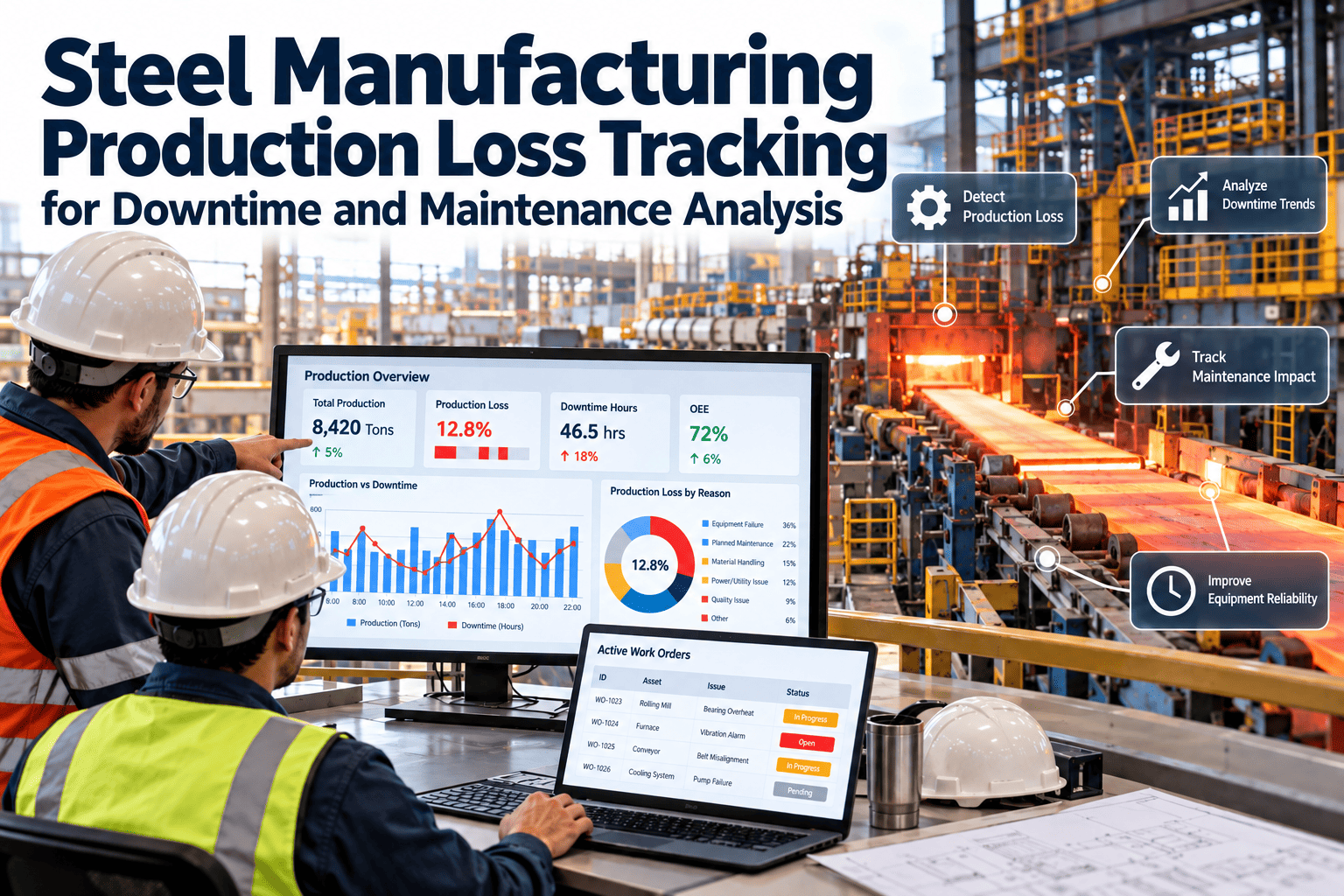
Steel manufacturing is one of the most capital-intensive industries on the planet, yet most steel plants operate at OEE levels between 45% and 65%—leaving millions of dollars of production capacity unrealised every year. The root cause is almost always the same: the six big losses. These six categories of waste—equipment failures, setup and adjustment losses, minor stoppages, reduced speed, process defects, and reduced yield—silently erode availability, performance, and quality across every casting line, rolling mill, furnace, and finishing operation. A mid-size steel mill in the Midwest learned this lesson when a recurring bearing failure on their continuous caster cost them 73 hours of unplanned downtime in a single quarter. The maintenance team had been replacing bearings reactively for two years, never connecting the pattern to a lubrication schedule that had drifted from its original TPM standard. When they finally mapped all six losses across the caster line, they discovered the bearing failures were just one symptom of a systemic breakdown costing $4.2 million annually in lost output, scrap, rework, and emergency repairs.
Total Productive Maintenance (TPM) and OEE-driven loss elimination programmes have proven that steel plants can recover 15–30% of hidden production capacity by systematically identifying, measuring, and eliminating each of the six big losses. The framework works because it forces steel manufacturers to see every minute of downtime, every percentage point of speed reduction, and every tonne of off-spec product as a measurable, addressable loss—not an inevitable cost of doing business. Oxmaint provides the CMMS platform that captures real-time OEE data, automates TPM workflows, tracks loss categories by equipment and production line, and generates actionable improvement plans that turn loss data into recovered capacity. Start your free trial to begin mapping and eliminating the six big losses across your steel plant today.
Definitive TPM Guide 2026
The Six Big Losses in Steel Manufacturing & How to Eliminate Them
Identify and eliminate the six big losses costing your steel plant millions annually. From equipment failures and setup losses to reduced speed and defects — this is the complete, actionable guide to mapping every loss category to its root cause, deploying TPM countermeasures, and recovering hidden OEE capacity across furnaces, casters, rolling mills, and finishing lines. Built for maintenance leaders, plant managers, and continuous improvement teams in steel manufacturing.
The Six Big Losses Framework: OEE Loss Categories Explained
The six big losses framework is the foundation of every successful TPM and OEE improvement programme in steel manufacturing. Developed as part of Total Productive Maintenance, the framework classifies all production losses into six categories mapped to the three OEE pillars: Availability, Performance, and Quality. Each loss has distinct root causes, measurement methods, and elimination strategies specific to steel plant operations. Understanding this architecture is the first step toward recovering the 35–55% of theoretical capacity that most steel mills leave on the table.
Six Big Losses Mapped to OEE Pillars6 Loss Categories
Loss 1: Equipment Failure
Unplanned breakdowns on furnaces, casters, rolling mills, and drives that halt production entirely — the single largest source of downtime losses in steel manufacturing
Availability Loss | Unplanned Downtime | Avg. 8–15% OEE Impact
Loss 2: Setup & Adjustment
Time lost during product changeovers, grade transitions, roll changes, mould swaps, and equipment adjustments — every minute of setup is a minute of zero output
Availability Loss | Planned Downtime | Avg. 5–12% OEE Impact
Loss 3: Minor Stoppages
Brief interruptions under 5 minutes — sensor trips, material jams, cobbles, misfeeds, and alarm resets that individually seem minor but collectively destroy throughput
Performance Loss | Idling & Small Stops | Avg. 3–8% OEE Impact
Loss 4: Reduced Speed
Running equipment below designed cycle time — derating furnaces, slowing casting speed, reducing rolling mill throughput due to wear, quality concerns, or operator caution
Performance Loss | Speed Loss | Avg. 5–15% OEE Impact
Loss 5: Process Defects
Off-specification product requiring rework, downgrading, or scrapping — surface defects, dimensional nonconformance, chemistry deviations, and mechanical property failures
Startup losses during furnace ramp-up, caster sequencing, and grade transitions — off-spec material produced between process start and stable production conditions
Quality Loss | Startup & Yield Loss | Avg. 1–5% OEE Impact
The Loss Cascade: How Six Losses Compound Into Millions
The six big losses in steel manufacturing never operate in isolation. A single unaddressed equipment degradation triggers a cascade that amplifies through every OEE pillar — turning a $50,000 bearing problem into a $2 million annual loss. The cascade below illustrates how a common failure mode on a continuous casting machine compounds through all six loss categories when TPM disciplines are absent. Discover how Oxmaint breaks this cascade at every stage.
Six Big Losses Compounding Cascade — Continuous Caster ExampleHow a single unaddressed degradation multiplies across all OEE pillars
1
Equipment Degradation
Mould oscillator bearing wear begins — vibration increases 0.3 mm/s per week but stays below alarm threshold. No predictive maintenance programme detects the trend
Weeks 1–4
2
Speed Reduction
Operators notice mould vibration and reduce casting speed from 1.4 m/min to 1.1 m/min to maintain surface quality — 21% throughput loss goes unreported
Weeks 4–6
3
Quality Defects
Mould oscillation irregularity creates surface cracks on slabs — 12% of output requires scarfing or is downgraded. Scrap costs accumulate unnoticed
Weeks 6–8
4
Breakdown Failure
Bearing seizes during casting — emergency shutdown, strand breakout risk, 18-hour unplanned outage for bearing replacement and mould rebuild
Week 8–9
5
Setup & Yield Loss
Post-repair startup requires 4 hours of setup plus 6 heats of reduced-yield transition material — $380K in combined setup and startup losses per incident
Each of the six big losses manifests differently across steel plant equipment. The matrix below maps every loss category to the specific equipment it impacts most, the measurable indicators that reveal the loss, the TPM countermeasure that eliminates it, and the typical annual cost per production line. This is the actionable reference for maintenance and production teams building their loss elimination programme.
Six Big Losses — Steel Equipment Impact & Elimination Matrix
Loss CategoryKey Equipment AffectedTPM CountermeasureTypical Annual Cost
OEE Recovery Benchmarks After Six Big Losses EliminationAchievable improvements for steel plants deploying structured TPM programmes
85%
Target OEE
World-class OEE benchmark for integrated steel operations
70%
Downtime Reduction
Average unplanned downtime eliminated through predictive TPM
50%
Setup Time Cut
Changeover time reduction using SMED and standardised procedures
60%
Defect Reduction
Quality losses eliminated through process control and poka-yoke
$4M+
Annual Savings
Typical recovered value per production line through loss elimination
9 mo
Full ROI
Typical payback period for TPM programme including CMMS deployment
TPM Loss Elimination Implementation Calendar
Eliminating the six big losses in a steel plant requires a structured implementation cadence. Attempting to attack all six losses simultaneously overwhelms teams and produces shallow results. The calendar below sequences loss elimination activities from daily operator-level actions through quarterly management reviews, building TPM discipline layer by layer until autonomous maintenance becomes embedded in plant culture.
Daily
Operators perform autonomous maintenance checks: cleaning, lubrication, tightening, inspection (CLTI)Record all minor stoppages and speed losses in CMMS with root cause tagsShift-end OEE review: Availability, Performance, Quality scores posted at line-side boardsDefect samples tagged, photographed, and logged for quality maintenance analysis
Weekly
TPM team reviews top 5 equipment failure and minor stoppage events from previous week5-Why root cause analysis completed for any breakdown exceeding 2 hoursSetup time tracking reviewed — identify changeovers exceeding standard time by 20%+Predictive maintenance data review: vibration trends, oil analysis, thermal findings
Monthly
OEE loss waterfall analysis: quantify each of six losses by equipment and production linePareto analysis of breakdown causes — update focused improvement project prioritiesSMED workshop on highest-impact changeover (target 30% time reduction per workshop)Yield loss review: analyse startup and transition losses, update ramp-up procedures
Quarterly
Management review: OEE trend by line, six big losses cost impact, project ROI validationAutonomous maintenance step audit — advance teams to next AM step levelEquipment criticality re-ranking based on updated failure and loss data
Annually
Full plant OEE benchmark against world-class standards — set next year's loss elimination targetsTPM maturity assessment: score each pillar and develop 12-month advancement planCapital investment prioritisation based on OEE loss data and equipment life-cycle analysis
Stop Losing Millions to the Six Big Losses
Oxmaint captures real-time OEE data from every furnace, caster, and rolling mill — automatically classifying downtime, speed losses, and quality events into the six big losses framework. Morning-ready dashboards show exactly where your capacity is hiding and which TPM actions will recover it fastest.
Most steel plants sit at Level 1 — reactive firefighting where breakdowns drive the maintenance schedule and nobody measures the other five losses. Understanding your maturity level determines your investment path, technology priorities, and the realistic timeline for closing the gap to world-class OEE performance.
Level 1: Reactive / Firefighting
Run-to-Failure MaintenanceNo OEE MeasurementPaper-Based Work OrdersLosses Unquantified
Typical OEE: 35–50%. Six big losses unmeasured. All maintenance is reactive. Equipment failures dominate production schedules. Setup times are uncontrolled.
Typical OEE: 80–92%. All six losses quantified, Pareto-ranked, and under active reduction. Zero-breakdown mindset. SMED on all changeovers. Startup yield optimised.
ROI: Reactive Maintenance vs. TPM Loss Elimination Programme
Annual Cost Impact: Single Integrated Steel Production LineReactive approach vs. structured TPM six big losses elimination programme
Actionable Elimination Strategies for Each Loss Category
Each of the six big losses requires a distinct elimination strategy tailored to steel manufacturing operations. Generic advice fails because the root causes of equipment failure in a rolling mill are fundamentally different from yield loss in an EAF. The strategies below provide specific, implementable countermeasures for each loss category — proven in steel plants operating furnaces, casters, hot and cold rolling mills, and finishing lines.
Equipment Failure Elimination
Deploy condition-based monitoring (vibration, oil analysis, thermography) on critical assets. Implement autonomous maintenance with operator CLTI routines. Build MTBF tracking into CMMS and set zero-breakdown targets for pilot equipment. Conduct PM optimisation to eliminate over-maintenance and under-maintenance simultaneously.
70% reduction in unplanned breakdowns achievable within 12 months of structured TPM
Setup & Changeover Reduction
Apply SMED (Single Minute Exchange of Die) to roll changes, mould swaps, and grade transitions. Convert internal setup tasks to external tasks performed while equipment runs. Standardise setup procedures with visual work instructions. Pre-stage tooling, consumables, and materials before planned changeovers.
50% setup time reduction per SMED cycle — with gains compounding across successive workshops
Minor Stoppage & Speed Loss Recovery
Install automated micro-stoppage logging to capture events under 5 minutes that operators rarely report. Conduct Pareto analysis on top stoppage causes weekly. Set ideal cycle times for every process step and track actual vs. ideal continuously. Remove speed-limiting constraints through focused improvement (kobetsu kaizen).
40% performance loss recovery by making invisible speed and stoppage losses visible and actionable
Defect & Yield Loss Elimination
Implement quality maintenance (hinshitsu hozen) linking equipment conditions to quality outcomes. Deploy SPC on critical quality parameters. Use poka-yoke devices to prevent defect-creating conditions. Optimise startup sequences with standardised ramp-up procedures to minimise transition material and first-pass yield loss.
60% reduction in quality losses through systematic connection of equipment conditions to defect types
Recover Hidden Capacity Across Every Production Line
From real-time OEE dashboards to automated loss classification, from predictive maintenance workflows to TPM audit tracking — Oxmaint delivers the complete digital platform that makes every minute of downtime, every percentage of speed loss, and every tonne of scrap visible, measurable, and eliminable.
CMMS Integration: Connecting Loss Data to Elimination Action
The difference between steel plants that talk about TPM and steel plants that achieve world-class OEE is the system that connects loss measurement to corrective action. The six capabilities below describe how Oxmaint transforms raw production data into structured loss analysis, prioritised improvement projects, and trackable results — closing the loop from loss identification to elimination.
01Automated OEE Data Capture
Oxmaint integrates with PLC/SCADA systems, production counters, and operator inputs to calculate real-time OEE across every furnace, caster, rolling stand, and finishing line. Availability, Performance, and Quality are computed automatically — eliminating manual data collection and ensuring accuracy.
02Six Big Losses Auto-Classification
Every downtime event, speed deviation, and quality rejection is automatically classified into the correct loss category using configurable reason code trees. The system distinguishes equipment failures from setup losses, minor stoppages from speed losses, and process defects from yield losses — building the Pareto automatically.
03Loss Waterfall & Pareto Dashboards
Interactive OEE waterfall charts show exactly how theoretical capacity decomposes through each of the six losses. Pareto analysis ranks loss events by cost, duration, and frequency — ensuring improvement teams always work on the highest-impact loss first. Drill from plant level to individual equipment.
04TPM Work Order Automation
Autonomous maintenance checklists, condition-based PM triggers, and focused improvement project tasks are managed through structured CMMS workflows. When predictive sensors detect degradation, the system auto-generates work orders with equipment history, failure mode, recommended parts, and optimal maintenance window.
05SMED & Changeover Tracking
Setup and adjustment losses are tracked against standard changeover times for every product transition. The system flags changeovers exceeding target times, captures delay reasons, and feeds SMED workshop prioritisation. Internal vs. external task split is tracked to validate SMED gains over time.
06ROI Tracking & Management Reporting
Every loss elimination project is linked to its measured impact on OEE and cost. Monthly and quarterly management reports quantify recovered tonnes, avoided downtime hours, reduced scrap rates, and dollar savings — proving TPM programme value and justifying continued investment in loss elimination.
Frequently Asked Questions
Q. What are the six big losses in steel manufacturing?
The six big losses are the standardised categories of production waste defined by Total Productive Maintenance (TPM), mapped to the three OEE pillars. Availability losses include (1) equipment failure/breakdown losses and (2) setup and adjustment losses. Performance losses include (3) minor stoppages/idling losses and (4) reduced speed losses. Quality losses include (5) process defect and rework losses and (6) reduced yield/startup losses. In steel manufacturing, these six losses typically account for 35–55% of theoretical production capacity. Equipment failures on furnaces, casters, and rolling mills are usually the largest single loss, followed by speed losses from equipment derating and quality losses from surface defects and off-spec chemistry.
Q. How do you calculate OEE losses in a steel mill?
OEE in a steel mill is calculated as Availability × Performance × Quality. Availability measures actual production time versus planned production time — accounting for equipment failures and setup losses. Performance measures actual throughput rate versus ideal cycle time — capturing minor stoppages and speed losses. Quality measures good output versus total output — reflecting process defects and yield losses. For example, a continuous caster with 88% Availability (downtime losses), 82% Performance (speed and stoppage losses), and 95% Quality (defect and yield losses) has an OEE of 68.5%. The gap between 68.5% and 100% represents the six big losses — which in this case equals 31.5% of theoretical capacity, worth millions of dollars annually. Sign up for Oxmaint to automate OEE calculation and loss tracking across your steel operations.
Q. Which of the six big losses has the highest cost impact in steel plants?
Equipment failure (breakdown loss) is typically the highest single-category cost in steel manufacturing, averaging $1.5M–$6M annually per major production line due to the extreme cost of unplanned downtime in continuous processes. However, reduced speed loss is often the largest total loss when properly measured — because it is chronic, continuous, and frequently unreported. Operators routinely run casting machines, rolling mills, and finishing lines 10–25% below ideal cycle time due to equipment wear, quality concerns, or habitual caution. This "hidden factory" of lost throughput often exceeds breakdown costs but is invisible without real-time OEE tracking. The most effective TPM programmes attack equipment failures first (for quick wins) while simultaneously making speed losses visible through automated performance monitoring.
Q. How does TPM differ from standard preventive maintenance in a steel plant?
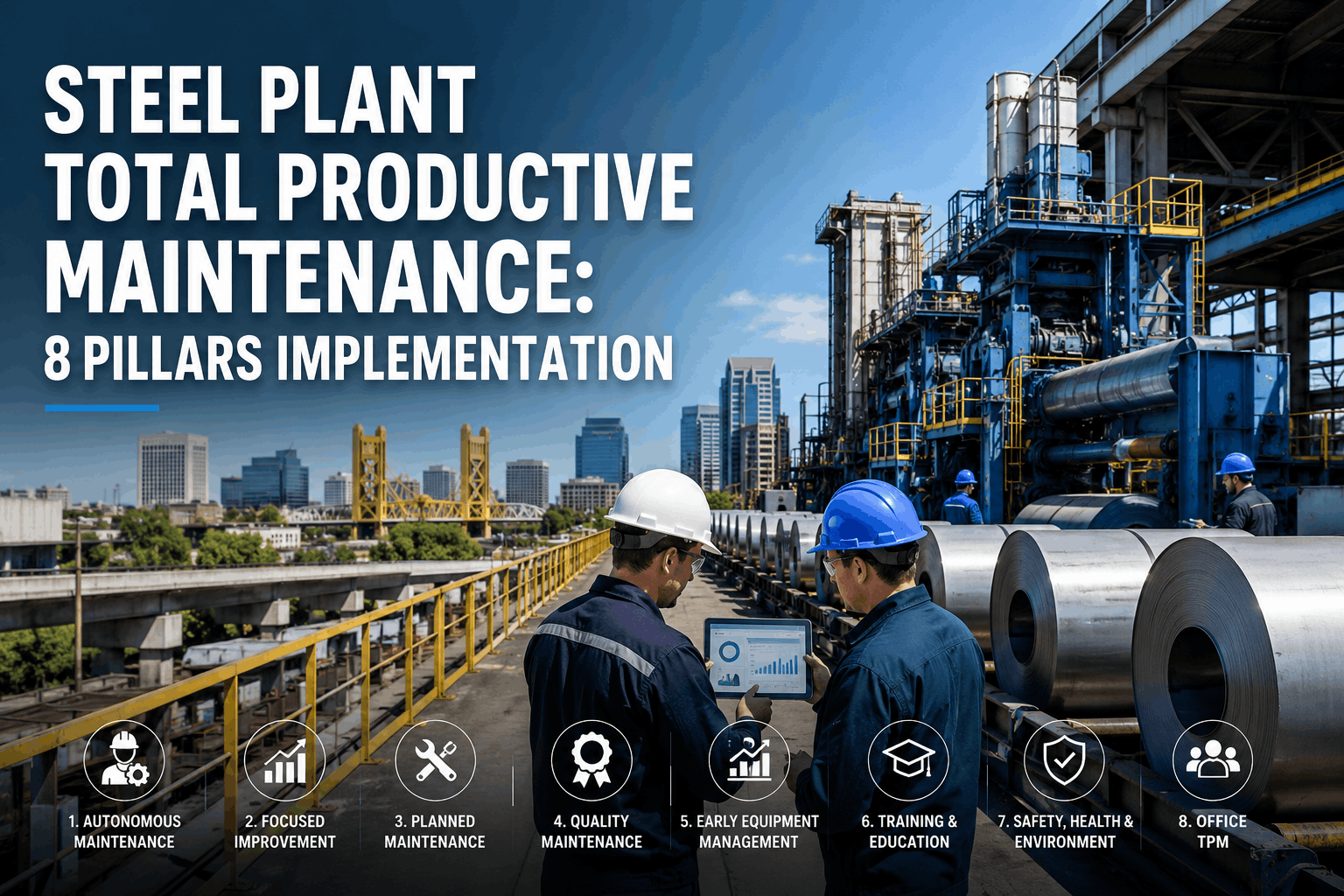
Standard preventive maintenance (PM) focuses on preventing equipment breakdowns through scheduled time-based or usage-based tasks — it addresses only the first of the six big losses. TPM addresses all six losses through eight pillars: autonomous maintenance (operators own basic equipment care), focused improvement (cross-functional teams eliminate specific losses), planned maintenance (optimised PM schedules), quality maintenance (linking equipment conditions to quality outcomes), early equipment management (designing out losses in new equipment), training and education, safety, and office TPM. The critical difference is that TPM treats setup losses, speed losses, minor stoppages, defects, and yield losses as maintenance responsibilities — not just production problems. This integrated approach is why TPM-deployed steel plants achieve 80–92% OEE while PM-only plants plateau at 55–68%. Book a demo to see how Oxmaint supports all eight TPM pillars.
Q. What is a realistic timeline to eliminate the six big losses in a steel plant?
A realistic six big losses elimination programme follows a 24–36 month trajectory. Months 1–3: deploy CMMS-based OEE tracking and establish loss baselines across all production lines. Months 4–9: launch autonomous maintenance on pilot equipment (typically the continuous caster or hot strip mill) and begin focused improvement projects on top-3 breakdown causes. Months 10–18: extend autonomous maintenance plant-wide, conduct SMED workshops on critical changeovers, and deploy predictive maintenance on highest-cost failure modes. Months 19–36: implement quality maintenance linking equipment conditions to defect types, optimise startup/yield procedures, and build continuous improvement culture. Most steel plants see 15–20% OEE improvement in the first 12 months and reach world-class levels (85%+) within 30–36 months. The first major breakdown prevention typically delivers full programme ROI within 9 months.