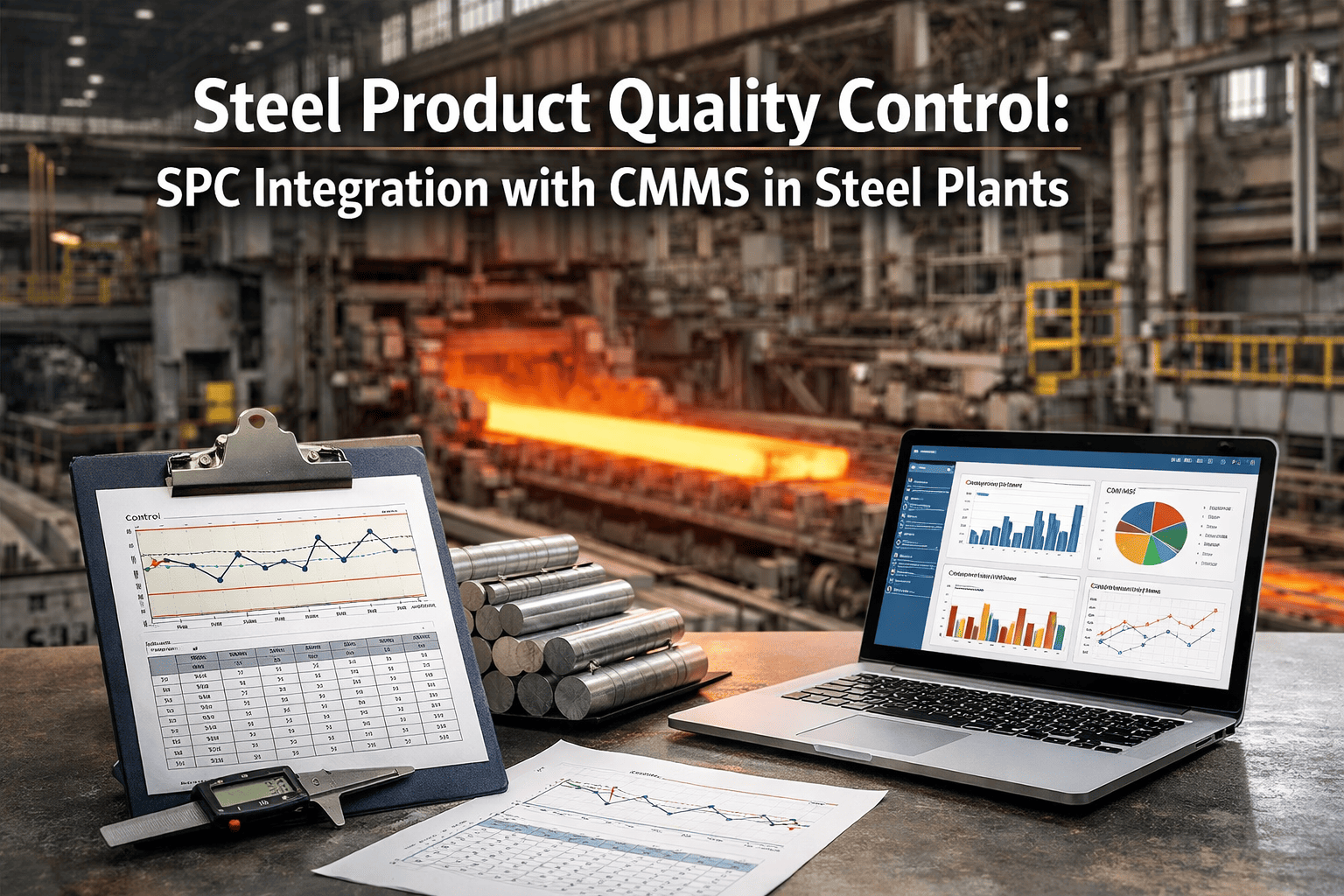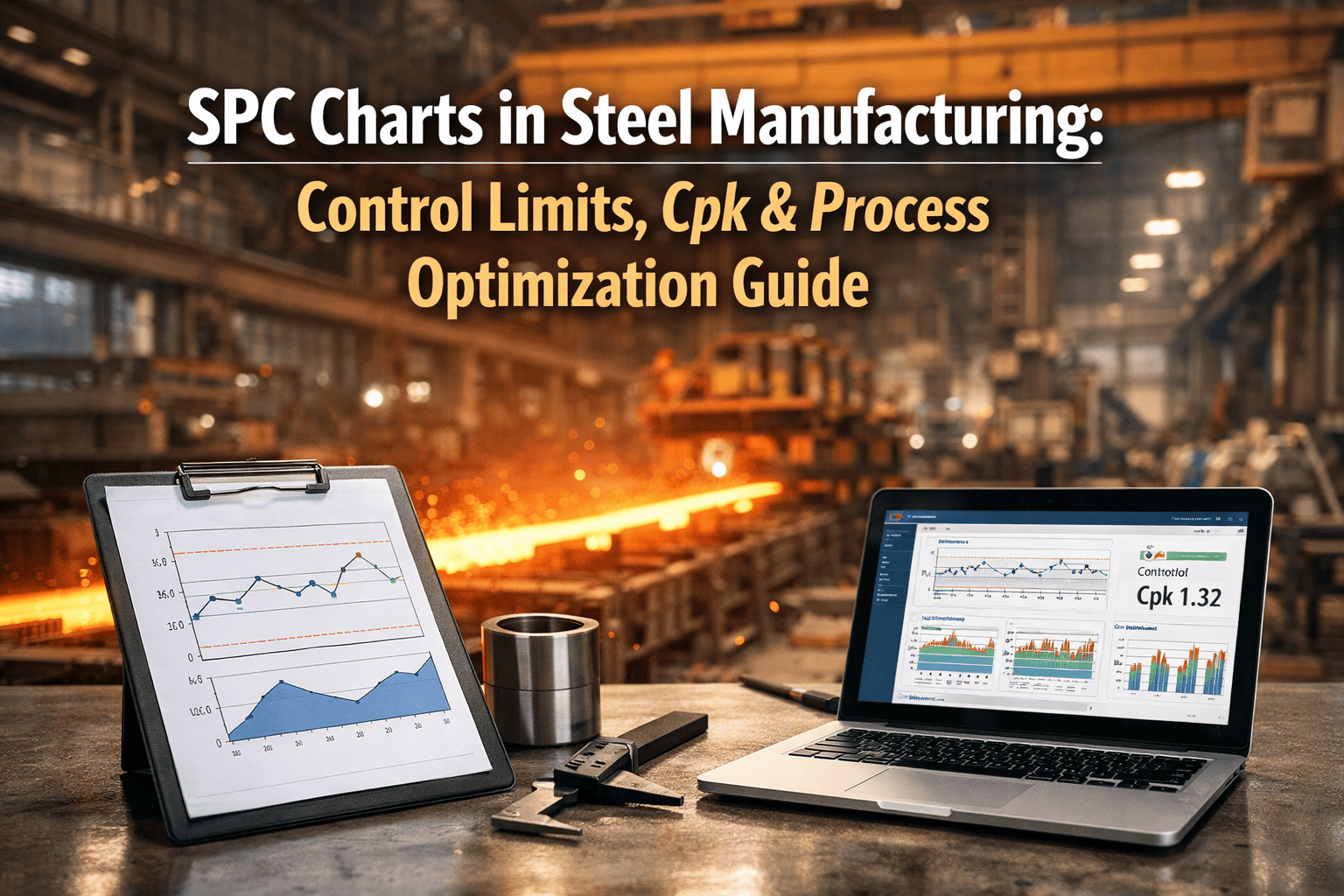
A wire rod mill quality team at a central European steel plant spent four hours every Monday morning compiling a weekly quality report — pulling thickness measurements from one system, tensile test results from another, and surface inspection data from a third, then manually calculating process capability indices in a spreadsheet and checking each against specification limits. The report described last week. It changed nothing about this week. The first time the quality manager used OxMaint's SPC Analytics module to review the same data in real time, the Xbar-R chart for rod diameter flagged a persistent upward trend across the previous 22 hours of production — a trend that the manual review process had never surfaced because it crossed two shifts and two separate data entry logs. The root cause was a worn guide box that had been drifting incrementally for eleven days. One corrective work order and one guide box change later, the Cpk for rod diameter improved from 0.94 to 1.41 without changing any rolling parameters. Sign in to OxMaint to activate SPC Analytics and real-time process capability monitoring for your steel plant. Book a demo to see OxMaint's SPC Charts and Cpk tracking working on live or simulated steel production data.
Steel manufacturing quality control spans three categories of SPC methods — variable measurement charts for continuous data, attribute charts for defect counting, and advanced statistical methods for detecting gradual shift and trend. OxMaint's SPC Analytics module supports all three families. Sign in to OxMaint to configure SPC chart types for each quality parameter in your production route.
Effective SPC implementation in steel production requires capability across four areas — each one building on the previous. OxMaint's SPC Analytics module addresses all four simultaneously from the first shift of data collection. Sign in to OxMaint to activate all four SPC capability areas for your production parameters.
01
Control Chart Construction and Control Limit Calculation
Control limits define the expected range of natural process variation — calculated from your own process data, not from specification tolerances. The standard 3-sigma control limits (UCL and LCL at ±3 standard deviations from the process mean) represent the boundary beyond which a process point is unlikely to be caused by random variation alone. In steel manufacturing, control limits must be established from a period of stable, in-control process operation — typically requiring 20–25 subgroups minimum — and must be recalculated whenever a confirmed process change is made.
OxMaint calculates and displays control limits automatically from incoming measurement data — updating baseline statistics when you confirm a process change and recalculating limits from the new stable period. Sign in to OxMaint to configure automated control limit calculation for your steel production quality parameters.
02
Process Capability Analysis — Cpk, Ppk, and Capability Indices
Process capability indices quantify how well a process performs relative to its specification limits — answering the question "is this process capable of consistently producing to specification?" rather than "is this particular measurement within tolerance?" Cpk measures capability in relation to where the process is currently centred; Ppk measures overall performance including long-term variation. In steel manufacturing, Cpk is calculated for every quality parameter with defined specification limits — dimensional tolerances, chemistry targets, mechanical property ranges, and surface quality criteria.
OxMaint calculates Cpk and Ppk continuously for every configured quality parameter and displays capability trend charts that show whether capability is improving, stable, or degrading over time. Book a demo to see Cpk trending for a steel rolling mill parameter set.
03
CUSUM and EWMA Trend Detection — Finding the Drift Before It Becomes a Defect
Standard Shewhart control charts (Xbar-R, Individuals) are powerful detectors of large, sudden process shifts — but they are designed to ignore small changes in process mean as normal variation. In steel manufacturing, the most economically significant quality problems often develop as small, sustained drifts rather than sudden jumps: a guide box wearing incrementally, a roll temperature gradient shifting by 3°C per hour, a chemistry target drifting 0.01% per campaign as converter refractory ages.
CUSUM and EWMA charts are specifically designed to detect these gradual shifts. CUSUM accumulates departures from target, making small sustained deviations visible as a steadily increasing sum. EWMA weights recent observations more heavily, tracking current process level more sensitively than a simple moving average. Both methods detect mean shifts of 0.5–1.5 standard deviations within 10–20 observations — where a Shewhart chart would require 40–80 observations to flag the same shift through Rule 2 (nine points same side of centreline). Sign in to OxMaint to configure CUSUM and EWMA charts alongside your Shewhart charts for gradual drift detection in steel production parameters.
04
Real-Time SPC Monitoring — From Shift Reports to Live Production Intelligence
The fundamental limitation of manual SPC is that it converts a real-time process signal into a lagging report. By the time a weekly Cpk summary reaches the rolling mill quality meeting, the process condition that generated it has either corrected itself, caused non-conformances on multiple coils, or both. Real-time SPC monitoring eliminates this lag by running control charts continuously on incoming measurement data and alerting the production team to out-of-control signals at the moment they occur — in the control pulpit, on the quality manager's dashboard, and in the maintenance work order system.
OxMaint's SPC Analytics module connects to automated measurement systems (laser gauges, X-ray thickness measurement, automated surface inspection) and to manual data entry — generating control chart updates and Cpk recalculations continuously as data arrives. Western Electric rules are applied in real time and alert notifications are issued to configured recipients immediately on signal detection. Quality engineers can acknowledge signals, log the investigation outcome, and trigger corrective actions without leaving the SPC dashboard. Book a demo to see real-time SPC monitoring working on a simulated steel rolling mill measurement stream.
OxMaint generates Xbar-R, Xbar-S, Individuals-MR, P, NP, C, U, CUSUM, and EWMA charts automatically for each configured quality parameter — without any manual plotting, calculation, or chart construction by the quality team. All 8 Western Electric rules are applied in real time to incoming data, and alert notifications are issued immediately when any rule is violated. Alert recipients, escalation rules, and notification channels are configured per quality parameter by the quality manager. Sign in to OxMaint to activate automated control chart generation for your steel plant quality parameters.
Cpk and Ppk are calculated continuously for every quality parameter as new measurements arrive — displayed on the SPC dashboard alongside the associated control chart. Capability trend charts show whether process capability is improving, stable, or degrading over time, enabling quality managers to evaluate the effectiveness of process improvements before the weekly report cycle. Customer-specific capability requirements (Cpk ≥1.33 for automotive, ≥1.67 for safety-critical grades) are configured per grade family with colour-coded status indicators. Book a demo to see Cpk trending and capability monitoring across a steel plant parameter set.
Every SPC signal generated by OxMaint remains open until a quality engineer acknowledges it, logs an investigation outcome, and either closes it as natural variation or raises a corrective action. Corrective action work orders are linked directly to the SPC signal record — so the effect of each corrective action on subsequent Cpk values is visible and measurable. Signal investigation history builds a root cause library that accelerates future investigations when similar control chart patterns reappear. Sign in to OxMaint to configure the SPC signal investigation workflow for your quality team.
OxMaint generates automated SPC performance reports — control chart summary by parameter, Cpk history by grade and production period, out-of-control signal log with investigation outcomes, and process improvement evidence — in formats aligned with IATF 16949 automotive supplier requirements, ISO 9001 quality management system documentation standards, and customer-specific SPC reporting templates. Quality audit preparation that previously required days of manual chart compilation is generated in minutes from the SPC Analytics database. Book a demo to see automated SPC reporting for IATF 16949 and ISO 9001 compliance.
We had been doing SPC for twelve years. Paper charts, manual Cpk calculations, weekly review meetings. When we connected OxMaint to our laser gauge on the hot strip mill, we saw in the first two days of real-time monitoring what twelve years of weekly SPC review had missed: our thickness Cpk was 1.28 on average but dropped to 0.91 in the third hour of every rolling campaign, consistently, before recovering. The pattern was invisible in weekly data because it averaged out across the full campaign. Real-time EWMA detected it as a repeating thermal gradient issue in the finishing stand that we addressed with a cooling water adjustment. Cpk went to 1.44 and held there.
Frequently Asked Questions — SPC in Steel Manufacturing
The drift that is degrading your process capability right now is visible in your measurement data — if the chart that detects it is running in real time. OxMaint makes every SPC chart continuous, every Cpk live, and every corrective action traceable.
Automated Xbar-R, CUSUM, EWMA, and Cpk charts. All 8 Western Electric rules. Real-time alert management. Corrective action integration. Customer Cpk target tracking. IATF 16949 SPC reporting. Active from your first measurement.