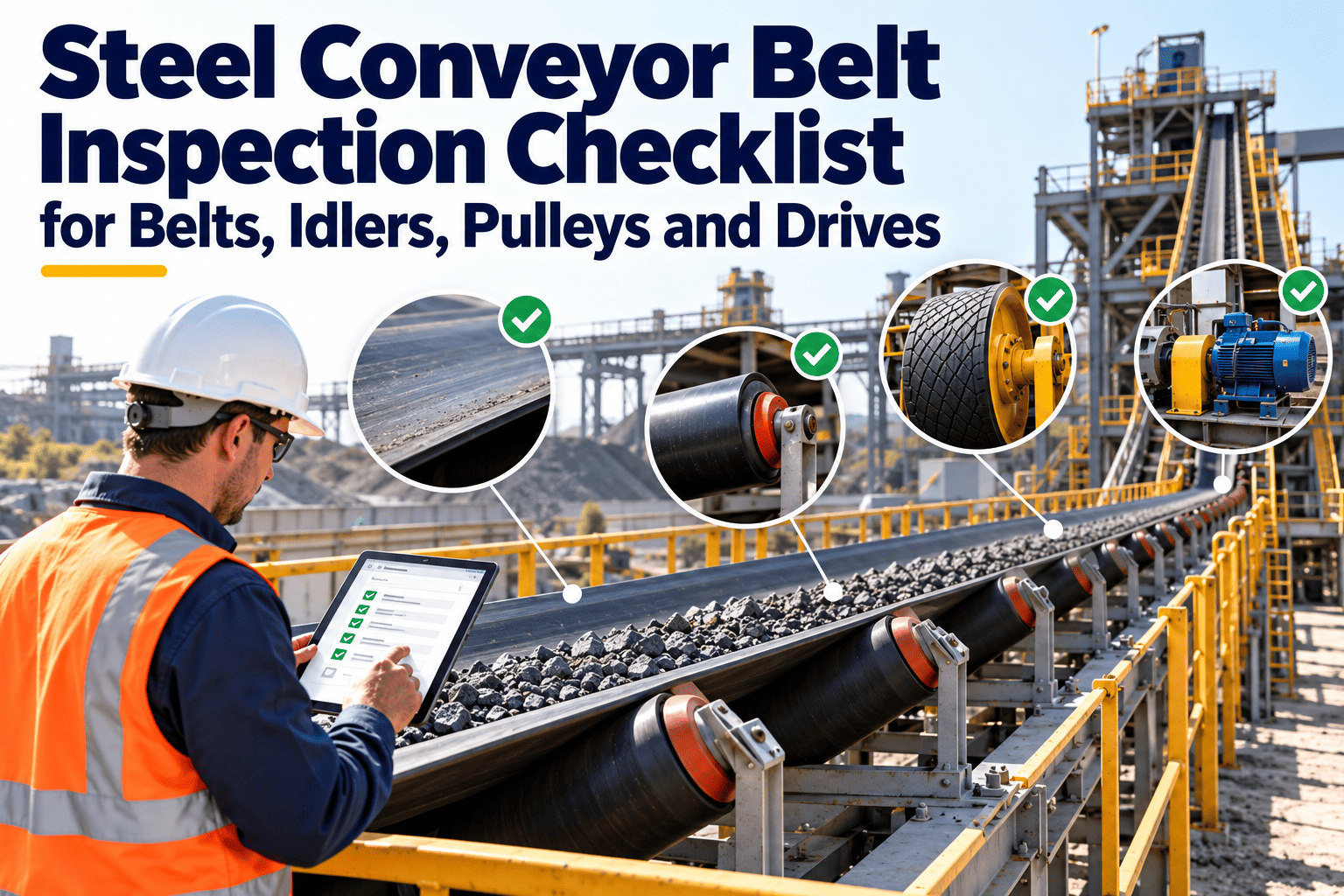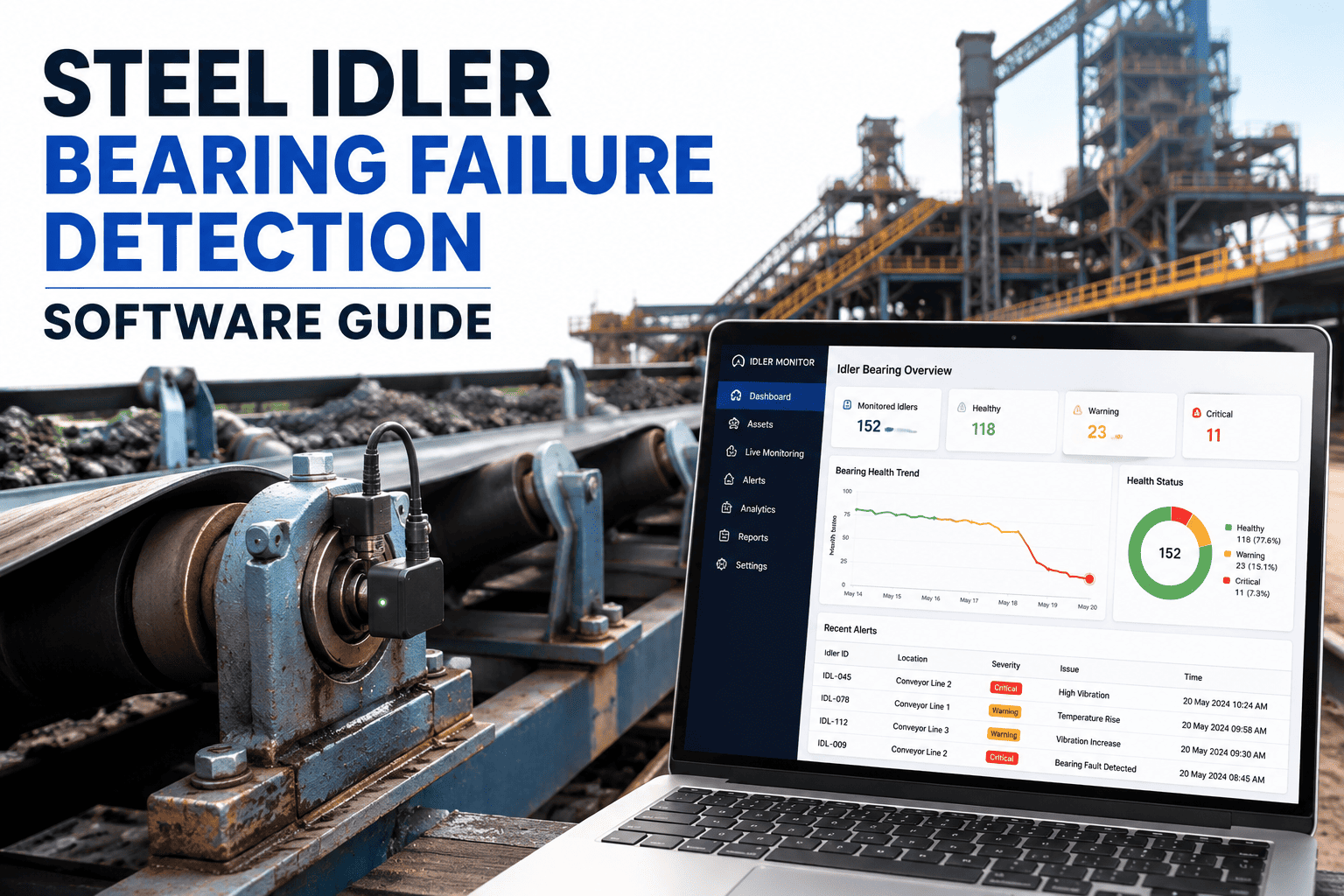
A conveyor idler rarely fails without warning. Weeks before a bearing seizes, the roller starts running warmer, louder and harder to turn, and in a steel plant that drift is easy to miss across thousands of idlers carrying ore, sinter, coke and limestone through dust, heat and moisture. Conveyor idler bearing failure detection turns those early signs into dated readings, ranked alerts and planned replacements instead of belt damage and emergency stops. This guide explains what to measure, how to read it, and how a maintenance team can connect the findings to scheduled work through Oxmaint maintenance management software.
Conveyor Idler Bearing Failure Detection for Steel Plant Conveyors
Find hot, noisy and dragging idlers while they are still a planned replacement. Combine thermal readings, inspection routes and work orders so a failing bearing never reaches the belt.
What one seized idler can set off on a steel plant conveyor
The idler is a low-cost part, yet its failure travels in a predictable chain. Each link is a chance to detect it earlier.
- Seal breachDust, water or mill scale gets past the labyrinth or contact seal and reaches the bearing.
- Lubricant breakdownGrease is contaminated, washed out or oxidised, and metal-to-metal contact begins.
- Heat build-upFriction lifts the housing and shell temperature above the idlers on either side.
- Rotation dragThe roller slows or stops turning while the belt keeps moving across it.
- Shell wear-throughA stationary shell wears thin and can leave a sharp edge in the belt path.
- Belt and fire exposureFriction heat near spilled fines, coke or coal adds ignition risk, and the belt cover can be cut or scorched.
The expensive part of this chain is rarely the roller. It is the belt repair, the lost conveying hours and the downstream starvation of furnaces, sinter strands or stockyard reclaim.
Idler stress differs by conveyor service
A single inspection interval for every belt wastes effort. Match attention to what the conveyor carries and where it runs.
| Conveyor service | Main stressor | Typical idler failure pattern | Inspection emphasis |
|---|---|---|---|
| Sinter raw mix and return fines | Fine abrasive dust, spillage, nearby process heat | Seal contamination, fines packed around rollers | Seal condition and thermal scans near transfers |
| Iron ore and pellet reclaim | Lump impact, moisture, loading shock | Dented shells, bearing damage at loading zones | Impact idlers and the first idlers after each chute |
| Coke and coal handling | Combustible dust and fines | Hot idlers that create an ignition concern | Short thermal route and fast response rules |
| Limestone and flux | Abrasive dust, wet and dry cycles | Seal wear and housing corrosion | Return idlers and drainage points |
| Slag and mill scale | Hot, wet, abrasive material | Shell wear, burnt seals, overheated bearings | Tighter intervals and heat-tolerant spares |
| Return side and tail section | Carry-back and wet build-up | Return rollers seizing under material cake | Clean-down plus a roller turn check |
Five ways to detect a failing idler bearing, compared
Most plants combine two or three methods. The right mix depends on conveyor length, access and consequence of failure.
| Method | What it catches | Main limit | Best use |
|---|---|---|---|
| Listening and visual checks from a safe position | Noise, wobble, stalled or missing rollers | Depends on the person and the noise level | Baseline coverage every shift |
| Handheld infrared thermometer or thermal camera | Surface temperature rise on housings and shells | Spot readings vary with technique | Scheduled routes on priority belts |
| Fixed thermal camera or infrared sensor | Repeated scans of one conveyor section | Limited field of view and mounting cost | Hazardous or hard-to-reach sections |
| Rail-mounted or robotic inspection | Thermal and acoustic data along long belts | Capital cost and integration effort | Long overland or gallery conveyors |
| Acoustic or vibration sensing | Bearing noise signature before heat is obvious | Background noise, needs a baseline | Confirming suspect idlers |
Why the same idler positions keep failing
Replacing a hot idler fixes the symptom. Repeat failures at one position usually point to a cause that detection can help expose.
Contaminated or worn seals
Check whether fines, water or scale are reaching the housing, and whether the seal type suits the zone.
Material carry-back and spillage
Packed material around a roller adds drag and insulates the housing, so heat builds faster.
Frame misalignment and belt tracking
A belt pushing to one side loads end bearings unevenly and shortens life at that position.
Impact at transfer points
Lump ore and scale falling from a chute can brinell bearings long before the shell shows damage.
Wrong idler specification
Light-duty rollers in a heavy-duty zone fail early. Compare the fitted class with the duty recorded for that position.
Lubrication practice
Sealed-for-life idlers need replacement planning, while greasable designs need the right grease at the right interval.
Handling hot idlers safely
A hot idler is a maintenance finding and a safety finding. Treat the response as both.
- Never reach into or touch a running idler or belt. Use the thermal tool from a safe distance.
- Isolate and lock out the conveyor before any replacement or clean-down.
- Remove spilled fines, coke or coal around a hot roller before work starts.
- Follow the plant hot work and permit rules if cutting or welding is needed nearby.
- Record the isolation, the work done and the sign-off against the work order.
Keeping these records with the work order gives auditors and safety teams a clear trail without a separate paper file.
Turn idler inspections into ranked, dated work
Log readings by conveyor position, flag the idlers running hot and schedule the change-out before the belt pays for it.
Three lenses that cut false alarms
A single temperature number is weak evidence. Use these three views together before raising a work order.
Absolute value
Compare the housing temperature against a site limit. Useful as a safety backstop, but it ignores weather and load.
Against neighbours
Compare an idler with the ones beside it under the same load. A clear gap is often the strongest early sign.
Trend over time
Track the same position scan after scan. A steady climb matters more than one warm reading.
Conditions that distort a reading
- Direct sun or hot process equipment near the idler.
- Shiny or dusty surfaces that change emissivity.
- Differences in belt loading between two scans.
- Fresh grease that briefly changes bearing temperature.
- Scanning at different distances or angles each round.
Record ambient temperature, belt load and scan distance with every reading so a technician next month can repeat the same method.
Match the response to condition and conveyor criticality
Example response bands are shown below. Calibrate the triggers to your own belts, materials and spares.
From a hot reading to a closed work order
Detection only pays off when the finding turns into work that gets done and recorded.
Scan
Follow a fixed route by conveyor and chainage, using the same tool and method.
Log
Enter temperature, noise note and load on a mobile inspection form against the idler position.
Rank
Apply the response matrix so urgent idlers rise above routine observations.
Plan
Create a work order, reserve the spare idler and book the stop window.
Close
Record the failed part, the cause found and the post-repair reading.
Where Oxmaint fits
- Asset records for each conveyor and idler position, with service history.
- Recurring inspection routes and preventive maintenance schedules.
- Mobile inspection forms that capture readings and notes in the field.
- Corrective work orders with assignment, priority and completion records.
- Inventory tracking for spare idlers, rollers and seals.
- Reports and dashboards for repeat failures and open backlog.
KPIs that show whether detection is working
Track a small set of measures and review them with operations each month.
| KPI | What it shows | Good direction |
|---|---|---|
| Planned versus unplanned idler changes | Whether failures are found before they stop the belt | More planned |
| Alert-to-replacement time | How fast a hot idler becomes completed work | Shorter |
| Belt downtime from idler causes | Direct production cost of missed detection | Lower |
| Repeat failures by position | Locations with a design, alignment or sealing problem | Fewer |
| Inspection route completion | Coverage of priority conveyors | Higher |
| Spare idler availability | Whether replacements are ready when alerts occur | Higher |
Setting a baseline first
Before judging improvement, capture three months of unplanned idler changes, stoppage hours and spare shortages. Without that starting point, a lower failure count cannot be tied to the new routine, and leadership will struggle to see the value of the inspection effort.
Seven habits that weaken idler failure detection
These problems appear in many plants and are inexpensive to correct once they are visible.
| Habit | Why it hurts | Better practice |
|---|---|---|
| Scanning without recording | No trend exists, so every reading is judged alone | Store each reading against the idler position |
| Using one absolute limit | Summer sun and heavy load trigger false alarms | Compare with neighbours and add trend rules |
| Ignoring the return side | Seized return rollers wear belt covers quietly | Include return idlers in the route |
| Replacing without cause notes | Repeat failures stay unexplained | Capture the failure cause at close-out |
| No spare reservation | Alerts wait for parts | Link inventory to the work order |
| Same interval for every belt | Critical belts are under-checked | Set intervals by consequence |
| Skipping post-repair checks | A bad fit goes unnoticed | Take a follow-up reading after the change |
Giving technicians a simple rule
Field teams follow rules they can remember. A short card that says what to measure, what to compare and who to notify works better than a long procedure nobody reads at 3 a.m.
Reviewing results with operations
Hold a short monthly review of hot-idler alerts, closed work orders and belt stoppages. Operations can confirm which conveyors matter most this quarter, and maintenance can show where early detection avoided an unplanned stop.
Make sure the replacement is ready when the alert lands
Detection that finds a failing idler but cannot supply a replacement only moves the delay.
- Group idlers by type and class: carry, return, impact, training and self-aligning.
- Set minimum stock higher for idlers used on critical belts and abrasive zones.
- Record the replacement lead time for each idler type, including specials.
- Reserve the spare against the work order as soon as the alert is confirmed.
- Track failed idlers by supplier batch to spot weak lots early.
Using position-level history
After a few months, sort alerts by conveyor, zone and position. Clusters often appear near chutes, wet areas or tail sections. Those clusters guide where to upgrade seals, add chute skirting or shorten inspection intervals.
What changes when idler monitoring is structured
Reactive habit
- Idlers are replaced after a loud failure or a stalled roller.
- Readings sit in notebooks or personal phones.
- Spares are found after the problem appears.
- Repeat failures are blamed on bad luck.
Condition-led routine
- Warm idlers are flagged and trended by position.
- Every reading is stored against the asset record.
- Spares are reserved when the work order is raised.
- Repeat positions are reviewed for root cause.
Start with one critical conveyor
A small pilot proves the method before you extend it across the plant.
- Pick the conveyor whose stoppage hurts production most.
- Tag idler positions by conveyor and chainage.
- Agree the scan tool, distance and time of day.
- Set example response bands with operations.
- Build the inspection form and route.
- Stock spare idlers for the pilot belt.
- Review the first month of readings together.
- Extend to the next conveyor once alerts lead to closed work orders.
Idler bearing failure detection FAQs
What is the earliest sign of idler bearing failure?
Usually a small temperature gap against neighbouring idlers, often with changed noise. Trending the same position shows it sooner.
Is heat or vibration better for idlers?
Heat is practical across many rollers, while acoustic or vibration checks help confirm suspects. Most plants use both.
How often should idlers be scanned?
Set intervals by consequence and material. Combustible fines or critical belts justify shorter routes than standby conveyors.
Can a CMMS help with thermal readings?
Yes. You can log readings per position and trigger work orders. Get started with a pilot conveyor.
How do we link detection to spares?
Tie each work order to an inventory item so the replacement is reserved. Book a demo to see the flow.
Replace the idler before it damages the belt
Bring thermal readings, inspection routes, spare parts and work orders into one maintenance workflow for your steel plant conveyors.