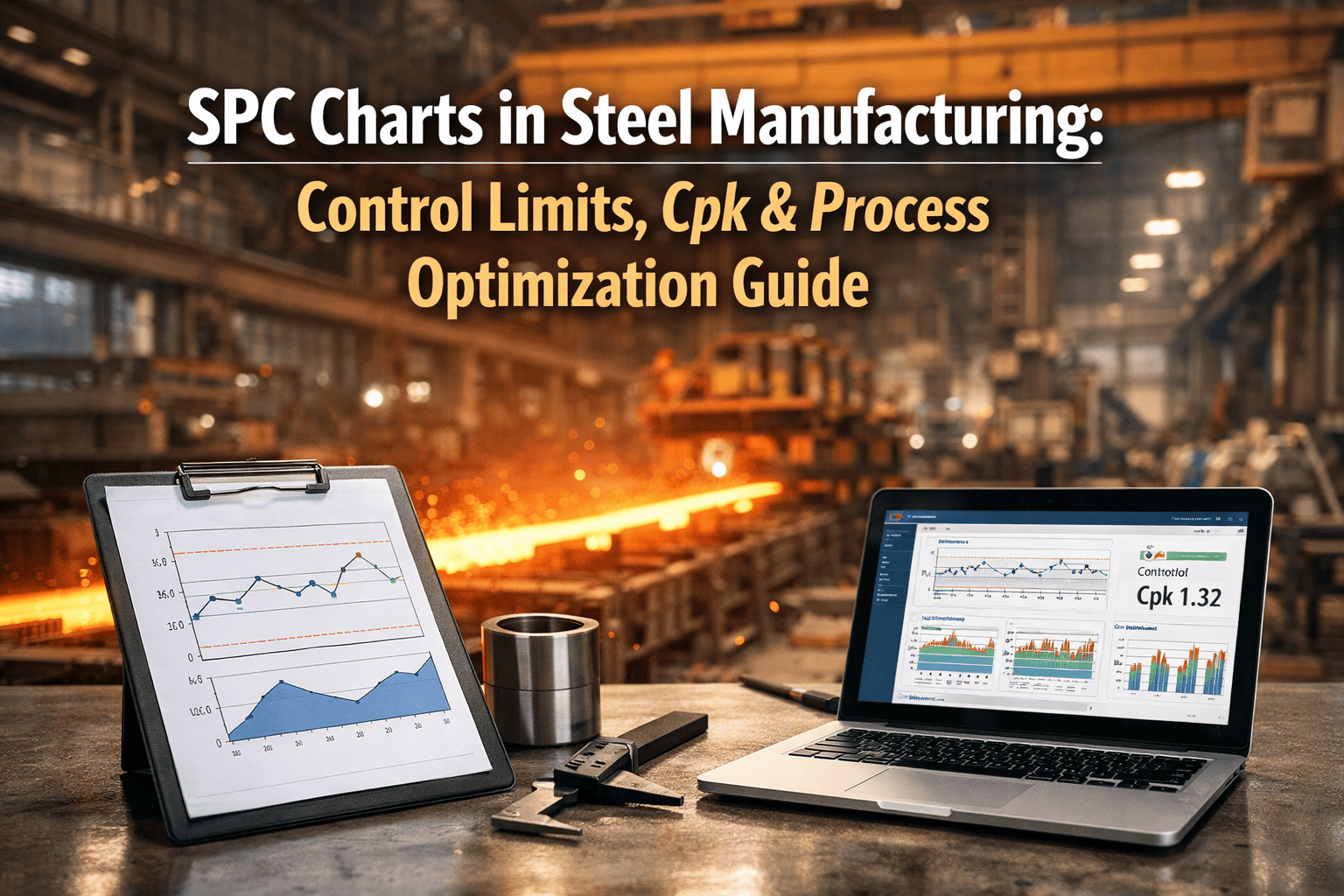
Steel manufacturing demands precision at every stage—from raw material processing to final product inspection. Even minor deviations in temperature, chemical composition, or dimensional tolerances can compromise structural integrity and product quality. Statistical Process Control (SPC) provides steel manufacturers with the systematic methodology to monitor critical parameters in real-time, detect variations before they become defects, and maintain consistent quality across production runs. Schedule a consultation to explore how SPC integration with maintenance management can transform quality control at your steel facility.
Why SPC Matters in Steel Manufacturing
Steel production involves complex processes where multiple variables interact simultaneously—furnace temperatures exceeding 1500°C, precise chemical compositions measured in parts per million, and dimensional tolerances within fractions of a millimeter. Traditional end-of-line inspection catches defects only after they occur, resulting in costly rework, scrap, and customer complaints. SPC shifts quality control from reactive detection to proactive prevention.
The Business Case for SPC in Steel
37%
Average reduction in defect rates within six months of implementing SPC control charts
70%
Defect reduction reported by manufacturers using AI-integrated SPC systems
5X
Higher costs paid by subpar manufacturers in scrap, rework, and recalls vs. industry leaders
25%
Yield improvement exceeding industry benchmarks through continuous SPC monitoring
Ready to reduce variation and improve steel quality? Join leading manufacturers using integrated SPC and maintenance management to achieve consistent production excellence.
Statistical Process Control uses statistical methods to monitor and control manufacturing processes by distinguishing between two types of variation. Common cause variation represents the natural, inherent variability in any process—it is predictable and consistent over time. Special cause variation indicates something unusual has occurred that requires investigation and corrective action, such as equipment malfunction, material defects, or operator error.
Types of Process Variation
Common Cause
Natural Process Variability
Inherent fluctuations within control limits—normal and expected. Requires no immediate action but can be reduced through process improvement.
Special Cause
Abnormal Deviation
Unexpected variation outside control limits indicating equipment failure, material issues, or process drift. Requires immediate investigation.
Critical Parameters for Steel SPC Monitoring
Effective SPC implementation in steel manufacturing requires monitoring parameters that directly impact product quality and process stability. Each production stage has specific variables that serve as early indicators of potential quality issues.
Control charts form the foundation of SPC implementation, providing visual representation of process behavior over time. Different chart types serve specific monitoring purposes based on the data characteristics and production requirements.
X-bar and R ChartsVariable Data
Monitor process mean and range for continuous measurements like steel thickness, temperature readings, and tensile strength values.
Best for: Subgroups of 2-10 samples taken at regular intervals
Individual-Moving Range (I-MR)Variable Data
Track individual measurements when subgrouping is not possible, such as batch chemical analysis or heat-specific properties.
Best for: One measurement per batch or expensive testing
p-Chart (Proportion)Attribute Data
Monitor the proportion of defective items in variable-size samples, tracking surface defect rates or pass/fail inspection results.
Best for: Defect percentage with varying sample sizes
CUSUM ChartTrend Detection
Detect small, sustained shifts in process mean that standard charts might miss—critical for detecting gradual equipment degradation.
Best for: Early detection of process drift
SPC Implementation Process
Successful SPC deployment requires systematic planning across data collection infrastructure, personnel training, and integration with existing quality management systems. A phased approach delivers measurable results while building organizational capability.
SPC Deployment Roadmap
1
Process Assessment
Week 1-2
Identify critical quality characteristicsMap measurement points across productionEvaluate existing data collection capability
2
Baseline Establishment
Week 3-4
Collect historical process dataCalculate initial control limitsValidate measurement system accuracy
3
Chart Deployment
Week 5-6
Configure control charts for each parameterTrain operators on chart interpretationEstablish response procedures for alerts
4
Continuous Monitoring
Ongoing
Real-time process surveillanceRoot cause analysis for special causesControl limit refinement based on improvements
SPC and Maintenance Integration
The connection between statistical process control and maintenance management creates a powerful feedback loop. When SPC detects process drift or special cause variation, it often indicates equipment issues that require maintenance intervention. Integrating SPC alerts with your CMMS enables automatic work order generation, ensuring quality issues trigger immediate corrective action.
Quality-Maintenance Connection
SPC Detects Variation
Alert Triggers in CMMS
Work Order Generated
Process Returns to Control
Connect quality control to maintenance workflows. Our team will show you how SPC integration accelerates issue resolution.
Beyond monitoring process stability, SPC includes capability analysis to determine whether a process can consistently meet specifications. Process capability indices quantify how well production output aligns with customer requirements and engineering tolerances.
Cp
Process Capability
(USL - LSL) / 6σ
Measures potential capability assuming the process is centered. A Cp of 1.33 or higher indicates the process can meet specifications if properly centered.
Cpk
Process Capability Index
min[(USL-μ)/3σ, (μ-LSL)/3σ]
Accounts for process centering. A Cpk of 1.33 means the process produces within specification with margin. Steel manufacturers typically target Cpk ≥ 1.67.
Documented Benefits in Steel Manufacturing
Steel manufacturers implementing comprehensive SPC programs report measurable improvements across quality, efficiency, and cost metrics. The return on investment compounds as organizations mature their statistical process control capabilities.
SPC Impact Metrics
40%
Reduction in customer complaints through quality management
32%
Average defect rate reduction with ISO 9001 and SPC
22%
Throughput increase from reduced rework and scrap
18%
Yield improvement within three months of SPC deployment
Transform Quality Control with Integrated SPC
Oxmaint connects statistical process control with maintenance management—enabling automatic work orders when quality parameters drift, real-time visibility into process stability, and data-driven decisions that reduce variation and improve steel quality.
What is the primary purpose of SPC in steel manufacturing?
SPC monitors and controls production processes using statistical methods to detect variations before they result in defects. Rather than inspecting finished products, SPC enables proactive quality management by identifying when processes drift from optimal parameters—allowing corrective action before scrap or rework becomes necessary. Sign up for Oxmaint to see how SPC integrates with maintenance workflows.
How do control charts help detect quality issues early?
Control charts plot process measurements over time against statistically calculated control limits. When data points fall outside these limits or show non-random patterns, it signals special cause variation requiring investigation. This visual approach enables operators to spot trends and shifts before they exceed specification limits, typically detecting issues 80% faster than traditional inspection methods.
What parameters should steel manufacturers monitor with SPC?
Critical parameters include temperature controls (furnace, cooling, rolling), chemical composition (carbon, alloys, trace elements), dimensional tolerances (thickness, width, flatness), and mechanical properties (tensile strength, hardness, yield strength). The specific parameters depend on your product specifications and which process variables most directly impact quality outcomes. Schedule a consultation to discuss parameter selection for your operation.
How does SPC connect with maintenance management?
When SPC detects special cause variation, it often indicates equipment-related issues—bearing wear, calibration drift, or component degradation. Integrating SPC with your CMMS enables automatic work order generation when control limits are breached, ensuring maintenance teams address the root cause before quality continues to degrade. This closed-loop system transforms quality data into maintenance action.
What ROI can steel manufacturers expect from SPC implementation?
Manufacturers report defect reductions of 32-70%, yield improvements of 18-25%, and significant reductions in scrap and rework costs. Top-performing manufacturers using SPC maintain Cost of Poor Quality rates around 1%, while those without effective SPC often see rates of 5% or higher—representing a 5X difference in quality-related costs.